Scenes we'd like to see department
Since July is fast turning out to be movie month on 2x3x7, I figured I'd keep the ball rolling by throwing in a post about remakes of five romantic classics that I'd like to see:
1. The Snows of Manhattan
Scene opens with Isaac Davis, divorced 40-something Manhattan dweller, making his breathless way downtown in order to stop his high school sweetheart, Tracy (not his sweetheart from high school, you understand, his sweetheart who's currently in high school) from leaving for England. He arrives at her apartment just as Tracy is leaving for the airport, escorted by her grandfather. Isaac realizes that all this while he's been banging Hemingway's granddaughter. Hemingway realizes that a bespectacled little git has been banging his underage grandchild, and reaches for his combination harpoon-cum-elephant gun. Isaac manages to lose Hemingway in the subway system by pretending to take the N train when he's really taking the Q (a move he's perfected through years of playing competitive Scrabble) but Hemingway eventually manages to track Isaac back to his apartment, mostly because it's the only bachelor apartment on the Upper East Side with a split-level living room and four bedrooms, each one the size of Grand Central. Isaac makes a desperate run for the savage wilderness of Elizabeth, New Jersey, but Hemingway gets a hook into him as he's crossing the turnpike and proceeds to reel him in in an epic forty-five minute struggle that leaves Hemingway, as well as his readers, with aching arms and bloodshot eyes. Hemingway then tries to take Isaac's corpse home to frame above his mantelpiece, but on the way the body is nibbled away as tips by cab drivers, so that by the time the old man gets home he has nothing to show for his pains but Isaac's spectacles.
2. Before Midnight
A remake of Before Sunrise starring Julie Delpy as Cinderella and Ethan Hawke as Rat-turned-Coachman. Cinderella is on her way to the ball to meet Prince Charming when The Rat points out that once they get there he doesn't have, like, any plans or anything, and will just be goofing about being human, etc. so maybe the two of them could, you know, hang out together, because well, at some point in history they must all have been part of one soul, see, but now...At this point Cinderella (thankfully) shuts him up by saying yes, after which the two of them spend two supremely blissful hours wandering about Fairy Tale City, where none of the other two-dimensional cartoons notice them, because they fit in so well. Through a series of long rambling conversations about death, relationships, and (in his more poetic moments) cheese, they discover that they are made for each other, since she's an insecure neurotic pretending to be a romantic while he pretends to be a cynic but is secretly a rodent. As midnight approaches Cinderella gets all mournful, thinking that she'll never see Rat again, but he promises to stay in touch provided she gets rid of the cat and stops putting down traps. Eventually, they have sex, mostly because as Rat points out, his chances of ever getting any girlie action once he's gone back to being a scabby rodent are nil, and because the way he nibbles at her ear makes Cinderella swoon (though it could be just her complexion - it's hard to tell in the moonlight). Afterwards, he recites Auden, taking care to skip over the odd stanza or two, while she tries to retrace their steps to the carriage by looking for the crumbs they scattered on the way there, until she realizes she's in the wrong fairy tale. Finally, the happy pair promises to meet in ten years or whenever the director manages to raise enough money for a sequel, whichever comes first, after which he vanishes with a squeal while she walks home thinking about how much fun the ugly sisters are going to make of her.
3. Gone with the Surge
Remake of Gone with the Wind where the South wins the war. The black people's struggle for life, liberty and the right not to talk in phony accents is ruthlessly crushed. Ashley becomes a nationally acclaimed war hero and eventually goes on to become President, with Melanie as gracious First Lady and Rhett Butler as a cynical Vice President who answers all allegations about alleged leaks by his aides and missing WMDs with the line "Frankly my dear Senate Commission, I don't give a damn!". Scarlett ends up with the loser she married before the war, but is rescued by Rhett, who has been impressed by her singular courage in shooting six Democrat volunteers when they came to Tara with a petition for gay men's right to have abortions. Rhett takes Scarlett's husband out on a hunting expedition and accidentally blows his head off with a shotgun. Rhett and Scarlett get married and have a good life together, until one day Rhett buys their daughter a pony despite Scarlett's protests, and the girl, in trying to jump her horse over a fence, turns lesbian. The grief of this drives the couple to drink and Rhett eventually leaves to go invade a faraway desert country while Scarlett returns to Tara where she is seen jumping up and down on her father's grave, cursing Melanie for having made it to the White House with Ashley (oh Ashley!).
4. A Taxi Fare to Remember
Nickie Ferrante (Cary Grant) and Terry McKay (Deborah Kerr) meet on a Transatlantic cruise and fall in love. Arriving in New York they agree to meet six months from the day at the Empire State Building if they still feel the same way about each other. Nickie spends every day of those six months going to the Empire State Building in the evenings and staring dreamily up at it. Terry, on the other hand, has a terrible accident at her hairdresser's the next day and spends the entire time trying to get her hair back to that impossible shade of red. When they finally meet, she tells him that she's not in love with him anymore, while keeping her hair entirely covered. Nickie is heartbroken, but eventually realizes that something is wrong and manages to trick Terry out of her burkah, at which point the whole terrible secret is revealed. Nickie assures Terry that he loves her anyway, and doesn't mind that she's now a blond, but breaks up with her when he realizes she wants him to move to Boston, which he refuses to do because in the six months he's been waiting he's secretly fallen in love with the Empire State Building and can't bear to leave Manhattan [1].
5. When Harry Sallied Through The Met
Remake of When Harry Met Sally set in an alternate universe where every New Year's Day 10% of the population is randomly reassigned to different life situations, their memory of their previous lives completely obliterated by a special brain scanning device brought down to earth by aliens who bear a striking resemblance to Jim Carrey. Movie approaches grand finale. Harry gatecrashes party and makes big speech: "I love that you get cold when it's 71 degrees outside, I love that it takes you an hour and a half to order a skim milk latte and then you have to go back to the counter because you forgot to ask for decaf, I love that when you crinkle up your nose to tell me that I'm nuts I can totally see your nose hair sticking out and it makes me feel so well-groomed...and it's not because it's New Year's Eve and it's not because it's in the script and they're paying me money to say it, though actually, it is, and it's not because this is my last shot at being taken seriously as a romantic lead before I end up starring in City Slickers two years from now. I came here tonight because when you realize you want to spend the rest of your life with somebody, you want the rest of your life to start as soon as possible." Sally looks at him all teary-eyed and says "Oh, Harry!". Band strikes up tune to Auld Lang Syne. Then just as they're about to kiss *poof!* Harry disappears and is replaced by his fellow Oscar host, who then enters into an hour long debate about whether it is ever possible for a woman to be just friends with another woman when one of the women in question is Ellen DeGeneres.
[1] Alt take: Remake of Affair to Remember starring James Gandolfini as Nickie and Paris Hilton as Tracy. Nickie and Tracy meet on a transatlantic cruise in the summer of 2001 and fall in love when Tracy sees Nickie whack his gracious, eighty year old grandmother. The two have wild sex on the boat and put copies of it on the Internet, then decide to meet six months later at the top of the World Trade Center, if they still feel the same way about each other. Movie ends with shot of Tracy (Ms. Hilton) crying because she can't figure out how to get to the WTC and everyone she asks just glares at her.
Monday, July 16, 2007

To see the world in a cup of coffee
Girl: Is poetry formative, or is it only embellishment?
Ivanoff: Well, everything that embellishes is formative.- Jean-Luc Godard, 2 ou 3 choses que je sais d'elle
Can't resist posting this clip from Godard's Two or Three Things I Know About Her, which I watched over the weekend, while everyone else in the Universe was apparently watching the twaddle that is Harry Potter (clip possibly NSFW) [1]. How can you not love a film where a conversation between two complete strangers in a cafe about the meaning of conversation is interrupted by a shot of two people, named, inevitably, Bouvard and Pecuchet, seated at a table surrounded by books, reading extracts from them at random and jotting them down?
Unfortunately, I couldn't find a clip with subtitles online, but the text of the commentary is given below (translation by Alfred Guzzetti [2]).
Commentary 10
Here is how Juliette, at 3:37 P.M., saw turn the pages of that object which, in journalistic language, is called a magazine. And there is how, about one hundred and fifty frames further along, another young woman, her likeness, her sister, saw the same object.
Where then is the truth? In full face or in profile? And anyway, what is an object?
(Music enters. The coffee is stirred and the spoon is put down on the saucer)
Commentary 11
Maybe an object is what permits us to relink...to pass from one subject to the other, therefore to live in society,
(The young man looks at Juliette. She returns his gaze)
to be together. But then,
(he looks down again)
since social relationships are always ambiguous, since my thought divides as much as it unites, since my speech brings nearer through that which it expresses and isolates through that about which it is silent,
(He looks at her again, then back down. She returns his gaze, then looks away)
since an immense gulf separates the subjective certitude that I have of myself from the objective truth that I am for others, since I do not cease to find myself guilty although I feel innocent, since each event transforms my daily life, since I ceaselessly fail to communicate -
(The spoon enters the frame and stirs the coffee)
I mean, to understand, to love, to be loved -
(The spoon leaves the frame)
and each failure makes me experience my solitude, since...
(Juliette looks up, off left. The bartender looks off right, then at what he is doing, then off right again, then again at what he is doing. He exits left. A hand pulls the faucet, lets it go, pulls it again, lets it go again.)
Commentary 12
since....since I cannot tear myself from the objectivity that crushes me nor from the subjectivity that exiles me, since I am permitted neither to lift myself to being nor fall into nothingness, I must listen, I must look around me more than ever at the world, my likeness, my brother.
(Juliette is looking at the young man. He turns to look at her, then they both look away. Pause. Just before the commentary starts, Juliette again looks at him.)
Commentary 13
The world by itself today, when revolutions are impossible, when bloody wars threaten it, when capitalism is no longer very sure of its rights and the working class is in retreat, when the advance...the lightning advances of science give to future centuries a haunting presence, when the future is more present than the present, when distant galaxies are at my door: my likeness, my brother.
(The young man smokes, looks down. He looks at Juliette, then looks away.)
Commentary 14
(A sugar cube plunges into the coffee. Pause.)
Where does it begin? But where does what begin? God created the heavens and the earth, of course. But that is a bit cowardly and easy.
(The image is out of focus and is becoming more so.)
One should be able to say something better, to say that the limits of language are those of the world, that the limits of my language are those of my world. And that in speaking, I limit the world, I end it. And that one logical and mysterious day death will come to abolish that limit and there will be neither question nor answer; everything will be fuzzy.
(The image starts to come into focus, becoming sharp after the word 'nettes' i.e. sharp)
But if by chance things again become sharp, this can be only with the appearance of consciousness and conscience. After that, everything will connect and proceed.
(Music.)
The swirling shapes in the coffee, conjuring both galaxies and the beginning of life (Pascal, anyone?), the haunted whisper of the monologue, the refrain from Baudelaire, the perfect evocation of the experience of sitting in a cafe thinking your own thoughts and looking up every now and then to notice the world around you. Brilliant, just brilliant.
Notes
[1] And which, incidentally, is been screened two weeks from now at the MOMA, along with Masculine Feminine - for those of you in NYC who may be interested.
[2] The translation of the conversation between the girl and Ivanoff later in the film is what I remember from the subtitles in the film. Guzzetti translates this exchange - which in the original reads "La poesie forme, ou bien est-ce qu'elle decore seulement?"; "Et bien, tout ce qui decore la vie est une formation" - as "Does poetry educate, or is it only decoration?"; "Well, everything that decorates life is education". His translation is probably more accurate, but it lacks a certain something.
Sunday, July 15, 2007
Take One
"Is that your girlfriend?"
"I'm sorry?"
"I said, is that your girlfriend?"
"Oh, errr, no, no actually she's my wife."
"I see. She's very beautiful."
"Why thank you."
"You're a very lucky man."
"Yes. Yes, I suppose I am."
"You suppose?"
"I am."
"Doesn't it strike you as strange that I, a complete stranger, and a woman at that, should be complimenting you on your wife?"
"On the contrary- if you were a man I would be offended."
"Are you that insecure?"
"No. But for a man to be checking out my wife and then telling me about it would be, as you put it, strange."
"And for a woman to 'check out' your wife and tell you about it?"
"I'm grateful."
"Really. Why?"
"Oh, I don't know. For taking an interest in me, I suppose."
"You mean an interest in your wife."
"I mean an interest in us."
"Do strangers not normally take an interest in you then?"
"Not normally, no."
"How do you know? Have you ever asked them?"
"No."
"Why not?"
"Because if I struck up a conversation then they wouldn't be strangers anymore."
"So you just assume they aren't interested in you?"
"Yes."
"Are you that uninteresting?"
"No. At least, I don't think so. Not particularly uninteresting."
"Well then?"
"I suppose it's just that, once one is married one assumes that strangers, especially strange women, don't take an interest in one."
"Why? Does being married stop you from taking an interest in strange women?"
"It stops me from showing my interest in them."
"So you wouldn't, for example, go up to a strange woman and tell her you thought she was good looking?"
"I might. I would if she were as good looking as you."
"Are you flirting with me now?"
"Not at all. This is purely academic. Besides, you complimented my wife. I'm just returning the favor."
"Oh, so you're only complimenting me out of a sense of obligation then?"
"It isn't that. I'm perfectly sincere. It's just that..."
"Just what?"
"It's just that your having paid my wife a compliment expanded the scope of our dialog, don't you see? In a sense, it gave me permission to compliment you in return."
"You needed permission? Are you that tame?"
"No, no. I'm not expressing myself well. Let's say that my pleasure in complimenting you is heightened by a sense of symmetry."
"Very good. But I said your wife was good looking, not you. Surely symmetry would demand that you compliment me on my husband"
"Do you have a husband?"
"Does it matter?"
"It does if I'm to compliment you on him"
"Only for that?"
"Well, also, now that we're no longer strangers, I need to know if you're married so I can introduce you to my wife properly. I don't know whether to call you madame or mademoiselle."
"You don't know my name either."
"I was coming to that."
"So the reason you want to know whether I'm married is so you can introduce me properly to your wife?"
"Among other things."
"I'm not wearing a ring."
"You could have taken it off."
"I could give you a false name."
"You could."
"What if your wife never comes back?"
"From the restroom you mean?"
"Yes."
"All the more reason to know whether you're single."
"So you are flirting with me!"
"Perhaps. What if your husband never gets here?"
"He will."
"So you are married!"
"Perhaps."
"My wife will come back."
"What if when she does you're not here?"
"You mean we're not here?"
"I suppose."
"Where would we be?"
"Does it matter?"
"I suppose she'd wait and meet your husband."
"I suppose."
"Do you think they'd like each other?"
"I think so. She seemed his type."
"How convenient. I suppose then he would be a lucky man?"
"Oh, I think he is already."
"Quite. One question though - who'll pay?"
"The bill?"
"The check."
"You're American, are you?"
"No, but I went to college there."
"I see. I suppose she would."
"My wife?"
"Yes."
"Your check or my check?"
"Both. Why not?"
"It hardly seems fair."
"Is anything?"
"Besides she doesn't have her purse with her."
"Isn't that it over there?"
"Yes, precisely. I can't just leave it here and walk out."
"Why not?"
"Someone might steal it."
"So?"
"So she wouldn't be able to pay the check. She'd be embarrassed."
"So it's okay for someone to steal your wife's husband, but not her purse?"
"I believe in avoiding embarrassment."
"You're a capitalist."
"I'm a snob. But where does that leave us?"
"Let's say my husband pays the check, as you so charmingly call it"
"So you are married."
"No."
"Then how can your husband pay the check?"
"Let's say that some rich, kind man pays the check and because of his generosity I start to consider him my husband."
"Perhaps it'd be better if I paid the check."
"Is that a proposal?"
"If it were, would you accept?"
"If it were, I wouldn't."
"But since it's not?"
"Waiter!"
P.S. By rights, this should be in French, but my French isn't that good. Just imagine that the real dialog is in French and you're reading the subtitles.
Friday, July 13, 2007
Stiff Upper Lip, Jeeves
Black Mamba's comment on my post about travel reads reminded me of one other incredible travel read that I forgot to mention - mostly because I tend to think of it less as a book and more as an experience.
This happened on a trip my parents and I took to Darjeeling and Sikkim a decade and a half ago. I was twelve (thirteen?) and had discovered Wodehouse (starting with Joy in the Morning) some six months ago. On this particular trip, we were carrying two Wodehouses with us - Stiff Upper Lip, Jeeves and The Luck of the Bodkins - brand new books bought less than a week before the trip as part of 'essential supplies'. On the first day out, sitting in our hotel room, we decided, just for a lark, to try reading one of the books out aloud. The plan was that we would take turns reading - each person taking one chapter (though when my chapter proved to be only a few pages long my parents were kind enough to let me 'share' theirs - even then I was infatuated with the sound of my own voice) and the whole thing progressing at three chapters a night.
I don't know if you've ever tried reading Wodehouse aloud. Hilarious as the man is read in the quiet of your own room, he's positively side-splitting when shared aloud in a group. Part of it is that reading him aloud forces you to linger over every little nuance, every clever aside. Part of it is that sharing the book with a group (and especially a group that includes one precocious twelve year old) creates an atmosphere of almost hysterical merriment, so that even some of the master's more predictable usages begin to seem uproariously funny. Part of it is that having the story drawn out over a whole week tends to amplify the element of surprise (not something I'd paid much attention to reading Wodehouse by myself) so that every new plot twist (arrived at, as it is, after days of chugging through the story) begins to feel like a wondrous discovery (remember, none of us had ever read the book before - so we didn't know what was going to happen), one that makes you laugh out loud. Finally, there's the inevitable gap between what the reader is reading out loud and what he or she is reading in his / her head, which means that every punch line, every comic turn of phrase hits you just one second before you actually read it - with the result that you have the reader breaking into a chuckle in the middle of a sentence, putting the book down and having a good long chortle, then going back to read whatever it was that was so funny; at which point, of course, the other two would start giggling and the whole room would rock with laughter. The closest thing I've ever experienced to the merriment of those is the experience of sitting with a group of friends while blindingly drunk (though obviously this was not something I was familiar with at the time).
At any rate, it wasn't long before this nightly ritual of ours had become one of the highlights of the trip. Even today, looking back on it fifteen years later, what I remember most vividly about that vacation is the nightly adventures of Messrs. Wooster, Fink-Nottle, Sidcup and Plank. Reading Wodehouse on that trip isn't just one of my happiest experiences on a vacation or one of my happiest associations with a book - it's one of the happiest memories of my life.
Oh, and Mom and Dad, since I know you're reading this - thanks.
Thursday, July 12, 2007
I dreamt you died
and they laid your death out,
elaborate as a table,
then watched, horrified,
as I ate and ate.
Forgive me.
I did not think
I would have such appetite,
that I would prove so hungry
for the thought of you.
elaborate as a table,
then watched, horrified,
as I ate and ate.
Forgive me.
I did not think
I would have such appetite,
that I would prove so hungry
for the thought of you.
Wednesday, July 11, 2007
Trains, planes, buses and Ambassadors
Over at his blog, zigzackly points to a Guardian series about travel reading, and invites comments on favorite travel reads, thus providing me with a convenient excuse (as though one were needed) to talk about books.
My reading when I'm traveling tends to be mostly poetry, because a) it's easier to read in short spurts, b) it's more amenable to re-reading so I can take fewer books with me and c) I tend to take only books that I own when I travel, and this usually means either philosophy or poetry (I almost never buy fiction anymore).
Not surprisingly, I have travel associations with dozens of volumes of poetry, though the ones that stand out most in my mind are a second-hand copy of Robert Lowell's Selected Poems (in a now obsolete Faber & Faber edition) that was my constant companion on DTC buses all through my second year in college, and Walcott's Midsummer, read on the flight three years ago that brought me to the United States.
The award for my most memorable reading experience, however, goes to Henry James' The Ambassadors, read on a seemingly interminable train journey to I no longer remember where. I'm something of an insomniac anyway, and find it even harder to sleep on trains, so on this particular trip I simply stayed up through the night, wedged awkwardly in the side lower bunk of a second AC train compartment, the gap where the two halves of the bed meet digging into my waist, and read and read and read. Something about the momentum of that journey - the constant sense of motion, the measured metronome of the train, the knowledge of great distances being covered, contradicted every time I looked out of my window by the sameness of the landscape - all this seemed to resonate with James' exquisitely baroque prose, so that lying there, cocooned in the semi-darkness, the book seemed to glow brighter in my hand, seemed to burn in the incandescence of its language, every finely tuned phrase lit up like a tongue of fire. To this day The Ambassadors remains one of my favorite James' novels, and I can never think of it without instantly evoking the memory of that night ride, that long, weary voyage, a cradle endlessly rocking, plunging me into the night.
Tuesday, July 10, 2007
Meanwhile, Billy Strayhorn is taking the swan into Harlem
Finally got around to opening the new double issue of Poetry that arrived while I was away in Oregon. And what a lovely issue it is. New work by Billy Collins, Wendy Cope, Tony Hoagland and Dean Young (among others), this clever little ghazal by Patricia Smith, Naeem Murr's side-splitting piece about what living with a real poet is like, Sven Birkerts reminiscing about the time when Heaney, Brodsky and Walcott were all in Boston and used to hang out together getting drunk and telling silly jokes (the very thought of which sends yours truly dizzy with fanboy excitement) and this hilarious, brilliant take on Yeats by Joan Murray:
- Joan Murray
Leda and the Train
A sudden jolt: the A train stopping short
Upsets the staggering girl, her body goes
Out with the crowd, her handbag caught on board,
It holds her helpless as the train doors close.
How can those terrified vague fingers draw
Her handbag out before the subway leaves?
Or let it spill out on the subway floor,
And let some strangers scoop it up like thieves?
A shudder in her gut predicts some pain.
The wall's ahead, her steadfast feet have raced her
To the platform's end.Being so caught upSo mastered by the swift speed of the train,
Did she come to a knowledge of what faced her
Unless her reluctant hand could let it drop?
- Joan Murray
Monday, July 09, 2007
Cooking, with Gusteau
Ratatouille
[some spoilers]
There's a scene towards the end of Brad Bird's Ratatouille where sneering food critic Anton Ego (voiced with blue-blooded superciliousness by the incomparable Peter O'Toole) arrives at the up and coming restaurant Gusteau's, intending to crush its fledgling reputation under an avalanche of scorn. Served a humble peasant dish (the ratatouille from which the movie gets its title) by the restaurant's unlikely chef (a rat - yes, really, a RAT - called Remy), Ego finds his eyes filling with tears, however, as the subtle flavors of the dish bring back memories of his childhood in the French countryside and his mother's cooking.
And there, in a nutshell, you have the experience of watching Ratatouille. Silly to the point of being ludicrous, predictable to the verge of cliche, Rataouille still manages to be, magically, a deeply endearing film. Part of it is the superb animation - the rattiness of the rats, the foodiness of the food, the Paris-ness of Paris - everything, in short, that we've come to love and expect from the wizards at Pixar. Part of it is the clever, clever trick of making a movie that ends with the vicious critic eating, if not quite humble pie, then at least modest ragout, thus effectively hamstringing anyone who thinks of writing a scathing review of the film. Mostly though it's the joie de vivre of the script - the sheer exhilaration of making a deliciously simple yet entirely outrageous film based on a premise that is, in turn both simple and outrageous at the same time. This is meta-cinema at its best - the idea that people would actually enjoy food made by a rat is just about as ridiculous as the idea that people would enjoy a film about people enjoying food made by a rat, which is why you're inclined to believe it.
At its heart, Rataouille is a retelling of that oldest of creative myths - inspired young artist with no formal training and an entirely impossible background comes to big city and wows the connoisseurs, thus transcending both the establishment and his own roots. The fact that the impossible background here happens to be membership in the genus Rattus and that the art form involved is culinary is a matter of mere detail. Okay, so there's a brief period right after you walk out of the theater when you feel an overwhelming urge to reach for a skillet [1], but the exuberance that sizzles and flambes through this film has little to do with food per se. Remy's problem is not that he can't cook - that comes to him as naturally as nibbling cheese - it's that as a common pest he's rodentia non grata in every kitchen on either side of the Seine. Egged on by the imagined spirit of his culinary guru Chef Gusteau (a disappointingly un-Anatole like figure whose specialty seems to be potage de poulet pour l'ame and whose motto 'Anyone Can Cook' becomes the film's battle cry) Remy adopts a hapless garbage boy named Linguini - a limp noodle if there ever was one - and proceeds to rise to the top of the cordon bleu food chain. It sounds bizarre, I know, but somehow, between the multiple near escapes that Remy goes through, his wild adventures through the kitchen, his relationship with his old-fashioned father and one particularly brilliant slap-dashing chase through Paris, you tend not to notice.
If Ratatouille succeeds (and succeed it does, though it isn't, in my opinion, quite the movie Bird's The Incredibles was) it's because the real fantasy here isn't a rat making good as a chef, it's the idea that with sufficient inspiration and a little bit of luck we can all beat the odds and succeed at whatever it is that moves and / or inspires us, just as long as we're clear on what that is. Ratatouille may not be great cinema, but as an appetizing way to spend a Sunday morning, delicately balancing the flavors of humor, charm, fantasy and excitement, it's pretty hard to beat.
[1] In my case it lasted all of five minutes, during which I pictured myself dicing and slicing and sauteing with the casual ease of that Jackie Chan of the kitchen - Martin Yan. Then reality struck.
Sunday, July 08, 2007
I spam what I am
It just occurred to me yesterday how I respond differently to different kinds of junk mail.
When those noisome advertisements for penile implants show up in my inbox I turn my nose up scornfully, thinking "Ha! Have they got the wrong man now!" [1].
When I get offers from credit card companies offering me their Super Premium Titanium Platinate card with 0% APR for the first six months (provided you don't actually buy anything) I let out a low hollow laugh, like a hyena with a good credit rating, thinking "Don't they know I have no money?! Why do they mock me this way?! Why?! Why?!!"
And yet, when I get a letter from the ACLU asking me for a donation, or a form letter from Bill Clinton in the name of the Democratic Party asking me to join the fight against Bush, I suddenly feel the glow of vindication running through my veins. Clearly these folks have done their homework. Clearly they know they're dealing with a man of principle and character. "Oh, Bill", I imagine Hillary saying, "have you sent that letter I asked you to? You know, the one for Falstaff, that man of the people, that outspoken champion of civil liberties everywhere, that staunch defender of the right to life, liberty and, especially, the pursuit of happiness. Oh, say you have, Bill. We need him on our side." "Why, I'll send it right away, dear. But you needn't worry. You know how old Falstaff has always stood for truth, justice and all that's logical. He won't let us down. Not Falstaff."
The truth is, of course, that the Democratic Party probably knows no more about my uprightness than the guys promising to help me "keep her up all night" know about my lack of it. Self-delusion, thy alias is Falstaff.
[1] It's not even, in my case, a question of whether I need enhancement or not. It's the much simpler question - who would know? [1]
[2] Scanning through my spam folder to write this post, I find that the mails I used to get for penile implants have now been replaced by offers to help increase my Internet speed. So maybe these guys do know something about my sex life after all.
Friday, July 06, 2007
Oregon Trails - Part 2
[continued from here]
Day 4

 Day 4 finds MR and BM both obsessing about reaching Tillamook, a town famous for its icecream (as well as other dairy products, but it's the icecream these two are drooling over). Fortunately, the navigation for this trip is in saner, more discerning hands, so that instead of driving hell for leather for Tillamook as the yen for icecream would have us do, we take the longer route via the Three Capes scenic highway, passing the town of Oceanside, where gaunt elbows of rock jut out from the sea and a dog chases gulls with the diligence of a process server, and finally stopping at the Cape Mears lighthouse. Here, the air is raucous with the cries of gulls and cormorants and a muffin shaped rock just off shore bristles with birds like a cupcake covered with candles. We have a 180 degree view of the Pacific, its blue expanse stretching into the unimaginable distance. Directly below us, a seal hunts in the water, its gray-white belly curving over the waves like an accent, before vanishing into the depths in search of fish.
From here we go to Tillamook, where MR and her icecream are finally united [1]. We stop at the Tillamook Cheese Visitor's Center which features a fast food restaurant, a fudge counter, a store selling Tillamook cheese products and a factory tour; but all we're really interested in is the ice cream. I plug my way through a large waffle cone's worth of German Chocolate and Coffee icecream, while BM eats a relatively staid Chocolate and Strawberry sundae and MR pigs out on something bathed in chocolate fudge. It's good icecream, but far from being exceptional, and our pleasure in it is somewhat dampened by the fact that everyone around us seems to weigh in excess of 250 pounds, so that we're reminded, with every bite we take, just what these calories we're snarfing down could do to us. It's like sitting down to share a turkey with the obese ghost of Christmas Future. MR is so dismayed by this that she actually stops eating for a while, and I have to lend her the base of my waffle cone before she starts to stuff her face again. We then go back into the store and pick up a small packet of daintily packed cheese cuboids, just to convince ourselves that we are connoisseurs, not gluttons.
From Tilamook we continue to head North, our destination now the trailhead for the Neahkanhie mountain that BM and MR intend to climb. This proves more difficult to find than we had anticipated. Our first turn-off takes us down a miles long road into rural Oregon. Our second turn-off clearly says Neahkanhie mountain trail, except that it turns out to be a dirt road barely one lane wide and climbing steeply up, which we eventually deduce is the actual trail itself and not a path meant to be driven on at all. It takes us a while to turn around and come down off that one, after which another mile's drive takes us to a parking lot by the side of the highway from which two trails branch off - the first (or so the map put up there claims) going up to the top of the mountain, while the other runs along the coast to a charming little suspension bridge and then on to Cape Falcon.
MR and BM take the high road; I, being less keen to go scrambling up mountains, take the low one. Five minutes later I'm wondering if this was a bad idea. The trail leads down a steep, rocky incline from the parking lot, then plunges into a thicket of seven foot high bushes, the plants so close together that the trail is barely visible anymore and you have to push your way through the branches, with leaves and twigs scratching at your face. If I hadn't seen a family of six go this way five minutes ahead of me, I would probably have turned back, convinced that I had lost my way and was following not the trail itself but the track of some deer. In the next ten minutes, I twice spot little brown snakes crossing the path just in front of me, their wriggling tails passing inches away from my descending shoes. My feet keep getting tangled in creepers, and my legs, exposed in shorts, are whipped and stinging with the undergrowth.
Some 250 metres down the trail the path finally emerges from this thick vegetation into a more open, wooded copse. At last, I think, and settle in to enjoy a pleasant walk along the coast. But 50 meters later the trail ends! There's a wire fence stretching across the path and a small bench looking out on a scenic overlook. Something that looks vaguely like a trail leads up into the mountain. It's going the wrong way from where it's supposed to, and since we're at the very edge of the land it's not likely to switchback, but I try to follow it anyway. One fork of it peters out in about 30 metres, becoming a one foot wide ledge that skirts along the cliff, a drop of about a hundred feet onto black sea-foamed rocks below it. The second fork, which is really little more than a deer path, leads up into the woods, but after I've clambered over my third fallen tree and jumped up the odd rock or two, it becomes pretty clear to me that this too leads nowhere and is certainly not a proper trail. I go back to the main trail. Could I have missed a turn-off at some point? I return to the parking lot for another look at the map, keeping an eye out not only for snakes but also for other trails leaving the main one. At one point there's a slight depression in the grass that might, with a little imagination, be a trail, but if so it's one that doesn't seem to have been walked on any time this year, and I'm not the kind of person who believes in being a pioneer.

I go back to the parking lot to check there are no other trails leaving from the lot, then finding none, brave the snake-infested trail once again, and decide to spend the hour or so before the others get back on the bench at the end of it. It's a nice spot. Below me a small inlet called Devil's Cauldron churns with green water, the cliff wall lined with ledges where seabirds nest, and broken, at its base, by a series of small caves, that give the whole thing a vaguely Enid Blyton air (the next cove along the coast is called Smuggler's Cove). There's a glorious view of the Pacific, with Cape Falcon stretching its languorous arm out to sea directly in front. Seagulls soar on eddies of wind all around me, their wings balanced and motionless, coming down to perch on a rock a mere ten meters away. The bench itself is in the shade of tall trees - an exceedingly comfortable place to sit. Best of all, there's no one else around - this is clearly not a popular trail.

I try reading for a bit, then lay the book aside and content myself with just staring out at the sea. What was it Keats said? "O ye who have your eyeballs vexed and tired / feed them upon the wideness of the sea". Thinking of Keats makes me want to quote some out loud. I look around guiltily, go a little way back on the trail to make sure no one is coming. Then, satisfied that I'm quite alone, I proceed to recite Ode to a Nightingale (or as much of it as I can remember). It's enchanting to hear the sound of those glorious syllables sifting through the branches, half-echoing through this deserted little woodland on a nameless headland at the very edge of the Western world.

After a while, I make a discovery. I'm staring at the rock face opposite and I realize that there's a whorl of rock that looks kind of like an ear. I decide to take a photograph of it. When I start to focus the camera I realize that it's more than just an ear - there's a whole face carved naturally in the rock face, complete with an overhanging slab of a nose, a grim mouth, a quasi-beard and even a small crescent like depression that could be horns. It looks like a satyr or a devil of some sort! I wonder if I'm imagining this. Maybe it's just my hyperactive imagination channeling Pan's Labyrinth. I take a couple of pictures to show MR and BM when I meet them, to test if they can see it too. I feel very kicked about this, because it's not something that ever showed up in a guidebook or a map. It's my own personal sight.
I'm still sitting there when a couple of large black dogs come running out of the forest, mouths open and snarling. They look like something out of The Hound of the Baskervilles, or Omen. One of them goes scampering off to investigate the nearest trees, but the other one comes right up to the bench and stares directly at me. I'm just beginning to wonder what my odds of surviving the drop into Devil's Cauldron are when their owner (an elderly woman) arrives and rescues me. I watch as she and her dogs make their way up the quasi-trail along the mountain that I'd followed earlier, and feel a sense of vindication when they too turn around and come back, having found the way unpassable. I let them return down the trail, then follow five minutes later, figuring the dogs must have scared any sunbathing snakes away. Back at the parking lot, I spend ten minutes waiting for BM and MR to show up, issuing friendly warnings to strangers considering taking the coast trail that goes nowhere, then decide to follow the trail going up the mountain until I meet the other two coming down.
From here we head to the town of Cannon Beach, where we plan to have lunch. By this time we're all in the mood to take life easy and relax, having got through four days of fairly hectic traveling. Cannon Beach turns out to be a picturesque little town, the epitome of Oregon's seemingly universal endeavour to be quaint and charming. It's an effort that almost every town we've passed through on the trip seems to share, but here, in Cannon Beach, it actually feels like the real thing. MR, predictably, has a yen for seafood, so we stop at the first restaurant we see that offers some. This restaurant (whose name now escapes me) turns out to have the most inattentive (to the point of being rude) service I've ever seen, so after ten minutes of waiting for someone to take our order we walk out.
Our next choice, The Driftwood Inn, proves more congenial. Here we're met by an extremely chirpy waitress and find ourselves relaxing on a sunkissed patio sipping cold glasses of beer and tucking our way into some delicious food - broiled salmon and seafood chowder for me, crab salad for BM and halibut with dill cream for MR. It's a glorious, relaxed lunch and we experience a sense of tremendous peacefulness, a casual initiation into leisure. Half the customers out here are locals who know each other (and the dog sleeping at the door) on a first name basis, and for an hour or so we feel as though we lived here too, or at least were here for a long, sleepy weekend, rather than just passing through for a quick meal.
This sense of well-being stays with us as we make our way down the town's main boulevard, stopping at a little cafe / bakery where MR gets the root beer float she's been craving while I get my daily caffeine fix in the form of an espresso sundae - one scoop of espresso ice-cream with a shot of hot espresso poured over it (yum!). We then drive to the Ecola state park - our final stopping point on the coast before we head back to Portland.

The trail that leads South to the beach from the Ecola Park parking lot is closed due to slides, which suits us fine because we're feeling too lazy to take it anyway. There's also a trail north upto Indian Beach, but once we discover that we can just drive up there instead we lose what little enthusiasm we had for this as well. So instead we walk the 0.2 miles to the observation point, taking in yet another sweeping view of the Pacific, staring contentedly at the circling gulls, peering through the binoculars at a lighthouse just off the coast and staring down with interest at Sea Lion rocks, which look like an artist's rendition of the evolution of stone.

MR fidgets around with her camera, taking picture after picture of the surrounding scenes. BM and I people-watch, taking in the man who's come on a vacation with his camera and brought his family along just in case; the photography buff who has attached a tripod to his camera and is now taking pictures holding both tripod and camera in the air; the two families bonding about the cuteness of each other's dogs while the animals in question attempt to tear each other's throats out; and most entertaining of all, the desi couple who are actually HOLDING HANDS IN PUBLIC (a gesture that they doubtless see as deeply romantic, but which, because of the man's regrettable tendency to walk faster than the woman and drag her along after him, as well as his reluctance to come within more than four feet of her - after all, some proprieties must be maintained - makes it look like they're wearing handcuffs), and who, doubtless feeling that the Pacific ocean by itself is too tame for their family photographs, insist on taking 'action' shots, including one where the woman pretends to swing from a tree, a second where she sits astride a grungy skull-and-crossbones painted bike wearing her floral knee-length skirt (not a pretty sight), and one where he, ignoring the danger signs posted all around, crosses over to the closed off section of the trail, and, paying no attention to the 50 foot drop yawning behind him, proceeds to panic because he has entrusted his beloved camera to a woman (horrors!), and spends the next five minutes shouting across frantic instructions at her.

We spend a good half hour lazing about at Ecola point, then head out, stopping for a few moments to take in the view from Indian Beach, where, against a backdrop of stone arches and great seething waves, surfers swerve and swivel on the surf, and small groups of people play with frisbees on the glowing sand beach.

An hour and a half's drive from here takes us back to Portland, where we make our way to the southern suburb of the city where R. lives. We'll be spending the night at his place, and he's promised to show us the nightlife of the city. R lives in a quintessential suburb, a dystopia of carbon copy mass-manufactured houses that he himself describes as a kind of mini-Stepford. The neighbourhood has all the character of a Big Mac. For all that, the man has a huge house - three bedrooms, three bathrooms and a living room larger than my entire student accommodation. It's a nice house, though perhaps more appropriate for, say, the Windsors. The three of us grab showers, reveling in the luxury of being able to do this in parallel, and then head out to Portland, intending to paint that city, if not quite red, then at least a modest maroon.
The next couple of hours have a distinctly surreal quality in my memory. We start at this place called the Brazen Bean, which seems like a nice, cosy place from the outside, housed as it is in a oldish looking mansion. Once inside, it turns out to be yet another trying-to-be-hip-but-only-succeeding-in-being-wannabe bar, with some species of noise blaring from the speakers that sounds like scrap metal being force fed into a concrete grinder and a drinks menu that includes 32 kinds of cocktails and exactly one ("house") wine. We get through the ritual of showing our ids [2] - mine, being beyond the comprehension of the cretin serving us, having to be referred to the Higher Authority of the bartender - and then ask if we can sit outdoors. Unfortunately, this being past 10 pm, outside seating has shut. So we endure the hellish tone-iness of the place, mostly because R. informs us that it is one of the most popular night spots in the city, and we can hardly insult him by walking out when he's putting us up at his place. After a while, the music quietens down, and I get enough Glenfiddich in my system to take the edge off my annoyance, so things aren't so bad.
Not that the conversation is exactly stellar. R., it turns out, is one of those people who are very concerned with 'philosophy' which means they've read Stephen Covey and think Zen and the Art of Motorcycle Maintenance is practically holy writ. His fundamental tenets in life, it seems, include the observations that a) all people are horny (this seems very important to him - he mentions it at least thrice) b) everyone's ultimate goal is to be happy c) Americans are happier than Desis because Americans are goal oriented and Desis are not and d) Portland is a really great city to be happy in, especially with the way property values are likely to rise. Not quite Wittgenstein, but there it is.
BM sits there trying desperately not to giggle. Yours truly throws in the occasional bon mot about the examined life, and watches it sink to the bottom of the conversation like a dropped stone scattering fish. MR, who's never let mere banality come in the way of her appreciation of a night out with a good looking man, tries gamely to keep the conversation going.
At some point in the evening, we move to another bar (having made our way through large groups of extremely drunk frat boys accosting strangers on the street), this one called Club 21, which is a lot nicer for being more relaxed and informal. Here things get a lot happier, and a little wilder. MR, under the influence of her third Bombay Tonic, flirts happily with R., causing him to panic a little. BM gets sprayed with water repeatedly: first when MR, in revenge for my having confiscated her camera (she was trying to do embarrassing things with it), tries to throw a glass of water at me and ends up dousing BM instead; next when R., in the course of making some forceful point manages to bring his hand down on his straw, sending cubes of ice arcing through the air onto BM; and finally when MR, this time making a particularly expansive gesture, manages to spill a second glass of water all over the table. BM takes refuge in the ladies room. I take away MR's drink and gulp it down before she can have any more. It begins to dawn on R., who has so far been too caught up in expounding his theories on life, that instead of a quorum of admiring disciples, he is, in fact, surrounded by a group of drunken near-lunatics. Amazingly, this makes him feel better, and he lightens up a lot. Our tattoo-bearing, nose-pierced waitress stops by our table to ask if we need anything else, then goes straight over to the 6 foot 2 guy in the cowboy hat checking ids at the door and whispers something in his ear, after which he proceeded to eye us suspiciously for the rest of the evening. I sit there, sipping my Jack Daniel's, thinking this is what it must feel like to be a character in a F. Scott Fitzgerald story.
Eventually we head back to R.s place, MR informing us along the way that she isn't really drunk, because the surest sign of someone being sober is that they refuse to walk a straight line even though they can. We ask her if she'd be willing to walk a straight line, and she refuses, so we know that she's really drunk. In retrospect, it probably isn't a bright idea to let R drive us back, but he seems to know what he's doing, and does, in fact, drive home pretty sensibly. We go to bed having made a few desultory plans to go to the Columbia River Gorge the next morning - plans that we are forced to leave incomplete because MR is in no shape to participate in any discussion.
Day 5
The last day of the trip. BM, R and I are up by 9, and sit around drinking tea and chatting about doctors and health service woes in what soon comes to resemble a meeting of Hypochondriacs Anonymous. MR finally makes her bleary-headed way down by around 10, soon after which the four of us leave to head out to the Columbia River Gorge, stopping on the way to pick up a breakfast of bagels and espresso.
The Gorge itself is beautiful enough, except that today being the Fourth of July (and a beautiful day in the bargain) it's turned into a horrendous tourist trap. We stop at this thing called the Multnomah Falls, and it takes us a good ten minutes to find parking, after which it's like walking around in Grand Central Station. We go a short way up the trail, stopping at a pretty little stone bridge that arches across the base of the falls. It would be a lovely spot, if it weren't for the fact that every inch of the bridge, on both sides, is lined back to back with people, and a third row of folks are trying to push their way between them. We stand on one edge and discuss the pros and cons of this bridge as a point to commit suicide from (no prizes for guessing whose contribution to the conversation that is) then head back to our car and onward to the next waterfall.

This turns out to be the Horsetail fall - a swishing little ribbon of water pouring down from a low hillside, not particularly high, really, but sparkling and gorgeous in the afternoon sun. A small rockpool spreads out at the base of the fall, and a path from the road leads right down to it, so pretty soon we've pulled off our shoes and are paddling about in the water. The pool is icy-cold, of course, but it's a welcome relief to feel the chill of it between your toes on such a hot day. I tread carefully about, feeling the treacherous sliminess of the rocks under me. We linger here for a half hour or so, while MR tries out every setting in her camera trying to capture the luminosity of the falling water, as well as the delicate green of the undergrowth around it. We're not sure we want to go any further on this road (how many falls can you see, really?) and finally decide to head back to town. On the way we stop at a couple of view points to take in the majesty of the gorge, one down by the river itself, the other up at an overlook called Vista Point.

Then it's back to the city for a generous seafood meal at Salty's on the Columbia - a couple of glasses of Riesling, some delicious chowder, and a wonderful triple appetizer of Fried Calamari, Coconut-flaked prawns and smoked salmon cakes - all this while sitting right on the edge of the river, watching the sailboats and the powerboats and the jet-skis go past, observing the bushy nests that some bird had built on the pilings of the abandoned pier. Even the presence of two very drunk men at the next table, who insist on coming over to tell us dumb blond jokes, only adds to our sense of holiday. It's a splendid way to round off a deeply satisfying trip and we leave the restaurant parking lot (throwing a last farewell glance at the hazy spectacle of Mt. Hood towering in the distance) with a sense of something very like accomplishment.
BM's flight leaves at 6.00 pm, so we hop off at the airport and I see her off on her flight before settling in to wait the four hours to mine, filling in the time by revisiting Mozart's Symphonies 21 through 26, as well as Beethoven's Emperor Concerto (MR is off doing the whole spoilt New Yorker deal by trying to find a massage place in Portland). Our four and a half hour flight from here will get us to Newark at 5.30 am local time, from where I will make my way back to Philly, collapsing in exhaustion by the time I get back to my place and waking up only late in the afternoon on the fifth to start blogging about this trip.
[1] MR is one of the most widely traveled people I know, but somehow all her travel stories seem to end up being about food. Ask her about her trip to Macchu Picchu and you'll be regaled with descriptions of the 12-item dessert buffet she had in some little town in Peru. Talk to her about her trip to Bryce and Zion, and you'll hear all about the incredible steak place she discovered in some little known Utah hamlet. Mention her recent trip to Morocco and she'll tell you how great the goat cheese there is. It's like traveling with a live version of Asterix and the Banquet.
[2] Oregon isn't just law-abiding about traffic rules. They also seem to have the strictest policy on checking ids I've ever experienced in the US. The first time we got asked for our ids, in Bend, we were are all rather flattered, since none of us looks like he / she could be even close to 21, let alone under it. It soon became obvious though, that this was standard practice here, though the combination of ids from California, Illinois and Pennsylvania continued to invite comment from the waitstaff.
Day 4

 Day 4 finds MR and BM both obsessing about reaching Tillamook, a town famous for its icecream (as well as other dairy products, but it's the icecream these two are drooling over). Fortunately, the navigation for this trip is in saner, more discerning hands, so that instead of driving hell for leather for Tillamook as the yen for icecream would have us do, we take the longer route via the Three Capes scenic highway, passing the town of Oceanside, where gaunt elbows of rock jut out from the sea and a dog chases gulls with the diligence of a process server, and finally stopping at the Cape Mears lighthouse. Here, the air is raucous with the cries of gulls and cormorants and a muffin shaped rock just off shore bristles with birds like a cupcake covered with candles. We have a 180 degree view of the Pacific, its blue expanse stretching into the unimaginable distance. Directly below us, a seal hunts in the water, its gray-white belly curving over the waves like an accent, before vanishing into the depths in search of fish.
From here we go to Tillamook, where MR and her icecream are finally united [1]. We stop at the Tillamook Cheese Visitor's Center which features a fast food restaurant, a fudge counter, a store selling Tillamook cheese products and a factory tour; but all we're really interested in is the ice cream. I plug my way through a large waffle cone's worth of German Chocolate and Coffee icecream, while BM eats a relatively staid Chocolate and Strawberry sundae and MR pigs out on something bathed in chocolate fudge. It's good icecream, but far from being exceptional, and our pleasure in it is somewhat dampened by the fact that everyone around us seems to weigh in excess of 250 pounds, so that we're reminded, with every bite we take, just what these calories we're snarfing down could do to us. It's like sitting down to share a turkey with the obese ghost of Christmas Future. MR is so dismayed by this that she actually stops eating for a while, and I have to lend her the base of my waffle cone before she starts to stuff her face again. We then go back into the store and pick up a small packet of daintily packed cheese cuboids, just to convince ourselves that we are connoisseurs, not gluttons.
From Tilamook we continue to head North, our destination now the trailhead for the Neahkanhie mountain that BM and MR intend to climb. This proves more difficult to find than we had anticipated. Our first turn-off takes us down a miles long road into rural Oregon. Our second turn-off clearly says Neahkanhie mountain trail, except that it turns out to be a dirt road barely one lane wide and climbing steeply up, which we eventually deduce is the actual trail itself and not a path meant to be driven on at all. It takes us a while to turn around and come down off that one, after which another mile's drive takes us to a parking lot by the side of the highway from which two trails branch off - the first (or so the map put up there claims) going up to the top of the mountain, while the other runs along the coast to a charming little suspension bridge and then on to Cape Falcon.
MR and BM take the high road; I, being less keen to go scrambling up mountains, take the low one. Five minutes later I'm wondering if this was a bad idea. The trail leads down a steep, rocky incline from the parking lot, then plunges into a thicket of seven foot high bushes, the plants so close together that the trail is barely visible anymore and you have to push your way through the branches, with leaves and twigs scratching at your face. If I hadn't seen a family of six go this way five minutes ahead of me, I would probably have turned back, convinced that I had lost my way and was following not the trail itself but the track of some deer. In the next ten minutes, I twice spot little brown snakes crossing the path just in front of me, their wriggling tails passing inches away from my descending shoes. My feet keep getting tangled in creepers, and my legs, exposed in shorts, are whipped and stinging with the undergrowth.
Some 250 metres down the trail the path finally emerges from this thick vegetation into a more open, wooded copse. At last, I think, and settle in to enjoy a pleasant walk along the coast. But 50 meters later the trail ends! There's a wire fence stretching across the path and a small bench looking out on a scenic overlook. Something that looks vaguely like a trail leads up into the mountain. It's going the wrong way from where it's supposed to, and since we're at the very edge of the land it's not likely to switchback, but I try to follow it anyway. One fork of it peters out in about 30 metres, becoming a one foot wide ledge that skirts along the cliff, a drop of about a hundred feet onto black sea-foamed rocks below it. The second fork, which is really little more than a deer path, leads up into the woods, but after I've clambered over my third fallen tree and jumped up the odd rock or two, it becomes pretty clear to me that this too leads nowhere and is certainly not a proper trail. I go back to the main trail. Could I have missed a turn-off at some point? I return to the parking lot for another look at the map, keeping an eye out not only for snakes but also for other trails leaving the main one. At one point there's a slight depression in the grass that might, with a little imagination, be a trail, but if so it's one that doesn't seem to have been walked on any time this year, and I'm not the kind of person who believes in being a pioneer.

I go back to the parking lot to check there are no other trails leaving from the lot, then finding none, brave the snake-infested trail once again, and decide to spend the hour or so before the others get back on the bench at the end of it. It's a nice spot. Below me a small inlet called Devil's Cauldron churns with green water, the cliff wall lined with ledges where seabirds nest, and broken, at its base, by a series of small caves, that give the whole thing a vaguely Enid Blyton air (the next cove along the coast is called Smuggler's Cove). There's a glorious view of the Pacific, with Cape Falcon stretching its languorous arm out to sea directly in front. Seagulls soar on eddies of wind all around me, their wings balanced and motionless, coming down to perch on a rock a mere ten meters away. The bench itself is in the shade of tall trees - an exceedingly comfortable place to sit. Best of all, there's no one else around - this is clearly not a popular trail.

I try reading for a bit, then lay the book aside and content myself with just staring out at the sea. What was it Keats said? "O ye who have your eyeballs vexed and tired / feed them upon the wideness of the sea". Thinking of Keats makes me want to quote some out loud. I look around guiltily, go a little way back on the trail to make sure no one is coming. Then, satisfied that I'm quite alone, I proceed to recite Ode to a Nightingale (or as much of it as I can remember). It's enchanting to hear the sound of those glorious syllables sifting through the branches, half-echoing through this deserted little woodland on a nameless headland at the very edge of the Western world.

After a while, I make a discovery. I'm staring at the rock face opposite and I realize that there's a whorl of rock that looks kind of like an ear. I decide to take a photograph of it.
 When I start to focus the camera I realize that it's more than just an ear - there's a whole face carved naturally in the rock face, complete with an overhanging slab of a nose, a grim mouth, a quasi-beard and even a small crescent like depression that could be horns. It looks like a satyr or a devil of some sort! I wonder if I'm imagining this. Maybe it's just my hyperactive imagination channeling Pan's Labyrinth. I take a couple of pictures to show MR and BM when I meet them, to test if they can see it too. I feel very kicked about this, because it's not something that ever showed up in a guidebook or a map. It's my own personal sight.
I'm still sitting there when a couple of large black dogs come running out of the forest, mouths open and snarling. They look like something out of The Hound of the Baskervilles, or Omen. One of them goes scampering off to investigate the nearest trees, but the other one comes right up to the bench and stares directly at me. I'm just beginning to wonder what my odds of surviving the drop into Devil's Cauldron are when their owner (an elderly woman) arrives and rescues me. I watch as she and her dogs make their way up the quasi-trail along the mountain that I'd followed earlier, and feel a sense of vindication when they too turn around and come back, having found the way unpassable. I let them return down the trail, then follow five minutes later, figuring the dogs must have scared any sunbathing snakes away. Back at the parking lot, I spend ten minutes waiting for BM and MR to show up, issuing friendly warnings to strangers considering taking the coast trail that goes nowhere, then decide to follow the trail going up the mountain until I meet the other two coming down.
From here we head to the town of Cannon Beach, where we plan to have lunch. By this time we're all in the mood to take life easy and relax, having got through four days of fairly hectic traveling. Cannon Beach turns out to be a picturesque little town, the epitome of Oregon's seemingly universal endeavour to be quaint and charming. It's an effort that almost every town we've passed through on the trip seems to share, but here, in Cannon Beach, it actually feels like the real thing. MR, predictably, has a yen for seafood, so we stop at the first restaurant we see that offers some. This restaurant (whose name now escapes me) turns out to have the most inattentive (to the point of being rude) service I've ever seen, so after ten minutes of waiting for someone to take our order we walk out.
Our next choice, The Driftwood Inn, proves more congenial. Here we're met by an extremely chirpy waitress and find ourselves relaxing on a sunkissed patio sipping cold glasses of beer and tucking our way into some delicious food - broiled salmon and seafood chowder for me, crab salad for BM and halibut with dill cream for MR. It's a glorious, relaxed lunch and we experience a sense of tremendous peacefulness, a casual initiation into leisure. Half the customers out here are locals who know each other (and the dog sleeping at the door) on a first name basis, and for an hour or so we feel as though we lived here too, or at least were here for a long, sleepy weekend, rather than just passing through for a quick meal.
This sense of well-being stays with us as we make our way down the town's main boulevard, stopping at a little cafe / bakery where MR gets the root beer float she's been craving while I get my daily caffeine fix in the form of an espresso sundae - one scoop of espresso ice-cream with a shot of hot espresso poured over it (yum!). We then drive to the Ecola state park - our final stopping point on the coast before we head back to Portland.

The trail that leads South to the beach from the Ecola Park parking lot is closed due to slides, which suits us fine because we're feeling too lazy to take it anyway. There's also a trail north upto Indian Beach, but once we discover that we can just drive up there instead we lose what little enthusiasm we had for this as well. So instead we walk the 0.2 miles to the observation point, taking in yet another sweeping view of the Pacific, staring contentedly at the circling gulls, peering through the binoculars at a lighthouse just off the coast and staring down with interest at Sea Lion rocks, which look like an artist's rendition of the evolution of stone.

MR fidgets around with her camera, taking picture after picture of the surrounding scenes. BM and I people-watch, taking in the man who's come on a vacation with his camera and brought his family along just in case; the photography buff who has attached a tripod to his camera and is now taking pictures holding both tripod and camera in the air; the two families bonding about the cuteness of each other's dogs while the animals in question attempt to tear each other's throats out; and most entertaining of all, the desi couple who are actually HOLDING HANDS IN PUBLIC (a gesture that they doubtless see as deeply romantic, but which, because of the man's regrettable tendency to walk faster than the woman and drag her along after him, as well as his reluctance to come within more than four feet of her - after all, some proprieties must be maintained - makes it look like they're wearing handcuffs), and who, doubtless feeling that the Pacific ocean by itself is too tame for their family photographs, insist on taking 'action' shots, including one where the woman pretends to swing from a tree, a second where she sits astride a grungy skull-and-crossbones painted bike wearing her floral knee-length skirt (not a pretty sight), and one where he, ignoring the danger signs posted all around, crosses over to the closed off section of the trail, and, paying no attention to the 50 foot drop yawning behind him, proceeds to panic because he has entrusted his beloved camera to a woman (horrors!), and spends the next five minutes shouting across frantic instructions at her.

We spend a good half hour lazing about at Ecola point, then head out, stopping for a few moments to take in the view from Indian Beach, where, against a backdrop of stone arches and great seething waves, surfers swerve and swivel on the surf, and small groups of people play with frisbees on the glowing sand beach.

An hour and a half's drive from here takes us back to Portland, where we make our way to the southern suburb of the city where R. lives. We'll be spending the night at his place, and he's promised to show us the nightlife of the city. R lives in a quintessential suburb, a dystopia of carbon copy mass-manufactured houses that he himself describes as a kind of mini-Stepford. The neighbourhood has all the character of a Big Mac. For all that, the man has a huge house - three bedrooms, three bathrooms and a living room larger than my entire student accommodation. It's a nice house, though perhaps more appropriate for, say, the Windsors. The three of us grab showers, reveling in the luxury of being able to do this in parallel, and then head out to Portland, intending to paint that city, if not quite red, then at least a modest maroon.
The next couple of hours have a distinctly surreal quality in my memory. We start at this place called the Brazen Bean, which seems like a nice, cosy place from the outside, housed as it is in a oldish looking mansion. Once inside, it turns out to be yet another trying-to-be-hip-but-only-succeeding-in-being-wannabe bar, with some species of noise blaring from the speakers that sounds like scrap metal being force fed into a concrete grinder and a drinks menu that includes 32 kinds of cocktails and exactly one ("house") wine. We get through the ritual of showing our ids [2] - mine, being beyond the comprehension of the cretin serving us, having to be referred to the Higher Authority of the bartender - and then ask if we can sit outdoors. Unfortunately, this being past 10 pm, outside seating has shut. So we endure the hellish tone-iness of the place, mostly because R. informs us that it is one of the most popular night spots in the city, and we can hardly insult him by walking out when he's putting us up at his place. After a while, the music quietens down, and I get enough Glenfiddich in my system to take the edge off my annoyance, so things aren't so bad.
Not that the conversation is exactly stellar. R., it turns out, is one of those people who are very concerned with 'philosophy' which means they've read Stephen Covey and think Zen and the Art of Motorcycle Maintenance is practically holy writ. His fundamental tenets in life, it seems, include the observations that a) all people are horny (this seems very important to him - he mentions it at least thrice) b) everyone's ultimate goal is to be happy c) Americans are happier than Desis because Americans are goal oriented and Desis are not and d) Portland is a really great city to be happy in, especially with the way property values are likely to rise. Not quite Wittgenstein, but there it is.
BM sits there trying desperately not to giggle. Yours truly throws in the occasional bon mot about the examined life, and watches it sink to the bottom of the conversation like a dropped stone scattering fish. MR, who's never let mere banality come in the way of her appreciation of a night out with a good looking man, tries gamely to keep the conversation going.
At some point in the evening, we move to another bar (having made our way through large groups of extremely drunk frat boys accosting strangers on the street), this one called Club 21, which is a lot nicer for being more relaxed and informal. Here things get a lot happier, and a little wilder. MR, under the influence of her third Bombay Tonic, flirts happily with R., causing him to panic a little. BM gets sprayed with water repeatedly: first when MR, in revenge for my having confiscated her camera (she was trying to do embarrassing things with it), tries to throw a glass of water at me and ends up dousing BM instead; next when R., in the course of making some forceful point manages to bring his hand down on his straw, sending cubes of ice arcing through the air onto BM; and finally when MR, this time making a particularly expansive gesture, manages to spill a second glass of water all over the table. BM takes refuge in the ladies room. I take away MR's drink and gulp it down before she can have any more. It begins to dawn on R., who has so far been too caught up in expounding his theories on life, that instead of a quorum of admiring disciples, he is, in fact, surrounded by a group of drunken near-lunatics. Amazingly, this makes him feel better, and he lightens up a lot. Our tattoo-bearing, nose-pierced waitress stops by our table to ask if we need anything else, then goes straight over to the 6 foot 2 guy in the cowboy hat checking ids at the door and whispers something in his ear, after which he proceeded to eye us suspiciously for the rest of the evening. I sit there, sipping my Jack Daniel's, thinking this is what it must feel like to be a character in a F. Scott Fitzgerald story.
Eventually we head back to R.s place, MR informing us along the way that she isn't really drunk, because the surest sign of someone being sober is that they refuse to walk a straight line even though they can. We ask her if she'd be willing to walk a straight line, and she refuses, so we know that she's really drunk. In retrospect, it probably isn't a bright idea to let R drive us back, but he seems to know what he's doing, and does, in fact, drive home pretty sensibly. We go to bed having made a few desultory plans to go to the Columbia River Gorge the next morning - plans that we are forced to leave incomplete because MR is in no shape to participate in any discussion.
Day 5
The last day of the trip. BM, R and I are up by 9, and sit around drinking tea and chatting about doctors and health service woes in what soon comes to resemble a meeting of Hypochondriacs Anonymous. MR finally makes her bleary-headed way down by around 10, soon after which the four of us leave to head out to the Columbia River Gorge, stopping on the way to pick up a breakfast of bagels and espresso.
The Gorge itself is beautiful enough, except that today being the Fourth of July (and a beautiful day in the bargain) it's turned into a horrendous tourist trap. We stop at this thing called the Multnomah Falls, and it takes us a good ten minutes to find parking, after which it's like walking around in Grand Central Station. We go a short way up the trail, stopping at a pretty little stone bridge that arches across the base of the falls. It would be a lovely spot, if it weren't for the fact that every inch of the bridge, on both sides, is lined back to back with people, and a third row of folks are trying to push their way between them. We stand on one edge and discuss the pros and cons of this bridge as a point to commit suicide from (no prizes for guessing whose contribution to the conversation that is) then head back to our car and onward to the next waterfall.

This turns out to be the Horsetail fall - a swishing little ribbon of water pouring down from a low hillside, not particularly high, really, but sparkling and gorgeous in the afternoon sun. A small rockpool spreads out at the base of the fall, and a path from the road leads right down to it, so pretty soon we've pulled off our shoes and are paddling about in the water. The pool is icy-cold, of course, but it's a welcome relief to feel the chill of it between your toes on such a hot day. I tread carefully about, feeling the treacherous sliminess of the rocks under me. We linger here for a half hour or so, while MR tries out every setting in her camera trying to capture the luminosity of the falling water, as well as the delicate green of the undergrowth around it. We're not sure we want to go any further on this road (how many falls can you see, really?) and finally decide to head back to town. On the way we stop at a couple of view points to take in the majesty of the gorge, one down by the river itself, the other up at an overlook called Vista Point.

Then it's back to the city for a generous seafood meal at Salty's on the Columbia - a couple of glasses of Riesling, some delicious chowder, and a wonderful triple appetizer of Fried Calamari, Coconut-flaked prawns and smoked salmon cakes - all this while sitting right on the edge of the river, watching the sailboats and the powerboats and the jet-skis go past, observing the bushy nests that some bird had built on the pilings of the abandoned pier. Even the presence of two very drunk men at the next table, who insist on coming over to tell us dumb blond jokes, only adds to our sense of holiday. It's a splendid way to round off a deeply satisfying trip and we leave the restaurant parking lot (throwing a last farewell glance at the hazy spectacle of Mt. Hood towering in the distance) with a sense of something very like accomplishment.
BM's flight leaves at 6.00 pm, so we hop off at the airport and I see her off on her flight before settling in to wait the four hours to mine, filling in the time by revisiting Mozart's Symphonies 21 through 26, as well as Beethoven's Emperor Concerto (MR is off doing the whole spoilt New Yorker deal by trying to find a massage place in Portland). Our four and a half hour flight from here will get us to Newark at 5.30 am local time, from where I will make my way back to Philly, collapsing in exhaustion by the time I get back to my place and waking up only late in the afternoon on the fifth to start blogging about this trip.
[1] MR is one of the most widely traveled people I know, but somehow all her travel stories seem to end up being about food. Ask her about her trip to Macchu Picchu and you'll be regaled with descriptions of the 12-item dessert buffet she had in some little town in Peru. Talk to her about her trip to Bryce and Zion, and you'll hear all about the incredible steak place she discovered in some little known Utah hamlet. Mention her recent trip to Morocco and she'll tell you how great the goat cheese there is. It's like traveling with a live version of Asterix and the Banquet.
[2] Oregon isn't just law-abiding about traffic rules. They also seem to have the strictest policy on checking ids I've ever experienced in the US. The first time we got asked for our ids, in Bend, we were are all rather flattered, since none of us looks like he / she could be even close to 21, let alone under it. It soon became obvious though, that this was standard practice here, though the combination of ids from California, Illinois and Pennsylvania continued to invite comment from the waitstaff.
Thursday, July 05, 2007
Oregon Trails - Part 1
I'm back. And as usual, I have a long, long post to write about the trip - writing blog posts being, of course, the key reason why I travel - after all, how would I know how much fun I had if I didn't write it down? So let's get on with it, shall we:
Day 1
Saturday morning. 5 am. MR and I make our sleepy-eyed way to the Port Authority Bus Terminal to catch the Olympia shuttle to Newark Airport. There's no one wearing a gabardine suit and we're not awake enough to play games with the faces, but something about the combination of sitting on a bus and driving the New Jersey Turnpike has me humming America under my breath. We get to our gate "disgustingly early" by MR's standards (which means we're there an hour and FIVE WHOLE MINUTES before the departure time - MR considers any airport arrival that gets you to the boarding gate more than two minutes before it closes wasteful), so she occupies herself in buying twelve different ingredients and assembling some complicated yogurt breakfast, 40% of which she proceeds to spill on her skirt.
Up in the air, MR sleeps. On the monitor directly overhead, Billy Bob Thornton is stoically making his way through the Astronaut Farmer, the on-screen story so hackneyed that dialog proves superfluous. I stare out of the window. At first the landscape is busy and fragmented, a jigsaw of mismatched farms ribboned by highways and speckled with the crumbs of towns. As we proceed west, though, the land opens up. Great prairies stretch out, then divide into perfect squares. Circular farms patch the land like massive radar screens of bright or dull green, like the playing board of some elaborate cross-continent game. Here and there, windmills dot a high ridge, looking like crosses set in place to mark some giant burial. Petrified waves of foothills stripe the land; small, anonymous lakes nestled in their folds like eggs of nostalgic blue. It's a gloriously clear day and visibility extends for miles. Half an hour from Portland, a trio of peaks appears outside my window, passing by on the right like great white-sailed ships. There's the majestic crest of Mt. Adams; Mt. Rainier standing aloof, haughty with grandeur; and the ivory breadbasket that is Mt. St. Helens. Further along, the plains give way to low hills covered with a thick alpine-looking forest, the blue-green swathe of the Columbia river running along its northern edge. As we descend into Portland, I can see the traffic of boats and water-skis streaking the river white with comet like tails. It feels like descending into an idyllic world, into the personified promise of a leisurely summer.
At the airport, MR and I meet our fellow travelers - MR's friend R., who lives in Portland and will be joining us for the weekend, and Black Mamba (BM) who has flown in from California to join us for the trip. A quick lunch at a restaurant called Azteca (ah, the ubiquity of Mexican restaurants everywhere) where the portion sizes are large enough to feed an entire Inca village for a week, and we're on our way to Crater Lake.
It doesn't take us long to discover that Oregon, though stupendously beautiful in an almost artificial way, is also one of the slowest states in the country to drive in. It's not just that the speed limit even on a major interstate is just 55 miles an hour - it's that everyone seems to actually stick to the damn limit. There's something deeply un-American about having a wide open highway in front of you and not being able to accelerate to your heart's content.
Eventually we get to the North Entrance of Crater Lake National Park, from where a 10 mile stretch of road (passing through a short stretch of pumice desert) takes us to the Rim Drive that runs right around Crater Lake. It's from the point where the entrance road meets the rim drive that we get our first view of the lake itself.

It's difficult to describe what that first view feels like. It's like being hit by 44o volts of pure blue, an electrifying sense of being witness to something so perfect, so miraculous, it should be impossible anywhere outside the imagination. And yet there it is, circled by a ring of gray snowcapped cliffs, a presence cobalt and ultramarine, like the pure distillate of a Caravaggio painting, the tranquil mercy of its waters contrasting with the grim foreboding of the wall of dark stone that surrounds it, hems it in. It's like stumbling over the parapet of some enormous fortress, to discover it contains not the angry wilderness of twisted rock that you had imagined, but a store of beauty so intense, so bottomless, as to be a kind of forgiveness. It seems impossible to believe that what you see before you is actually a caldera, created some 7,700 years ago by the eruption of Mt. Mazama - it's not just that the mind boggles at the sheer size of the mountain that collapsed to leave so huge a crater, it's also that it feels impossible to connect this peaceful, shimmering lake with something as violent as a volcanic explosion. Shelley, in Epipsychidion speaks of "a well of sealed and secret happiness". It's a phrase that springs to mind staring down at the lake, with its sense of completeness, of something contained and exquisite.
Having recovered from our first sight of the lake, we drive on along the rim. In places, the road narrows to little more than a thin ridge of land, two lanes wide, so that driving along it is like running along the edge of a great stone bowl. There is still snow by the side of the road here, and gradual slopes of white fall away to our left, inviting the imagination to ski down them. Away to the south, we see the peaks of the Cascade range - Union Peak, Mt. Shasta - a continuation of the chain of volcanoes that includes Mt. St. Helens and Mt. Rainier in the North. Directly above us, the cabin atop Watchman peak glints in the sun, the trail to it blocked by several feet of thick snow.

We spend the rest of the day driving around the lake, taking a brief detour on our way to stop at the Pinnacles overlook, where thin fingers of ash rise like ghosts into the air, their surfaces gleaming golden in the setting sun. We take a short trail through the forest here, but the country around us seems dead - no bird calls, no unexplained rustlings in the underbrush, just a thin, dusty path through a forest of bitter trees and the hum of great swarms of hungry mosquitoes. The trail we are following leads nowhere special, ending abruptly at the point where the National Park gives way to the State Forest, and we return a little disappointed and badly bitten.
 Back on the Rim Drive though, we continue to be amazed by the sight of the lake stretching below us. We're over the first surprise now, and there's a trace of monotony starting to creep in, but it's kept at bay by the way the lake, seen from different angles and in changing light, constantly reinvents itself, offers us an endless series of perspectives that serve only to convince us of the impossibility of seeing this incredible sight in its entirety. No one, it seems to me, can ever claim to have really seen Crater Lake - like all things of genuine beauty it contains an inexhaustible store of impressions, and the best we can hope for is to capture a handful of them and make them our own. And it is to do this that we brave our way through the stinging mosquitoes to stare down at the imagined masts of the Phantom Ship, or to eye the evocatively sculptured shapes of the white pine trees lining the rim. Eventually, we end up back at the North Junction, just in time to catch a glorious sunset, Clifford Brown playing on the car stereo as the day comes to an end.

From here, we drive to the town of Klamath Falls, our plan being to spend the night there and return next morning to hike some of the trails around the lake. It's a pretty drive, running through picturesque cattle country (a smattering of dilapidated barns and road signs that feature the stolid silhouette of a cow set against a background of yellow) though mostly wasted on us because we're driving it after dark. Still, the stars are out like spilled salt, Venus shines bright in the Western sky, while some other planet (Mars? Jupiter?) glows like a delicate little pearl set into our windshield. And when the moon comes up over the low foothills that surround Klamath Lake, its full, bronze face seems almost operatic with glory.
Reaching Klamath Falls, we check into this place called the Running Y ranch - a pretentious golf resort that R. has selected as part of his campaign to impress us with how sophisticated Oregon is [1]. The Running Y features (I'm told) a spa, a gift shop with local handicrafts and an 18-hole golf course - all the amenities entirely unnecessary to people trying to grab a quick six hours of shut-eye before heading into the outdoors again - but does not, alas, have a kitchen that is open by the time we get there, which means that we now have to drive miles back to town (the Running Y, being all super-exclusive, is naturally in the middle of nowhere) in order to get a Subway sandwich. Ah well.
Day 2
The second day. I wake up early, my usual insomnia made worse by R's snoring. Since the others are still asleep, and look like they will be for a while, I decide to wander about the 'ranch'. Wildlife is in abundance here. A doe and her fawn graze the margins of the parking lot next to our car, vanishing over a nearby hill when I approach. A flock of American White Pelicans feeds on the lake, soaring into the air on their long black-tipped wings. Small rodents (squirrels? chipmunks?) punctuate the yellowing summer grass like commas. And when I sit down to read on a rough-hewn wooden rocking chair on the hotel terrace, I find myself surrounded by a great herd of golfers - red-complexioned and loud voiced creatures to whom the distant glimmering lake is just another water hazard, and who sit around marveling at the vision of the man who saw, in this waste of a forest, the dazzling possibility of a golf course.
I sit on this terrace for a good three hours, reading Nabokov, soaking in the sun. Eventually, my sleepyhead companions emerge, and a quick breakfast of scrambled eggs and sausages later, we're on our way back to Crater Lake. This time we park at the head of the Cleetwood trail (the only trail in the park that provides access to the lake itself), and proceed to follow a narrow, switchbacking path down to the water. It's a pleasant walk going down, until you realize that you're going to have come back the same way that you're going, and this nice 30 to 45 degree slope you're skipping down presently is going to seem like a nightmare going up. I decide to stop half way (I have the lung capacity of an eight year old, and the stamina of an arthritic octogenarian, so going all the way down a trail that leaves fairly experienced looking hikers panting seems like a bad idea) choosing to perch myself on a strategically located bench on the way and stare in dumb wonder at the beauty of the lake in the late morning sun.

It is an exquisite sight. Off in the distance, Mt. Red Horn raises its rhino head, while the Watchman Peak towers jealously over the water, its shoulders armored in snowy silver. In the center of the lake, Wizard Island stands forlorn as an orphaned child, a tiny afterthought of a volcano hiding in the larger fact of the Mazama caldera. Above Chaski Bay the cliffs glisten, their snowy faces turned to the light like sunbathers reveling in an unexpected summer. A small boat makes its way across the shimmering surface of the lake its wake spreading behind it like the gills of some giant fish. As the afternoon advances, the waves in the lake seem lined with thin threads of gold, while their crests gleam like lapis kisses.

Of course, I'm not the only one who stops to admire the view. Before long, I find myself playing unofficial photographer to a steady stream of tourists, all wanting a group shot (I don't understand people - why would you want to block out more than half of this spectacular view, by putting yourself and your friends in the picture?). I begin to wonder if I wouldn't be better off doing this for a living instead of trying to make progress with my PhD. Eventually the other three return and we make our breathless way up to the top, the burning in my lungs so intense by the time I get to the parking lot that it's a full ten minutes before I can take a deep breath again without having it hurt. Plus the dust from the trail has ended up coating our tongues and throat, so that we spend the next five minutes coughing and tasting the grit between our teeth.
A quick lunch at the Annie Creek Restaurant just outside the south entrance of the park follows (it's an Italian buffet - pizza slices, make your own pasta and softserve icecream with fruit scumble), after which R heads back to Portland (he needs to be back at work on Monday) while MR, BM and I drive to the town of Bend, which a friend of ours has described to us as 'quaint and charming', and which, we are told, is famous for its micro-breweries.
On the way there, we take a quick detour off Route 97 into the Newberry National Volcanic Monument. On the way, a viewpoint offers us the majestic sight of the Cascades - showing us Mt. Bachelor and the Three Sisters, the peaks standing formally apart from each other like characters in a Chekhov short story. Next, we stop by the picturesque Paulina Falls, then spend a quarter of an hour by Paulina Lake, telling ourselves that those birds circling in the distance are, in fact, bald eagles. The map says that the road will take us to the Newberry caldera, so when we come to the point where the road narrows to a single lane and all we can see is a lake we stop to ask. It turns out that the entire area that we've been driving around in is one big crater. This should probably impress us, but it feels like a let down. We look around and it seems just like any other regular hill-lined plain.
It's only on the way back, when we stop at the unimaginatively named Big Obsidian Flow that we get the sense of being in true volcanic territory. This is a wasteland of black glass, of dark, twisted stones that have been tortured into confessing their fundamental smoothness, their affinity for light. Walking up the trail here is like walking through mile upon mile of sculptured rubble, or like ascending into an open mine of shattered clumps of glass. It is a landscape Eliot would have approved of - with its blending of the broken with the polished, of the rugged with the slickly opaque - a landscape of black mirrors showing us the stony darkness we carry in our souls. But I am also reminded, climbing up from a stagnant lake filled with green fronds that come straight out of Tarkovsky, of that scene in Kurosawa's Hidden Fortress, where the two bumbling soldiers try to climb their way up a crumbling stone scree.
From here, we head to Bend, anxious to experience the promised nightlife of the city. From the descriptions we've heard, Bend sounds like the kind of happening place where you can't throw a stone without hitting a micro-brewery and where you have only to park your car and get out on the street to be part of the excitement. It doesn't quite work out like that. Our first stop is the Old Mill District, which sounds promising, and which we've seen mentioned as one of more exciting places in the city. This turns out to be little more than a strip-mall, with a 16-screen multiplex and a motley collection of chain restaurants. We get out of there as fast as we can, and spend a good half hour driving around the city at random, without coming across anything that feels particularly enthralling. Eventually, we find one micro-brewery (called the Cascade Lakes brewery) and proceed to have a relaxed meal of fiery chicken wings followed by sandwiches and washed down with a pleasant collection of fine-tasting ales. It's a good way to unwind after the long day we've had, and we have fun, but it's not exactly a night on the town. Afterwards, too tired to go seeking the elusive Bend nightlife, we check into a nearby hotel and settle in for the night.
Day 3
The morning of day 3 sees us heading back to the National Volcanic Monument. This time our destination is the Lava River Cave - a mile long underground tunnel formed by the lava flow. We descend into the cave like dwarfs entering a mine, complete with lanterns we've hired from the park service in order to be able to see inside the pitch dark tunnel. It's a pretty spooky trip. The easy metal stairs leading down into the mouth of the cave soon give way to a tortuous path of broken, uneven rock. A few hundred feet and you've left sunlight far behind you, and entered a cave so vast that even with your lantern raised you can't see the roof or the upper parts of the walls. Great piles of fallen rock block the way, and as you half-climb, half-stumble your way on the narrow path that leads through them, it only adds to your anxiety to know that many of these rockfalls are relatively recent. You find yourself peering anxiously at the ceiling. Drops of water drip from the roof and hit you on the back of the neck. You wonder if there are bats in here, then realize there almost certainly are. It's a tricky path to negotiate, since little effort seems to have been made to make it easy to walk on, and the knowledge that you're holding in your hand a propane lamp that, in the words of the ranger at the entrance, could "burn you very badly" makes things worse. At one point BM trips and falls, managing to set her lantern down safely, but bruising her knee and scratching her face in the process.
A little way further the tunnel opens up into a vast hall, its roof arching away into the darkness, its floor covered with a thin carpet of sand, its walls sculpted in streaked rock and frozen magma. It's like entering a great dwarf hold. This is what Moira must have felt like, I think, and immediately imagine a Balrog waiting around the next corner.
The Lava River Cave runs for about a mile underground, eventually narrowing to a point where you have to crawl through the sand to go further. We, however, turn back about half way through, having only got to the point where the tube divides into two parts, one inside the other. It's a relief to see daylight again, and also a shock to return to the warmth of the summer day (the temperature inside the cave is 42 degrees F).
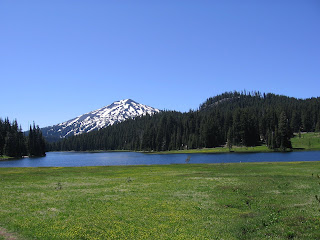
From here, we drive back to Bend, and then take the Cascade Lakes Highway west. Driving past Mt. Bachelor, we arrive at Todd Lake, a small sickle of water tucked away in the foothills of that mountain. A lovely 1.5 mile trail circles the lake, passing through coniferous woods, a meadow dotted with red and gold flowers that could come straight out of Monet, and swampy lake banks where you cross tiny trickles of streams on one-step single plank bridges, only to find yourself squelching through mud on the other side. It would be an idyllic trail to take anyway, but what makes it special is the incredible view of Mt Bachelor rising high above the demure water, its white reflection glistening on the surface. It's like a scene out of Bierstadt.

Having spent a leisurely morning by the lake, we head out for our next destination - the Oregon Coast. A five hour drive, with a stop at an excellent Thai restaurant in Eugene, takes us to Highway 101 (the last few miles of our route running parallel to the glorious Siuslaw river), from where we drive south to the town of North Bend and the Sunset Bay Park that lies just south of it. Here, I have my obligatory stout Cortez moment, staring at the Pacific with my bespectacled eyes, though MR and BM, both of whom are familiar with the California coast, seem entirely lacking in wild surmise. Part of this is because by this time the day has turned cloudy (the first time we've seen clouds so far) so that the ocean seems gray and depressing. We start making our way up a trail that leads from the Sunset Bay park along the headland to the nearby Shore Acres park. This looks exciting for a while - a woodchip covered trail carving it way through the forest - but a couple of switchbacks and a few hundred meters later all we seem to have done is come up behind a camping ground. Plus which the trail is poorly labeled and includes a number of small turn-offs to interesting view points, so that we keep wandering off the main trail. Eventually, we decide we'd rather head back and catch the sand dunes (that are the real reason we've come this far south) before nightfall.

Fifteen minutes later we're heading north again, stopping in the Umpqua State Park to take in a mile long loop trail that takes us into the dunes. Here, MR and BM go clambering up the nearest dune, happy as children, while I stand about and remember that I've always hated sand. The worst part about the trail we're on is that on the way up it's a pleasant little forest path, at one point crossing the road to the park camping ground (yet another example of how Oregon trails seem to have been purposely designed to be unnecessarily long and circuitous) but having lured you as far as the dunes, it becomes, treacherously, a track through the sand, so that you spend the last half mile slipping and sliding your way through the sand to get back to your car (you could, of course, just go back the way you came, but that feels too much like wimping out).
Done with the sand dunes, we decide to keep heading North, hoping to make it as close to the North Oregon coast town of Seaside as we can, so as to get an early start on what we have planned for tomorrow. We tell ourselves that we'll stop at Newport, after it gets dark, and get dinner, except that by this point we're all hungry, BM is longingly desperately for chocolate and yours truly is experiencing the caffeine deprivation equivalent of the DTs, so we end up stopping at a Safeway-cum-Starbucks in Florence to refuel. The Starbucks is shut by this point, but we do manage to get our hands on a fairly substantial chocolate cake and proceed to demolish it while driving North, BM and I scarfing down our shares with a few honest bites, while MR takes the more ladylike approach, meaning that she eats the lion's share of the cake, but does it in five bashful instalments over a half an hour period.
Lack of coffee notwithstanding, the drive North has its own shy magic. Every now and then the road coils its way around a cliff, offering us a vista of the sea spreading about before us, first scarlet with the sunset, then ghostly in the starlight. Lighthouses punctuate the way - from the squat modest lighthouse at Umpqua, to the one winking at us from across the bay at Heceta Head, to the unseen lighthouse whose beam leaves large swathes of light through the night sky just before Newport. As the sun goes down, we see the clouds on the horizon erupt into color and then fade, their purple and bloodied tints giving way to a silver-lined gray.
By the time we finally get to Newport it's half past ten, and the only restaurant we can find open is this diner called the Apple Peddler (apparently a chain in Oregon). Here we book ourselves a place to stay in nearby Lincoln City, while the waitress serving us proceeds to forget (in order) - first the options on the menu, then our coffee, then the cream and sugar for our coffee, then our cutlery, then the soup that MR was supposed to get with her meal, then the rolls of bread we were supposed to get for the table. It's the most depressing meal we've had all through the trip, and what makes it so poignant is that we're actually glad to be having it.
(to be continued - Day 4 and Day 5 here)
[1] For some obscure reason, R., whom I'd never met before, seemed to feel that our having come from New York / Philadelphia implied a criticism of his living in Oregon. He spent the first five minutes after we met telling me how he has the option of living in Seattle but actually prefers Portland, and how he recently visited the East Coast and found the traffic there unbearable. This went on throughout the trip as we were treated to long, self-indulgent discussions about the escalating property values in suburban Portland, the hardiness of the local populace (they walk about in the rain without umbrellas!), the wonderful weekend getaways that Portland offers, the myriad ways in which states like Oregon and Iowa (where R used to live before he moved to Portland) represent the 'true' America, rather than fake, neurotic cesspool that is New York City. It was like traveling with a real estate salesman. And it's a shame because he's a fairly nice, harmless guy (with lovely table manners and toned, muscular good looks) who it might actually be pleasant to talk to, if you didn't have the constant sense that all his easy, banal banter is leading up to a discussion of some new condominium scheme.
Day 1
Saturday morning. 5 am. MR and I make our sleepy-eyed way to the Port Authority Bus Terminal to catch the Olympia shuttle to Newark Airport. There's no one wearing a gabardine suit and we're not awake enough to play games with the faces, but something about the combination of sitting on a bus and driving the New Jersey Turnpike has me humming America under my breath. We get to our gate "disgustingly early" by MR's standards (which means we're there an hour and FIVE WHOLE MINUTES before the departure time - MR considers any airport arrival that gets you to the boarding gate more than two minutes before it closes wasteful), so she occupies herself in buying twelve different ingredients and assembling some complicated yogurt breakfast, 40% of which she proceeds to spill on her skirt.
Up in the air, MR sleeps. On the monitor directly overhead, Billy Bob Thornton is stoically making his way through the Astronaut Farmer, the on-screen story so hackneyed that dialog proves superfluous. I stare out of the window. At first the landscape is busy and fragmented, a jigsaw of mismatched farms ribboned by highways and speckled with the crumbs of towns. As we proceed west, though, the land opens up. Great prairies stretch out, then divide into perfect squares. Circular farms patch the land like massive radar screens of bright or dull green, like the playing board of some elaborate cross-continent game. Here and there, windmills dot a high ridge, looking like crosses set in place to mark some giant burial. Petrified waves of foothills stripe the land; small, anonymous lakes nestled in their folds like eggs of nostalgic blue. It's a gloriously clear day and visibility extends for miles. Half an hour from Portland, a trio of peaks appears outside my window, passing by on the right like great white-sailed ships. There's the majestic crest of Mt. Adams; Mt. Rainier standing aloof, haughty with grandeur; and the ivory breadbasket that is Mt. St. Helens. Further along, the plains give way to low hills covered with a thick alpine-looking forest, the blue-green swathe of the Columbia river running along its northern edge. As we descend into Portland, I can see the traffic of boats and water-skis streaking the river white with comet like tails. It feels like descending into an idyllic world, into the personified promise of a leisurely summer.
At the airport, MR and I meet our fellow travelers - MR's friend R., who lives in Portland and will be joining us for the weekend, and Black Mamba (BM) who has flown in from California to join us for the trip. A quick lunch at a restaurant called Azteca (ah, the ubiquity of Mexican restaurants everywhere) where the portion sizes are large enough to feed an entire Inca village for a week, and we're on our way to Crater Lake.
It doesn't take us long to discover that Oregon, though stupendously beautiful in an almost artificial way, is also one of the slowest states in the country to drive in. It's not just that the speed limit even on a major interstate is just 55 miles an hour - it's that everyone seems to actually stick to the damn limit. There's something deeply un-American about having a wide open highway in front of you and not being able to accelerate to your heart's content.
Eventually we get to the North Entrance of Crater Lake National Park, from where a 10 mile stretch of road (passing through a short stretch of pumice desert) takes us to the Rim Drive that runs right around Crater Lake. It's from the point where the entrance road meets the rim drive that we get our first view of the lake itself.

It's difficult to describe what that first view feels like. It's like being hit by 44o volts of pure blue, an electrifying sense of being witness to something so perfect, so miraculous, it should be impossible anywhere outside the imagination. And yet there it is, circled by a ring of gray snowcapped cliffs, a presence cobalt and ultramarine, like the pure distillate of a Caravaggio painting, the tranquil mercy of its waters contrasting with the grim foreboding of the wall of dark stone that surrounds it, hems it in. It's like stumbling over the parapet of some enormous fortress, to discover it contains not the angry wilderness of twisted rock that you had imagined, but a store of beauty so intense, so bottomless, as to be a kind of forgiveness. It seems impossible to believe that what you see before you is actually a caldera, created some 7,700 years ago by the eruption of Mt. Mazama - it's not just that the mind boggles at the sheer size of the mountain that collapsed to leave so huge a crater, it's also that it feels impossible to connect this peaceful, shimmering lake with something as violent as a volcanic explosion. Shelley, in Epipsychidion speaks of "a well of sealed and secret happiness". It's a phrase that springs to mind staring down at the lake, with its sense of completeness, of something contained and exquisite.
Having recovered from our first sight of the lake, we drive on along the rim. In places, the road narrows to little more than a thin ridge of land, two lanes wide, so that driving along it is like running along the edge of a great stone bowl. There is still snow by the side of the road here, and gradual slopes of white fall away to our left, inviting the imagination to ski down them. Away to the south, we see the peaks of the Cascade range - Union Peak, Mt. Shasta - a continuation of the chain of volcanoes that includes Mt. St. Helens and Mt. Rainier in the North. Directly above us, the cabin atop Watchman peak glints in the sun, the trail to it blocked by several feet of thick snow.

We spend the rest of the day driving around the lake, taking a brief detour on our way to stop at the Pinnacles overlook, where thin fingers of ash rise like ghosts into the air, their surfaces gleaming golden in the setting sun. We take a short trail through the forest here, but the country around us seems dead - no bird calls, no unexplained rustlings in the underbrush, just a thin, dusty path through a forest of bitter trees and the hum of great swarms of hungry mosquitoes. The trail we are following leads nowhere special, ending abruptly at the point where the National Park gives way to the State Forest, and we return a little disappointed and badly bitten.
 Back on the Rim Drive though, we continue to be amazed by the sight of the lake stretching below us. We're over the first surprise now, and there's a trace of monotony starting to creep in, but it's kept at bay by the way the lake, seen from different angles and in changing light, constantly reinvents itself, offers us an endless series of perspectives that serve only to convince us of the impossibility of seeing this incredible sight in its entirety. No one, it seems to me, can ever claim to have really seen Crater Lake - like all things of genuine beauty it contains an inexhaustible store of impressions, and the best we can hope for is to capture a handful of them and make them our own. And it is to do this that we brave our way through the stinging mosquitoes to stare down at the imagined masts of the Phantom Ship, or to eye the evocatively sculptured shapes of the white pine trees lining the rim. Eventually, we end up back at the North Junction, just in time to catch a glorious sunset, Clifford Brown playing on the car stereo as the day comes to an end.

From here, we drive to the town of Klamath Falls, our plan being to spend the night there and return next morning to hike some of the trails around the lake. It's a pretty drive, running through picturesque cattle country (a smattering of dilapidated barns and road signs that feature the stolid silhouette of a cow set against a background of yellow) though mostly wasted on us because we're driving it after dark. Still, the stars are out like spilled salt, Venus shines bright in the Western sky, while some other planet (Mars? Jupiter?) glows like a delicate little pearl set into our windshield. And when the moon comes up over the low foothills that surround Klamath Lake, its full, bronze face seems almost operatic with glory.
Reaching Klamath Falls, we check into this place called the Running Y ranch - a pretentious golf resort that R. has selected as part of his campaign to impress us with how sophisticated Oregon is [1]. The Running Y features (I'm told) a spa, a gift shop with local handicrafts and an 18-hole golf course - all the amenities entirely unnecessary to people trying to grab a quick six hours of shut-eye before heading into the outdoors again - but does not, alas, have a kitchen that is open by the time we get there, which means that we now have to drive miles back to town (the Running Y, being all super-exclusive, is naturally in the middle of nowhere) in order to get a Subway sandwich. Ah well.
Day 2
The second day. I wake up early, my usual insomnia made worse by R's snoring. Since the others are still asleep, and look like they will be for a while, I decide to wander about the 'ranch'. Wildlife is in abundance here. A doe and her fawn graze the margins of the parking lot next to our car, vanishing over a nearby hill when I approach. A flock of American White Pelicans feeds on the lake, soaring into the air on their long black-tipped wings. Small rodents (squirrels? chipmunks?) punctuate the yellowing summer grass like commas. And when I sit down to read on a rough-hewn wooden rocking chair on the hotel terrace, I find myself surrounded by a great herd of golfers - red-complexioned and loud voiced creatures to whom the distant glimmering lake is just another water hazard, and who sit around marveling at the vision of the man who saw, in this waste of a forest, the dazzling possibility of a golf course.
I sit on this terrace for a good three hours, reading Nabokov, soaking in the sun. Eventually, my sleepyhead companions emerge, and a quick breakfast of scrambled eggs and sausages later, we're on our way back to Crater Lake. This time we park at the head of the Cleetwood trail (the only trail in the park that provides access to the lake itself), and proceed to follow a narrow, switchbacking path down to the water. It's a pleasant walk going down, until you realize that you're going to have come back the same way that you're going, and this nice 30 to 45 degree slope you're skipping down presently is going to seem like a nightmare going up. I decide to stop half way (I have the lung capacity of an eight year old, and the stamina of an arthritic octogenarian, so going all the way down a trail that leaves fairly experienced looking hikers panting seems like a bad idea) choosing to perch myself on a strategically located bench on the way and stare in dumb wonder at the beauty of the lake in the late morning sun.

It is an exquisite sight. Off in the distance, Mt. Red Horn raises its rhino head, while the Watchman Peak towers jealously over the water, its shoulders armored in snowy silver. In the center of the lake, Wizard Island stands forlorn as an orphaned child, a tiny afterthought of a volcano hiding in the larger fact of the Mazama caldera. Above Chaski Bay the cliffs glisten, their snowy faces turned to the light like sunbathers reveling in an unexpected summer. A small boat makes its way across the shimmering surface of the lake its wake spreading behind it like the gills of some giant fish. As the afternoon advances, the waves in the lake seem lined with thin threads of gold, while their crests gleam like lapis kisses.

Of course, I'm not the only one who stops to admire the view. Before long, I find myself playing unofficial photographer to a steady stream of tourists, all wanting a group shot (I don't understand people - why would you want to block out more than half of this spectacular view, by putting yourself and your friends in the picture?). I begin to wonder if I wouldn't be better off doing this for a living instead of trying to make progress with my PhD. Eventually the other three return and we make our breathless way up to the top, the burning in my lungs so intense by the time I get to the parking lot that it's a full ten minutes before I can take a deep breath again without having it hurt. Plus the dust from the trail has ended up coating our tongues and throat, so that we spend the next five minutes coughing and tasting the grit between our teeth.
A quick lunch at the Annie Creek Restaurant just outside the south entrance of the park follows (it's an Italian buffet - pizza slices, make your own pasta and softserve icecream with fruit scumble), after which R heads back to Portland (he needs to be back at work on Monday) while MR, BM and I drive to the town of Bend, which a friend of ours has described to us as 'quaint and charming', and which, we are told, is famous for its micro-breweries.
On the way there, we take a quick detour off Route 97 into the Newberry National Volcanic
 Monument. On the way, a viewpoint offers us the majestic sight of the Cascades - showing us Mt. Bachelor and the Three Sisters, the peaks standing formally apart from each other like characters in a Chekhov short story. Next, we stop by the picturesque Paulina Falls, then spend a quarter of an hour by Paulina Lake, telling ourselves that those birds circling in the distance are, in fact, bald eagles. The map says that the road will take us to the Newberry caldera, so when we come to the point where the road narrows to a single lane and all we can see is a lake we stop to ask. It turns out that the entire area that we've been driving around in is one big crater. This should probably impress us, but it feels like a let down. We look around and it seems just like any other regular hill-lined plain.
It's only on the way back, when we stop at the unimaginatively named Big Obsidian Flow that we get the sense of being in true volcanic territory. This is a wasteland of black glass, of dark, twisted stones that have been tortured into confessing their fundamental smoothness, their affinity for light. Walking up the trail here is like walking through mile upon mile of sculptured rubble, or like ascending into an open mine of shattered clumps of glass. It is a landscape Eliot would have approved of - with its blending of the broken with the polished, of the rugged with the slickly opaque - a landscape of black mirrors showing us the stony darkness we carry in our souls. But I am also reminded, climbing up from a stagnant lake filled with green fronds that come straight out of Tarkovsky, of that scene in Kurosawa's Hidden Fortress, where the two bumbling soldiers try to climb their way up a crumbling stone scree.

From here, we head to Bend, anxious to experience the promised nightlife of the city. From the descriptions we've heard, Bend sounds like the kind of happening place where you can't throw a stone without hitting a micro-brewery and where you have only to park your car and get out on the street to be part of the excitement. It doesn't quite work out like that. Our first stop is the Old Mill District, which sounds promising, and which we've seen mentioned as one of more exciting places in the city. This turns out to be little more than a strip-mall, with a 16-screen multiplex and a motley collection of chain restaurants. We get out of there as fast as we can, and spend a good half hour driving around the city at random, without coming across anything that feels particularly enthralling. Eventually, we find one micro-brewery (called the Cascade Lakes brewery) and proceed to have a relaxed meal of fiery chicken wings followed by sandwiches and washed down with a pleasant collection of fine-tasting ales. It's a good way to unwind after the long day we've had, and we have fun, but it's not exactly a night on the town. Afterwards, too tired to go seeking the elusive Bend nightlife, we check into a nearby hotel and settle in for the night.
Day 3
The morning of day 3 sees us heading back to the National Volcanic Monument. This time our destination is the Lava River Cave - a mile long underground tunnel formed by the lava flow. We descend into the cave like dwarfs entering a mine, complete with lanterns we've hired from the park service in order to be able to see inside the pitch dark tunnel. It's a pretty spooky trip. The easy metal stairs leading down into the mouth of the cave soon give way to a tortuous path of broken, uneven rock. A few hundred feet and you've left sunlight far behind you, and entered a cave so vast that even with your lantern raised you can't see the roof or the upper parts of the walls. Great piles of fallen rock block the way, and as you half-climb, half-stumble your way on the narrow path that leads through them, it only adds to your anxiety to know that many of these rockfalls are relatively recent. You find yourself peering anxiously at the ceiling. Drops of water drip from the roof and hit you on the back of the neck. You wonder if there are bats in here, then realize there almost certainly are. It's a tricky path to negotiate, since little effort seems to have been made to make it easy to walk on, and the knowledge that you're holding in your hand a propane lamp that, in the words of the ranger at the entrance, could "burn you very badly" makes things worse. At one point BM trips and falls, managing to set her lantern down safely, but bruising her knee and scratching her face in the process.
A little way further the tunnel opens up into a vast hall, its roof arching away into the darkness, its floor covered with a thin carpet of sand, its walls sculpted in streaked rock and frozen magma. It's like entering a great dwarf hold. This is what Moira must have felt like, I think, and immediately imagine a Balrog waiting around the next corner.
The Lava River Cave runs for about a mile underground, eventually narrowing to a point where you have to crawl through the sand to go further. We, however, turn back about half way through, having only got to the point where the tube divides into two parts, one inside the other. It's a relief to see daylight again, and also a shock to return to the warmth of the summer day (the temperature inside the cave is 42 degrees F).

From here, we drive back to Bend, and then take the Cascade Lakes Highway west. Driving past Mt. Bachelor, we arrive at Todd Lake, a small sickle of water tucked away in the foothills of that mountain. A lovely 1.5 mile trail circles the lake, passing through coniferous woods, a meadow dotted with red and gold flowers that could come straight out of Monet, and swampy lake banks where you cross tiny trickles of streams on one-step single plank bridges, only to find yourself squelching through mud on the other side. It would be an idyllic trail to take anyway, but what makes it special is the incredible view of Mt Bachelor rising high above the demure water, its white reflection glistening on the surface. It's like a scene out of Bierstadt.

Having spent a leisurely morning by the lake, we head out for our next destination - the Oregon Coast. A five hour drive, with a stop at an excellent Thai restaurant in Eugene, takes us to Highway 101 (the last few miles of our route running parallel to the glorious Siuslaw river), from where we drive south to the town of North Bend and the Sunset Bay Park that lies just south of it. Here, I have my obligatory stout Cortez moment, staring at the Pacific with my bespectacled eyes, though MR and BM, both of whom are familiar with the California coast, seem entirely lacking in wild surmise. Part of this is because by this time the day has turned cloudy (the first time we've seen clouds so far) so that the ocean seems gray and depressing. We start making our way up a trail that leads from the Sunset Bay park along the headland to the nearby Shore Acres park. This looks exciting for a while - a woodchip covered trail carving it way through the forest - but a couple of switchbacks and a few hundred meters later all we seem to have done is come up behind a camping ground. Plus which the trail is poorly labeled and includes a number of small turn-offs to interesting view points, so that we keep wandering off the main trail. Eventually, we decide we'd rather head back and catch the sand dunes (that are the real reason we've come this far south) before nightfall.

Fifteen minutes later we're heading north again, stopping in the Umpqua State Park to take in a mile long loop trail that takes us into the dunes. Here, MR and BM go clambering up the nearest dune, happy as children, while I stand about and remember that I've always hated sand. The worst part about the trail we're on is that on the way up it's a pleasant little forest path, at one point crossing the road to the park camping ground (yet another example of how Oregon trails seem to have been purposely designed to be unnecessarily long and circuitous) but having lured you as far as the dunes, it becomes, treacherously, a track through the sand, so that you spend the last half mile slipping and sliding your way through the sand to get back to your car (you could, of course, just go back the way you came, but that feels too much like wimping out).
Done with the sand dunes, we decide to keep heading North, hoping to make it as close to the North Oregon coast town of Seaside as we can, so as to get an early start on what we have planned for tomorrow. We tell ourselves that we'll stop at Newport, after it gets dark, and get dinner, except that by this point we're all hungry, BM is longingly desperately for chocolate and yours truly is experiencing the caffeine deprivation equivalent of the DTs, so we end up stopping at a Safeway-cum-Starbucks in Florence to refuel. The Starbucks is shut by this point, but we do manage to get our hands on a fairly substantial chocolate cake and proceed to demolish it while driving North, BM and I scarfing down our shares with a few honest bites, while MR takes the more ladylike approach, meaning that she eats the lion's share of the cake, but does it in five bashful instalments over a half an hour period.
Lack of coffee notwithstanding, the drive North has its own shy magic. Every now and then the road coils its way around a cliff, offering us a vista of the sea spreading about before us, first scarlet with the sunset, then ghostly in the starlight. Lighthouses punctuate the way - from the squat modest lighthouse at Umpqua, to the one winking at us from across the bay at Heceta Head, to the unseen lighthouse whose beam leaves large swathes of light through the night sky just before Newport. As the sun goes down, we see the clouds on the horizon erupt into color and then fade, their purple and bloodied tints giving way to a silver-lined gray.
By the time we finally get to Newport it's half past ten, and the only restaurant we can find open is this diner called the Apple Peddler (apparently a chain in Oregon). Here we book ourselves a place to stay in nearby Lincoln City, while the waitress serving us proceeds to forget (in order) - first the options on the menu, then our coffee, then the cream and sugar for our coffee, then our cutlery, then the soup that MR was supposed to get with her meal, then the rolls of bread we were supposed to get for the table. It's the most depressing meal we've had all through the trip, and what makes it so poignant is that we're actually glad to be having it.
(to be continued - Day 4 and Day 5 here)
[1] For some obscure reason, R., whom I'd never met before, seemed to feel that our having come from New York / Philadelphia implied a criticism of his living in Oregon. He spent the first five minutes after we met telling me how he has the option of living in Seattle but actually prefers Portland, and how he recently visited the East Coast and found the traffic there unbearable. This went on throughout the trip as we were treated to long, self-indulgent discussions about the escalating property values in suburban Portland, the hardiness of the local populace (they walk about in the rain without umbrellas!), the wonderful weekend getaways that Portland offers, the myriad ways in which states like Oregon and Iowa (where R used to live before he moved to Portland) represent the 'true' America, rather than fake, neurotic cesspool that is New York City. It was like traveling with a real estate salesman. And it's a shame because he's a fairly nice, harmless guy (with lovely table manners and toned, muscular good looks) who it might actually be pleasant to talk to, if you didn't have the constant sense that all his easy, banal banter is leading up to a discussion of some new condominium scheme.
Subscribe to:
Posts (Atom)
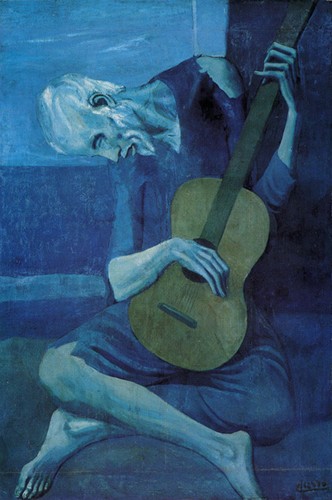

 Posts


