Overheard on the bus:
"You mean he didn't tell her he slept over with you on his birthday?"
Thursday, October 08, 2009

Tuesday, October 06, 2009
Beyond an uncertain point
It's not that you wish to die. On the contrary, you no longer feel the need for a reason to live.
Somewhere there is a world where everything you no longer believe has proven true. What remains is both less probable and more necessary. The way a sealed window is an invitation to look down at the city, to look up at the sky.
It's not that you wish to die. It's just that above a certain height you have to consider the possibility.
Somewhere there is a world where everything you no longer believe has proven true. What remains is both less probable and more necessary. The way a sealed window is an invitation to look down at the city, to look up at the sky.
It's not that you wish to die. It's just that above a certain height you have to consider the possibility.
Monday, October 05, 2009
But a whimper
"Dissipation is actually much worse than cataclysm."
-Tracy Letts August: Osage County
People are always saying how when one door closes another opens. Which is bullshit. When a door closes you look for a fucking window and if you're lucky enough to find one you jump straight out of it without bothering to look.
And you hope you aren't too high.
Yes and No
Fastidiousness or indecision? In either case an unwillingness to commit. A refusal to take sides is a sign of judgment, until its a sign of cowardice. The difference between reaching across a fence and sitting on it. "The best lack all conviction", Yeats says. No, the best just take their time to be convinced. Yet how do we tell a diplomat from a politician? Is there a difference?
Does that answer your question?
Does that answer your question?
Sunday, October 04, 2009
Saturday, October 03, 2009
Hanumanhattan
Scenes we'd like to see dept.
A version of the Ramayan with Hanuman as King Kong.
Hanuman grabs Sita (Scarlett Johansson) and climbs to the top of the Empire State building. Ravan (Javier Bardem) comes after them in his Curtiss Helldiver named Pushpak, and proceeds to set Hanuman / Kong's ass on fire, at which point Hanuman / Kong threatens to incinerate most of mid-town sparing only the brief stretch of Lexington with his favorite desi places. Things look pretty dire for Manhattan until Ram (Woody Allen) arrives and proceeds to read Kierkegaard to Hanuman / Kong until the big ape can't take it any more and commits suicide by ripping his chest open and tearing out his heart. Sita (Johansson) throws herself at Ram (Allen) because nothing makes a girl hornier than being saved from Javier Bardem by a short man in glasses old enough to be her grandfather, but Ram has just realized that being the sixth incarnation of god makes him an existential schizophrenic, and ignores her.
The End.
A version of the Ramayan with Hanuman as King Kong.
Hanuman grabs Sita (Scarlett Johansson) and climbs to the top of the Empire State building. Ravan (Javier Bardem) comes after them in his Curtiss Helldiver named Pushpak, and proceeds to set Hanuman / Kong's ass on fire, at which point Hanuman / Kong threatens to incinerate most of mid-town sparing only the brief stretch of Lexington with his favorite desi places. Things look pretty dire for Manhattan until Ram (Woody Allen) arrives and proceeds to read Kierkegaard to Hanuman / Kong until the big ape can't take it any more and commits suicide by ripping his chest open and tearing out his heart. Sita (Johansson) throws herself at Ram (Allen) because nothing makes a girl hornier than being saved from Javier Bardem by a short man in glasses old enough to be her grandfather, but Ram has just realized that being the sixth incarnation of god makes him an existential schizophrenic, and ignores her.
The End.
First Movement
A music of madmen rearranging furniture in rooms of sound.
The rhythm of things lifted, let down. Muscles tensed and released.
Pause. Are you pleased?
Let's try it differently. But quick, quick, before silence gets home.
The rhythm of things lifted, let down. Muscles tensed and released.
Pause. Are you pleased?
Let's try it differently. But quick, quick, before silence gets home.
Friday, October 02, 2009
Tuesday, September 29, 2009
Largo
There are days when my happiness depresses me.
***
There is an ugliness to perfection - it is too obvious, too ostentatious. To be beautiful is to be damaged, in subtle and irreparable ways.
Like the wings of the butterfly crushed to pure color. Or the mournful call of the cello that knows itself alone.
***
There is an ugliness to perfection - it is too obvious, too ostentatious. To be beautiful is to be damaged, in subtle and irreparable ways.
Like the wings of the butterfly crushed to pure color. Or the mournful call of the cello that knows itself alone.
Monday, September 28, 2009
Water Walking
"to walk
on water as water, demonstrating
that we hardly know under what terms
we perform our sitting in air, our miraculous,
perilous stepping out in the flesh
over the everyday void."
- Tess Gallagher, 'Water Walking' from Dear Ghosts, (Graywolf 2006)
***
Impression follows impression. Nothing sinks in.
An escapist vision: the Resurrection as the first film. The sea a dark negative the light touches and moves on.
Or, as the three wise critics said, a star is born.
A house with everything you've ever dreamt of...
...would be an extremely scary place.
Think of the monsters under the bed, the snakes in the shower, the staircases you couldn't help falling down.
Think of how the floor would constantly trip you, so you'd stumble yourself awake.
***
Have you ever had a fall where it felt like you were dreaming until your face hit the ground?
***
The plane explodes mid-sentence, at the height of a blue morning. I look up and the sky is filled with cogs. A propeller comes spinning down, like a lethal tumbleweed, bounces off the road, smashes into the house.
Think of the monsters under the bed, the snakes in the shower, the staircases you couldn't help falling down.
Think of how the floor would constantly trip you, so you'd stumble yourself awake.
***
Have you ever had a fall where it felt like you were dreaming until your face hit the ground?
***
The plane explodes mid-sentence, at the height of a blue morning. I look up and the sky is filled with cogs. A propeller comes spinning down, like a lethal tumbleweed, bounces off the road, smashes into the house.
Saturday, September 26, 2009
Unsleeping Ghost
You return to loss the way one returns to a bed one has slept in, long ago, as a child.
Amazed that your body still fits within its dimensions. Tempted to pretend you never left.
Amazed that your body still fits within its dimensions. Tempted to pretend you never left.
Sunday, September 20, 2009
Tuesday, September 15, 2009
The Puddle
Toss the moon in a puddle and it becomes a coin.
Someone has run the puddle over. It lies by the roadside, eyes wide open, ripples opening and closing like a mouth that has something to say.
Evaporating confessions.
Tomorrow it will be impossible to tell a damp spot from your shadow, your forgetting from my past.
Someone has run the puddle over. It lies by the roadside, eyes wide open, ripples opening and closing like a mouth that has something to say.
Evaporating confessions.
Tomorrow it will be impossible to tell a damp spot from your shadow, your forgetting from my past.
Friday, September 11, 2009
Intelligent design
The fact that we can find pattern in the Universe is proof that existence is man-made.
Would a supremely intelligent being be satisfied with anything less than true randomness?
Would a supremely intelligent being be satisfied with anything less than true randomness?
Monday, September 07, 2009
Not here forever
"If you were to enter the room now and say: 'I am leaving for a long time, forever' - or: 'I don't think I love you any more' - I would not, I believe, feel anything new: each time you leave, each hour that you are not here - you are not here forever and you do not love me."
- Marina Tsvetaeva, Earthly Signs
***
It finally happened. You left. Just as I always feared you would. All those business trips when I was so sure you weren't coming back.
So why is it that now that you've finally left I keep expecting you to walk through that door?
- Marina Tsvetaeva, Earthly Signs
***
It finally happened. You left. Just as I always feared you would. All those business trips when I was so sure you weren't coming back.
So why is it that now that you've finally left I keep expecting you to walk through that door?
Sunday, September 06, 2009
The Promenades of Euclid

Rene Magritte
Aspiration
Inspiration
What it reaches
Where it leads
A mirror held up to
A glass through which we see
Geometry
Transcendence
Above
Beyond
More evidence that I'm a sociopath
"At one point, Jackson showed Gregory Exhibit No. 60—a photograph of an Iron Maiden poster that had hung in Willingham’s house—and asked the psychologist to interpret it. “This one is a picture of a skull, with a fist being punched through the skull,” Gregory said; the image displayed “violence” and “death.” Gregory looked at photographs of other music posters owned by Willingham. “There’s a hooded skull, with wings and a hatchet,” Gregory continued. “And all of these are in fire, depicting—it reminds me of something like Hell. And there’s a picture—a Led Zeppelin picture of a falling angel. . . . I see there’s an association many times with cultive-type of activities. A focus on death, dying. Many times individuals that have a lot of this type of art have interest in satanic-type activities.”
from David Grann's incredible must-read piece in this week's New Yorker.
Saturday, September 05, 2009
Walking on the beach
"The complete concurrence of souls requires the concurrence of the breath...for people to understand one another, they must walk or lie side by side."
- Marina Tsvetaeva, from Earthly Signs (translation: Jamey Gambrell)
***
You set your pace by the ocean, I matched my step to yours.
We talked of ice cream and sunsets, and how to tell a castle from a mound of sand.
Meanwhile the tide withdrew to a distance, and the waves snickered among themselves.
- Marina Tsvetaeva, from Earthly Signs (translation: Jamey Gambrell)
***
You set your pace by the ocean, I matched my step to yours.
We talked of ice cream and sunsets, and how to tell a castle from a mound of sand.
Meanwhile the tide withdrew to a distance, and the waves snickered among themselves.
Friday, September 04, 2009
Cerro Blanco
Because it is there.
An emptiness surrounded by space. A silence from which the lines radiate.
Neither source nor center, it is a surrender of coordinates, the held breath of a horizon between feeling and music, dark earth and air.
Things come together. Anarchy cannot hold.
Passing time is noise, eternity merely volume; after the end and before the beginning there is only this - a balance that is destroyed in being established.
Like the difference between white and blank, invisible and transparent,
long ago and far away.
An emptiness surrounded by space. A silence from which the lines radiate.
Neither source nor center, it is a surrender of coordinates, the held breath of a horizon between feeling and music, dark earth and air.
Things come together. Anarchy cannot hold.
Passing time is noise, eternity merely volume; after the end and before the beginning there is only this - a balance that is destroyed in being established.
Like the difference between white and blank, invisible and transparent,
long ago and far away.
Of the night for the morrow
Love: to recognize something as necessary and know you can never have it.
If our ideas about death are romantic, it is because we are mortal.
If our ideas about death are romantic, it is because we are mortal.
Sunday, August 30, 2009
Affirmation
"I have never clogged myself with the praises of pastoral life, nor with nostalgia for an innocent past of perverted acts in pastures. No. One need never leave the confines of New York to get all the greenery one wishes--I can't even enjoy a blade of grass unless i know there's a subway handy, or a record store or some other sign that people do not totally regret life. It is more important to affirm the least sincere; the clouds get enough attention as it is and even they continue to pass. Do they know what they're missing? Uh huh."
- Frank O'Hara, 'Meditations in an Emergency'
P.S. To the owners of the Kalahari Resort Convention Center and Kosmix shawls. Dudes, get a clue. Seriously.
The Source
Afterwards, the experts would study the blast pattern, sift through the rubble. Eventually, they would trace the explosion back to its source, here, by this vegetable stall in the crowded market.
The thought made him smile. He'd always wanted to be the center of attention.
The thought made him smile. He'd always wanted to be the center of attention.
Saturday, August 29, 2009
Your own end
All night you sit in the dark, the gun ticking at your temple.
Every goodbye is a compromise. If you could explain how you were feeling you would not need to do this. And yet your suffering is as ordinary as newsprint, and you want to pretend you are not in love with death, that you are just using her.
Not judgment after death, but a death that does not judge.
Every goodbye is a compromise. If you could explain how you were feeling you would not need to do this. And yet your suffering is as ordinary as newsprint, and you want to pretend you are not in love with death, that you are just using her.
Not judgment after death, but a death that does not judge.
Friday, August 28, 2009
Thursday, August 27, 2009
Night Show
Sooner or later, someone is bound to shout fire.
Your desire a theater, crowded with images, larger than life. You never see the one next to you, never even try. You're in a hurry to leave the moment it's over, not even stopping to learn the names.
You say you're not looking for credit, you're looking for blame.
One night sleep is projector you cannot break, seeing in through to the end, your technicolor nightmare, waking to find you're still in the dark.
The old black and whites are watching you.
Your desire a theater, crowded with images, larger than life. You never see the one next to you, never even try. You're in a hurry to leave the moment it's over, not even stopping to learn the names.
You say you're not looking for credit, you're looking for blame.
One night sleep is projector you cannot break, seeing in through to the end, your technicolor nightmare, waking to find you're still in the dark.
The old black and whites are watching you.
Wednesday, August 26, 2009
From time to time I hear
There's really nothing like the thrill of discovery, is there?
Consider:
Now, as everyone knows, that's a line Eliot riffs on in The Waste Land. What I didn't know, and only realized a few days ago, re-reading Virgil (while thinking about the whole stud / stallion / wild horses as a metaphor for sexual desire - but that's a whole other story), that those lines themselves probably come from this [1]:
The more things change, etc.
[1] I say probably because this is pure conjecture on my part. On the one hand, I feel fairly certain that Marvell would have been familiar with the Virgil, which makes the connection likely. On the other hand, it's possible that Fallon, in translating Virgil, is (consciously or unconsciously) channeling Marvell (for an alternate translation, see here). Or the whole thing could be just coincidence. I suppose there are people out there who study / research this sort of thing and would know for sure. But frankly, I'm uninterested in whether I'm right or not. The speculation's the point.
Consider:
"But at my back I always hear
Time's winged chariot hurrying near;"
-Andrew Marvell, To his Coy Mistress
Now, as everyone knows, that's a line Eliot riffs on in The Waste Land. What I didn't know, and only realized a few days ago, re-reading Virgil (while thinking about the whole stud / stallion / wild horses as a metaphor for sexual desire - but that's a whole other story), that those lines themselves probably come from this [1]:
"You've seen - surely you've seen - how in a race, right from the off,
the chariots will gobble ground to take the lead,
and the charioteers, their hopes sky high and hearts in mouth,
lean forward as they ply their whips
and strain to give the horses their head, pushing them on.
The wheels are turning so quickly they burn.
Now up, now down, as if they're poised for take-off.
And no let up, and no let off, they're kicking up such a storm.
On their backs they feel the clammy breath of their pursuers."
- Virgil, Georgics III. 103-111 (translation by Peter Fallon)
The more things change, etc.
[1] I say probably because this is pure conjecture on my part. On the one hand, I feel fairly certain that Marvell would have been familiar with the Virgil, which makes the connection likely. On the other hand, it's possible that Fallon, in translating Virgil, is (consciously or unconsciously) channeling Marvell (for an alternate translation, see here). Or the whole thing could be just coincidence. I suppose there are people out there who study / research this sort of thing and would know for sure. But frankly, I'm uninterested in whether I'm right or not. The speculation's the point.
Sunday, August 23, 2009
Woke up this morning...
...and dreamed it was still night.
***
Singers have multiplied more than traffic lights.
I met one at the crossroads. He said, "Are you the Devil?"
Such hope in his eyes I had to say yes.
He said, "I'll pay no mind to your reputation."
I said, "I wouldn't sell it for less."
He said, "I've got no soul, but I've got a guitar"
I said, "I've got no money, but I've got the blues."
He said, "I've got something to offer."
I said, "I've got nothing to lose."
***
I met the devil at the crossroads and he said, "All I ever wanted was to play the blues."
He said, "I'll make a deal with you. I'll give you the wings of my back if you'll give me the song in your heart."
I said, "I know where this will end, but I don't know where to start."
***
Singers have multiplied more than traffic lights.
I met one at the crossroads. He said, "Are you the Devil?"
Such hope in his eyes I had to say yes.
He said, "I'll pay no mind to your reputation."
I said, "I wouldn't sell it for less."
He said, "I've got no soul, but I've got a guitar"
I said, "I've got no money, but I've got the blues."
He said, "I've got something to offer."
I said, "I've got nothing to lose."
***
I met the devil at the crossroads and he said, "All I ever wanted was to play the blues."
He said, "I'll make a deal with you. I'll give you the wings of my back if you'll give me the song in your heart."
I said, "I know where this will end, but I don't know where to start."
Wednesday, August 19, 2009
Burning the oiled midnight
I lent the fire my nightmare and it ate up the house.
Afterwards, I oiled the burnt midnight, so the darkness would open silently, and let me pass through.
Afterwards, I oiled the burnt midnight, so the darkness would open silently, and let me pass through.
The couple two tables away
are breaking up. You can see it in her eyes: that half anxious, half indignant look as she talks and talks and waits for him to react. And in the way he adds sugar to his coffee, eyes focused on the task, the air of deliberation as he opens each packet and pours it in, taking care to let nothing spill. Empty packets clutter the table. This must be his sixth, maybe even his seventh. Soon he will have to stop adding sugar, will have to bring the cup to his lips. But the coffee will taste too sweet to him now, it will sicken him, disgust him. He will abandon it with something almost like relief, letting it sit there, growing cold on the table, until someone comes and clears it away.
Sunday, August 16, 2009
Unsung
It's not that he's on his own. He's been on his own before, has lived alone for most of his adult life. It's that moving to this new place has meant entering a new circle of loneliness, a purer, more profound solitude. There are days now when he doesn't speak to another human being, not even to say hello or thank you, so that the sound of his own voice, as he reads a poem aloud, say, or a passage from a book, startles him, seems an imposition. He has taken to mouthing the words instead, appropriating the shapes of the phrases even as he maintains his own privacy.
Words are not all he appropriates. When he listens to music now he pretends to play along - guitar, piano, saxophone, cello - he has many imaginary talents, though the applause at the end is always the same. He has trouble reconciling his popularity in these daydreams with the reality of his social life. Could he really handle being in the spotlight all the time? He imagines himself as a enigmatic, hermit-like figure, refusing to grant interviews, offering no comment to the endless speculation about him in the press.
Or perhaps, (since the cost to his privacy seems hardly worth it), he could be one of those greats who are only discovered after their deaths? No, that would mean they would dig up all these details about him afterwards, come up with all sorts of salacious gossip, misinterpret who he was entirely.
So maybe it'd be better if he remained undiscovered, his talents obscured by some combination of natural reticence and missed opportunity. Maybe that was the kind of artist he was meant to be, an unsung genius, one of the thousands playing their music in suburban garages and empty nightclubs, just waiting for someone to notice them.
Yes, that seemed about right.
Words are not all he appropriates. When he listens to music now he pretends to play along - guitar, piano, saxophone, cello - he has many imaginary talents, though the applause at the end is always the same. He has trouble reconciling his popularity in these daydreams with the reality of his social life. Could he really handle being in the spotlight all the time? He imagines himself as a enigmatic, hermit-like figure, refusing to grant interviews, offering no comment to the endless speculation about him in the press.
Or perhaps, (since the cost to his privacy seems hardly worth it), he could be one of those greats who are only discovered after their deaths? No, that would mean they would dig up all these details about him afterwards, come up with all sorts of salacious gossip, misinterpret who he was entirely.
So maybe it'd be better if he remained undiscovered, his talents obscured by some combination of natural reticence and missed opportunity. Maybe that was the kind of artist he was meant to be, an unsung genius, one of the thousands playing their music in suburban garages and empty nightclubs, just waiting for someone to notice them.
Yes, that seemed about right.
Loneliness is underrated
I've probably said this before, but there's really nothing like watching a movie when you're the ONLY ONE in the entire theater. It's like having a living room with a 20-foot high screen and impeccable surround sound. Plus, someone else makes the popcorn. What more could one ask for?
P.S. The movie, if you must know, was (500) Days of Summer, and is the source of the title of this post.
P.S. The movie, if you must know, was (500) Days of Summer, and is the source of the title of this post.
Friday, August 14, 2009
On Facebook
"Do we want to return to the womb? Not at all.
No one really desires the impossible:
That is only the image out of our past
We practical people use when we cast
Our eyes on the future, to whom freedom is
The absence of all dualities.
Since there never can be much of that for us
In the universe of Copernicus,
Any heaven we think it decent to enter
Must be Ptolomaic with ourselves at the centre."
- W. H. Auden
And there, in a nutshell, is the rationale for Facebook.
Thursday, August 13, 2009
Wednesday, August 12, 2009
Bookstore neurosis
Stock home syndrome: The urge to buy a book in order to 'rescue' it. Like finding a copy of Catcher in the Rye tucked away on a shelf of Harry Potter and Twilight books, and taking it home out of pure sympathy.
Deweydecimania: The need to rearrange books in a bookstore to restore them to proper alphabetical order. May be accompanied by indistinct muttering about people who put Marquez after Maugham.
Deweydecimania: The need to rearrange books in a bookstore to restore them to proper alphabetical order. May be accompanied by indistinct muttering about people who put Marquez after Maugham.
Sunday, August 09, 2009
It's a woman's life, they said
You know what I don't get? Is the use of 'persuasion' to mean gender. You know, how people will say so-and-so is of the female persuasion. I mean, are we really to believe that so-and-so was going to be a man until someone came along and changed her mind? Is there some sort of special purgatory up there where large numbers of gender salesmen roam the mountain passes, trying to recruit people into their gender?
"You there, have you considered becoming a woman? It's really great, you know. Sure, you get treated like a second-class citizen pretty much anywhere you go, but on the flip side, you get to wear make-up and have lots more fashion choices and can always find someone to have sex with you, though there is the chance this may result in you ending up all bloated and gross and then having to undergo unimaginable pain, but it's all in the interest of propagating the species, and what's more, if you sign up for a lifetime subscription we give you this neat biological clock absolutely free! So what do you say? Yes, you'll join? Great! just sign here please. What's that? You'd rather be a man? Are you sure? Well, okay, but can I at least interest you in a fine set of encyclopedias?"
"You there, have you considered becoming a woman? It's really great, you know. Sure, you get treated like a second-class citizen pretty much anywhere you go, but on the flip side, you get to wear make-up and have lots more fashion choices and can always find someone to have sex with you, though there is the chance this may result in you ending up all bloated and gross and then having to undergo unimaginable pain, but it's all in the interest of propagating the species, and what's more, if you sign up for a lifetime subscription we give you this neat biological clock absolutely free! So what do you say? Yes, you'll join? Great! just sign here please. What's that? You'd rather be a man? Are you sure? Well, okay, but can I at least interest you in a fine set of encyclopedias?"
Wednesday, August 05, 2009
Paranoia
To be convinced you're paranoid is a paranoia in itself.
Unless, that is, you really are paranoid.
Unless, that is, you really are paranoid.
Monday, August 03, 2009
Mistakes
After a while, you run out of mistakes to make.
Then you start to wonder - would it be a mistake to make the same mistake again? Isn't it better, since mistakes are inevitable, to pick one you already know how to survive?
Then you start to wonder - would it be a mistake to make the same mistake again? Isn't it better, since mistakes are inevitable, to pick one you already know how to survive?
Sunday, August 02, 2009
Virga
"the presence of his widow in my office caused my months of dogged rationalization to evaporate like virga."
- Stephen White (New York Times, Aug 1, 2009)
Okay, quick show of hands: how many of you knew that virga are wisps of precipitation that evaporate before they reach the ground?
Should I be depressed that pulpy crime thriller writers have a better vocabulary than I do?
- Stephen White (New York Times, Aug 1, 2009)
Okay, quick show of hands: how many of you knew that virga are wisps of precipitation that evaporate before they reach the ground?
Should I be depressed that pulpy crime thriller writers have a better vocabulary than I do?
Aida
Aida: the vulgarity of triumph and an extreme case of the Stockholm syndrome. Not to mention (in the case of Radames) really, really bad work-life balance.
***
The production of Aida I'd like to see would be one set on an early slave plantation (maybe around Memphis?) with Aida as the young girl sold into slavery, Amneris as the plantation owner's daughter, Radames as (initially) her beau and Amonasro as the leader of a slave revolt [1]. The whole thing preferably directed by Julie Taymor. If you think about it, it's actually fascinating how well that would work.
***
Isn't we've-been-buried-alive sex the best sex ever?
***
Just got back from a performance of Aida by the Minnesota Orchestra. A fine performance on the whole, though I think an opera loses something in being performed in concert rather than being fully staged, and that's particularly true of Aida with its rousing crowd scenes [2]. The soloists in general did a good job, though Carl Tanner did manage to show me a whole range of comic possibilities in the role of Ramades that I'd never seen before. But the star of the show was indisputably Latonia Moore, whose Aida was perfection itself.
Notes
[1] Actually, come to think of it, you could combine Aida with Gone With the Wind, with Scarlett = Amneris, Ashley = Ramades and Melanie = Aida. Can't you just see Olivia de Havilland singing O Patria Mia?
[2] It didn't help that for some reason they decided to have the chorus come and go in the middle of the performance. I assume this was supposed to make the concert more exciting, but on the whole it was more of a distraction. It's a lot harder to take Amneris' final protests over Ramades' fate seriously when you're watching three dozen men in tuxedos scrambling awkwardly to get into position behind her.
***
The production of Aida I'd like to see would be one set on an early slave plantation (maybe around Memphis?) with Aida as the young girl sold into slavery, Amneris as the plantation owner's daughter, Radames as (initially) her beau and Amonasro as the leader of a slave revolt [1]. The whole thing preferably directed by Julie Taymor. If you think about it, it's actually fascinating how well that would work.
***
Isn't we've-been-buried-alive sex the best sex ever?
***
Just got back from a performance of Aida by the Minnesota Orchestra. A fine performance on the whole, though I think an opera loses something in being performed in concert rather than being fully staged, and that's particularly true of Aida with its rousing crowd scenes [2]. The soloists in general did a good job, though Carl Tanner did manage to show me a whole range of comic possibilities in the role of Ramades that I'd never seen before. But the star of the show was indisputably Latonia Moore, whose Aida was perfection itself.
Notes
[1] Actually, come to think of it, you could combine Aida with Gone With the Wind, with Scarlett = Amneris, Ashley = Ramades and Melanie = Aida. Can't you just see Olivia de Havilland singing O Patria Mia?
[2] It didn't help that for some reason they decided to have the chorus come and go in the middle of the performance. I assume this was supposed to make the concert more exciting, but on the whole it was more of a distraction. It's a lot harder to take Amneris' final protests over Ramades' fate seriously when you're watching three dozen men in tuxedos scrambling awkwardly to get into position behind her.
Saturday, August 01, 2009
Hunt and Picks
 He's late. She leans back in her chair, stares into the fire, watching the quiet dance of its flames. The book at her knee is forgotten. Her mind wanders, imagining what it would be like to live like this, winter evenings spent at home, the soft certainty of domestic peace.
Lost in the daydream, her face is beautiful, the guilelessness of its repose belying her jewels and her dress. The glow of the fire fills the room with a kind of contentment. It is a lovely scene, made even more lovely by the knowledge that any moment now he will arrive and the trance will be broken, the illusion dissolved.
The painting is William Holman Hunt's Il Dolce Far Niente from an exhibition of Hunt's work at the Minneapolis Institute of Art.
Now, personally, I've never been big on the Pre-Raphaelites. They're nice enough, I suppose, but their work always strikes me as a little stodgy and well, Victorian, lacking the weight of the old Masters, the passion of the Impressionists and the wit and inventiveness of modern art. Still, there's something charming about an exhibition that includes scenes from Keats (The Flight of Madeline and Porphyro) and Shakespeare (Claudio and Isabella) instead of the usual biblical fare [1]. And Hunt is an exquisite draftsman, with an eye for telling detail, and an ability to capture emotion, even if his pallette strikes me as a little garish [2].

These qualities are perhaps best seen in Hunt's Finding of the Savior at the Temple (above). The group of Elders at the left is done in a way that would make the Old Masters proud - combining near photographic realism with a richness of variety and detail - and the figure of Mary clasping her son perfectly conveys both relief and solicitude. The boy Christ is hypnotic: burning with self-confidence and inner strength he stands free of all around him, effortlessly dominating the scene; yet for all that he is an unidealised figure, a portrait of an innocent and beautiful, vaguely middle-eastern twelve year old. But what makes the painting for me is the figure of the beggar sitting just outside the door, the perfect counterpoint to the lavish interior of the temple and a depiction (along with the figures in the right background, putting together what looks like a white coffin) of the distance between the reality of human suffering and the power-hungriness of organized religion. Mary's gesture of drawing her son away is thus two-fold, both the act of a mother concerned for her son, and a reminder, perhaps, that the true savior's place is not among the priests, disputing matters of metaphysics, but among the suffering and the needy.
Glorious as this painting is, however, it is easily outshone by Hunt's Lady of Shalott (below), easily the finest work on display at the MIA exhibition. I've always associated Tennyson's poem with another painting of the Lady, one by Waterhouse [3], but having seen Hunt's version I'm tempted to transfer my loyalties.
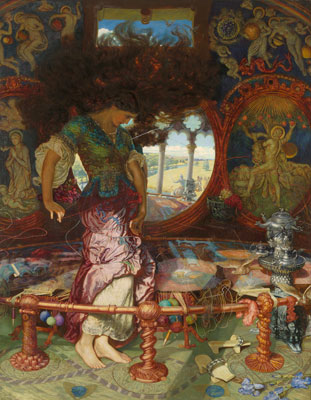
What makes this painting so vivid is the sheer violence of the scene, the sense, so perfectly conveyed, of a room, no, a world being shattered. The mirror cracks, the doves take off in panic, the flowers fall to the floor and the Lady's hair explode into a torch of raging fire, as if her senses had been set aflame. The Lady herself is tangled in thread from the weaving, thread that she is tugging off her, so that the painting becomes, literally, the portrait of a woman coming undone. And when you get past the first impact there are other, subtler touches. Like the depiction of Hercules picking the golden apples, with its echo of the fate of Atalanta, another occasion when a moment's break in concentration led to a permanent fall. Or the figure of Lancelot, so distant, so perfectly unaware, riding away in the sunshine of his freedom, seen in a mirror that is at once a porthole and a crystal ball. And is it just me, or does the pallette here look forward to Klimt, and don't those electric squiggles of yarn remind you of Pollock? The Lady of Shalott is an explosive, visionary work, one that makes a strong case for Hunt as a painter [4], and that, by itself, makes the MIA exhibition worth a visit.
[1] I'm particularly fond of the latter painting, because of the way Hunt sets up the contrast between Claudio's flashiness and Isabella's sobriety, a contrast echoed in reverse by the lyre hanging behind her shoulder and the chains lying at his feet.
[2] One result of this is that in many cases I find that I prefer the etchings that reproduce Hunt's paintings - some of which are included in the exhibition - to the paintings themselves.
[3] I'm told that Waterhouse's connection to the Pre-Raphaelites is a somewhat tenuous one, but to me he's very much part of the genre, and arguably my favorite of the lot.
[4] The exhibition focuses mostly on Hunt's work, though a few paintings by others are included: a couple of Dante Gabriel Rossetti's (notable only for the fact that it's not everyday you find a painting accompanied by two technically perfect sonnets describing it) and Arthur Hughes' Long Engagement, which is like a portrait of how the Arnolfinis would have turned out if they'd been too poor to marry.
Wednesday, July 29, 2009
So I'm not the only one
"I'm pretty sure I stopped growing up in my teens and have been faking ever since."
Randall Munroe nails it. Again.
Randall Munroe nails it. Again.
Tuesday, July 28, 2009
The Gift
Sometimes he wonders whether the gift is worth it.
Nights alone in his apartment, three thousand miles and three time zones away from home, staring at a blank computer screen, waiting for the words to come.
Once upon a time...
Once upon a time there was a story, a plot, an outline for a novel. Once upon a time there was a purpose to all this, the loneliness, the booze, the long hours spent in a daze in front of the computer turning out paragraph after paragraph to be torn apart the next day. Once upon a time he was still capable of putting word after word, the way a workman puts brick against brick, building something solid, something with a shape.
That was long ago.
Nowadays the best he can do is string phrases together, stray arrangements of words that drift across the page like clouds in a colorless sky. They mean nothing, these sentences of his, connect to nothing. They are unpublishable. They are a way of filling up the page.
But they are beautiful.
Sometimes he wonders whether it's a gift at all.
Nights alone in his apartment, three thousand miles and three time zones away from home, staring at a blank computer screen, waiting for the words to come.
Once upon a time...
Once upon a time there was a story, a plot, an outline for a novel. Once upon a time there was a purpose to all this, the loneliness, the booze, the long hours spent in a daze in front of the computer turning out paragraph after paragraph to be torn apart the next day. Once upon a time he was still capable of putting word after word, the way a workman puts brick against brick, building something solid, something with a shape.
That was long ago.
Nowadays the best he can do is string phrases together, stray arrangements of words that drift across the page like clouds in a colorless sky. They mean nothing, these sentences of his, connect to nothing. They are unpublishable. They are a way of filling up the page.
But they are beautiful.
Sometimes he wonders whether it's a gift at all.
Sunday, July 26, 2009
Transubstantiation
Neither bread to flesh nor wine to blood. But pain to forgiveness, agony as redemption. The seductive idea that suffering may have a point.
A miracle we all wish we could believe in.
A miracle we all wish we could believe in.
Saturday, July 25, 2009
Mirror
Mirror
The mirror is broken, broken, broken.
Look at your face this once,
See how it's changed.
Do your eyes still blaze with color?
Or are they timid, afraid?
I saw such beauty in this mirror once,
It seems hard to believe;
And asked, proudly,
Could anyone be fairer?
It wasn't the magic of the mirror.
You were beautiful, and it showed.
And so the world discovered you
Before you found yourself.
And when you found yourself:
Why did you break the mirror?
More (for this alone was no loss)
Why did you lose sight of yourself?
Look at your face this once,
See how it's changed.
- Kaifi Azmi (translation mine)
Cross-posted from Lost and Found, the new translation wiki in response to this (thanks to Binu for setting it all up). You can see alternate translations and the transliterated original, as well as my comments on the wikipage.
P.S. Bonus Azmi translation (plus audio) here.
The mirror is broken, broken, broken.
Look at your face this once,
See how it's changed.
Do your eyes still blaze with color?
Or are they timid, afraid?
I saw such beauty in this mirror once,
It seems hard to believe;
And asked, proudly,
Could anyone be fairer?
It wasn't the magic of the mirror.
You were beautiful, and it showed.
And so the world discovered you
Before you found yourself.
And when you found yourself:
Why did you break the mirror?
More (for this alone was no loss)
Why did you lose sight of yourself?
Look at your face this once,
See how it's changed.
- Kaifi Azmi (translation mine)
Cross-posted from Lost and Found, the new translation wiki in response to this (thanks to Binu for setting it all up). You can see alternate translations and the transliterated original, as well as my comments on the wikipage.
P.S. Bonus Azmi translation (plus audio) here.
Friday, July 24, 2009
Public Investigation
(or: keeping your wits about you)
The case is everything that is the world.
If only you could be sure a crime has been committed. That your suspects really exist. You stand by the window, dusting the rain for fingerprints. Your partner insists on the facts, the facts, but you have your own suspicions. An old man in a white beard tells you the grass is evidence, though he dare not say of what. You arrest him on the spot and hand him to the executioners. They singe his body electric. Later, it turns out that History had an alibi. When you wake up in the morning the sky has been cleared.
The case is everything that is the world.
If only you could be sure a crime has been committed. That your suspects really exist. You stand by the window, dusting the rain for fingerprints. Your partner insists on the facts, the facts, but you have your own suspicions. An old man in a white beard tells you the grass is evidence, though he dare not say of what. You arrest him on the spot and hand him to the executioners. They singe his body electric. Later, it turns out that History had an alibi. When you wake up in the morning the sky has been cleared.
Monday, July 20, 2009
Why 'Indian' poetry?
Just wanted to add my two-bits to Vivek Narayanan's piece on Indian Poetry in English and its quest for an audience (hat tip: Space Bar).
Overall, I agree with almost everything Vivek says in his piece, including his criticism of anthologies [1]. The one thing Vivek doesn't say, though, is that a "thriving, vigorous poetry community" needs not only a deep awareness of its own poetic history but also, and (I would argue) more importantly, a stronger engagement with contemporary poetry elsewhere in the world.
I may be mistaken, but it seems to me that the Indian poetry community at large is fairly limited in its reading, with a fairly sketchy awareness of what poets in the US or the UK are doing. Certainly the work I read in the few Indian journals I know of seems extremely narrow in its influences. Much of that is availability, of course; I'm keenly aware of how difficult it is to get access to contemporary poetry in Indian book stores (or, for that matter, in book stores anywhere). Still, I can't help thinking that the Indian poetry scene would be richer if a lot of the enthusiasm people seem to put into writing poetry (and trying to find an audience for it) were spent in reading more [2].
Greater engagement with *other* contemporary poetry communities is important for three reasons. First, it would help broaden the ideas and influences Indian poets bring to their writing, setting the stage for greater debate and conflict. If Indian poetry in English lacks "ferocious, voracious arguments, unending discussions, even intellectual fist fights or several rival aesthetic camps" (and I agree that it does, and I agree that this is a lack) I have to think that's in part because there aren't enough rival aesthetics to go around. Second, more links with the outside world would mean that the Indian poetry community would be less cloistered and less incestuous, and that would help set the stage for more frank and open criticism. And third, greater engagement with the international poetry scene would help keep Indian poetry more honest, because it would bring a set of external standards by which the poetry we produce would be judged, rather than just the standards we choose to establish for ourselves.
What makes this interesting and relevant is that the spread of online journals and an increase in paperless submissions provides Indian poets with an opportunity they never really had before. Ten years ago, the logistics of trying to publish in US or UK poetry journals (especially if you were just starting out) seemed staggering. Postage costs of mailing paper submissions to US journals were prohibitive, and access to leading journals was often hard to come by. Today there are dozens of exciting online journals publishing cutting edge work that are freely available to anyone with an Internet connection (some of them bookmarked in the sidebar of this blog) and most journals (even those that still print paper versions) have moved to some form of electronic submission. Which means that there's really no reason why poets living in India can't actively participate in a larger poetry community, reading the work of their peers across the world and trying to publish in a wide array of international journals. Yet somehow, I don't see very much of that happening. And I have to wonder why. If poets in India feel they don't have enough of an audience domestically, what's stopping them from reaching out to a wider audience across the globe [3]?
In his article, Vivek says that "there is no question at all that today, it is far easier to make your way in the world as an emerging poet than it was for figures like Jussawalla and Mehrotra in the 1960s and 1970s." I agree, but I can't help wondering if this is entirely a good thing. Obviously more opportunities for high quality work are always welcome, but if the greater ease of publication comes at the cost of lower standards, then the net effect is negative.
Look, publishing poetry is hard. But to an extent, the fact that it's hard is a good thing, because a) it winnows out those who are genuinely interested in poetry from those who just want to be 'poets' and b) it means that poets are constantly challenged, and therefore constantly growing. In the last 2-3 years I've collected dozens upon dozens of rejection slips. It's been brutal, depressing and frustrating. But it's also meant that I've been forced to revisit and question my own writing, and I have to believe that's made me a better poet than I was three years ago. And it's meant that when I've finally managed to get a poem accepted at a journal I value and care about, it's been a source of real satisfaction and pride.
None of which is to say that we should look exclusively elsewhere in our quest for a community. On the contrary, my point is that it's only by engaging more aggressively with contemporary poetry elsewhere that we'll be able to develop a vibrant community of our own. By focusing too much on 'Indian' poetry, we risk creating a community that is insulated, complacent and nepotistic.
As for the problem of readership - I think the problem is less the lack of an audience for Indian poetry but the lack of an audience for poetry in India. The real victims of poor readership are not, to my mind, the poets who can't get people to come to their book readings [4], but the potential readers who are missing out on all that poetry, as an art form, has to offer. But that's a whole other problem, and one that Indian poetry is a long way away from taking on. Our more immediate priority, as Vivek suggests, should be to make a more productive community available to our poets, and reaching out to a wider international audience for poetry is, I would argue, the way to get there.
[1] In general, I'm for anthologies - I think they serve a useful purpose, problems of unrepresentative selection notwithstanding, by making one aware of poets one may not otherwise know of. That said, I agree entirely that anthologies should not be the primary repository of poetry. Anthologies are good complements to individual collections, but poor substitutes for them. And the situation that Vivek describes - where anthologies become the only available source of a poet's work - is a troubling one. It's a bit like living in a world where cinema theaters show only trailers and no actual movies.
[2] Interestingly, my sense is that this was actually true for the generation of poets from the 1970's that Vivek discusses in his piece.
[3] Not that there's a massive audience for poetry anywhere else, but an audience of a few hundred, even a few thousand is better than an audience of a few dozen.
[4] Ironically, I suspect that if Indian readers did have a better understanding of poetry and were capable of closer reading, that would work against a subset of Indian poets.
Overall, I agree with almost everything Vivek says in his piece, including his criticism of anthologies [1]. The one thing Vivek doesn't say, though, is that a "thriving, vigorous poetry community" needs not only a deep awareness of its own poetic history but also, and (I would argue) more importantly, a stronger engagement with contemporary poetry elsewhere in the world.
I may be mistaken, but it seems to me that the Indian poetry community at large is fairly limited in its reading, with a fairly sketchy awareness of what poets in the US or the UK are doing. Certainly the work I read in the few Indian journals I know of seems extremely narrow in its influences. Much of that is availability, of course; I'm keenly aware of how difficult it is to get access to contemporary poetry in Indian book stores (or, for that matter, in book stores anywhere). Still, I can't help thinking that the Indian poetry scene would be richer if a lot of the enthusiasm people seem to put into writing poetry (and trying to find an audience for it) were spent in reading more [2].
Greater engagement with *other* contemporary poetry communities is important for three reasons. First, it would help broaden the ideas and influences Indian poets bring to their writing, setting the stage for greater debate and conflict. If Indian poetry in English lacks "ferocious, voracious arguments, unending discussions, even intellectual fist fights or several rival aesthetic camps" (and I agree that it does, and I agree that this is a lack) I have to think that's in part because there aren't enough rival aesthetics to go around. Second, more links with the outside world would mean that the Indian poetry community would be less cloistered and less incestuous, and that would help set the stage for more frank and open criticism. And third, greater engagement with the international poetry scene would help keep Indian poetry more honest, because it would bring a set of external standards by which the poetry we produce would be judged, rather than just the standards we choose to establish for ourselves.
What makes this interesting and relevant is that the spread of online journals and an increase in paperless submissions provides Indian poets with an opportunity they never really had before. Ten years ago, the logistics of trying to publish in US or UK poetry journals (especially if you were just starting out) seemed staggering. Postage costs of mailing paper submissions to US journals were prohibitive, and access to leading journals was often hard to come by. Today there are dozens of exciting online journals publishing cutting edge work that are freely available to anyone with an Internet connection (some of them bookmarked in the sidebar of this blog) and most journals (even those that still print paper versions) have moved to some form of electronic submission. Which means that there's really no reason why poets living in India can't actively participate in a larger poetry community, reading the work of their peers across the world and trying to publish in a wide array of international journals. Yet somehow, I don't see very much of that happening. And I have to wonder why. If poets in India feel they don't have enough of an audience domestically, what's stopping them from reaching out to a wider audience across the globe [3]?
In his article, Vivek says that "there is no question at all that today, it is far easier to make your way in the world as an emerging poet than it was for figures like Jussawalla and Mehrotra in the 1960s and 1970s." I agree, but I can't help wondering if this is entirely a good thing. Obviously more opportunities for high quality work are always welcome, but if the greater ease of publication comes at the cost of lower standards, then the net effect is negative.
Look, publishing poetry is hard. But to an extent, the fact that it's hard is a good thing, because a) it winnows out those who are genuinely interested in poetry from those who just want to be 'poets' and b) it means that poets are constantly challenged, and therefore constantly growing. In the last 2-3 years I've collected dozens upon dozens of rejection slips. It's been brutal, depressing and frustrating. But it's also meant that I've been forced to revisit and question my own writing, and I have to believe that's made me a better poet than I was three years ago. And it's meant that when I've finally managed to get a poem accepted at a journal I value and care about, it's been a source of real satisfaction and pride.
None of which is to say that we should look exclusively elsewhere in our quest for a community. On the contrary, my point is that it's only by engaging more aggressively with contemporary poetry elsewhere that we'll be able to develop a vibrant community of our own. By focusing too much on 'Indian' poetry, we risk creating a community that is insulated, complacent and nepotistic.
As for the problem of readership - I think the problem is less the lack of an audience for Indian poetry but the lack of an audience for poetry in India. The real victims of poor readership are not, to my mind, the poets who can't get people to come to their book readings [4], but the potential readers who are missing out on all that poetry, as an art form, has to offer. But that's a whole other problem, and one that Indian poetry is a long way away from taking on. Our more immediate priority, as Vivek suggests, should be to make a more productive community available to our poets, and reaching out to a wider international audience for poetry is, I would argue, the way to get there.
[1] In general, I'm for anthologies - I think they serve a useful purpose, problems of unrepresentative selection notwithstanding, by making one aware of poets one may not otherwise know of. That said, I agree entirely that anthologies should not be the primary repository of poetry. Anthologies are good complements to individual collections, but poor substitutes for them. And the situation that Vivek describes - where anthologies become the only available source of a poet's work - is a troubling one. It's a bit like living in a world where cinema theaters show only trailers and no actual movies.
[2] Interestingly, my sense is that this was actually true for the generation of poets from the 1970's that Vivek discusses in his piece.
[3] Not that there's a massive audience for poetry anywhere else, but an audience of a few hundred, even a few thousand is better than an audience of a few dozen.
[4] Ironically, I suspect that if Indian readers did have a better understanding of poetry and were capable of closer reading, that would work against a subset of Indian poets.
Friday, July 17, 2009
Watching you read
The way you tilt your head to let the light over your shoulder. As though inviting the lamp to read with you.
Still reading, the book balanced on your thighs, you reach both hands behind your head to do up your hair.
A single strand stays free, resting against your nape like the line of a poem you read over and over, savoring the sound of the words until it no longer matters what they mean.
Still reading, the book balanced on your thighs, you reach both hands behind your head to do up your hair.
A single strand stays free, resting against your nape like the line of a poem you read over and over, savoring the sound of the words until it no longer matters what they mean.
Apotheosis
Two days after he moves into his new apartment, before the furniture arrives, he sets up the screen by the west wall, plugs his laptop into an LCD projector, plays his favorite DVD.
At first he just sits there, squatting on the floor, watching. His computer is set to mute, so there is no sound, only the repetition of the familiar gestures, life-sized and a little blurred.
After a while he rises, walks closer to the screen, and then, on an impulse, steps into the cone of light from the projector. Behind him, his shadow blacks out half the screen, but he doesn't care, doesn't want to care. He feels transcended, absorbed. The images flicker across his skin, and the light blinds him.
At first he just sits there, squatting on the floor, watching. His computer is set to mute, so there is no sound, only the repetition of the familiar gestures, life-sized and a little blurred.
After a while he rises, walks closer to the screen, and then, on an impulse, steps into the cone of light from the projector. Behind him, his shadow blacks out half the screen, but he doesn't care, doesn't want to care. He feels transcended, absorbed. The images flicker across his skin, and the light blinds him.
Wednesday, July 15, 2009
Withered Flowers
There is a man riding the rush hour bus with a satchel full of withered flowers.
Are they a symbol? Of failing romance, promises betrayed? Is he carrying them to someone as a message? Will she understand? Has he been sent?
Is he rescuing them perhaps? Does he feel for these creatures, once so loved, and now cast aside? Does he relate?
Are they a treat for a pet?
Are they ingredients for some secret potion, some special drug? Preparations for some satanic rite?
Is he just bad at judging flowers? Has someone sold them to him, pretending they're fresh? Is he on his way to present them to someone, imagining how thrilled they will be, not realizing?
Were they fresh when he bought them? Has he been carrying them around for days, trying to build up his courage?
Does he plan to sell them, maybe make a little cash? Not really sell them, of course, but use them to ask for alms - a reason, an excuse.
There's fennel for you, and columbines; there's rue for you; and here's some for me
And so I come back to you, Ophelia, trapped in the flow of the traffic and the smell of dying flowers.
Are they a symbol? Of failing romance, promises betrayed? Is he carrying them to someone as a message? Will she understand? Has he been sent?
Is he rescuing them perhaps? Does he feel for these creatures, once so loved, and now cast aside? Does he relate?
Are they a treat for a pet?
Are they ingredients for some secret potion, some special drug? Preparations for some satanic rite?
Is he just bad at judging flowers? Has someone sold them to him, pretending they're fresh? Is he on his way to present them to someone, imagining how thrilled they will be, not realizing?
Were they fresh when he bought them? Has he been carrying them around for days, trying to build up his courage?
Does he plan to sell them, maybe make a little cash? Not really sell them, of course, but use them to ask for alms - a reason, an excuse.
There's fennel for you, and columbines; there's rue for you; and here's some for me
And so I come back to you, Ophelia, trapped in the flow of the traffic and the smell of dying flowers.
Tuesday, July 14, 2009
You know you've hit writer's block when...
...you consume a pint of Guinness and six Barthelme short stories for lunch, and you still can't find the inspiration to write.
In other news, can I just say that I feel personally betrayed by Capitalism. What's the point of free enterprise if you can't get proper service even if you're willing to pay for it? Thrice in the last week I've ordered things on 'expedited' delivery, only to receive apologies and a refund when they didn't arrive by the agreed deadline (NOTE to vendors: I don't want a @#%&!ng refund, I want my shipment!!).
I don't understand why Capitalism is doing this to me, after all that we've been through the years. Can it be she finally found out about by affair with Marxism in college? Is this her way of taking revenge?
In other news, can I just say that I feel personally betrayed by Capitalism. What's the point of free enterprise if you can't get proper service even if you're willing to pay for it? Thrice in the last week I've ordered things on 'expedited' delivery, only to receive apologies and a refund when they didn't arrive by the agreed deadline (NOTE to vendors: I don't want a @#%&!ng refund, I want my shipment!!).
I don't understand why Capitalism is doing this to me, after all that we've been through the years. Can it be she finally found out about by affair with Marxism in college? Is this her way of taking revenge?
Saturday, July 11, 2009
Joblessness redefined
Ron
is gone
but the con
goes on
- placard at Anti-Scientology demonstration outside the Church of Scientology, Minneapolis.
Personally, I have no use for scientology (or any other organized system of faith), but I can't help thinking that organizing a demonstration against it, complete with placards and masks and loudspeaker and soap bubbles (don't ask!) is overkill. One protests evil, not silliness.
Oh, and as the more lynx-eyed among you have already noticed, I've bid farewell to Philadelphia and moved to Minneapolis, where I'm currently busy assembling furniture (correction: trying to assemble furniture) and stocking my kitchen and generally being depressingly domestic. Will return to blogging once I've managed to wrestle myself back to civilization.
is gone
but the con
goes on
- placard at Anti-Scientology demonstration outside the Church of Scientology, Minneapolis.
Personally, I have no use for scientology (or any other organized system of faith), but I can't help thinking that organizing a demonstration against it, complete with placards and masks and loudspeaker and soap bubbles (don't ask!) is overkill. One protests evil, not silliness.
Oh, and as the more lynx-eyed among you have already noticed, I've bid farewell to Philadelphia and moved to Minneapolis, where I'm currently busy assembling furniture (correction: trying to assemble furniture) and stocking my kitchen and generally being depressingly domestic. Will return to blogging once I've managed to wrestle myself back to civilization.
Tuesday, July 07, 2009
Betrayal
He would have been dismayed by the betrayal if he hadn't suspected it all along. Which is not to say it didn't surprise him, but only in the way that one is surprised by the inevitable arrival of a long-lost brother bearing an unexpected gift. Not that the traitor in this instance was his brother, or indeed, a relation of any sort, which is what made the betrayal so puzzling, because why pretend allegiance to someone whom you owe nothing? So perhaps there was something the traitor owed, or thought he owed. Had he helped the traitor in some way, done him some unconscious kindness, the burden of which had now caused him to snap? It was possible. And should he then forgive him, or choose reprisal, even vengeance, as a way of balancing things out? Would it be more of a penalty to betray him in turn, or to ensure his guilt by refusing to betray him? And wasn't this calculation itself a betrayal? What were the ethics of mirrors? Was it possible to observe oneself in a moral stance?
Friday, July 03, 2009
Thursday, July 02, 2009
Something
Measure the magnitude of an injustice by the smallness of what counts as a triumph.
Not a victory, then, but an achievement, a giving way.
How obscene to have to celebrate this; to have to celebrate the fact that having sex with someone you love no longer makes you a criminal.
And for that reason alone, how necessary to celebrate it.
It's good to know that India has finally arrived in the 20th century. Here's hoping it doesn't take till 2109 to get to the 21st.
Not a victory, then, but an achievement, a giving way.
How obscene to have to celebrate this; to have to celebrate the fact that having sex with someone you love no longer makes you a criminal.
And for that reason alone, how necessary to celebrate it.
It's good to know that India has finally arrived in the 20th century. Here's hoping it doesn't take till 2109 to get to the 21st.
Thursday, June 25, 2009
That's Dr. Falstaff to you
5 years
= STATA + JSTOR + rewrites + conference presentations + the annual caffeine output of a medium-sized Colombian plantation
= 49,000 words + 300 references + 24 tables
= 15 slides + 1 hour defense
= 1 dissertation, signed and delivered.
And it's barely lunchtime.
= STATA + JSTOR + rewrites + conference presentations + the annual caffeine output of a medium-sized Colombian plantation
= 49,000 words + 300 references + 24 tables
= 15 slides + 1 hour defense
= 1 dissertation, signed and delivered.
And it's barely lunchtime.
Wednesday, June 24, 2009
Four years
Depressing thought # 1461: This blog has now lasted longer than any relationship I've been in.
Tuesday, June 23, 2009
Booklamite
After he stopped sleeping, he moved into the library, staying hidden when the doors closed in the evening so he could spend all night wandering the shelves, picking out books at random, reading straight through till dawn.
He estimated it would take him twenty five years to read every book the library had. In fact, it took him twenty seven.
By the time he finished, he could no longer speak with anyone. A long habit of absolute silence made that impossible. Instead he spent three days sitting quietly in his carrel, thinking back over all he had read. On the fourth day he made a decision, found the book that he wanted, began to re-read.
He estimated it would take him twenty five years to read every book the library had. In fact, it took him twenty seven.
By the time he finished, he could no longer speak with anyone. A long habit of absolute silence made that impossible. Instead he spent three days sitting quietly in his carrel, thinking back over all he had read. On the fourth day he made a decision, found the book that he wanted, began to re-read.
Sunday, June 21, 2009
Abandon
"Maybe all people are abandoned children. Perhaps birth is like being abandoned on earth by God."
- Yasunari Kawabata The Old Capital [1]
Or like running away. Here we are then, delinquents in search of adventure, impatient of safety, a galaxy of shooting stars. The self an assertion of independence. Mortality a coming of age.
At what point does escape turn into exile?
Robert Frost defines home as "something you somehow haven't to deserve". Who can blame us then, if death feels like home?
[1] translated from the Japanese by J. Martin Holman
Gladioli
Every Sunday she buys seven white gladioli, arranges them in the tall vase in her bedroom, their long stems immersed in water. Their presence gives the room a kind of clarity, a sense of well-being she draws sustenance from, even though she knows her joy is rootless, that her hope, even as it opens, is beginning to fade.
Sunday, June 07, 2009
Rhymes
You know how people who don't know anything about it are always saying that they don't like modern poetry because it doesn't rhyme? Well, aside from being lazy and short-sighted, that particular prejudice isn't even true - a fair number of modern poets do, in fact, work in rhyme, and this month's issue of Poetry features two of the finest I know. Here's Stephen Edgar:
and A.E. Stallings:
Go read.
P.S. Those of you who don't need poems to rhyme should also check out Armantrout, who is as delightful as ever.
Look. The moon’s pale-copper sphereRings—a gong too faint to hear—Through the city.
- Stephen Edgar, 'The Building of Light'
and A.E. Stallings:
I hate you,How the children pleadAt first sight—
I want, I need,I hate how nearlyAlways I
At first say no,And then comply.(Soon, soon
They will grow boredClutching yourUmbilical cord)
- A.E. Stallings, 'The Mother's Loathing of Balloons'
Go read.
P.S. Those of you who don't need poems to rhyme should also check out Armantrout, who is as delightful as ever.
Wednesday, June 03, 2009
Morning Post
The paper arrives with its newsprint rain.
The world is sodden with happening. My throat is dry.
I scan the horoscopes, circle the futures I like.
Unfolded, the silence is as wide as my arms.
The world is sodden with happening. My throat is dry.
I scan the horoscopes, circle the futures I like.
Unfolded, the silence is as wide as my arms.
Monday, June 01, 2009
R.I.P. Kamala Das
Just heard the news.
I must admit I've never much cared for Ms. Das - I've only read her poems, and they've always struck me as being predictable, turgid and overripe. The sort of poems you'd expect from Edna St. Vincent Millay [1].
Still, I did read them, and while I may not be particularly fond of Ms. Das's efforts, I cannot question the sincerity of those efforts, or the immeasurable importance of her having made them.
One mourns for her the way one mourns for an elderly relative: however out of date her conversation, however embarrassing her presence, her death is still a loss.
[1] I realize some people might consider this a compliment. It's not meant to be.
I must admit I've never much cared for Ms. Das - I've only read her poems, and they've always struck me as being predictable, turgid and overripe. The sort of poems you'd expect from Edna St. Vincent Millay [1].
Still, I did read them, and while I may not be particularly fond of Ms. Das's efforts, I cannot question the sincerity of those efforts, or the immeasurable importance of her having made them.
One mourns for her the way one mourns for an elderly relative: however out of date her conversation, however embarrassing her presence, her death is still a loss.
[1] I realize some people might consider this a compliment. It's not meant to be.
Sunday, May 31, 2009
Saturday, May 30, 2009
The Apocalypse
is never personal. It can no more happen to you than you can happen to a speck of cigarette ash.
It is not that the universe is incapable of malice. If it knew we existed it would despise us. Or pity us. But it's too busy to care.
I am too absent-spirited to count;
The loneliness includes me unawares
The world is unfair, but impartial.
We are abandoned children. We seek conspiracy in the stars.
It is not that the universe is incapable of malice. If it knew we existed it would despise us. Or pity us. But it's too busy to care.
I am too absent-spirited to count;
The loneliness includes me unawares
The world is unfair, but impartial.
We are abandoned children. We seek conspiracy in the stars.
Betraying Chopin
"Don't remember the music;
remember it as something obvious
that you are compelled, doomed, to obscure
and complicate. You erase it twice.
The first time
as you listened, unable
to have it,
the second time
as you were unable
to remember it."
- Arda Collins, 'Not for Chopin' from It Is Daylight (Yale University Press, 2009)
remember it as something obvious
that you are compelled, doomed, to obscure
and complicate. You erase it twice.
The first time
as you listened, unable
to have it,
the second time
as you were unable
to remember it."
- Arda Collins, 'Not for Chopin' from It Is Daylight (Yale University Press, 2009)
Friday, May 29, 2009
Thursday, May 28, 2009
Allegro Marcato
The handpump of history creaks in the night.
Death is sealed and hollow.
The taste of iron leaks into the water, like the voices of the lost singing under the music.
A rusted day gushes from the dawn.
(inspired by Honegger's Symphony no. 3)
Death is sealed and hollow.
The taste of iron leaks into the water, like the voices of the lost singing under the music.
A rusted day gushes from the dawn.
(inspired by Honegger's Symphony no. 3)
Heartbreak - 1
The first time is easy. You gamble, you take the hit. You pretend that the pain is making you stronger. You wonder what you did wrong, though you secretly know the answer. You do not want to believe in inevitability. It all seems very romantic, a kind of validation, the comfort of knowing that what you lost was real. You tell yourself despair is a grown-up emotion. And you can't help feeling a little proud.
Tuesday, May 26, 2009
Hope
He hasn't lost it.
He hasn't. It's here. Somewhere. Underneath all this mess. It has to be. He saw it the other day. It couldn't simply have vanished. He just has to find it. Just has to look more carefully. It's sure to turn up.
At least, he hopes so.
He hasn't. It's here. Somewhere. Underneath all this mess. It has to be. He saw it the other day. It couldn't simply have vanished. He just has to find it. Just has to look more carefully. It's sure to turn up.
At least, he hopes so.
Sunday, May 24, 2009
A blurring of lines
This is what the whiskey helps with - not forgetting, but a blurring of lines.
Sip by slow sip the past comes back to him.
Everything glows. Sadness, like the light at sunset, touches all things golden.
If only there was something left to wait for.
After the fourth drink the old songs make sense to him. Lena Horne singing Stormy Weather. The sweetness of lost disturbances, of rooms through which no one moves.
He's had enough. He fumbles about for the bottle cap but cannot find it. He gives up, pours himself another.
His throat aches.
Dark outside now. He should turn on the light, draw the curtain. Instead he sits, watching the streetlight come through the window, the shadow of the wind chime on his bedroom wall.
Two wind-stirred figures, dancing delicately apart.
Sip by slow sip the past comes back to him.
Everything glows. Sadness, like the light at sunset, touches all things golden.
If only there was something left to wait for.
After the fourth drink the old songs make sense to him. Lena Horne singing Stormy Weather. The sweetness of lost disturbances, of rooms through which no one moves.
He's had enough. He fumbles about for the bottle cap but cannot find it. He gives up, pours himself another.
His throat aches.
Dark outside now. He should turn on the light, draw the curtain. Instead he sits, watching the streetlight come through the window, the shadow of the wind chime on his bedroom wall.
Two wind-stirred figures, dancing delicately apart.
Friday, May 22, 2009
Concentric Paths
Thomas Ades Violin Concerto Op. 24
What, exactly, does time circle?
Scale after shimmering scale, the music a snake, feeding on itself.
The coin spinning to rest on the table has its own symmetry, its own precision.
An agitation building to silence.
The slower hand of the sunlight, the faster hand of the storm.
Stop.
If the machine has a soul it must be broken.
The bow runs across the strings like a knife across a thumbprint.
What, exactly, does time circle?
Scale after shimmering scale, the music a snake, feeding on itself.
The coin spinning to rest on the table has its own symmetry, its own precision.
An agitation building to silence.
The slower hand of the sunlight, the faster hand of the storm.
Stop.
If the machine has a soul it must be broken.
The bow runs across the strings like a knife across a thumbprint.
Thursday, May 21, 2009
One Downsmanship
I step into the elevator behind you, wait for you to press your floor.
You hit 6.
I pause for a moment, then hit 5.
I try hard not to smirk.
You hit 6.
I pause for a moment, then hit 5.
I try hard not to smirk.
Wednesday, May 20, 2009
Monday, May 18, 2009
Interpretation
Does it still qualify as a nightmare if it makes you sad, but not afraid?
***
In the dream I'm meeting with my analyst and we have a breakthrough. I discover that for the last 25 years I've been repressing the memory of a tragic accident I had as a child. I can't believe I've been hiding this from myself all these years. It explains so much.
When I wake up I think - what was the dream trying to tell me?
***
I don't believe in psychoanalysis. Apparently, my subconscious does.
***
In the dream I'm meeting with my analyst and we have a breakthrough. I discover that for the last 25 years I've been repressing the memory of a tragic accident I had as a child. I can't believe I've been hiding this from myself all these years. It explains so much.
When I wake up I think - what was the dream trying to tell me?
***
I don't believe in psychoanalysis. Apparently, my subconscious does.
Sunday, May 17, 2009
Laugh about it, shout about it
Friday, May 15, 2009
An embarassment of Rich
"Applied to a particular historical subject, the feminist passion yields conclusions which, however true, are extremely general. Like all capital moral truths, feminism is a bit simple-minded. That is its power and, as the language of Rich's letter shows, that is its limitation."
- Susan Sontag
Via Book Bench, a link to a glorious exchange between Adrienne Rich and Susan Sontag, which, in my opinion at least, Sontag (no surprise!) wins hands down.
Cause of death
"Loneliness is not a cause of death"
- Jean-Luc Godard, Made in U.S.A.
A consequence. Or a disguise.
Consciousness neither alive nor dead, like a cat with nine dreams.
A coward with nine deaths.
A murderer with nine wives.
Neither heaven nor hell but a beforelife, an irreconcilable solitude, time's reflection in a mirror that may or may not be your soul.
Not a cause, but a reason.
Cheating
Not cheating when you can is stupid. And getting caught irrelevant.
All that matters is that you not lie to yourself about it.
All that matters is that you not lie to yourself about it.
Thursday, May 14, 2009
Prejudice
I told you they wouldn't understand. Not at first anyway. They're small-minded that way, the lot of them. Not bigoted, you understand - they mean well - just slow, and a little petty. They'll come around in time. Probably. And if they don't, well, that's their problem. You don't need them. Not really. It would be nice to have them on your side, but you don't need them. You don't. Oh, come on. You can't mean that. You've got to learn to stand up for yourself. For who you are, what you believe. You can't let them bully you. That's what they want, you know. They're refusing to understand it because they're hoping that if they don't understand it pretty soon you won't understand it either and it'll all go away. I don't mean they're pretending not to understand it, I mean they're choosing not to. And you've got to deny them that choice. You've got to force them. And you can do it too. I'm telling you you can. And besides, you'll have to now. So maybe this is a good thing, their not understanding it. Maybe it'll force you to grow up a little. Show a little backbone. Not just sit there sniveling all the time. What? You want me to lie to you, want me to treat you with kid gloves. Why? Because of who you are? Is that really what you want? Is that why you're doing this, because you want special treatment? I thought you wanted equality. I thought that was what this was about. Oh, all right. I'm sorry. I know you're having a hard time. I didn't mean to shout at you, I really didn't, it's just that sometimes...look, forget it. You know I'm on your side. You do know that, don't you? So what if they don't understand? Like I said, I'm sure they'll come around eventually. I just didn't realize it meant that much to you. I didn't think you'd be so upset. You shouldn't have told them if it was going to hurt you this badly. I told you they wouldn't understand.
Tuesday, May 12, 2009
The Game
This is the kind of thing they don't teach you at school.
All those years of waiting, hoping, wanting to learn how to play. And then you find out there are no rules, that there isn't even really a game. Just a confused back and forth with no one keeping score.
No way to tell if you're winning. Always afraid that you've lost.
All those years of waiting, hoping, wanting to learn how to play. And then you find out there are no rules, that there isn't even really a game. Just a confused back and forth with no one keeping score.
No way to tell if you're winning. Always afraid that you've lost.
Monday, May 11, 2009
Troubling allure
Troubling allure of eating disorder books
- Headline from the NY Times, May 11, 2009
What's for dinner tonight, honey? Ah, that book on schizophrenia I caught at Barnes & Noble last week. Yum!
- Headline from the NY Times, May 11, 2009
What's for dinner tonight, honey? Ah, that book on schizophrenia I caught at Barnes & Noble last week. Yum!
Sunday, May 10, 2009
A beacon from Troy
In the mountains the shortest way is from peak to peak, Nietzsche writes but for that route thou must have long legs.
And I think of Klytaimestra and her beacons: tongues of fire singing, from peak to peak, the fall of Troy.
Landscape as poetry. Death's trochees written across the sky.
Something is left unreconciled in this relay of tragedy to tragedy. Not a meeting of eyes, but the demand of one eye for another.
***
An exercise in bad form: To end an epic battle with a haiku of blood.
Three quick stabs is all it took. The red carpet a bloodline, bringing Agamemnon to his award.
O Apollo! Apollo!
Not a poetic fate, but fate as poetry.
***
The shortest distance between two silences is a unspoken line.
***
The old men wouldn't believe it at first. They wanted more, not fire and smoke but words, clear as a mirror,
reflecting a hope newly shaven,
reflecting heads newly shaved.
***
Poetry and prose. Smoke and mirrors.
They say it's seven years bad luck to kill a messenger. But Klytaimestra had been waiting for ten.
Besides, there were two messengers. The other came from the future, a future to which she would not return.
What she had in common with fire was language, its knowledge laughing and untouched.
Smoke and mirrors. Prophecy and news.
***
In the end, it didn't matter that fire was the truer herald. By the time they understood her, it had all turned to ash.
N.B. The italicised phrase in the middle comes from Anne Carson's magnificent new translation of Aiskhylos' Agamemnon, which this post is largely inspired by.
And I think of Klytaimestra and her beacons: tongues of fire singing, from peak to peak, the fall of Troy.
Landscape as poetry. Death's trochees written across the sky.
Something is left unreconciled in this relay of tragedy to tragedy. Not a meeting of eyes, but the demand of one eye for another.
***
An exercise in bad form: To end an epic battle with a haiku of blood.
Three quick stabs is all it took. The red carpet a bloodline, bringing Agamemnon to his award.
O Apollo! Apollo!
Not a poetic fate, but fate as poetry.
***
The shortest distance between two silences is a unspoken line.
***
The old men wouldn't believe it at first. They wanted more, not fire and smoke but words, clear as a mirror,
reflecting a hope newly shaven,
reflecting heads newly shaved.
***
Poetry and prose. Smoke and mirrors.
They say it's seven years bad luck to kill a messenger. But Klytaimestra had been waiting for ten.
Besides, there were two messengers. The other came from the future, a future to which she would not return.
What she had in common with fire was language, its knowledge laughing and untouched.
Smoke and mirrors. Prophecy and news.
***
In the end, it didn't matter that fire was the truer herald. By the time they understood her, it had all turned to ash.
N.B. The italicised phrase in the middle comes from Anne Carson's magnificent new translation of Aiskhylos' Agamemnon, which this post is largely inspired by.
Everyday
When he awakes his eyes are a little less bloodshot, his beard a little more gray.
Perhaps it'll be better today.
He lets the water run in the basin for a minute, untouched, then turns off the tap.
No, not yet.
He goes back to the bed, sits by the phone, feet on the carpet, waiting for the wake-up call.
When it comes, he lets the phone ring four times before he answers, then tries to sound sleepy as he says "Yes, yes, thank you."
It's a small victory, but the minute he puts the phone down the tiredness reclaims him.
It begins again, just as he knew it would.
Perhaps it'll be better today.
He lets the water run in the basin for a minute, untouched, then turns off the tap.
No, not yet.
He goes back to the bed, sits by the phone, feet on the carpet, waiting for the wake-up call.
When it comes, he lets the phone ring four times before he answers, then tries to sound sleepy as he says "Yes, yes, thank you."
It's a small victory, but the minute he puts the phone down the tiredness reclaims him.
It begins again, just as he knew it would.
Suspicion
She can't understand why he hasn't confronted her about her suspicions, now that they've been proven untrue.
Could it be that there was something to it after all? No, impossible. But maybe there's something else, something he's not telling her, something he feels guilty about. Maybe that's why he hasn't picked a fight.
Or maybe he doesn't care about the way she acted. Maybe all the time she was upset he didn't even notice. Or maybe that's what he expects of her, maybe he sees her that way - as shrewish and untrusting.
Or maybe it's all a ploy. Maybe he's saving it up for the future, planning to use it against her the next time they have a fight. Maybe he thinks he can punish her more this way - by pretending to be the bigger person.
Or maybe, just maybe, he actually is the bigger person?
No, she doesn't think so.
Could it be that there was something to it after all? No, impossible. But maybe there's something else, something he's not telling her, something he feels guilty about. Maybe that's why he hasn't picked a fight.
Or maybe he doesn't care about the way she acted. Maybe all the time she was upset he didn't even notice. Or maybe that's what he expects of her, maybe he sees her that way - as shrewish and untrusting.
Or maybe it's all a ploy. Maybe he's saving it up for the future, planning to use it against her the next time they have a fight. Maybe he thinks he can punish her more this way - by pretending to be the bigger person.
Or maybe, just maybe, he actually is the bigger person?
No, she doesn't think so.
Friday, May 08, 2009
Ashvamedh
I forget, but I do not forgive.
Outrages persist like old report cards, buried away in some drawer, their scribbled grades still unfair.
I set my memories free years ago. Today one returns, having claimed everyone's past in my name. Thirsty, and a little lame, but irrevocably mine.
Childhood is a time of unforgivable happiness.
Outrages persist like old report cards, buried away in some drawer, their scribbled grades still unfair.
I set my memories free years ago. Today one returns, having claimed everyone's past in my name. Thirsty, and a little lame, but irrevocably mine.
Childhood is a time of unforgivable happiness.
Thursday, May 07, 2009
The Basics
Writing 4,000 words of my dissertation in a single day
+ Discovering a new poet
+ Simon Rattle conducting Bruckner
+ Dark chocolate
= Happiness
+ Discovering a new poet
+ Simon Rattle conducting Bruckner
+ Dark chocolate
= Happiness
Confession
I can tell you suspect nothing. Which is why this confession is necessary. Ignorance is one thing, innocence another.
No, I can't explain everything.
Some things I don't understand myself. Others I could explain but don't think I should. There are things, of course, that I could explain, but with everything I would have to leave out it hardly seems worth it.
No, I can't explain everything.
Some things I don't understand myself. Others I could explain but don't think I should. There are things, of course, that I could explain, but with everything I would have to leave out it hardly seems worth it.
Wednesday, May 06, 2009
Il Viaggio a Reims
In other news, I just got back from one of the worst opera performances I've ever seen. The Curtis Opera Theatre's production of Rossini's Il Viaggio a Reims.
Part of the problem, of course, was that it was Rossini (and mediocre Rossini at that) - which meant that the music was trite, uninspired and repetitive and all the characters sounded exactly like each other. But I was expecting that. What I wasn't expecting was a campy, sophomoric production comprised entirely of the kind of overdone slapstick that only below average high school students could possibly find amusing. I mean seriously, compared to this stuff the Austin Powers films would have seemed witty and sophisticated [1].
Which was a shame because if you closed your eyes and ignored the shenanigans on stage there was some real talent on display. Allison Sanders brought power and soul to her role as Marchesa Melibea, Evan Hughes (who was spectacular as Don Giovanni earlier this year) continued to impress and Elizabeth Reiter sang an exquisite Corinna. None of that really mattered though, because the silliness on stage entirely eclipsed any musical merit the production may have had.
[1] Which didn't stop the woman sitting next to me from squealing with hysterical laughter every 30 seconds or so - a fact that no doubt contributed to my annoyance with the performance.
Part of the problem, of course, was that it was Rossini (and mediocre Rossini at that) - which meant that the music was trite, uninspired and repetitive and all the characters sounded exactly like each other. But I was expecting that. What I wasn't expecting was a campy, sophomoric production comprised entirely of the kind of overdone slapstick that only below average high school students could possibly find amusing. I mean seriously, compared to this stuff the Austin Powers films would have seemed witty and sophisticated [1].
Which was a shame because if you closed your eyes and ignored the shenanigans on stage there was some real talent on display. Allison Sanders brought power and soul to her role as Marchesa Melibea, Evan Hughes (who was spectacular as Don Giovanni earlier this year) continued to impress and Elizabeth Reiter sang an exquisite Corinna. None of that really mattered though, because the silliness on stage entirely eclipsed any musical merit the production may have had.
[1] Which didn't stop the woman sitting next to me from squealing with hysterical laughter every 30 seconds or so - a fact that no doubt contributed to my annoyance with the performance.
What's in a name?
Via Book Bench, the news that German courts have decided to limit hyphenated last names to three. I wonder what that means for the greatest name in German baroque music?
Tuesday, May 05, 2009
On Love Poetry
Writing a good love poem is hard.
When you manage to write one you really like or, at the very least, are prepared to live with, you want to hold on to it, then measure everyone you meet against it till you find someone who's right.
Don't even think about trying it the other way round. After all, people are just what you make of them. Poems, on the other hand, are real.
When you manage to write one you really like or, at the very least, are prepared to live with, you want to hold on to it, then measure everyone you meet against it till you find someone who's right.
Don't even think about trying it the other way round. After all, people are just what you make of them. Poems, on the other hand, are real.
Monday, May 04, 2009
Lean on me
We all need somebody to lean on the song says. And I imagine the world as an endless line of dominoes, each sharing a little, but not all, of its weight with the one next to it, the whole system of support and coercion running its course until we come to the final domino, the one that is both the last and the first to fall (because the others haven't fallen, they're leaning), the one who bears (filtered through six billion fractions) the weight of the world on his shoulders, Chief Stopped Buck, the only one, in the end, who can take the collapse of the world lying down.
Sunday, May 03, 2009
Notes on echo
After Me
repeat
peter
terra
peat
rep
eat
err
***
The artist's dilemma: To become an echo, one must first find a voice.
***
For never was a story of more woe
Than this of Narcissus and his Echo-o.
***
And what of Ripple? Who took the beauty of her beloved and bore it, in fragments, to the edge of every sea?
***
The sound of emptiness clearing its throat.
***
What do you know of loss, whose cries come back to you? There are greater abysses. Frightful, sheer, no man-fathomed.
The deepest feeling always shows itself in silence.
Nor is it insincere to say: Ask and you shall be answered. All answers are coincidences.
***
Qaasid ke aate aate khat ek aur likh rakhoon
Main jaanta hoon jo voh likhenge jawaab main
Ghalib at the tavern, waiting to judge the depth of her feelings not by the content of her message, but the speed of her reply.
Hamne maana ki tagaphul na karoge lekin
Khaak ho jayenge ham tumko khabar hone tak.
Ghazals like sonar, symmetric with anticipation. The plumbed echoes of language stirring ghosts from long ago.
***
What did Echo say when she realized she'd made a mistake?
Oh-uh
***
Je t'aime
Tame
Aim
I'm
Mmm.
repeat
peter
terra
peat
rep
eat
err
***
The artist's dilemma: To become an echo, one must first find a voice.
***
For never was a story of more woe
Than this of Narcissus and his Echo-o.
***
And what of Ripple? Who took the beauty of her beloved and bore it, in fragments, to the edge of every sea?
***
The sound of emptiness clearing its throat.
***
What do you know of loss, whose cries come back to you? There are greater abysses. Frightful, sheer, no man-fathomed.
The deepest feeling always shows itself in silence.
Nor is it insincere to say: Ask and you shall be answered. All answers are coincidences.
***
Qaasid ke aate aate khat ek aur likh rakhoon
Main jaanta hoon jo voh likhenge jawaab main
Ghalib at the tavern, waiting to judge the depth of her feelings not by the content of her message, but the speed of her reply.
Hamne maana ki tagaphul na karoge lekin
Khaak ho jayenge ham tumko khabar hone tak.
Ghazals like sonar, symmetric with anticipation. The plumbed echoes of language stirring ghosts from long ago.
***
What did Echo say when she realized she'd made a mistake?
Oh-uh
***
Je t'aime
Tame
Aim
I'm
Mmm.
Life: Third Degree
No, I didn't see the trigger being pulled, the bullet finding the wound and entering it, the swoon of metal meeting flesh. By the time I turned to look the facts were on the ground and the woman was leaving. Which is to say I missed it, as usual. Death is elsewhere.
Afterwards you took down our names and phone numbers, said we might be called as witnesses.
But you never called.
I suppose it's better to live in the shadow of tragedy than in the shadow of greatness. At least this way what you feel is not envy, but smallness. As though your existence didn't matter, and this was something to be grateful for.
If you had called me I would have answered, would have taken the stand reluctantly, would have told you everything I know, which would have proved too little. We would have walked away from the moment without conviction, knowing our doubts were reasonable and our reasons doubtful.
Just once I would like to say "It was me. I did it. I'm the one you want."
After that, I would go quietly.
Afterwards you took down our names and phone numbers, said we might be called as witnesses.
But you never called.
I suppose it's better to live in the shadow of tragedy than in the shadow of greatness. At least this way what you feel is not envy, but smallness. As though your existence didn't matter, and this was something to be grateful for.
If you had called me I would have answered, would have taken the stand reluctantly, would have told you everything I know, which would have proved too little. We would have walked away from the moment without conviction, knowing our doubts were reasonable and our reasons doubtful.
Just once I would like to say "It was me. I did it. I'm the one you want."
After that, I would go quietly.
Saturday, May 02, 2009
Marguerite
Yes, Faust struck a bargain.
Your love was worth so much more than a soul.
In the end, who was fooled? The one who'd never known love or the one who'd never known hell?
P.S. Just got back from a Philadelphia Orchestra performance of Berlioz's Damnation of Faust, Simon Rattle conducting.
Your love was worth so much more than a soul.
In the end, who was fooled? The one who'd never known love or the one who'd never known hell?
P.S. Just got back from a Philadelphia Orchestra performance of Berlioz's Damnation of Faust, Simon Rattle conducting.
Subscribe to:
Posts (Atom)

 Posts
Posts


