We know those tales of gods in hot pursuit
Who frightened wood-nymphs into taking root
And changing then into a branchy shape
Fair, but perplexing to the thought of rape:
But this, we say, is more how love is made -
Ply and reply of limbs in fireshot shade,
Where overhead we hear tossed leaves content
To take the wind in free dishevelment
And, answering with supple blade and stem,
Caress the gusts that are caressing them.
- Richard Wilbur
The last day of autumn. A park bench under the fading sun, the park ankle-deep in fallen leaves. And Richard Wilbur. Such a beautiful melancholy, such a warm and glorious sadness.
Richard Wilbur has long been a poet I greatly admire for the incredible ear he brings to his poetry. His images and metaphors are uneven - strikingly brilliant in parts, disappointingly trite in others and there are times when you can sense the rhyme constraining him - but at his best, he is a poet who combines the verbal precision of Auden [1] with a sound that is pure Frost. This is one of his better poems (I especially love 'Ply and reply of limbs in fireshot shade') and one that seemed strangely apt this afternoon, perhaps because there was an urgency in the air, a sense of imminent parting. The sense, in Shelley's words, of "aught mute but deeply shaken".
[1] Writing on the occasion of Auden's death, Wilbur writes:
"you, who sustained the civil tongue
In a scattering time, and were poet of all our cities,
Have for all your clever difference quietly left us,
As we might have known that you would, by that common door."
Sunday, November 13, 2005

Teleblindness: The evil in our midst
 "Watching things occupies more and more of our time, while doing things occupies less and less"
- Robert Putnam, Bowling Alone
One of the most pernicious ideas that our age is prey to is the notion, prevalent in almost all mass media, that entertainment can only be achieved at the cost of intelligence. That people can only enjoy what does not challenge them, does not require them to think. That the media, like some caring mother bird, must soften all news and opinion to the sort of intellectual mushiness that will prove palatable to even the meanest of human intelligences. This is the dark side of democracy - where intellectual superiority can no longer be acknowledged, where intelligence equals elitism, everything must perforce be reduced to the lowest common denominator.
Perhaps the most willing accomplice in (if not the perpetrator of) this conspiracy is Television. More than any other form of communication, television is an inherently vegetative medium, one that encourages reduced attention span and undermines the human capacity for dialogue. The world of television is a two-dimensional one - it looks pretty but there's no depth to it.
Why television in particular?[1] Studies have shown that television, alone among most other media discourages social participation and is closely correlated with social isolation and a retreat into purely private realms. People who watch more television are statistically less likely to take an active interest in world events, socialise, volunteer, etc. [2]. TV has also been shown to fragment the family unit - this is especially true in households that have multiple television sets, but it is also true of single TV families because family members spend more time watching TV than talking to each other. The result is that you could end up knowing more about the life of characters in your favourite soap than you know about people in your own family. Robert Putnam, in his book Bowling Alone, argues that the advent of television may be responsible for more than 25% of the deterioration in American social capital today - a phenomenon associated with higher crime rates, lower educational performance, poorer health conditions and higher incidence of emotional and psychological trauma.
Why is it that television, and television alone has this negative influence? Putnam and other researchers point to a number of factors. First, TV is habit-forming, even addictive. This makes television a time-sink - studies show that advances in technology over the last 50 years made available as much as one hour a day of additional leisure time. On an average though, more than that time got taken up in watching TV, so that we ended up with less time for other activities.
Second, and more dangerously, TV creates the illusion of being engaged with the world without actually providing that engagement. Precisely because television is neither interactive (like the internet) nor particularly challenging (like literature / the arts), it allows us to get the benefits of participating in other people's lives without having to develop the skills and abilities to earn that right; it allows us to share in other people's thoughts without having to think ourselves. This is made worse by the Tivo-enabled ubiquity of television, so that even when people are actually interacting with other people they may end up talking about television. This non-interactive nature of television also means that watching television is insulating - because we experience the world from safely behind a glass screen, we do not see the need to actively participate in it.
In a sense then, TV is self-perpetuating, self-fulfilling. As more and more people spend increasing amounts of time in front of the TV screen, their intellectual abilities atrophy and their ability to engage in meaningful or serious thought (or to appreciate more nuanced art) is compromised. Offered more rigorous and intelligent fare, these people find themselves unable to cope - a fact that is used to prove that television is what the people 'really want'. Donne writes:
Do his hurts reach me? doth my worth decay?
Or do they reach his judging mind, that he
Should now love less what he did love to see?
That which in him was fair and delicate
Was but the milk, which in love's childish state
Did nurse it: who now is grown strong enough
To feed on that, which to disused tastes seems tough.
It is a shame to think that the apotheosis of human civilisation should be a childlike state where the human intellect is capable of little better than the soul-deadening mindless stimulus-response that passes for entertainment on television.
You could argue, of course, that as long as people are happy, all of this does not matter [3]. Unfortunately, there are also studies to show that television doesn't actually make people happier. Studies by Bowden and Offer and by Kubey and Csikszentmihalyi have shown that television watching is not associated with particularly high levels of enjoyment (it may in fact, be about as enjoyable as doing housework) and is often associated with general malaise - poor health, headaches, depression, etc. Television is 'popular' not because people like it, but because it represents the least demanding way of killing time. Like junk food, people crave television not because they like the taste, but because it's the easy way out. This is the true sense in which TV is escapist - it allows us to get away with not thinking, not needing to have an opinion. It may give us very little, but it demands even less.
Here again, we see the seditiousness of the medium - the more television you watch, the lower your ability to transcend its confines and make the effort to actually do something more challenging and stimulating - therefore the more television you end up watching. Call me an idealist, but it is my belief that human beings want to be stimulated, that the human consciousness longs to be engaged and forced to think. It's only that such engagement is threatening, and television, by providing a medium that can never really threaten our self-security, allows us to remain safe within our mindless wombs, and this is a temptation that proves too much for most of us.
To summarise, it seems to me that television is a sort of intellectual cancer, a malignancy that grows rapidly amongst us, feeding on and ultimately destroying our human and social intelligence. We have seen the face of the enemy - and it has 87 channels. It's tele-blindness, not television.
I personally do not own a television set - I've decided I'd rather read and listen to music than waste my time watching Fox News. It may be the best decision I've ever made in my life.
Notes
Post inspired by watching Good Night, and Good Luck. It seems to me that Ed Murrow's prophecy about the evolution of television has come scarily true in our age - television has become precisely the instrument of idiocy, of intellectual complacence, that Murrow feared it would become.
[1] The 'facts' quoted here draw heavily upon Robert Putnam's powerful and interesting book Bowling Alone. Some of Putnam's empirics are a little dodgy, taken by themselves, but it's hard to argue with the overall conclusions of his book. A highly recommended read. In particular, in the context of this post, see Chapter 13.
[2] One could argue, of course, that correlation is not causality and that the association between social insularity and television may arise from the fact that people who are more isolated, depressed, etc. may be precisely the ones who watch more television. This is possible, but there is some research to show that causality runs from television to disengagement, and some of the inter-generational statistics are hard to argue with. Even if there is a selection bias built in, however, the fact remains that television, by giving people who have a natural tendency to be disengaged an easy and legitimate option, only makes that trend significantly stronger.
[3] That conclusion is a function of whether you believe that the goal of human existence is happiness or stimulation, but that's a debate I don't want to get into here.
Saturday, November 12, 2005
The Dawn
 The night before his flight they sat up in his hotel room and talked. All night. Not that they had anything particular to talk about, not that there was anything to be said between them that hadn't been said already and wouldn't be said again. They talked through the night because it was a way of being together, the kind of casual intimacy that was all that either of them was prepared for. There was no urgency to their conversation, no desperate attempt to keep the time from slipping away. Rather it was a conversation marked by a kind of lingering togetherness, like the warmth of a handshake that you are unwilling to let go.
If they talked in the dark it was not because there was anything that they were afraid to face - it was simply that it never occured to either of them that the question of light might be relevant. Locked in the back and forth of their discussion, it no longer mattered that they were unable to see each other; they had learnt long ago to read the truth of the other's feelings in the braille of his or her voice. Sitting there, in the faint moonlight, they were like dancers in some ancient ritual, warriors who had come to know each others swordplay so well that they could fight each other blindfolded. It occured to him later, looking back, that in those hours of darkness their voices were a distillation of the self, a pure filtrate of what they had come to mean to each other.
What did they talk about? About Keats, and the difficulty of finding good drycleaners, and whether candles were romantic or simply a fire hazard. About whether ambition mattered, and to whom. About why people got married and whether there was something to be learnt about the political evolution of the United States by studing the decline of Rome. About Faiz and what he said about Chopin and the impossibility of sharing the nocturnes with anyone else. About how his parents had made him write out the classics, five, ten pages a day in an attempt at self-improvement that had done nothing to make his handwriting more legible, but had left him with a lifelong aversion to Dickens. How her parents had done the same to her, except they'd got her to copy her schoolbooks. About whether handwriting was still relevant, now that everything was typed.
There was no pattern to this conversation of theirs, no design. They were like two blind people feeling their way around some mythical animal. Their talk seemed haphazard, groped together, - neither of them would have been able to tell you, afterwards, its general shape. Yet there was a solidity to it, an opaqueness - it felt important, tangible, like something you placed your hand against without trying to grasp.
It was only when the first hint of twilight spilled out into the sky that they fell silent. Perhaps there was something in those silheouttes of each other, floating to the light's surface like drowned bodies, that outlined for them more clearly the shape of things to come. Perhaps there occured to them, so late in the game, the utter impossibility of defining what had just passed between them, of explaining it to someone else in terms that did not include the word 'love' (What was it Shelley said? "One word is too often profaned / For me to profane it / One feeling too falsely disdained / For thee to disdain it") Perhaps that first faint light was a mirror, showing them how this night would look to an outsider, so that they retreated into their heads to prepare a defense against what such an observer would say, to deny this moment its significance, its sense of occasion. In that first silence of the day, it was as though a great machine had suddenly become aware of itself, and stood amazed at its own temerity.
Perhaps they were just tired.
At any rate, as the distant hum of the city lightened the hush of the night, as the dawn began to spread across the sky in that first, vaguely embarassed flush, they fell silent. For a moment they continued to sit across from each other on the couch, fidgeting, not knowing what to do with this awkwardness they had so absently, so pointlessly picked up. Then he rose and went over to the window. The streetlights along Marine Drive shone in fading glory, like a necklace of pearls that has been left locked away for too long. The sea was crumpled and grey, like a soldier's bed. Small, yellow taxis picked their way through the waking streets, alert like beaks for passengers to peck at.
She came and stood beside him. Between them now there was a sense of waiting, a silence that demanded the ticking of a clock that they both listened for but neither could find. Together, hand in hand, they gazed out upon this city that was to be the lost inheritance of their time together, a city of heraclitean dreams that they would never again return to.
As the day cleared, and the light over the horizon grew stronger, she turned to him and asked, "How do you know when it's day again?". He looked at her surprised, uncomprehending. "I mean how do you know exactly? At what point can you say it is now sunrise, the day has officially begun? They publish times for sunrise and sunset in the papers don't they? How do they measure that?". He shrugged. "I don't know", he said, "I suppose you just know when there's light enough. I don't think you can see it from here anyway. Does it matter?"
Later there would the panic of things thrown into his bag at the last minute, there would be hurried goodbyes and that creeping sense of regret that overtakes you in the backseat of taxis you are alone in, going away. Later there would be flights to catch, baggage to check, things to remember having forgotten. But for now they stood there, uncertain children at the edge of an indecipherable Eden, watching the horizon for that moment when the night would finally change into day.
Sometimes these quizzes are just too close for comfort
You are a Tortured Conceptual Artist. Your fellow postmodernists call you an anachronism, but you've never cared much about the opinions of others. After all, most of them are far too simple-minded to appreciate the nuances of your work. They talk, while you are part of a lived tradition.
Take the quiz here
Take the quiz here
Friday, November 11, 2005
Do I contradict myself?
What do we really mean when we talk about ourselves, our self? Is there really such a thing? Or is who we are a variable that changes with time and situation?
At the heart of our conceptualisation of the self is this notion of identity, meaning one, meaning a stable and consistent set of values, beliefs and preferences that define who we are - in other words, a personality. But how true is this conceptualisation? And even if it is generally applicable, does it need to be? Anecdotally, we know that there are people who behave very differently in different contexts, so that we find ourselves saying things like "Oh, he / she was a completely different person then". It is possible to possess multiple identities, multiple selves?
Understand, I don't mean this in the involuntary, schizophrenic sense. I mean, rather, can we choose to adopt different identities, can we choose to be different things with different people, in different settings? Understand also, that I'm not talking about a multiplicity of identities that comes from pretense [1] - most of us, at some time or the other, have pretended to be someone we're not. What I'm talking about is the act of authentically experiencing different identities as being true, of genuinely relating to these different persona as all being the 'real' you.
Is this possible? I believe it is. I think it is possible to find stimulation and satisfaction in a wide variety of different (and sometimes opposed) life experiences, and in some cases the only way to explore those experiences fully may be to construct (and live) different selves for each. Say, for instance, you're really interested in physics and poetry. As a physicist, you'd need to be logical, fact-based, analytical. As a poet, you'd need to be creative, impulsive, unstructured. My contention is that you could do both - that you could live your life in a way where those who worked with you as a physicist found you structured and precise, and those who watched you write knew you as someone who was chaotic and wilful. (Whether you'd be really good at either is a different matter, and one that need not concern us here).
How can this work, you ask? What does it mean to have preferences and 'values' that are so variable? First, I think that different personal attributes have different salience depending on context. So, for instance, you may be deeply religious at home (I'm not, but just by way of example) but not consider religion to be an important component of work place interaction. So actions that you might be opposed to at home may be perfectly acceptable to you in the workplace. In an Indian context, the classic example of this is people who eat non-vegetarian food outside but don't eat it at home. For these people, there is no contradiction in such behaviour, because for them, home is a very different environment from outside.
That said, I do think it is true that maintaining fundamentally different selves requires a certain degree of control over one's emotions / preferences. Or, alternatively, it requires the ability to switch between selves, to throw oneself whole-heartedly into a new personality so that it doesn't just feel real, it is real. In some sense, this is the creed of the good actor taken to an extreme. Whether this is truly possible is, unfortunately, a question that cannot be emprically answered (how would you ever seperate what was pretense from what was real) but personally I think it can be done. More, I think it's one of the most exciting and fulfilling ways to live your life. To the extent that we have only one life to live, adopting a multiplicity of selves may well be the only (though admittedly imperfect) way to try out a number of different conceptualisations of who we could be.
Notes
[1] From a purely existential perspective, of course, it's not clear that there's any real distinction between the two - to be something is to pretend to be it, only with absolute conviction.
Thursday, November 10, 2005
My Hero
Finally, someone with the right idea. I've always wondered why we don't have more restaurants with 'no children' sections. Or restaurants that don't allow children in at all. It would be so wonderful to be able to go out and eat and not have the perpetual threat of some noisy brat hanging over you (the threat, not the brat - though that too). I actually think there might be a decent business opportunity in it.
That's actually the reason why I think this restaurant owner isn't going far enough. Instead of being stuck in this polite limbo where he's making the spawners unhappy but not really offering anything to those of us who abhor the little tykes, he's essentially losing money both ways. What he should do is just go the whole hog and ban kids entirely. Hell, I'd fly down to Chicago just to go eat in his cafe. Seriously.
At this point, people who have kids will say something silly like, "What are we supposed to do - stop having a life just because we have kids?". My answer to that is: yes, that's exactly what you should do. If you're having kids at all, the presumption is that you're getting some utility out of them, so I don't see why you shouldn't have to pay a cost for that benefit. In some ways this whole thing is a classic free rider problem - society bears the cost of tolerating the little monsters, and then the parents get to reap all the benefits. Is your kid going to come look after me when I'm old and dying of cancer? No, right. Then I don't see why I should have my pleasant brunch ruined by his / her antics. On the whole, I think the world would be a much better place if people had to pay the price for foisting kids upon the world - it would hopefully make them think twice about having kids (rather than having them by a sort of motor reflex) and would mean that they would take the whole thing more seriously.
But it's not like it's even necessary for people to bear that cost. Just given the number of feckless breeders around, I'm sure there's more than sufficient market for family restaurants - satanic pits of infantile depravity where children can swarm like termites and compete in throwing spoons across the floor or screaming themselves hoarse to their heart's content. All I'm saying is, let's segregate public places so that those of us who have no desire to be put upon by other people's children can have some peace. People who have kids (or, saddest of all, people who don't have kids but want to) can go spend time in their little leper colonies, leaving the rest of us to breathe the pure, intelligent air of civilisation.
Why has this not already happened, I wonder? If you believe Coase, it should have. The reason, I think, is a social milieu where it is simply not acceptable to dislike kids. The problem, I think, is that too many people have no identity except as parents, no accomplishments that they can point to except for their children (whether having a child is an accomplishment is a question I've looked into elsewhere, and won't go into again). The result is that they're unable to accept that having children is a preference, not a value. That's why they're offended by people who disapprove of their children - they see it as an attack on who they are, rather than a simple statement of a different personal choice. And that's why it's not possible for us to evolve to a point where a coherent market for childlessness can develop. At a microcosmic level, could I walk across to a young couple who was sitting at a table next to me with their 6 month old baby and offer to pay them to leave? Why not? It's not insulting, it's pure economics. [1]
Obviously, I would prefer it if the ownership rights were defined the other way, and people had to pay extra to get their kids into restaurants rather than those of us who want to avoid kids having to pay extra for that convenience (I hesitate to say privilege - it should be a right). But I'm realistic enough to know that that's not going to happen. Still, it would be nice if we could have places where you could pay them to keep the kids out. Oh, there are bars, of course (one reason why I increasingly seem to be eating out only in bars / pubs - there are never any kids), but it would be nice if there were breakfast places that offered the same service.
Meanwhile, if you're reading this blog and live in Chicago, please, please, do me a favour. Go to the restaurant in the article, order a big meal, give the guy a big tip and thank him for keeping the children out.
Notes
[1] The other side of this social pressure is the ridiculous assurance with which people seem to assume that everyone likes kids and will tolerate them. I think people need to be educated out of this. The next time some parent lets his brat wander over to my table unattended and generally bug me I'm going to either a) teach it a whole set of choice four-letter words in my most loving voice ('can you say, "mother". Good! Now, can you say...." you get the idea!) or b) scare it into hysterics with a knife. If people won't keep their kids under control out of decency, maybe they will out of fear.
Wednesday, November 09, 2005
Other People
I think other people are overrated. I mean okay, so every now and then you'll have one of those moments when you're feeling insecure and you need to talk to someone to convince yourself that you're not THAT stupid. And it's always nice to be admired. And there's always sex. But even given all that, you have to think of the mind-blowing amounts of redundancy out there and think, couldn't God have done this more efficiently? Whatever happened to parsimony?
That, I think, is the biggest problem with this whole intelligent design thing. I mean, even counting just humans alone, we're talking six and half billion lines of genetic code to run one lousy program of a planet. And with more fixes, if the Bible is to be believed, than Windows. That's hardly state-of-the-art programming, is it?
Now a theory of unintelligent design, that I would buy. A theory that says: if there really were a ruthless and efficient process of evolution working to shape higher forms of life over millions of years, don't you think it would have come up with something better than Britney Spears or George W. Bush? It's obvious that there's some higher power up there that's systematically goofing up[1]. What was it Woody Allen said about God being an underachiever?
Meanwhile, of course, I'm stuck with other people. The trouble with these people is that they don't seem to understand that their only purpose is to slave away in mines and factories and call centres so that I can have a better life. They're not actually supposed to be sharing my daylight with me. Yet everywhere I look there they are - crowding up the parks, taking my seat on the bus or my table at the restaurant, slowing me down on the sidewalk or on the road. Worse, they BREED! The arrogance of it. Someone should take them aside and have a kindly word with them, explain to them how they're just ciphers in my existence. I would, except that I'm too modest and self-effacing. Besides, as Browning puts it:"Who'd stoop to blame / This sort of trifling?"
I blame the education system.
[1] To read more on this, see a story called The Janitor on Mars from Martin Amis' brilliant collection Heavy Water. He makes the point that humans have taken an insanely long time to evolve - our ape ancestors were still climbing down from trees when the Martians were already engaging in epic battles with distant star systems.
Tuesday, November 08, 2005
Dowd-y old things
I SWORE I wouldn't do this. I swore I wasn't going to put a post about Maureen Dowd's now infamous article in last Sunday's NYT. For eight whole days I managed to resist the temptation, at points physically clutching onto my desk from getting started. When posts about the issue appeared on Veena's blog, on Indian Writing, I still managed to hold out.
Then, yesterday, just as I thought the worst was over, a friend sent me a copy of the article, wondering if I had read it (clearly, she'd been in hibernation all of last week). It was the straw that broke the cavil's back.
Let me start by saying that unlike many others, I wasn't particularly offended or angered by Dowd's article - on the whole I found it entertaining, if somewhat irritatingly trite. Maybe it's just a predilection for not taking things too seriously, but I didn't see it as being the next definitive comment on feminism in our age, more as a sort of tattle piece for a lazy Sunday morning. Dowd is not, I think, food for serious thought; in the pyramid of intellectual diet she is a light dessert, a fluffy concoction with an amusing taste but little nutritional value.
That said, I thought there was a lot to disagree with in the article. Much has already been said by others about the poor factual quality of the article, the empirical flimsiness of its contentions. I will only say that I fully second these objections, adding only that I can safely say, on evidence at least as good as Dowd's (read: my mother and I both agree) that while there are men who are intimidated by smart, successful women, there are also a fair (and I suspect growing) number who actively seek them out.
So much for the facts (never my favourite topic). My larger objection to Dowd's article is that she obscures an important, no, critical difference between having to make a difficult choice and being placed in a difficult situation without any realistic choice at all. To understand this, consider a market where there is initally no trading, no money, and all consumers have to go to a standard ration shop, that gives them whatever is available. There are differences in quality in the goods that the consumers receive, but these are not systematic, and consumers have little control over what they get (partly because information is hard to come by / demand, partly because they have little or no ability to postpone consumption). So no matter who the consumer is or what her utility function might be, she has to take what's available.
Now imagine that at some point private shops are allowed and money is made available to consumers to buy from them. The private shops offer significantly higher quality goods. Because this is a new and unfamiliar situation, private trade will evolve slowly. Consumers will be slow to shift to private shops, and given the slow increase in demand, private shops will develop slowly and sporadically as well. Over time, however, consumers will come to realise the benefits of private shops and more and more consumers will seek out the private market. On the assumption that private traders are slow to predict the sudden upsurge in demand as early adopters of private shops give way to mainstream consumers, there will be a period where demand for private goods will outstrip supply - private shop prices will rise and consumers whose utility preferences for private goods are not that strong will be competed out of the market. These consumers will be seen to exit the private market and return to the ration shops to get the goods they need (or they will simply delay their consumption to the point when private trade supply catches up).
To an external and uninformed observer, this may look as though the old ways were coming back. But it's obvious that that is not true - even if a large number of consumers are still dependent on the ration shops, this is a fundamentally different economy. First, because of the high profits that private traders stand to gain in the short run, more and more production will shift to private trade - not only will supply increase bringing down prices, but quality of product may go up as well, driven by the needs of private trade. In the medium run, then, we will see an expansion of private trade and a further improvement in the situation. Even if this does not happen, though, the presence of money means that the economy is more efficient, in a Pareto sense, than the ration shop system - even if only few consumers are getting higher quality private goods, these are the consumers whose utility for them is the highest, as revealed by the price they are willing to pay. That's better than a system where consumers and goods get matched to other randomly.
What does all of this have to do with the Dowd article? My contention is that what Dowd is observing (to the extent that her empirics are valid at all) is precisely the same sort of short-term spike in demand - in a world where the supply of men who value smart, successful women, (though steadily growing) has not kept up with the supply of such women, the 'price' of getting such a man will be higher, and there will be women on the margins who will not think it's worth it. The cost that smart, successful women have to pay to get a man who will appreciate them is not a symptom of their increasing marginalisation, then, on the contrary, it is a consequence of their rapidly growing numbers.
The critical point, I think, is that an increasing number of women have the economic freedom that gives them the opportunity to make that choice. Dowd seems to gloss over this, but it seems to me to be a critical point. Not only have decades of 'feminism' (for want of a better term) ensured that women have far superior access to economic independence, it has also significantly changed (I think) the household dynamic, with the division of household chores moving towards greater equity [1]. Yes, women, in general, are still assigned a disproportionate share of household chores (though the NYT also carried an article a while back about a growing trend of stay at home husbands), but I think the differences are smaller than they were in our parent's generation, and continually shrinking. These are not small victories.
A closely linked problem I have with Dowd's article is that she seems to assume that by not getting a man, any man, a woman is somehow missing out. I'm not sure why this is true - the question it would be useful to ask, I think is: If you have to dumb yourself down to be attractive to him, is getting into a relationship with him really desirable at all? Getting a man may be the only point of life in Dowd's world, but I suspect (and hope) that there are women out there who have other sources of fulfillment. For such women, not getting together with some neanderthal who will expect them to be meek and dainty may not be such a loss, and they may in fact be grateful for being able to make an informed and independent choice about the matter.
Of course, Dowd would argue that a woman shouldn't have to choose. And that, I think, is the essence of what's wrong with Dowd's piece. Joan Didion, in an essay on feminism in the White Album, argues that in many ways the 'vision' of modern feminism is little more than a schoolgirl fantasy, an ideal world where women get to live like spoilt and innocent princesses. That's precisely the sort of petulant 'why can't we have our cake and eat it to' daydreaming that Dowd seems to fall into.
Yes, it would be wonderful if we could all have rich, fulfilling lives both at home and work. If we could be respected, successful, loved, desired and worshipped all at the same time. Yet the fact that we can't always have it all, that there are trade-offs between work and personal life, that succeeding at one thing often means giving up on something else, is hardly an exclusively feminist problem - it is the reality of being an adult, of either gender, in the modern world. It would be disingenuous to assume, for instance, that men are not as much victims of gender roles as women are, that men do not make trade-offs between work and family (often with less leeway than women - try being a man without a career and getting someone to marry you), that men get everything they want out of life and are always completely fulfilled. Life is about making difficult choices and living with the frustrations and disappointments that naturally follow, not even the most rigorous gender equality will make that go away.
To summarise then, even if we assume that by some miracle Dowd's 'facts' are empirically accurate - we still need to think carefully about their implications. It is my contention that a) the very framing of the problem that Dowd puts forward represents a considerable advance for the status of women from a few decades ago, that b) there is no reason to believe that this advance will not continue and that c) even as we evaluate that advance, we need to keep in mind that the purpose of the feminist movement cannot be to make women happy - it is only to ensure that there are no more unhappy than men.
Notes:
[1] See, this is why I didn't want to argue about facts. I have no idea whatsoever if this is empirically true. Based on anecdotal evidence I think it may be true, but I'm probably just making it up. I wonder if there's a spot on the NYT staff for an Op-Ed columnist?
Where there's life, there's Hobbes
Article in Slate paying tribute to C&H. A little over the top (all this end of the cartoons is nigh stuff - I mean okay, so there'll never be another Calvin and Hobbes, but there are plenty of really good strips still around) but hey, as long as it's a photo essay you can just read the strips and forget about the thousand words!
Monday, November 07, 2005
The ups and downs of life
Why are people so stupid?
Every two or three days there'll be someone who'll come up to me just as I've got into the elevator and ask "Going Down?". By itself, this would not be a totally unreasonable question. I mean, sure, there's a big yellow arrow pointing down that's flashing on top of the open door, which you would think might be a clue, but okay. Maybe you're colour blind. Maybe you've never figured out what those pesky arrow things are for. Maybe you've never been able to tell your up from your down. Maybe you're afraid of heights and can't bear to look up to see what's on top of the door. Maybe you saw the arrow but thought you would triangulate. Just in case some secret terrorist organisation had rigged the sign on top of the elevator JUST to fool you. Maybe.
The trouble is, I live on the top floor of my building. Top floor - meaning nothing overhead except God's blue sky, meaning the end of the line, meaning the lift stops here. The lift cannot be going anywhere but down because there is nowhere else for it to go! Yet every second day someone will ask. They even manage to look surprised when I tell them it is, as though it were some sort of lucky chance that they happened to catch it on its way down. Somedays I'm tempted to say, "No, going up" and leave them stranded there.
Morons.
Sunday, November 06, 2005
Today
A beautiful day. Temperature in the low 70's, and the mellow sunlight of late autumn ripening on the trees. Fall has finally arrived in Philadelphia, like a long awaited relative. The trees blush in the warmth of his embrace; everywhere I look the branches flame out in yellow or amber or fiery red. A thick carpet of golden leaves gilds the sidewalks of the UPenn campus. Squirrels dart about in the lush undergrowth, plump as rabbits, quick as whips. It is a lazy Sunday afternoon.
I sit on a park bench, sipping my Cappucino, reading Orwell's Homage to Catalonia. His prose as crisp as fallen leaves. A great expanse of emerald grass stretches out in front of me, at the edge of which the tree I'm sitting under hesitates, like a child too shy to play. It is cool here at first, there is a thin breeze, but soon the sunlight finds me and I can feel the heat of its thick fingers pressing into my skin. I feel an incredible sense of peace. On the lawn in front of me the people gather slowly, in twos and threes. Laughing families with their frisbees and dogs and mini-footballs. Couples lying on the grass, their bodies curling together like obedient punctuation marks, safe in the mutual speechlessness of their love. The occasional jogger stopping for a rest. A distant bell peals the hour. Someone plays the Beatles on an organ.
There is a burnished light to the scene, as if the sunlight were a ray of delicate bronze. There is a sense of holiday, of occasion, as though someone had polished the very air. Everywhere I look the colours shine out at me, almost too vivid to be real. The day seems suspended, timeless. Here it is, at last, the beauty that Frost spoke of, "the beauty of November days / Before the coming of the snow".
I fold my jacket into a pillow, stretch out on the park bench, on my back, reading. The hard wooden planks of the bench cut into my back, but the sky, glimpsed through the orange branches, is a glorious azure, and that more than makes up for my discomfort. As I read, stray leaves fall across my forehead, my chest. I am reminded of a line from Spender, a line about those "who hoarded from the Spring branches / the desires falling across their bodies like blossoms". It is the wrong season now, but the sense of awe is still the same.
By three thirty the light is beginning to fade. The sunlight yawns, as if preparing for bed. There is the faintest hint of cold in the air - not a chill so much as a premonition. I finish my book, moved beyond words by the beauty, the depth, the compassion of it. As I look up into the gathering dusk it seems that the day too has read the book with me, that the day understands. I sense, in its slow, dying glory an empathy for all things betrayed, for all grandeur lost. As I get up and begin to walk away, a great gust of wind shakes the trees all around me, and I walk, Danae-like, through a shower of gold, the leaf fall gentle as a hand, touching me lightly, bidding me adieu.
It has been a warm and heartbreaking day, a diffused day, a day of grief, lovely and becalmed. A day like a still white sail, wating for the wind to find it. A day of perfect autumn.
Telling Stories
"The point of my keeping a notebook has never been, nor is it now, to have an accurate factual record of what I have been doing or thinking. That would be a different impulse entirely, an instinct for reality which I sometimes envy but do not possess. At no point have I ever been able successfully to keep a diary; my approach to daily life ranges from the grossly negligent to the merely absent, and on those few occasions when I have tried dutifully to record a day's events, boredom has so overcome me that the results are mysterious at best. What is this business about "shopping, typing piece, dinner with E, depressed"? Shopping for what? Typing what piece? Who is E? Was this "E" depressed, or was I depressed? Who cares?
In fact I have abandoned altogether that kind of pointless entry; instead I tell what some would call lies. "That's simply not true," the members of my family frequently tell me when they come up against my memory of a shared event. "The party was not for you, the spider was not a black widow, it wasn't that way at all." Very likely they are right, for not only have I always had trouble distinguishing between what happened and what merely might have happened, but I remain unconvinced that the distinction, for my purpose, matters."
- Joan Didion, 'On keeping a Notebook'
There is fiction in the space between
The lines on your page of memories
Write it down but it doesn’t mean
You’re not just telling stories
There is fiction in the space between
You and me
There is fiction in the space between
You and reality
You will do and say anything
To make your everyday life
Seem less mundane
There is fiction in the space between
You and me
- Tracy Chapman, 'Telling Stories'
In the week just gone by, I have had occasion to post, on this blog, a number of musings that at least one reader described as 'personal'. This has not been deliberate. If I have seemed more introspective, more self-referential, it is merely a coincidence of timing, mood and opportunity. This is not a new direction, it is a straying from the path.
Be that as it may, these posts have prompted many of the people who read this blog to enquire, either through comments or through e-mail, whether I am "all right" (a question, by the way, I have never quite figured out how to answer) and to offer advice or support of some kind. While I am touched by the concern, let me say once and for all that everything on this blog is, to a lesser or greater degree, fiction; meant more to be enjoyed (at least I hope you enjoy it), than to be taken seriously. Or rather, to be taken seriously only to the extent that it aids in one's enjoyment.
I have no interest in sharing my self with the world. It's not just that I am, in most ways, an almost pathologically private person, it's also that I don't find my 'self' interesting enough to want to inflict it on other people (notice I say my self as opposed to myself - in other words, my life is boring, except as Berryman points out, I must not say so). I am not some neurotic Manhattan woman who thinks she's a fish. I have no desire to bare my soul to you or to involve you in the pettiness of my emotions. This is not, repeat NOT, a blog about me.
On the contrary, the whole point of this blog, of Falstaff, is the creation of an alternate self - a sort of spiritual cyber-cousin, a character [1]. Falstaff is, in Auden's terms, "a way of happening, a mouth", that is all. That many of his experiences bear a family likeness to my own life is incidental - no, wait, that is not quite true - his experiences bear a family likeness to my own life in direct proportion to however much of my life I believe is fiction-worthy. In writing about Falstaff's self, I am creating a version of my life as I would have written it if life were something we could write for ourselves. In projecting Falstaff, I am consciously and deliberately supressing some facts about myself, and embellishing or plain inventing others, and that is precisely what makes it, for me, worthwhile.
You could argue that this is an exercise in deception, in deceit. It is. But in some sense, all memory is a similar betrayal, because we choose what we want to remember and that selection is never unbiased. The very notion of personality is a dishonest one. No human being can ever share himself or herself completely with another, because to do so would require that the other person become you, and if that were to happen, even if it were possible, then there would no longer be a self left to share. We are all projections of ourselves, silheouttes on a screen of thought, shadow puppets cut into the light of recognition. This blog is merely a more self-conscious, more microcosmal means to explore that phenomenon.
Is this escapism? Am I insecure enough about myself that I feel the need to create an alternate persona to show the world? Perhaps. I am not going to bother to deny that. I am only going to point out that you could just as easily argue that I am so content with who I am that I no longer feel the need to ratify it in the public gaze. It seems to me (it has always seemed to me) that insecurity and confidence are both sides of the same coin (one asks the question, the other answers), and I will let you decide which side of that toss I come down on.
But this is all besides the point (or rather, it is to the point only in so far as the point is not to have one). Didion writes: "The impulse to write things down is a peculiarly compulsive one, inexplicable to those who do not share it, useful only accidentally, only secondarily, in the way that any compulsion tries to justify itself." The true motivation for this blog is not some contorted speculation on the creative process, the true motivation for this blog is simply the unquenchable urge to write. Writing is more than a habit, it is an addiction - as obssessive as love, as desperate as nicotine or alchohol, as visceral as sex. It is a craving that overwhelms you, a restlessness under your skin that can only be calmed by the soft tapping of a keyboard and the appearance of words, resolute as ants, across a computer screen. Just as the point of a mirror is not the way you look but the possibility of seeing yourself from the outside, the desire, no, the need to write stems from the deeply physical sensation of wrestling words together rather than from anything one might have to say.
Bukowski writes:
I am not trying to raise a family
to send through Harvard
or buy hunting land,
I am not aiming high
I am only trying to keep myself alive
just a little longer,
so if you sometimes knock
and I don't answer
and there isn't a woman in here
maybe I have broken my jaw
and am looking for wire
or I am chasing the butterflies in
my wallpaper,
I mean if I don't answer
I don't answer, and the reason is
that I am not yet ready to kill you
or love you, or even accept you,
it means I don't want to talk
I am busy, I am mad, I am glad
or maybe I'm stringing up a rope;
so even if the lights are on
and you hear sound
like breathing or praying or singing
a radio or the roll of dice
or typing -
go away, it is not the day
the night, the hour;
it is not the ignorance of impoliteness,
I wish to hurt nothing, not even a bug
but sometimes I gather evidence of a kind
that takes some sorting,
and your blue eyes, be they blue
and your hair, if you have some
or your mind - they cannot enter
until the rope is cut or knotted
or until I have shaven into
new mirrors, until the world is
stopped or opened
forever.
- Charles Bukowski, 'don't come around, but if you do'
[1] Please, no jokes about how a) I have no character or b) this blog thing is character-building.

Saturday, November 05, 2005
The Smell
 The rat, if that's what it was, must have been dead for a week before he noticed the smell. It was a faint whisper of a smell at first, thin as the November cold, but there was a hint of finality in it, an insolence, like the eyes of a hardened criminal. The smell, it seemed to say, was here to stay.
At first he simply ignored it. Those first two, three days it was slight enough so he could pretend he was imagining it, pretend it was coming from outside. He brewed copious cups of coffee to fill the room with the dark, seductive fragrance of caffeine; he cursed the neighbours, the janitor, the garbage collectors. It was only when the fourth day came around and the smell, instead of fading away as he'd expected, had actually grown stronger, that he admitted that he had to do something about it.
But what? The first thing, of course, was to try to figure out where it was coming from. Gingerly, nose extended, he felt for the thin thread of the smell, letting it seep into his nostrils, acknowledging its full presence the way a clerk, looking up from his desk, meets the stare of a man who has been waiting patiently before him. But no, he could not find a direction to it, it seemed dissolved, ubiquitous. Perhaps if he let it get stronger? With the full richness of that odour still in his nostrils, the thought nauseated him, spurred him on. Recklessly he started to pull furniture aside, expose the hidden corners of his apartment. As he worked, feverishly and out of breath, he felt a strange sort of negative happiness, the sublime rage of a man tearing his own house apart. There was an obscure liberation in this. It was as though the house were a woman he was forcing to stand before him naked, forcing to expose herself to his harsh, seeking glare.
He found nothing. The corners of his house were innocent, the guilt lay elsewhere. As he pushed his things back into their usual places, he could feel the adrenalin seeping out of him. What now? Perhaps it was the drains. Yes, that must be it. He went to the market, bought himself a bottle of acid. He knew acid was bad for drains, but surely this was a special case. He felt guilty anyway. He entered his building clutching the bottle under his coat like a murderer concealing a knife.
When he poured the acid into the drain there was a satisfying hiss, and a vague intimation of something burning. Tiny wisps of smoke rose up from the drain, like spirits released from captivity. He felt strong, decisive. Goodbye, rat smell.
For a day or two it did in fact feel as though the smell had gone away, but this, he realised later, was more a triumph of hope than anything else. Three days later he had to admit that the odour was no better - rather it was fast developing into a stench. Day after day he charted its progress with the avidity of a weatherman watching a hurricane develop, knowing that his home lies directly in its path. He made another scan of the apartment, did a few desultory searches on the Net, but in his heart he knew he was defeated already. The smell would simply have to run its course.
But how long was that course going to be? It had already been a little over a week since it first started. How long could it take for a rat to decompose? The stench was unbearable now. He bought deodorants, air fresheners, incense sticks, scattered them around the apartment. He bought a small exhaust fan and left it running all day. And still the smell was always there, a squat, leering presence in the centre of the room, a djinn that could not be exorcised.
He began to stay out late to avoid it. He figured if came in late and left early he would avoid the bulk of it (it seemed to get worse in the middle of the day) and besides, he would be too exhausted to really notice. He would stay back in office, working late, getting home way past midnight. At that hour, the streets were empty, deserted, the streetlights were eyes, watching him with suspicion. This was a side of the city he'd never seen before, the cold skeleton of its physical structure, without the flesh of crowds to hide it.
People at work couldn't understand what had come over him. His boss called him into his office, questioned him. He was concerned he said, but there was a note of sly approval in his voice. Co-workers bitched about how some people would do anything to get ahead. With anyone who asked he was evasive, deliberately vague. It was just a little extra work, he said, just temporary.
Meanwhile, the conviction was beginning to grow upon him that this was more serious than a dead rat. It had been over two weeks now and the stench was still getting stronger. Something deeper, more fundamental had gone wrong. He wondered if he should call his landlord. But what could the landlord do? What could maintenance (except charge him a pretty packet for doing nothing)? It was beyond human intervention now. What cannot be cured, must be endured.
By now it felt like he carried the smell with him everywhere he went. Like a second cologne, like a part of his skin. Every time his hands came near his nose, he could smell it; the fug of it saturated his clothes. He kept waiting for someone else to notice, to comment. But no one did. Was it all just in his head then? Was he imagining the whole thing? No, no, he pushed the thought away.
Day by day he grew more desperate. He had quit smoking three years ago, but he started again - 12, 15 cigarettes a day. It wasn't just that his nerves needed it, it was more that by drowning himself in the smell of smoke, by placing the tang of nicotine deep in his lungs, he hoped to gain a respite from that other, more depraved reek. He began to frequent bars, finding the ones that were open till two or three in the morning, waiting for the bartender to throw him out before he staggered his way home, too drunk (he hoped) to notice the swampy smell of his apartment.
One of these drunken evenings (but early, before the whisky had got to him) he fell into a conversation with a young woman. She was alone. She was hot. She wasn't uninterested. Carefully, with the painstaking precision of two hands pressed against spinning clay, they put a certain emphasis on the night, sculpted it into a certain shape. It was only as they were getting ready to leave that he remembered about the smell. A wave of horror passed over him. How could he take her home with the stench lurking in wait? Should he suggest her place, maybe a hotel? But how would he explain that? At the door of the bar he shook hands with her, asked her if he could get her a taxi. She looked bewildered, hurt. Taking advantage of her surprise, he bundled her into a taxi, sent her home.
By now the stench at home was so dense that to walk into the house was to enter a thick jungle of sticky, suffocating undergrowth. One had to hack one's way through it to breathe. He took to wearing a surgical mask at home, sprinkling it with aftershave to keep from smelling the air. He wondered why the neighbours hadn't noticed, why no one had complained. Did they not smell it at all? Or had they also resigned themselves to its presence, were they also sitting in their houses, a handkerchief clasped over their nose, trying not to breathe?
He began to worry about his health. Winter was just around the corner, but he decided he would go for walks in the park, morning and night, just to treat himself to some fresh air. He knew the park wasn't supposed to be safe at night, but the smell was so bad by now that even the prospect of being mugged did not seem to frighten him. One night he even fell asleep, right there on a park bench. When he woke the sparrows were chirping in the trees and the sun was just coming out. His bones ached from the night spent on the hard bench, his neck was a vise of pain, but he could feel the clear morning air singing in his lungs, and he was happy.
When the smell had gone on for a month, he sought out a realtor in desperation. He needed a new apartment, he told the agent, his current place didn't suit him anymore. He wanted to move. As soon as possible. He could pay, he had money. Three days later the agent had a list of apartments for him to see.
The first two apartments didn't appeal to him - they were too gloomy, too cramped. The third was beautiful though - high windows, a glorious view of the skyline, wide, breathing rooms. He was just about to tell the agent that this was the one he wanted, when he smelt it. The smell! No, it couldn't be, not here, not halfway across the city! He had turned pale, he could see the agent looking at him anxiously. He sniffed the air again, more cautiously this time, but with the determination of a detective who must know all the facts. Yes, the odour was unmistakable. Others might have been fooled (it was faint after all, barely noticeable) but how could he, who had slept with it by his side like a faithful wife all these nights, not recognise it. So. The smell had found him out, had announced its intention of following him wherever he went. There was really no point seeing any more apartments. He thanked the agent, made some excuse - an appointment remembered, an urgent matter, very grateful, would be in touch. He hurried home to his own stifling house.
Another week and it was clear to him that he couldn't go on this way if he wished to keep his sanity. One night he woke up screaming, shouting "What do you want from me?" at the smell, as if a smell could answer (though a smell has ears, of course, a smell listens). Another night, trying to burn scented wood chips in a brazier, he set off the fire alarm. As he stood on the fire escape, watching the other residents of the building stagger sleepily out in their pyjamas, he didn't feel the least bit guilty, instead he felt a warmth in their companionship. Why should they sleep easy when he was being tortured so? He was glad they were getting a taste of his life.
No, this couldn't go on. Someone in office mentioned a position in a different country. A two year posting. Four days later, he was on the plane, sinking into the scented warmth of his seatback, his old life (and, dare he say it? Its smell) firmly behind him.
At first he was afraid that the smell might follow him here as well, that there would be no escaping it, even with the Atlantic between them, but a few anxious sniffs told him it was okay. He had made it. The air here was sterile, safe.
Later, lying awake in his hotel room in a strange city, he felt restive, incomplete. It's probably the jet lag, he thought, burrowing gratefully into the crisp fragrance of the fresh linen, it'll take me a day or two to adjust.
Two nights later he still couldn't sleep. Could it be that the Time of the Smell (for that was how he jokingly thought of it now, like something out of a Marquez novel) had done lasting damage to his sleep cycle? He'd heard of things like this - people who lost the ability to sleep for more than 3-4 hours at a stretch. Why, oh why hadn't he got out of that apartment earlier?
By the end of the week, he was forced to admit the terrible truth - he missed the smell. That was why he was restless in bed, that was why he couldn't sleep. The memory of it haunted him, in its absence his bed seemed alien, disconnected. He was addicted to the stench.
Three days after he moved into his new apartment, well past midnight, he emerged from his building. His jaw was set in a sort of resigned determination, his eyes held the guilt of defeat. There was a light drizzle. He had turned up the collar of his raincoat and lowered the brim of his hat to hide his face. In his hand he clutched a black polythene bag.
Cautiously, carefully scanning the area around him, he crossed the street, entered the alley on the other side. It was dark here, there were no streetlights, and the lights in the houses around had been turned off because their inhabitants were asleep. Warily, his muscles alert, he checked the alley to make sure no one was lying in wait for him. Then he began to search, letting his nose roam the fetid landscape of the alley like an unleashed dog. Somewhere, in some dumpster, behind some trash can, there had to be a dead rat.
Friday, November 04, 2005
Too old to rock and roll, but never too young to be a snob
"Snobbery is as woven into the human fabric as the sexual and aggressive impulses it seeks to refine."
Welcome to the world of the rock snob.
Welcome to the world of the rock snob.
When in doubt, procrastinate
Most people don't realise this, but procrastination is one of the most potent and fulfilling life forces in the universe.
Take the ancient theological question about the meaning of life. "If you really believe that there is no higher purpose to life, no God, no supreme power, then why don't you just kill yourself", people are always asking me (this whole line of encouraging me to suicide is an exceptionally popular one, btw, especially among my ex-girlfriends). Oh, I give them some spiel about existential absolutism and the triumph of the creative will, but the real answer to that question is: laziness. I mean look, you're talking to someone who sits for hours in front of a TV screen watching The Weather Channel because he's too lazy to get up and find the remote - you really think this person is going to find the motivation to end his life because it's meaningless? Sure, I should kill myself, I plan to, believe me, it's on my to-do list. But, you know, what's the rush?
Thinking about it, I've realised that procrastination may well be my true calling. Unfortunately, I can't think of a single career that I could take up that would allow me to fully develop this unique talent of mine (apparently you have to be a US citizen to be head of FEMA). Not that there aren't tons of people out there who are getting paid for doing absolutely nothing - all I need to do is go see a career counsellor. I'm sure they could tell me. Yup, that's what I'm going to do. Tomorrow. Or maybe the day after. Or how about next week...
What? You claim to be a champion procrastinator too? Ha! I scoff at your amateur laziness. Here are ten things that prove that I'm the laziest person ever. Eat my dust (and given how rarely I vacuum, there's a lot of that, let me tell you):
1. I started learning how to drive when I was 15. Today, 12 years later, I still don't know how.
2. It's been six days since daylight saving time ended, but I haven't bothered to reset the time on my alarm. This means that I get woken up an hour earlier every morning, but I figure, if I just let it be, we'll eventually go back to Daylight Saving and then the problem will just go away.
3. Four months ago, convinced that I needed new clothes, I bought four new shirts (all the same colour of course, I'm too lazy to actually bother choosing what I'm going to wear every day!). Three of them are still lying in my wardrobe unopened because I haven't got around to making the stupendous effort of cutting off the sales tags and taking out the pins / cardboard pieces they came packed with.
4. If the building I'm in happens to have an automatic door, I will always take it. I have been known to walk half-way across a building, just so I won't have to use MY OWN HANDS to open the door.
5. I never untie the laces of my shoes. I simply wrestle my feet in and out of them.
6. I never eat breakfast. By the time it occurs to me that I should eat something, it's usually lunch time.
7. I need to get to know someone over the course of at least three years before I'll consider dating them. And even then, they have to ask me. (You begin to see why I have so much time to spend on this blog)
8. I own some 300 odd CDs, but I once spent an entire fortnight listening to Mark Knopfler's Sailing to Philadelphia because I couldn't be bothered to replace the CD in my system. By the time I finally switched CDs, I'd heard The Last Laugh an estimated 29 times.
9. For the last ten years, I've been trying to believe in God, if only because I think it would be fun to believe in some incoherent superior being who had no clue what he / she was talking about. So far, I'm still struggling to believe in Maureen Dowd.
10. I could come up with a tenth point, but I don't feel like it.
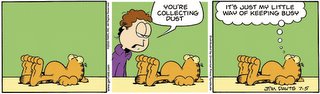
Take the ancient theological question about the meaning of life. "If you really believe that there is no higher purpose to life, no God, no supreme power, then why don't you just kill yourself", people are always asking me (this whole line of encouraging me to suicide is an exceptionally popular one, btw, especially among my ex-girlfriends). Oh, I give them some spiel about existential absolutism and the triumph of the creative will, but the real answer to that question is: laziness. I mean look, you're talking to someone who sits for hours in front of a TV screen watching The Weather Channel because he's too lazy to get up and find the remote - you really think this person is going to find the motivation to end his life because it's meaningless? Sure, I should kill myself, I plan to, believe me, it's on my to-do list. But, you know, what's the rush?
Thinking about it, I've realised that procrastination may well be my true calling. Unfortunately, I can't think of a single career that I could take up that would allow me to fully develop this unique talent of mine (apparently you have to be a US citizen to be head of FEMA). Not that there aren't tons of people out there who are getting paid for doing absolutely nothing - all I need to do is go see a career counsellor. I'm sure they could tell me. Yup, that's what I'm going to do. Tomorrow. Or maybe the day after. Or how about next week...
What? You claim to be a champion procrastinator too? Ha! I scoff at your amateur laziness. Here are ten things that prove that I'm the laziest person ever. Eat my dust (and given how rarely I vacuum, there's a lot of that, let me tell you):
1. I started learning how to drive when I was 15. Today, 12 years later, I still don't know how.
2. It's been six days since daylight saving time ended, but I haven't bothered to reset the time on my alarm. This means that I get woken up an hour earlier every morning, but I figure, if I just let it be, we'll eventually go back to Daylight Saving and then the problem will just go away.
3. Four months ago, convinced that I needed new clothes, I bought four new shirts (all the same colour of course, I'm too lazy to actually bother choosing what I'm going to wear every day!). Three of them are still lying in my wardrobe unopened because I haven't got around to making the stupendous effort of cutting off the sales tags and taking out the pins / cardboard pieces they came packed with.
4. If the building I'm in happens to have an automatic door, I will always take it. I have been known to walk half-way across a building, just so I won't have to use MY OWN HANDS to open the door.
5. I never untie the laces of my shoes. I simply wrestle my feet in and out of them.
6. I never eat breakfast. By the time it occurs to me that I should eat something, it's usually lunch time.
7. I need to get to know someone over the course of at least three years before I'll consider dating them. And even then, they have to ask me. (You begin to see why I have so much time to spend on this blog)
8. I own some 300 odd CDs, but I once spent an entire fortnight listening to Mark Knopfler's Sailing to Philadelphia because I couldn't be bothered to replace the CD in my system. By the time I finally switched CDs, I'd heard The Last Laugh an estimated 29 times.
9. For the last ten years, I've been trying to believe in God, if only because I think it would be fun to believe in some incoherent superior being who had no clue what he / she was talking about. So far, I'm still struggling to believe in Maureen Dowd.
10. I could come up with a tenth point, but I don't feel like it.
Thursday, November 03, 2005
Cine qua non
Have you ever been alone in a cinema theatre? I don't mean the seat next to me is empty alone. I mean I'm-the-only-living-thing-in-this-entire-hall alone?
I've come close a couple of times - I remember one wintry Delhi morning some 6-7 years back when I and a friend went to see Carlos Saura's Carmen (it was playing as part of some film festival or the other) and ended up being the only people in the balcony. Or more recently, going to watch Herzog's Grizzly Man and being one of two people in the theatre.
Then yesterday I finally managed it. Went for an afternoon matinee show of Wallace and Gromit: The Curse of the Were-Rabbit (see my review here) and was the ONLY person in the entire hall (and yes, I was watching a 4 pm show of a movie on a Wednesday - weep, ye corporate types!). I have to say it's quite a surreal experience. You sit there thinking "Oh, come on, this has to be a dream, worse, a cliched dream! Oh well, at least I still have all my clothes on". You have this strange nagging urge to make noise. To stand up and move around. To jump up and down waving your hands at the screen. (Is a ringing cell phone in an empty movie theatre still an annoyance, even though there's no one there to annoy?). You wonder what would have happened if you weren't here either. Would they still run the film even if the theatre was completely empty? Is there a projectionist sitting back there watching you intently from his little window? Could you ask him to fast forward the bits you don't care for?
The worst is when you laugh out loud. There you'll be chuckling away, then you realise that no one else is laughing. Of course, that's because there's no one else there, but that doesn't matter. You can still hear your laugh echoing in the pin-drop silence of the hall. You feel deeply embarassed. You feel indignant. What is it with all these other people? Why aren't they in here and laughing at this joke with you? The cretins.
Finally the movie's over. By instinct, you think you'll just sit and read the credits, let the other people file out. Then you remember that there are no other people. All the time you're walking out, you can feel the credits watching you, following you as you leave. You feel guilty. You feel you should apologise to all those people whose names are going to roll through after you've left. As you shut the door to the auditorium behind you, you have the impression of leaving a tomb, a temple. You feel like a criminal. You worry that you may have left some traces of your presence behind, you imagine them (whoever they might be) dusting all the seats until they find your fingerprints.
It's only when you're finally on your way back home that it finally sinks in. You just watched a movie on a thirty foot high screen in what was effectively a monstrously over-sized living room. Heh.
Wednesday, November 02, 2005
Mr. and Mrs. Klump, meet Mr. and Mrs. Klump
One of the problems with belonging to a really small community where everyone has the same last name and inter-community marriages are common, is that marriage invitations end up sounding incredibly incestuous.
Take this wedding invite I got from my cousin today, for instance (yeesh! that's what the world needs - more married people!). His last name is the same as mine. Let's call it Klump. So he's Mr. Klump. And his parents are Mr. and Mrs. Klump. Only trouble is, his mother's maiden name is Klump as well, so his grandparents are Mr. and Mrs. Klump and Mr. and Mrs. Klump.
To add to the fun, his fiancee's last name is also Klump. As, obviously, is her parents'.
So the invitation I got today is a card addressed to Mr. Klump, inviting him to the wedding of Mr. Klump, grandson of Mr and Mrs Klump and Mr and Mrs Klump, to Miss Klump, daughter of Mr. and Mrs. Klump. Scary, isn't it?
On the plus side, this means my family has long ago solved the dilemma of whether a woman should take on her husband's last name after marriage - all you have to do is have the same last name to start with! So much for feminism.
NB: People reading this post are NOT allowed to make any of the following crummy jokes:
"Is there Klump in the house?"
"Do you take on Klump with your tea, or two?"
"You can't make a porridge without having Klumps"
Exultate Jubilate
 If you can't rely on Mozart, who can you rely on?
Managed to get myself all blue and depressed yesterday (Depression "is an art, like everything else. / I do it very well / I do it so it feels like hell / I do it so it feels real / I guess you could say I've a call"), so decided the only thing to do was turn off all the lights and listen to Mozart's Exultate, Jubilate (K.165). By the time I got to that last towering Alleluia I could feel myself soaring again, I was so prodigiously, dizzily happy.
Thank God for Mozart.
Or rather, Thank Mozart for God.
P.S. So now the only thing that cheers me up when I'm blue is the sound of a castrato singing. Great, just great.
Tuesday, November 01, 2005
Where's the fire? / My obligatory Diwali Post
So it's Diwali. Again.
The thing is, I don't really care much for Diwali. Actually, I don't care much for any festival, except maybe Christmas (and that's just a sort of mercenary nostalgia for Santa Claus, coupled with a yearning for my Mother's Rum and Ginger cakes). And I do prefer Diwali to Holi, which is barbaric and unbearable. But still, I don't care for Diwali much.
As a child my big problem with Diwali was with fireworks. I never understood them. Every Diwali I would stare in confusion at all these laughing people around me who seemed to think that there was nothing more fun than holding burning sticks in your hand and setting off things that made loud sounds and left you coughing with smoke. What was the point of it all, I wondered. Where did it come from, this caveman fascination with the idea that things could burn? And what was the deal with all these flickering little candles, all these twinky little diyas. If you really wanted light, what did you think electricity was for? Okay, so some of this stuff looked nice; it was fun to glance out of a window and see a rocket exploding over the skyline, fun to look up from a book and see a cone exploding into sparks, but why would you want to devote hours to this sort of thing?
I'd like to be able to claim that my aversion to fireworks came from some distant recognition of the Promethean majesty of fire, of the danger we ran as mortals by making so awe-inspiring a force the dupe of children's games. I'd like to be able to claim that it was the anarchy of fireworks that upset me, that violated my preference for order, for neatness. The truth is simpler - I was, and have always been, mortally afraid of fire.
Call it having a morbid imagination. All through Diwali night I would be on tenterhooks, waiting for disaster to strike. While other people watched the lights of the fireworks in wonder, my eyes would follow the stray sparks that were blown here and there, watching them to make sure that they hadn't found something inflammable (even now, the imagined image of a stray rocket slamming through a window and setting a house on fire stays with me). Where other people saw pious and rustic lamps, I saw receptacles of raw, burning oil, with the power to singe and ignite. It wasn't just that I wouldn't go near any of these things (I was convinced against all reason, that even the smallest spark from the most harmless little phooljhadi could leave me a wasted cripple - if someone handed me so much as a lighted candle I would scream in terror), it was also that watching other people go near them I was always mortally afraid. Every time my father would scurry forward to light yet another firework, I would be convinced that this time he wasn't going to make it out of range in time, I would shut my eyes to keep from seeing him burned, seeing him hurt. It galled me that the adults around me, who were supposed to be the responsible ones after all, didn't see the terrible risks they were putting themselves and their children to. That it fell to me, all of 7 years old, to watch out for everyone else.
The result of all this was that by the time the Diwali fireworks were over, I would be a nervous wreck. Every nerve, every instinct in my body would have been stretched past breaking point. I would run back into the house in relief, glad that it was finally all over, amazed that we had all somehow survived it. You know the saying "Cowards die a thousand times before their death" - the first time I heard it the only thing I could think of was Diwali.
The trouble, of course, was that my parents (bless them) just couldn't accept this. Oh, they understood that I was afraid of firecrackers, and never forced me into anything, but they just couldn't come to terms with the idea that someone (least of all a 7 year old) could hate firecrackers and not want anything to do with them. They were afraid, presumably, that if they didn't celebrate Diwali properly, I would be 'missing out'. The irony was that I don't think they particularly cared for crackers either - they were doing it mostly for my sake!
So every year we would make the obligatory trip to the cracker shop, every year we would feign excitement and pick out a bunch of crackers. Every year I would stand on our roof at night, cowering in fear while my parents set off cracker after cracker, trying desperately to draw me into the excitement of the whole thing. Convinced that they must do something to help me get over my irrational fear, they would do things to show me that there was nothing to fear, they would 'encourage' me to try it for myself. This of course, only made the whole thing worse. Don't get me wrong, I'm not unappreciative of what they were trying to do, and the dinner my mother would put together afterwards would almost make up for all the cringing horror of the firecrackers, it's just that I hated the whole thing from start to smoky finish.
I suspect that's why I don't like Diwali. Whenever I think about it all I can see is firecrackers, all I can smell is suffocating smoke. The point is that I never had fun on Diwali - on the contrary, the chore of setting off firecrackers on Diwali night and then going to school the next day and having all my friends talk enthusiastically about all the different types of 'bombs' they set off was something I rapidly came to dread. That's why, even now, I can't wait for Diwali to be over.
It's also why far from being homesick I actually love spending Diwali in the US. Take today for instance. Once I'm done with work, I'll go get a drink with a bunch of friends who have no idea what Diwali is and therefore feel no need to celebrate it. Then I'll go home and curl up in bed and peacefully read my book, without being threatened by the imminent arrival of relatives, without having to deal with the noise and smoke and screaming people and loud music outside. Being in the US means that I can completely deny that Diwali exists, and that's really valuable to me.
So if you're one of those people who look forward to Diwali and think it's special and like celebrating it - I hope you're having a good time. I certainly am.
P.S. To be fair, I should say that in my more recent experiences, even in the hell-hole that is Delhi, Diwali has been much quieter, much more dignified. I understand that there are no campaigns against firecrackers running in schools, that children are being encouraged to stay away from them. Just my luck to be born in the wrong generation.
Subscribe to:
Posts (Atom)

 Posts


