Again and again in those final years he returned to a single image - the view from his kitchen window - squat East Village skyline, propellers of shrubbery, an open window flirting with the wind, and half a dozen droplets of rain shining on a clothesline, meaning nothing symbolic, you understand, no poetry as high wire act, placement of words on the taut line, points of focus making the scene come true, only the instinct of an old poet, his empathy for all that clings by a thread, familiar alchemy of shabbiness to sadness achieved by fragile means.
And all around that image the photographs of his friends from the old days - Burroughs, Corso, Kerouac - all that mad and generous generation, so easy in their young men's faces, so tired in their old, a gallery of portraits in impromptu glory, resplendent as drops on a clothesline, that hold, their fall inevitable, true to the light.
[Inspired by an exhibition of Ginsberg's photographs at the National Gallery of Art]
Update: Edmund White in the NYRB on the exhibition
Tuesday, August 31, 2010

Sunday, August 29, 2010
On Beauty
You want to believe beauty can save you, but it can't.
You want to believe you can save beauty, hold on to it, preserve it, and you can, but you won't.
The only relation possible between you and beauty is the one between the mirror and the light: both suffer endlessly for the other, but neither can bear the other's touch.
You want to believe you can save beauty, hold on to it, preserve it, and you can, but you won't.
The only relation possible between you and beauty is the one between the mirror and the light: both suffer endlessly for the other, but neither can bear the other's touch.
Saturday, August 28, 2010
Raindrop
A raindrop on an autumn leaf
Reminds me of all the ways
New beauty is vulnerable
And the hurt in her eyes.
- Hu Ming-Xiang
Reminds me of all the ways
New beauty is vulnerable
And the hurt in her eyes.
- Hu Ming-Xiang
Sunday, August 22, 2010
How would we know if time passed us by?
I smell the dust by the roadside.
I join the procession of ghosts.
Then the wind lifts like a summer veil
And the evening is empty again.
- Hu Ming-Xiang
I join the procession of ghosts.
Then the wind lifts like a summer veil
And the evening is empty again.
- Hu Ming-Xiang
Sunday, August 01, 2010
The suspicion of beauty
...clings to every fragile thing.
Perhaps it is the hysteresis of suffering, that makes us helpless in the face of helplessness. Or a proactive nostalgia for what must soon be ruined.
Perhaps it is a dangerous sense of our own presence, like the wonder of a child watching the cobweb billow with his every breath.
Perhaps it is the hysteresis of suffering, that makes us helpless in the face of helplessness. Or a proactive nostalgia for what must soon be ruined.
Perhaps it is a dangerous sense of our own presence, like the wonder of a child watching the cobweb billow with his every breath.
Saturday, July 24, 2010
As tears go by
You sit, weeping, on the banks of the river.
The tears bitter on your young lips.
But the river will flow a long way from here
And your tears will sweeten the tongues of the sea.
- Hu Ming-Xiang
The tears bitter on your young lips.
But the river will flow a long way from here
And your tears will sweeten the tongues of the sea.
- Hu Ming-Xiang
Friday, July 23, 2010
Locked Out
The day they locked the door to the temple
We learned to tell a knock from a prayer.
Now the path to heaven is covered in moss
And I return home with a beaten heart.
- Hu Ming-Xiang
We learned to tell a knock from a prayer.
Now the path to heaven is covered in moss
And I return home with a beaten heart.
- Hu Ming-Xiang
Saturday, July 17, 2010
The Raindrop Effect
A single raindrop in Japan today could set a kaleidoscope of butterflies fluttering through a Brazilian rain forest two weeks from now.
Friday, July 16, 2010
Maslow's Pyramid Scheme
via the NY Times' 'Idea of the Day', a call for revising Maslow's heirarchy, replacing self-actualization with parenting.
Personally, I think the idea that the apex of human desire is to be a parent is so much garbage, but I'll spare you the Nietzschian griping about the need to transcend the human, not propagate it [1], as well as the obvious criticism that parenting is already in there, two levels down, with family and belonging. And I won't even start on how using parenting as a means of self-actualization is how children end up buried under the frustrated dreams of their parents.
The larger (though perhaps subtler) problem with placing parenting on top is that it's too easy. It's always seemed to me that Maslow's heirarchy is based not so much on emotional significance as on difficulty of attainment. At any given point, the need most salient to us is the one we have the greatest hope of satisfying, so that it's only when we've satisfied an easier need do we move on to one that is more difficult. Or perhaps, given that value comes from scarcity, we value the attainment of some needs more precisely because they are harder to attain. In any case, our needs are arranged heirarchically in the increasing order of the effort required to satisfy them. Or, put another way, if a higher order need were more easily attainable than one lower down in the pyramid, why wouldn't people just leapfrog to the higher order need?
Which is why putting parenting on top doesn't work. Being a parent is too easy an accomplishment [2] to merit being at the top. It makes little sense to make the apex of human desire a state that almost anyone can achieve, and almost everyone does.
(and that almost everyone manages to feel smugly satisfied about - I'd be more willing to put parenting on top of Maslow's pyramid if more parents responded to their babies like this)
Notes
[1] Of course, Nietzsche would argue that self-actualization is a pre-requisite for parenting (see Thus Spake Zarathustra, Part I, Chapter 20)
[2] Being a good parent is exceedingly hard, but that's a whole other story.
Personally, I think the idea that the apex of human desire is to be a parent is so much garbage, but I'll spare you the Nietzschian griping about the need to transcend the human, not propagate it [1], as well as the obvious criticism that parenting is already in there, two levels down, with family and belonging. And I won't even start on how using parenting as a means of self-actualization is how children end up buried under the frustrated dreams of their parents.
The larger (though perhaps subtler) problem with placing parenting on top is that it's too easy. It's always seemed to me that Maslow's heirarchy is based not so much on emotional significance as on difficulty of attainment. At any given point, the need most salient to us is the one we have the greatest hope of satisfying, so that it's only when we've satisfied an easier need do we move on to one that is more difficult. Or perhaps, given that value comes from scarcity, we value the attainment of some needs more precisely because they are harder to attain. In any case, our needs are arranged heirarchically in the increasing order of the effort required to satisfy them. Or, put another way, if a higher order need were more easily attainable than one lower down in the pyramid, why wouldn't people just leapfrog to the higher order need?
Which is why putting parenting on top doesn't work. Being a parent is too easy an accomplishment [2] to merit being at the top. It makes little sense to make the apex of human desire a state that almost anyone can achieve, and almost everyone does.
(and that almost everyone manages to feel smugly satisfied about - I'd be more willing to put parenting on top of Maslow's pyramid if more parents responded to their babies like this)
Notes
[1] Of course, Nietzsche would argue that self-actualization is a pre-requisite for parenting (see Thus Spake Zarathustra, Part I, Chapter 20)
[2] Being a good parent is exceedingly hard, but that's a whole other story.
Tuesday, July 13, 2010
The trouble with violent solutions
And so the Teacher took him to the cart and said, "Your first task is to untie this knot."
And the boy examined the knot for a while, and when he could see no way to undo it, he took out his sword and cut it in two.
The Teacher said, "For decades men have struggled with this knot, yet none have thought to do what you have just done."
The boy smiled.
"Now, for your second task", said the Teacher, "tie the knot back."
And the boy examined the knot for a while, and when he could see no way to undo it, he took out his sword and cut it in two.
The Teacher said, "For decades men have struggled with this knot, yet none have thought to do what you have just done."
The boy smiled.
"Now, for your second task", said the Teacher, "tie the knot back."
Friday, July 09, 2010
Solo
[Five pieces inspired by solo dance performances by the recipients of the 2008 and 2009 McKnight Fellowships that I watched at the Southern Theater tonight.]
Floor Plan
Memory: the arrangement of emptiness into space. A fugue of small adjustments. The discovery of the familiar in the placing of hands.
To hold on to what is lost join a circle of repetitions. Pretend the clock is you.
No one is fooled.
Fragment of Adam
Only a madman would bring the moon roses. Epiphanies of the not-blue. Blood, rose, moon. A bouquet of tongues folded into each other.
What remains of the lover when the petals have been spilled? Only the beast Desire, eating raw flesh. Only the current that dances on the crest of the waves , marking the place where electricity drowned.
Kutu
The weight of the world is carried on bent backs. This is politics: the suffering of women, the making of hay. A raised harvest of hands from which the sun rises, singing, beating down. The dance of the tree standing silent, proud.
Cohesion
Every note of this suicide is a beautiful dream. A soldier dances in the uncrumpled moonlight, his uniform held at arm's length. Like an enemy. Or a lover. All is fair. All is fair.
The Lamb
Long chains of cattle cars rattle the night. The damned are brought screeching to the furnace of hell. Death has a mind of metal, he weeps from rusted eyes.
In Hiroshima, the heat of the explosion turns walls to shadow, light to ash. The breathing door shuts tight. The outstretched hand leaves the air unmarked.
The names of the victims do not matter now that masks are mass-produced. Every skull a gesture of solidarity. A million photocopies of the one human face.
Floor Plan
Memory: the arrangement of emptiness into space. A fugue of small adjustments. The discovery of the familiar in the placing of hands.
To hold on to what is lost join a circle of repetitions. Pretend the clock is you.
No one is fooled.
Fragment of Adam
Only a madman would bring the moon roses. Epiphanies of the not-blue. Blood, rose, moon. A bouquet of tongues folded into each other.
What remains of the lover when the petals have been spilled? Only the beast Desire, eating raw flesh. Only the current that dances on the crest of the waves , marking the place where electricity drowned.
Kutu
The weight of the world is carried on bent backs. This is politics: the suffering of women, the making of hay. A raised harvest of hands from which the sun rises, singing, beating down. The dance of the tree standing silent, proud.
Cohesion
Every note of this suicide is a beautiful dream. A soldier dances in the uncrumpled moonlight, his uniform held at arm's length. Like an enemy. Or a lover. All is fair. All is fair.
The Lamb
Long chains of cattle cars rattle the night. The damned are brought screeching to the furnace of hell. Death has a mind of metal, he weeps from rusted eyes.
In Hiroshima, the heat of the explosion turns walls to shadow, light to ash. The breathing door shuts tight. The outstretched hand leaves the air unmarked.
The names of the victims do not matter now that masks are mass-produced. Every skull a gesture of solidarity. A million photocopies of the one human face.
Wednesday, July 07, 2010
Brazil in Pictures
You ask for photographs, I give you photographs. Now you may have been thinking Brazil = pictures of beaches filled with hot bikini-clad women, but you really should know me better than that. Instead I give you:


Christ on the Mountain
Corcovado, Rio de Janeiro

Beach Debris
Ilha Grande
 Boat passing in the twilight
Ilha Grande
 Dry Salvages
Angra dos Reis
 A Wilderness of Flamingos
Parque des Aves, Iguacu
 The March of Progress
Itaipu Dam
 Cathedral
Itaipu Dam
Corcovado, Rio de Janeiro

Beach Debris
Ilha Grande
 Boat passing in the twilight
Ilha Grande
 Dry Salvages
Angra dos Reis
 A Wilderness of Flamingos
Parque des Aves, Iguacu
 The March of Progress
Itaipu Dam
 Cathedral
Itaipu Dam
And just to prove that it wasn't all depression and gloom:
 Iguacu Falls
 Iguacu Falls
Sunday, June 27, 2010
Rio
To enter Rio is to enter Byzantium. The young in one another's arms, the dolphin-torn sea. Just walking the streets here I feel ragged, stick-like, which is to say I am conscious the city is more attitude than place, is the catalyst for an emotional reaction to which leaves me inert. Everywhere I look people are living out their test-tube vacations, bubbles of laughter fizzing from their eyes.
Friday, June 18, 2010
Thursday, June 17, 2010
Attribution Error in the Blogosphere
To credit all positive comments to your own perspicacity and talent, and blame all negative comments on the stupidity and prejudice of your commenters.
Well said
"For many centuries in the Western tradition, how well you expressed a position corresponded closely to the credibility of your argument. Rhetorical styles might vary from the spartan to the baroque, but style itself was never a matter of indifference. And “style” was not just a well-turned sentence: poor expression belied poor thought. Confused words suggested confused ideas at best, dissimulation at worst."
That's Tony Judt over at the NYRB blog. It's a point of view I happen to wholeheartedly agree with, if only because empirical observation proves it to be true. People who write badly think badly. Every now and then I'll grit my teeth and try to read something that's ungrammatical and badly structured because what it says might be 'important' (for a particularly egregious recent example, see here), and almost without exception the piece in question will turn out to be illogical, incoherent or just plain silly.
(This doesn't work in reverse, of course. The most exquisite prose may make no sense whatsoever).
I think the point is that lucid writing is a byproduct of a process of careful thought. The more deeply you think about an issue, the more word choices start to matter, the clearer the purpose of each phrase and each sentence becomes, and the more the sentences themselves fall into a natural order. Clarity of thought produces clarity of writing.
It's a standard too few people seem to care about.
Spending Time
If it were possible to spend what one does not own, I would trade the restlessness of the ocean for this moment of silence, you and I alone on the balcony, high above the traffic, afraid to look down. You say you are afraid of falling. I say I am afraid of heights. What we have in common is that we understand these two fears are not the same. The balcony is a cage of glass and air. We both wish we didn't have to fly.
Tuesday, June 01, 2010
Peter Orlovsky 1933 - 2010
No, the madness didn't destroy him. He outlived them all: Cassady, Kerouac, Allen himself. Survived the drugs and the alcohol, the sex and the protests, to die unoutrageously of lung cancer at the age of 76.
No, he was not his animal. In the poems he is an altogether quieter, more domestic presence, a shadow you barely see. And yet he is there on the front page of Kaddish, an angel of grief, and there again twenty years later, lending his back and strong shoulders to Ginsberg Sr., being told not to grow old, and (as we now know) ignoring the advice. He is there in the elegies to O'Hara and Cassady, lending his sympathetic ear and voice to the general sorrow. Again and again, when death intercedes, he is there to comfort, console.
When they first met, half a century ago, Allen wrote:
and here they are, 40 years later, two old men sitting in companionable silence around a dining table; two bowls, chipped and almost empty, laid side by side.

No, he wasn't the best mind of his generation. But what he was, and what he had, is hard not to envy. And if even some of the power of those poems draws strength from his presence, that is more than most of us can hope to contribute.
Notes:
Ginsberg quote taken from 'Malest Cornifici Tuo Catullo' . Ginsberg and Orlovsky image taken from this piece by Gordon Ball in Jacket, July 2007.
No, he was not his animal. In the poems he is an altogether quieter, more domestic presence, a shadow you barely see. And yet he is there on the front page of Kaddish, an angel of grief, and there again twenty years later, lending his back and strong shoulders to Ginsberg Sr., being told not to grow old, and (as we now know) ignoring the advice. He is there in the elegies to O'Hara and Cassady, lending his sympathetic ear and voice to the general sorrow. Again and again, when death intercedes, he is there to comfort, console.
When they first met, half a century ago, Allen wrote:
"discovered a new young cat,
and my imagination of an eternal boy
walks on the streets of San Francisco,
handsome, and meets me in cafetarias
and loves me."
and here they are, 40 years later, two old men sitting in companionable silence around a dining table; two bowls, chipped and almost empty, laid side by side.
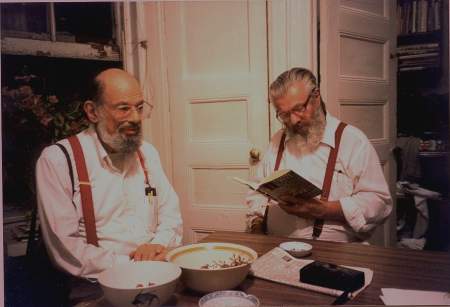
No, he wasn't the best mind of his generation. But what he was, and what he had, is hard not to envy. And if even some of the power of those poems draws strength from his presence, that is more than most of us can hope to contribute.
Notes:
Ginsberg quote taken from 'Malest Cornifici Tuo Catullo' . Ginsberg and Orlovsky image taken from this piece by Gordon Ball in Jacket, July 2007.
Sunday, May 30, 2010
That poetry makes nothing happen
may be one of its chief delights.
To create something that has immediate and practical application is to be a cog in the utilitarian machine. But to make something that has neither definable quality nor discernible purpose is to experience first hand the joy of original creation.
Adam gave names to all the animals. We give the animal back to the names.
***
As you may have already figured out, it's been a particularly rewarding weekend, poetry reading wise - D.A. Powell's Cocktails, Rachel Zucker's Bad Wife Handbook and Armantrout's Up to Speed, with Geoffrey Hill's Selected Poems to follow. Happiness.
To create something that has immediate and practical application is to be a cog in the utilitarian machine. But to make something that has neither definable quality nor discernible purpose is to experience first hand the joy of original creation.
Adam gave names to all the animals. We give the animal back to the names.
***
As you may have already figured out, it's been a particularly rewarding weekend, poetry reading wise - D.A. Powell's Cocktails, Rachel Zucker's Bad Wife Handbook and Armantrout's Up to Speed, with Geoffrey Hill's Selected Poems to follow. Happiness.
Subscribe to:
Comments (Atom)

 Posts
Posts


