Showing posts with label Arts. Show all posts
Showing posts with label Arts. Show all posts
Wednesday, July 06, 2011


Thursday, February 17, 2011
Devotion
Just got back from a theater / dance performance by Sarah Michelson / Richard Maxwell which asks the important moral question: what if God is a sadistic personal trainer and life just an endless series of high energy aerobics (to overly loud music) whose only purpose is to see how long it takes you to collapse of exhaustion?
The shame of it is that Maxwell's text for the performance is really quite beautiful - witty, moving and profound - which only serves to highlight how wooden and uninspired the choreography that goes with it really is.
The shame of it is that Maxwell's text for the performance is really quite beautiful - witty, moving and profound - which only serves to highlight how wooden and uninspired the choreography that goes with it really is.
Friday, November 19, 2010
Intimacy
Not who we dance with, but what we dance around.
Not closeness, but distance made aware of itself. The heartbeat in the next room, eyes meeting in the crowd.
Turn it inside out and every emptiness is an ache. Angles of expectation add up to desire.
We must return to the old savageries. You bring the broken dances, my love. I'll bring the fire.
***
Just returned from watching a performance by the Zenon Dance Company, the highlight of which was the premiere of luciana achugar's glorious Structures of Feeling, but which also included a mesmerizing performance of a 1992 piece by Susana Tambutti called Like An Octopus - a sort of deconstruction of the tango that is also the inspiration for this post.
Tuesday, August 31, 2010
Beat Memories
Again and again in those final years he returned to a single image - the view from his kitchen window - squat East Village skyline, propellers of shrubbery, an open window flirting with the wind, and half a dozen droplets of rain shining on a clothesline, meaning nothing symbolic, you understand, no poetry as high wire act, placement of words on the taut line, points of focus making the scene come true, only the instinct of an old poet, his empathy for all that clings by a thread, familiar alchemy of shabbiness to sadness achieved by fragile means.
And all around that image the photographs of his friends from the old days - Burroughs, Corso, Kerouac - all that mad and generous generation, so easy in their young men's faces, so tired in their old, a gallery of portraits in impromptu glory, resplendent as drops on a clothesline, that hold, their fall inevitable, true to the light.
[Inspired by an exhibition of Ginsberg's photographs at the National Gallery of Art]
Update: Edmund White in the NYRB on the exhibition
Friday, July 09, 2010
Solo
[Five pieces inspired by solo dance performances by the recipients of the 2008 and 2009 McKnight Fellowships that I watched at the Southern Theater tonight.]
Floor Plan
Memory: the arrangement of emptiness into space. A fugue of small adjustments. The discovery of the familiar in the placing of hands.
To hold on to what is lost join a circle of repetitions. Pretend the clock is you.
No one is fooled.
Fragment of Adam
Only a madman would bring the moon roses. Epiphanies of the not-blue. Blood, rose, moon. A bouquet of tongues folded into each other.
What remains of the lover when the petals have been spilled? Only the beast Desire, eating raw flesh. Only the current that dances on the crest of the waves , marking the place where electricity drowned.
Kutu
The weight of the world is carried on bent backs. This is politics: the suffering of women, the making of hay. A raised harvest of hands from which the sun rises, singing, beating down. The dance of the tree standing silent, proud.
Cohesion
Every note of this suicide is a beautiful dream. A soldier dances in the uncrumpled moonlight, his uniform held at arm's length. Like an enemy. Or a lover. All is fair. All is fair.
The Lamb
Long chains of cattle cars rattle the night. The damned are brought screeching to the furnace of hell. Death has a mind of metal, he weeps from rusted eyes.
In Hiroshima, the heat of the explosion turns walls to shadow, light to ash. The breathing door shuts tight. The outstretched hand leaves the air unmarked.
The names of the victims do not matter now that masks are mass-produced. Every skull a gesture of solidarity. A million photocopies of the one human face.
Sunday, May 09, 2010
Albee / I need a drink
Watching Who's Afraid of Virginia Woolf? (in a superb production by the Jungle Theater) I begin to understand why gladiators were so popular in Ancient Rome.
The visceral spectacle of two people tearing at each other, no hope of escape. The pettiness of victory in the sport of pain.
And now, if you'll excuse me, I have to go find that bourbon.
The visceral spectacle of two people tearing at each other, no hope of escape. The pettiness of victory in the sport of pain.
And now, if you'll excuse me, I have to go find that bourbon.
Sunday, February 28, 2010
Murder most foul
Just got back from an evening at the Guthrie that easily counts as the worst performance of Macbeth I've ever been subjected to. The kindest interpretation of what I watched tonight is that Joe Dowling, taking Act V Scene V to heart, decided that the best way to do Macbeth was to hire a couple of poor players, have them strut and fret upon the stage for a couple of hours with as much sound and fury as possible, and hope that the whole thing would signify, if not nothing, then as little as possible. If such was his intention, he succeeded admirably.
Easily the worst offender in this night's travesty was Erik Heger, whose turn as Macbeth combined gratuitous overacting with bizarre line readings to reach lows of incompetence many a high school wannabe could not achieve. The result was a performance that betrayed not the slightest glimmer of insight into Macbeth's psyche, while managing to obscure the power and flow of Shakespeare's poetry - no mean feat when one is playing Macbeth. I know the play was advertised as including graphic violence, but I didn't realize it was the language itself that was to be so butchered. Mr Heger, the playbill informs me, has performed in a number of popular soaps; I suggest he restrict his future career to daytime television and not sully the stage attempting Shakespeare again.
While Mr. Heger's performance was particularly cringe-worthy, the rest of the show wasn't much better. It didn't help that, for reasons known only to them, the company decided to restrict the play to a two-hour performance without intermission [1,2]. The upshot of this was that large swathes of the text had to be cut - including, for instance, about a third of Act IV Scene I [3] - and what remained was often delivered at such break-neck speed as to make it not only unintelligible to anyone not already familiar with the script, but also entirely inauthentic. Are we really to believe that all the tangled phrases of Act I Scene V trip lightly off the tongues of Lord and Lady Macbeth? These are words to be savored, phrases to be wrenched from the writhing pit of inner turmoil. Not lines to be rattled off with the speed of a waitress reciting the day's specials.
The one bright spot in this general wreck was Robert Berdahl's performance as Macduff, which rose cleanly above the mediocrity around him, so that the one scene in the entire play charged with genuine emotion was Act IV Scene III. It's fitting then, that the best description of tonight's performance can be found in the words of Macduff upon discovering Duncan's murdered corpse:
[1] I suppose that in itself should have tipped me off - a performance of Macbeth in two hours could hardly be anything but botched.
[2] In retrospect, I have mixed feelings about the 2 hours / no intermission thing. On the one hand, its shortness was the one mercy the performance afforded. On the other, if there had been an intermission I could have walked out and salvaged some part of my evening.
[3] What perverse, tone-deaf idiot chooses to cut, of all things, the full list of the cauldron's ingredients, Hecate's entire role and Macbeth's glorious speech as he enters the witches' lair?
Easily the worst offender in this night's travesty was Erik Heger, whose turn as Macbeth combined gratuitous overacting with bizarre line readings to reach lows of incompetence many a high school wannabe could not achieve. The result was a performance that betrayed not the slightest glimmer of insight into Macbeth's psyche, while managing to obscure the power and flow of Shakespeare's poetry - no mean feat when one is playing Macbeth. I know the play was advertised as including graphic violence, but I didn't realize it was the language itself that was to be so butchered. Mr Heger, the playbill informs me, has performed in a number of popular soaps; I suggest he restrict his future career to daytime television and not sully the stage attempting Shakespeare again.
While Mr. Heger's performance was particularly cringe-worthy, the rest of the show wasn't much better. It didn't help that, for reasons known only to them, the company decided to restrict the play to a two-hour performance without intermission [1,2]. The upshot of this was that large swathes of the text had to be cut - including, for instance, about a third of Act IV Scene I [3] - and what remained was often delivered at such break-neck speed as to make it not only unintelligible to anyone not already familiar with the script, but also entirely inauthentic. Are we really to believe that all the tangled phrases of Act I Scene V trip lightly off the tongues of Lord and Lady Macbeth? These are words to be savored, phrases to be wrenched from the writhing pit of inner turmoil. Not lines to be rattled off with the speed of a waitress reciting the day's specials.
The one bright spot in this general wreck was Robert Berdahl's performance as Macduff, which rose cleanly above the mediocrity around him, so that the one scene in the entire play charged with genuine emotion was Act IV Scene III. It's fitting then, that the best description of tonight's performance can be found in the words of Macduff upon discovering Duncan's murdered corpse:
MACDUFFO horror, horror, horror! Tongue nor heartMACBETH LENNOX
Cannot conceive nor name thee!What's the matterMACDUFF
Confusion now hath made his masterpiece!
[1] I suppose that in itself should have tipped me off - a performance of Macbeth in two hours could hardly be anything but botched.
[2] In retrospect, I have mixed feelings about the 2 hours / no intermission thing. On the one hand, its shortness was the one mercy the performance afforded. On the other, if there had been an intermission I could have walked out and salvaged some part of my evening.
[3] What perverse, tone-deaf idiot chooses to cut, of all things, the full list of the cauldron's ingredients, Hecate's entire role and Macbeth's glorious speech as he enters the witches' lair?
Sunday, February 14, 2010
Hedda Gabler
Watching Hedda Gabler tonight, it occurs to me that sexual frustration ripens, in due course, into an appetite for tragedy.
***
An adequate but curiously unsympathetic performance. A Hedda worthy of Strindberg rather than of Ibsen.
***
An adequate but curiously unsympathetic performance. A Hedda worthy of Strindberg rather than of Ibsen.
Friday, December 04, 2009
Falstaff Culture Tip # 308
Never, ever sit in the front row at a Taiko performance.
Watching the drummers from five feet away is an incredible experience, but your ribs ache for hours afterwards from the pounding they take.
Watching the drummers from five feet away is an incredible experience, but your ribs ache for hours afterwards from the pounding they take.
Sunday, October 18, 2009
The mindlessness of strangers
You know, the more time I spend in the company of strangers, the more I despair for the future of the species. There's just no getting away from it - people are weird.
Take the woman sitting next to me at the concert on Friday, who sat through Anthony Ross' encore with a scissor in hand, trimming her nails. Yes, actually trimming her nails while the cellist was playing [1]!
Or the woman at the ballet yesterday [2] who decided that since her ticket said Row 20 Seat 4, she was obviously in the first seat in row 24 (because 20+4=24, see!).
Or the person sitting behind me in the bus this afternoon, saying this to an acquaintance she ran into on the bus (and speaking, needless to say, really, really loud):
I'm NOT exaggerating. Promise.
[1] Okay, said encore consisted of a fairly uninspired rendition of Somewhere Over the Rainbow [3], so it wasn't exactly the highpoint of the evening, but still.
[2] The Royal Winnipeg Ballet premiering their new ballet - Moulin Rouge. All in all, an exquisite performance. The fact that it kept slipping into bathos probably has more to do with the fact that I'm not a big fan of traditional ballet than anything else.
[3] Which is a nice enough song, but playing it after Schumann is like serving Hershey bars after a wine tasting.
Take the woman sitting next to me at the concert on Friday, who sat through Anthony Ross' encore with a scissor in hand, trimming her nails. Yes, actually trimming her nails while the cellist was playing [1]!
Or the woman at the ballet yesterday [2] who decided that since her ticket said Row 20 Seat 4, she was obviously in the first seat in row 24 (because 20+4=24, see!).
Or the person sitting behind me in the bus this afternoon, saying this to an acquaintance she ran into on the bus (and speaking, needless to say, really, really loud):
"I have to confess I keep going back there just for him. I can't help it. I really want him. He's so delicious. I know it's silly. I know I have to stop. But, I mean, I'm not doing any harm am I? I mean, it's not like I'm stalking him or anything. I just keep showing up there to see him. To be honest, I've known for some time that he's into boys. You know. And that just makes me sad. I keep thinking maybe he'll get over it and notice me. I know it's silly. I really have to stop, don't I?"
[acquaintance, who has been maintaining an embarrassed silence through this outpouring, says something noncommittal]
"Yes, I know. I will. It's just that I've never felt the kind of passion I feel for him for anyone else. But then, passion can turn bad too, you know. But I don't think that's happening to me. I just need to stop myself from going there. But he's so attractive..."
I'm NOT exaggerating. Promise.
[1] Okay, said encore consisted of a fairly uninspired rendition of Somewhere Over the Rainbow [3], so it wasn't exactly the highpoint of the evening, but still.
[2] The Royal Winnipeg Ballet premiering their new ballet - Moulin Rouge. All in all, an exquisite performance. The fact that it kept slipping into bathos probably has more to do with the fact that I'm not a big fan of traditional ballet than anything else.
[3] Which is a nice enough song, but playing it after Schumann is like serving Hershey bars after a wine tasting.
Sunday, September 06, 2009
The Promenades of Euclid

Rene Magritte
Aspiration
Inspiration
What it reaches
Where it leads
A mirror held up to
A glass through which we see
Geometry
Transcendence
Above
Beyond
Saturday, August 01, 2009
Hunt and Picks
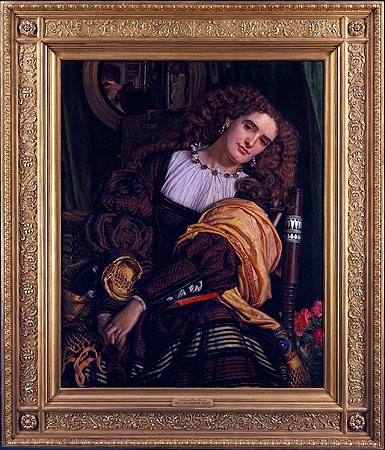 He's late. She leans back in her chair, stares into the fire, watching the quiet dance of its flames. The book at her knee is forgotten. Her mind wanders, imagining what it would be like to live like this, winter evenings spent at home, the soft certainty of domestic peace.
Lost in the daydream, her face is beautiful, the guilelessness of its repose belying her jewels and her dress. The glow of the fire fills the room with a kind of contentment. It is a lovely scene, made even more lovely by the knowledge that any moment now he will arrive and the trance will be broken, the illusion dissolved.
The painting is William Holman Hunt's Il Dolce Far Niente from an exhibition of Hunt's work at the Minneapolis Institute of Art.
Now, personally, I've never been big on the Pre-Raphaelites. They're nice enough, I suppose, but their work always strikes me as a little stodgy and well, Victorian, lacking the weight of the old Masters, the passion of the Impressionists and the wit and inventiveness of modern art. Still, there's something charming about an exhibition that includes scenes from Keats (The Flight of Madeline and Porphyro) and Shakespeare (Claudio and Isabella) instead of the usual biblical fare [1]. And Hunt is an exquisite draftsman, with an eye for telling detail, and an ability to capture emotion, even if his pallette strikes me as a little garish [2].
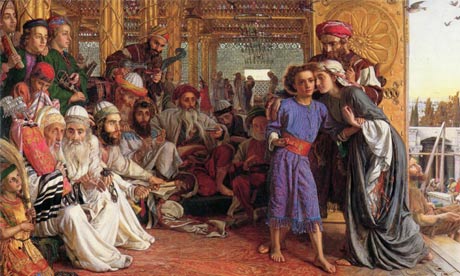
These qualities are perhaps best seen in Hunt's Finding of the Savior at the Temple (above). The group of Elders at the left is done in a way that would make the Old Masters proud - combining near photographic realism with a richness of variety and detail - and the figure of Mary clasping her son perfectly conveys both relief and solicitude. The boy Christ is hypnotic: burning with self-confidence and inner strength he stands free of all around him, effortlessly dominating the scene; yet for all that he is an unidealised figure, a portrait of an innocent and beautiful, vaguely middle-eastern twelve year old. But what makes the painting for me is the figure of the beggar sitting just outside the door, the perfect counterpoint to the lavish interior of the temple and a depiction (along with the figures in the right background, putting together what looks like a white coffin) of the distance between the reality of human suffering and the power-hungriness of organized religion. Mary's gesture of drawing her son away is thus two-fold, both the act of a mother concerned for her son, and a reminder, perhaps, that the true savior's place is not among the priests, disputing matters of metaphysics, but among the suffering and the needy.
Glorious as this painting is, however, it is easily outshone by Hunt's Lady of Shalott (below), easily the finest work on display at the MIA exhibition. I've always associated Tennyson's poem with another painting of the Lady, one by Waterhouse [3], but having seen Hunt's version I'm tempted to transfer my loyalties.
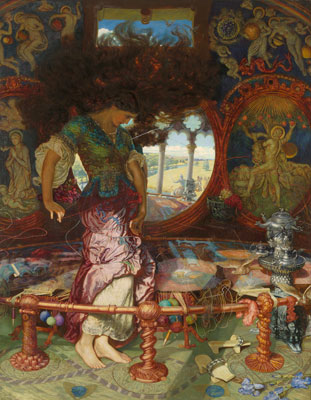
What makes this painting so vivid is the sheer violence of the scene, the sense, so perfectly conveyed, of a room, no, a world being shattered. The mirror cracks, the doves take off in panic, the flowers fall to the floor and the Lady's hair explode into a torch of raging fire, as if her senses had been set aflame. The Lady herself is tangled in thread from the weaving, thread that she is tugging off her, so that the painting becomes, literally, the portrait of a woman coming undone. And when you get past the first impact there are other, subtler touches. Like the depiction of Hercules picking the golden apples, with its echo of the fate of Atalanta, another occasion when a moment's break in concentration led to a permanent fall. Or the figure of Lancelot, so distant, so perfectly unaware, riding away in the sunshine of his freedom, seen in a mirror that is at once a porthole and a crystal ball. And is it just me, or does the pallette here look forward to Klimt, and don't those electric squiggles of yarn remind you of Pollock? The Lady of Shalott is an explosive, visionary work, one that makes a strong case for Hunt as a painter [4], and that, by itself, makes the MIA exhibition worth a visit.
[1] I'm particularly fond of the latter painting, because of the way Hunt sets up the contrast between Claudio's flashiness and Isabella's sobriety, a contrast echoed in reverse by the lyre hanging behind her shoulder and the chains lying at his feet.
[2] One result of this is that in many cases I find that I prefer the etchings that reproduce Hunt's paintings - some of which are included in the exhibition - to the paintings themselves.
[3] I'm told that Waterhouse's connection to the Pre-Raphaelites is a somewhat tenuous one, but to me he's very much part of the genre, and arguably my favorite of the lot.
[4] The exhibition focuses mostly on Hunt's work, though a few paintings by others are included: a couple of Dante Gabriel Rossetti's (notable only for the fact that it's not everyday you find a painting accompanied by two technically perfect sonnets describing it) and Arthur Hughes' Long Engagement, which is like a portrait of how the Arnolfinis would have turned out if they'd been too poor to marry.
Sunday, March 15, 2009
Hunger

(for Space Bar - because this is as visual as I get)
Did I mention that I just got back from the Philadelphia Art Museum's Cezanne and Beyond exhibition? (NY times slide show here)
Sunday, December 28, 2008
Nuts!
I feel sorry for Tchaikovsky. I really do. He's not a composer I'm too crazy about, but he's written some fine pieces and he certainly doesn't deserve to be reduced to the racist, sexist, nauseatingly saccharine kitsch that is the Balanchine version of the Nutcracker [1]. So here, in no particular order, are six alternate versions of the Nutcracker I would like to see:
1. Nutcracker as a drug rave
Herr Drosselmeier as a shifty pusher (he looks the part anyway) who brings Marie a bong for Christmas. Marie then proceeds to get seriously high, thus explaining the rest of the ballet: the snowflakes are cocaine, tea is tea, and the sugar plum fairy is, inevitably, the brown sugar fairy.
2. Minimalist Nutcracker
A performance of the Balanchine Nutcracker with no sets, no props and no costumes - everyone to wear plain black tights and dance on a bare stage. We'll soon see how impressive a ballet it is then.
3. The Mouse King
A performance of the Nutcracker which follows the usual script all the way to the fight scene between the Nutcracker and the Mouse King, only at that point the Mouse King kills the Nutcracker, wins Marie's Heart, and then spends the entire Second Act pillaging, looting and burning his way through the Land of Sweets, with the help of his faithful Mouse Commandos. Death to the Sugar Plum Fairy!
4. Hypothermic Nutcracker
A performance of the Nutcracker where Marie, frightened by the Mice, runs out into the snow and proceeds to freeze to her death. The entire second act consists of Marie lying at the front of the stage shivering with the cold at first, and then slowly falling into a coma, while the Balanchine version of the second act plays out behind a transparent screen and represents Marie's hallucinations while she dies. Ideally, the light behind the screen would slowly fade throughout the second act, so that by the time the pas de deux between the Sugar Plum Fairy and the Chevalier came on, the stage would be entirely dark and the audience would hear the music but see only the still form of Marie on stage.
5. Product Placement Nutcracker
A version of the Nutcracker where every dance in the second act is sponsored by, and modified to advertise, a specific Brand. So the Spanish dance becomes the Hershey's dance, the Arabian dance becomes the Starbucks dance, and so on. So much more honest.
6. The Subaltern Nutcracker
A rendering of the Nutcracker where the party scene is shown from the point of view of the serving maids. The scene opens with the stage divided into two halves - one half being the main party room (complete with presents and Christmas tree), the other being a smelly, grimy, kitchen where the household staff slaves away. The action in the 'party' half of the stage would exactly mimic the current Balanchine version, except that every time the serving maid crossed over into the kitchen area, the music would drop to half its volume and the party room would go dark.
[1] A version of which I found myself watching this afternoon - largely because it was the only ballet / opera / orchestra performance happening in the city during the holidays. It didn't help that the audience seemed to think they were at the circus rather than at a ballet and broke out into loud clapping every time anyone on stage executed a half-way difficult step. Sigh.
Thursday, November 13, 2008
A sad tale's best for winter
Just got back from a performance of Winter's Tale. Such a strange play: half Euripidean tragedy, half pastoral farce - the whole thing capped by that terrible, terrible ending, the entire final act making me squirm in my seat.
It's always seemed to me that if you took the first half of Winter's Tale and the second half of Pericles you'd have one genuinely good play. And it wouldn't be hard to do, either - the characters are more or less the same - just a few name changes, a slight tweaking of the plot (maybe the shepherd who finds Perdita - no, Mariana, so much sweeter a name - could sell her to a brothel when she came of age - this is Bohemia after all - where Florizel could find her) and Polixenes your uncle!
Still, even a play as relatively mediocre as the Winter's Tale has its moments. My personal favorite is the two lines in Act III Scene 2 where Leontes, faced with the oracle, proclaims it false and calls for the trial to proceed. It's a genuinely shocking moment, if only because you've been expecting that this is where the scales shall fall from Leontes' eyes, and his sudden outburst offers the possibility that perhaps that won't happen, that perhaps Leontes really shall go on, defying both the gods and dramatic necessity. I may be alone in thinking this, but I've always wished that Shakespeare had carried through on this, had subverted all the laws of Tragedy (which he's going to do anyway, with that sheepish fourth Act) and let the play turn darker and darker, Leontes growing more and more evil, eventually dying (or more likely being killed) without ever seeing the folly of his beliefs. Now that would have been a truly great play.
The other marvellous thing about Winter's Tale is the role of Paulina, easily the most interesting character in the play, and one of Shakespeare's most criminally overlooked heroines. I can't think of another female character in all of Shakespeare's plays who is as independent, as intelligent, or as resolutely asexual. It's fascinating that Shakespeare chooses to make the one person with the strength of character to stand up to Leontes a woman - a woman, moreover, who is her own person, holds her own ground without help from or need of a man, and emerges, by the end, as both the noblest and most sensible person in the play. All of which makes her, as women in Shakespeare go, unique.
There's also, of course, poor Antigonus - he of the 'exit pursued by bear' fame - who I've always felt gets treated most unfairly. All the poor guy is doing is following orders, both from his master and from the spirit of Hermoine, and yet he alone, of all the people in the play, meets a cruel and ignoble death. And what a death! Torn to pieces by a savage bear: "how the bear tore out his shoulder-bone, how he cried to me for help...how the poor gentleman roared and the bear mocked him". And all so Shakespeare can pair up Paulina and Camillo in the final scene (a plot twist I confess I'd completely forgotten). Talk about a raw deal.
Thursday, June 26, 2008
More Herakles
My other favorite part of Herakles starts at line 819. Herakles has returned from Hades, rescued his family, killed the evil tyrant who was threatening to kill them, and generally proved himself the true champion that he is. Everything looks set for a chorus-filled, they-all-lived-happily-ever-after ending. Then this happens:
- Euripides (trans. by Anne Carson)
And there you have it, girls and boys, a deus ex machina - literally - except one that comes, not to save the hero in his hour of need, but to punish him in his hour of triumph. And why must Herakles suffer? Not because he has done something wrong, not because it is his 'fate' - on the contrary, it is his destiny, ironically enough, that has been protecting him - but because Hera (and Iris!) doesn't like him, because "either gods are nothing and mortals prevail / or this man has to pay a price". The gods inflict pain not out of sport, which would be bad enough (remember "as flies to wanton boys"?), but because they are insecure. From this moment on, Herakles is doomed - he must kill his wife and children, pull down his house and emerge from the ruin of himself a broken man, limping reluctantly into immortality. And all so Hera can feel a little more important.
Has there ever been a playwright more pessimistic than Euripides?
The first time I read this episode, nearly a decade ago, I was disappointed in Euripides [1]. The whole thing struck me as being fairly clumsy. This, I thought, is not how tragedy works - true tragedy is an engine without mercy, that moves smoothly but surely towards its horrifying yet inevitable conclusion. And yet here was Euripides tacking on this arbitrary plot device, just to make the story come out right.
Reading the play again yesterday, and going over Carson's essays on this play and the three others that accompany it, it seems to me that what Euripides is doing here is actually rather brilliant. Subversive, but brilliant. Because arbitrary as the doom Iris pronounces may seem, is anything in classical tragedy really less contrived? Why, for instance, if the gods can cleanse mortals of bloodguilt, do they wait till the final act of the Oresteia before they call off the furies? By showing us the malice of the gods in all its pettiness, by making the interjection of fate seem gratuitious and cruel, Euripides strips tragedy of its lyric mask, makes suffering stand before us naked, shorn of all consolation, stripped to the bare lineaments of anger, humiliation and pain.
Carson, in her preface to Hekabe, cites Beckett (whom she compares Euripides to, aptly) on language, expressing his intention "To bore hole after hole in it,until what cowers behind it seeps through". This, it seems to me, is exactly what Euripides is doing: by placing a scene so dramatically transparent at the centre of his play, he is enabling us to see through the veneer of tragedy, to the corruption that lies growling behind.
(Tomorrow: Alkestis, and the notion of heroic sacrifice)
[1] My favorite Euripides play then, as now, is Hekabe. If, that is, a word like favorite can be applied to something so savage, so gloriously visceral.
Chorus
EA! EA! (cry)
Look!
Terror!
What kind of apparition is that above the house?
Run! Run! Lift your feet!
Lord Apollo protect me!
Iris
Calm down, old men.
This is Madness, daughter of the Night.
I am Iris, servant of the gods.
We do not come to harm your city.
Against one man we have a war to wage -
the so-called son of Zeus and Alkmene.
Until he finished with his bitter labors,
his destiny protected Herakles
and Zeus did not let me or Hera harm him.
But now he is done with the tasks of Eurystheus,
Hera wants to stain him in the blood
of his own children.
So do I.
Come then,
unmarriageable daughter of black Night,
make your heart hard.
Drive insanity into this man - throw
childkilling chaos into his mind and his jumping feet!
Pay out the rope of blood
by which he'll pull his children into Hades
with his own hand.
So he may come to know the rage of Hera,
my rage too!
Either gods are nothing and mortals prevail,
or this man has to pay a price.
- Euripides (trans. by Anne Carson)
And there you have it, girls and boys, a deus ex machina - literally - except one that comes, not to save the hero in his hour of need, but to punish him in his hour of triumph. And why must Herakles suffer? Not because he has done something wrong, not because it is his 'fate' - on the contrary, it is his destiny, ironically enough, that has been protecting him - but because Hera (and Iris!) doesn't like him, because "either gods are nothing and mortals prevail / or this man has to pay a price". The gods inflict pain not out of sport, which would be bad enough (remember "as flies to wanton boys"?), but because they are insecure. From this moment on, Herakles is doomed - he must kill his wife and children, pull down his house and emerge from the ruin of himself a broken man, limping reluctantly into immortality. And all so Hera can feel a little more important.
Has there ever been a playwright more pessimistic than Euripides?
The first time I read this episode, nearly a decade ago, I was disappointed in Euripides [1]. The whole thing struck me as being fairly clumsy. This, I thought, is not how tragedy works - true tragedy is an engine without mercy, that moves smoothly but surely towards its horrifying yet inevitable conclusion. And yet here was Euripides tacking on this arbitrary plot device, just to make the story come out right.
Reading the play again yesterday, and going over Carson's essays on this play and the three others that accompany it, it seems to me that what Euripides is doing here is actually rather brilliant. Subversive, but brilliant. Because arbitrary as the doom Iris pronounces may seem, is anything in classical tragedy really less contrived? Why, for instance, if the gods can cleanse mortals of bloodguilt, do they wait till the final act of the Oresteia before they call off the furies? By showing us the malice of the gods in all its pettiness, by making the interjection of fate seem gratuitious and cruel, Euripides strips tragedy of its lyric mask, makes suffering stand before us naked, shorn of all consolation, stripped to the bare lineaments of anger, humiliation and pain.
Carson, in her preface to Hekabe, cites Beckett (whom she compares Euripides to, aptly) on language, expressing his intention "To bore hole after hole in it,until what cowers behind it seeps through". This, it seems to me, is exactly what Euripides is doing: by placing a scene so dramatically transparent at the centre of his play, he is enabling us to see through the veneer of tragedy, to the corruption that lies growling behind.
(Tomorrow: Alkestis, and the notion of heroic sacrifice)
[1] My favorite Euripides play then, as now, is Hekabe. If, that is, a word like favorite can be applied to something so savage, so gloriously visceral.
Wednesday, June 25, 2008
The Madness of Herakles
"Then in his mind he saw a chariot,
mounted it, rode off,
lashing with an imaginary whip.
The servants were caught between laughter and panic -
glancing at one another -
"Is the master playing or has he gone mad?"
Up and down the rooms he ranged
and though he had come to the city of Nisos,
though he was in fact in the midst of his own house.
He lay on the floor and imagined he was feasting.
This went on awhile, then he claimed he was
approaching the Isthmos.
There he stripped himself naked
and engaged in a wrestling match with no one,
proclaiming himself victor over no one,
bowing to an audience of no one.
The roaring out curses at Eurystheus
he declared he'd come to Mykenai.
His father touched his hand and said,
"O child what's happening to you? What is this strangeness?"
Has the blood of your killings made you mad?"
But taking him for the father of Eurystheus
Herakles thrust him off
and got out his bow to use against the children -
thought they were Eurystheus' children -
darting in terror this way and that,
one to his mother's robes, one to the shade of a pillar,
on hunched under the altar like a little bird.
The mother screamed, "You are their father!
Do you kill your own sons?"
Then the old man screamed. The servants screamed.
But he circled the pillar to get at this son
and with a dreadful pivoting move
shot him right through the liver.
The child fell back
and stained the stones red.
Herakles let out a war cry:
"That's the first one dead of Eurystheus' litter -
to repay me for his father's abuse!"
- Euripides (translated by Anne Carson)
It's Euripides day here in Falstaff-land, as I read my way through not one but two new (well, relatively new) books of the man's work by two poets whose work I like - Medea by Robin Robertson and Grief Lessons (including Herakles, Hekuba, Hippolytos and Alkestis) by Anne Carson - the latter particularly valuable for the short essays that accompany the plays in which Carson, in her inimitable style, muses on Tragedy, war, Euripides and theater.
I particularly love this scene from Herakles - it's so vivid, so haunting, so perfectly balanced between laughter and horror, such a perfect microcosm of classical tragedy but also such a strikingly modern act of the imagination.
***
And speaking of translations, easily the most stunning translation I've read this year is A.E. Stallings' version of Lucretius' De Rerum Natura. To render a classic text in fluent translation is an achievement in itself, to do it all in heptameter is astonishing, but to put it in rhyming couplets and still make it sound natural is just plain unbelievable.
***
And finally, speaking of discoveries, I stumbled upon this thing called bigthink today - a sort of YouTube for ideas. I have my doubts about the whole thing (I don't get why you would want to take a group of people whose key expertise is expressing ideas and arguments in writing, and put up videos of them), but while it's up there you can go see Billy Collins talking about inspiration and how the great teachers of poetry are not in the classrooms but in the library.
Saturday, June 07, 2008
Paul Taylor Dance Company
And speaking of Violas, I caught a performance by the Paul Taylor Dance Company this afternoon, the highlight of which (well, for me at least) was a revival of Taylor's 1975 Esplanade - a spry, swirling piece that brings Bach's Violin Concerto in E Major and Concerto for Two Violins in D minor vividly to life. It's an exceptional work, that pays tribute to the leaping, tumbling energy of Bach's allegros even as it captures the exquisite harmony of his slow movements, his mastery of counterpoint. And watching Ms. Lisa Viola dance her lithe way through Bach's skipping passages was a real joy.
The real star of the show, though, was Ms. Annmaria Mazzini, who (sadly) didn't appear in Esplanade, but who featured in the two other pieces the company performed - Changes (2008) and Lines of Loss (2007) - and totally stole the show in both. In a review of the Company last year, Gia Kourlas compared Ms. Mazzini to "the big guitar solo at a rock concert", and it's not hard to see why. Her performance of 'California Earthquake' was the best thing about Taylor's new Changes - an otherwise predictable and lackluster piece - the sheer energy she radiated made the whole stage seem to vibrate, and her electric, in your face presence was the only fragment of genuine attitude in the whole show. And when she returned in Lines of Loss to perform an intense, heartbreaking solo to a mournful Schnittke slow movement, her dancing, though mirroring Ms. Viola's opening solo for the piece, deepened and transcended it, bringing to the repeated gestures a passion and urgency they hadn't had before.
***
On a somewhat unrelated note, what I'd love to see, just once, is a dance performance that really inverted gender roles - where the women lifted the men onto their shoulders / tossed them into the air / caught them as they leaped into their arms, etc. Okay, so I realize there are differences in weight and strength and all that, but still, it can't be that hard to do.
Monday, June 02, 2008
Painting of the Day # 2

Bronzino An Allegory with Venus and Cupid
A maelstrom of tortured forms dances around the central figures - Time, that old lecher, exposes and censors, is both outraged and envious, clutching his thin fabric; Decay looks on in hollow, speechless horror, Frustration howls in her corner and Folly, feigning innocence, watches with blank, basilisk eyes. A rubbish of doves and lions, of masks and snake skins strews the canvas. And in the midst of all this frenzy the two lovers rise, oblivious, rapt in each other, a statuary of flesh.
Am I the only one who thinks of Oedipus? Of Tragedy shrieking in the background as the two incestuous lovers, Mother and Son, embrace, watched over by a fatal innocence and lured on by the sly, child-faced Sphinx with her tail of a serpent and her lion's paw? And is the figure in the top left, that mask without substance, that face invented for the sake of its cry, not perhaps the Chorus, and the other figure, the balding, hoary old man who unveils this scene not Sophocles himself, appalled by what he has revealed?
***
I had ambitious plans for this blog today, I really did. I was going to review the new Coetzee novel, or tell you about all the other new Indian fiction I read over the weekend; I was going to talk about the poetry of Antjie Krog, who I'm just discovering, or describe the glorious weather here in Philly or the accident I saw from my window the other day. I was going to do all that, except then Amazon went and delivered my copy of The Enchantress of Florence, so I plan to spend the next few days drowning in Rushdie. Meanwhile, you can check out two gifts from the Guardian - the first, a Tsvetaeva poem translated by Elaine Feinstein, the second, a new collaborative fiction project featuring Ali Smith and Jeanette Winterson.
Saturday, May 31, 2008
Painting of the Day # 1
[okay, so I've realized that if I keep waiting to write full length posts about the galleries I visited, I'm never going to get done. So I figure I'll just throw in a painting a day and do longer posts on a couple of things - Nicholas Poussin, for instance, or the Dada exhibition at the Tate Modern]

That blue! Is it Life, snatched from the woman's shoulders by a sudden wind, crackling above her like an electric ghost? Or Death, claiming her like a lover, encircling her in the flickering smoke of his arms? Is it a man she flees, or just this mortal cloak?
Slowly we take in the other details: the woman to the right, who lies in a pool of the same shimmering blue (is she an unconscious companion, or a premonition of the corpse to come?); the spilled pot; the tiny figure of Orpheus in a nearby clearing, singing his songs to an audience of wild and mythic creatures (notice the Unicorn), oblivious of the tragedy that is soon to engulf him; the city with its temples and towers already starting to vanish into the haze; and, most remarkably, the distant churn of the landscape, where the water lies still and pale while the mountains boil in great scudding waves.
Niccollo dell'Abate The Death of Eurydice
That blue! Is it Life, snatched from the woman's shoulders by a sudden wind, crackling above her like an electric ghost? Or Death, claiming her like a lover, encircling her in the flickering smoke of his arms? Is it a man she flees, or just this mortal cloak?
Slowly we take in the other details: the woman to the right, who lies in a pool of the same shimmering blue (is she an unconscious companion, or a premonition of the corpse to come?); the spilled pot; the tiny figure of Orpheus in a nearby clearing, singing his songs to an audience of wild and mythic creatures (notice the Unicorn), oblivious of the tragedy that is soon to engulf him; the city with its temples and towers already starting to vanish into the haze; and, most remarkably, the distant churn of the landscape, where the water lies still and pale while the mountains boil in great scudding waves.
Subscribe to:
Posts (Atom)

 Posts


