Right. It's final then. Oscar and I are officially over. Finished. Kaput. You go your way and I go mine. I take the high road and you take the low.
The thing with the Oscar's is, every year I tell myself that it's just a stupid award ceremony, it doesn't mean anything, I shouldn't let it get to me. And then every year, come Oscar night I sit there raving saying No! No! You've got it all WRONG! Sigh. It's the sheer consistency of it that gets me, the way they manage to get everything but the most painfully obvious things wrong. I mean, for my money, you could get a group of three blindfolded monkeys to throw darts at the nominations and still get a more intelligent set of picks.
Okay, so I'm going to try and suspend judgement here, given that I haven't actually seen some of the stuff that won. So it's POSSIBLE that Reese Witherspoon, who has always struck me as the quintessential featherbrain, may actually have delivered a better performance than Felicity Huffman's glorious turn in Transamerica. And maybe, just maybe, Memoirs of a Geisha got all the art direction, cinematography type stuff right, even if, by all accounts, they managed to get everything else wrong (note to self: Never, ever watch a movie because it got 'Three Oscars' without first enquiring into what they were for). But Rachel Weisz? Best supporting actress? Really? On the theory, presumably, that the more emotion you show the better the performance, never mind if you play a self-sacrificing activist as a self-righteous little brat. Even George Clooney's performance in Syriana was more deserving, and the best I can say about that is that it was mostly harmless.
And fine, so I won't crib about Crash winning Best Picture because I actually thought it was a really good film [1], even though I think both Brokeback Mountain and Capote were better. But Best Original Screenplay? This is the same movie where all of Los Angeles is peopled by exactly twelve people and a thirteenth guy who turns out to be the twelfth guy's brother, right? I suppose I should be grateful that Munich didn't win for adapted screenplay - if they're rewarding the sacrifice of elementary logic for the sake of making some obscure political point, that would have been the most obvious pick.
Ah well. At least this way I'm sure some theatre in Philly will show me Tsotsi. Oh, and Wallace and Gromit won. Proof that even the Oscars haven't got to the point where they can overlook outright genius. Yet.
[1] Of course, it stands to reason that the one movie I watch and don't write a review of has to end up winning the Oscar for Best Picture.
Categories: Arts, Rant
Monday, March 06, 2006

Sunday, March 05, 2006
Goin' to Chicago : The Soundtrack
Who says only movies are allowed to have soundtrack? Personally, I've always felt that my life deserved nothing less than a soundtrack of its own.
In keeping with that notion, here are the Top 5 songs about travelling to Chicago [1]:
1. Count Basie: Going to Chicago Blues
When you see me coming
Raise your window high
When you see me coming
Raise your window high
When you see me passing
Hang your head down and cry.
2. Robert Johnson: Sweet Home Chicago
Baaaby, baby don't you want to go?
Baaaby, baby don't you want to go?
Back to that same old place
My sweet home Chicago
3. Led Zeppelin: When the Levee Breaks
Going, go’n’ to chicago,
Go’n’ to chicago,
Sorry but I can’t take you.
Going down, going down now, going down.
4. Crosby, Stills, Nash and Young: Chicago
Won't you please come to Chicago
Just to sing
5. Frank Sinatra: My Kind of Town
Chicago is
My kind of razzmatazz
And it has
All that jazz
Bonus Track:
Grateful Dead: Truckin'
Arrows of neon and flashing marquees out on main street.
Chicago, New York, Detroit and it’s all on the same street.
Your typical city involved in a typical daydream
Hang it up and see what tomorrow brings.
Coming Soon:
Leavin' Chicago: The Soundtrack (MR, talk about upcoming releases, heh.)
featuring the inimitable talents of Muddy Waters and ZZ Top
[1] Yes, indeed, I'm Chicago bound. Leaving tomorrow. Back in a week. I'd like to say that this means I might be blogging with less frequency. But really, who I am kidding?
Categories: Personal, Arts
In keeping with that notion, here are the Top 5 songs about travelling to Chicago [1]:
1. Count Basie: Going to Chicago Blues
When you see me coming
Raise your window high
When you see me coming
Raise your window high
When you see me passing
Hang your head down and cry.
2. Robert Johnson: Sweet Home Chicago
Baaaby, baby don't you want to go?
Baaaby, baby don't you want to go?
Back to that same old place
My sweet home Chicago
3. Led Zeppelin: When the Levee Breaks
Going, go’n’ to chicago,
Go’n’ to chicago,
Sorry but I can’t take you.
Going down, going down now, going down.
4. Crosby, Stills, Nash and Young: Chicago
Won't you please come to Chicago
Just to sing
5. Frank Sinatra: My Kind of Town
Chicago is
My kind of razzmatazz
And it has
All that jazz
Bonus Track:
Grateful Dead: Truckin'
Arrows of neon and flashing marquees out on main street.
Chicago, New York, Detroit and it’s all on the same street.
Your typical city involved in a typical daydream
Hang it up and see what tomorrow brings.
Coming Soon:
Leavin' Chicago: The Soundtrack (MR, talk about upcoming releases, heh.)
featuring the inimitable talents of Muddy Waters and ZZ Top
[1] Yes, indeed, I'm Chicago bound. Leaving tomorrow. Back in a week. I'd like to say that this means I might be blogging with less frequency. But really, who I am kidding?
Categories: Personal, Arts
Saturday, March 04, 2006
Comment on that
boss i am disappointed in
some of your readers they
are always asking how does
archy work the shift so as to get a
new line or how does archy do
this or do that they
are always interested in technical
details when the main question is
whether the stuff is
literature or not
- don marquis, 'mehitabel was once cleopatra' [1]
You know. It had been a while since I'd put any poetry. And well, it's been that kind of a day. Cockroaches of the world unite. You have nothing to lose but your...SQUISH!
[1] from the delightful archy and mehitabel
Categories: Whimsy, Poetry
some of your readers they
are always asking how does
archy work the shift so as to get a
new line or how does archy do
this or do that they
are always interested in technical
details when the main question is
whether the stuff is
literature or not
- don marquis, 'mehitabel was once cleopatra' [1]
You know. It had been a while since I'd put any poetry. And well, it's been that kind of a day. Cockroaches of the world unite. You have nothing to lose but your...SQUISH!
[1] from the delightful archy and mehitabel
Categories: Whimsy, Poetry
Friday, March 03, 2006
In the summer, when it drizzles
Another of Shoe-fiend's insidious little assignments:

He dropped the sausages into the smoking oil, and listened to them sizzle. It was a sound he loved, the sharpness of it, the indignation. Like the hissing of some snake, roused rudely from sleep.
I love the sausage in the saucepan, when it sizzles. Wait, who'd said that? It was her, wasn't it? He'd been standing here, in this very kitchen, cooking frankfurters for brunch and she'd suddenly broken out into song. I love the sausage at our lunchtime. Yes, that's right, he remembered now. It must have been a Sunday. He'd called her over first thing in the morning so they could listen to his new Ella LP. Ella Fitzgerald's Greatest Hits. Such a glorious album. He wondered where it was now. They used to listen to it all the time. But that time, the one when she sang the song, was the first. I love the sausage when it fries. He chuckled softly to himself. How much they'd laughed then. How they'd spent the rest of the day making up stupid parodies like that. 'Say it's only a bacon rind / Frying over a non-stick pan'; 'I've got you under my spoon'; 'How high the stove', 'Bacon Street Blues'. And this one of course, the one she came up with first. I love the sausage in the summer, when it drizzles.
Yes, she loved it when it drizzled. She used to go stir-crazy when it rained. He still remembered the first time she'd suggested going out to get wet in it. How much the idea had shocked him then. Two decades of being a good little boy, the kind who knows better than to catch a cold by getting drenched in the rain, had rebelled against it. Two decades of being proper, coupled with an instinctive suspicion of anything that felt like it came out of a Gene Kelly movie. He'd opened his mouth to say no and realised that she was already out there, on the terrace, dancing about in the downpour. Her shirt clinging to her like a kind of white, transparent happiness. Seeing that slight figure give itself entirely to the monsoon, watching the swirling grace of it, he had a sudden vision of what spontaneity must look like. Then she had come running back to him again, her lips mouthing words he couldn't quite make out, her hand taking his. How could he resist her then? He stumbled after her, an anxious smile on his lips, feeling his inhibitions drain from him, a sense of abandon soak him through. That feeling that tells you that is no longer possible to go further than you have already come, get any wetter than you already are. He threw back his head and felt the raindrops on his eyelids, and he laughed, feeling the joy of that moment drip from his hair, the happiness trickled down through his clothes, all the way to his feet.
Yes, those were good times. He turned the sausages over, exposing the charred side. It had been weeks now since he'd had an e-mail from her. He supposed she was busy, what with the new baby and all. Still, she could write. The sausages were starting to stick together. He teased them apart, pushed them to opposite ends of the pan. Maybe he should try calling her. It would be good to hear her voice again. He looked at the sausages. He had time. He could at least go get her number.
He opened his little notebook and stared at the page that had her numbers on it. There were so many of them, most of them crossed out now. Like the scars of old wounds. Her home number, from when she still lived with her parents, for instance. The way her brother would hang up if he heard a male voice asking for her. Remember the time he'd been trying to call her from that PCO booth in Rajahmundry? He'd finally had to pay the woman who ran the PCO to get on the phone and ask for her. And that one, the number of that sub-let in Germany, the one where the landlady didn't speak any English. "Errr...Enschuldigen Sie. Ich mochte en fraulein sprachen, bitte?" That had been a nuisance. And her boyfriends, of course. A whole string of them. Not that he'd ever called any of them. Still, it was good to have the numbers. "In case of an emergency", she said. "You mean like if I'm re-reading Plath and get carried away?"."Idiot." He used to threaten her that if she didn't take his calls he would call up her then boyfriend (whoever he might be) and tell him all about 'us'. Not that there was ever anything to tell, of course.
The smell of burning meat finally made it through to his brain. The sausages! He'd completely forgotten them! The kitchen was filled with grey, greasy smoke. He opened the windows and the smell of wet earth greeted him. It had grown cloudy without his noticing it. It was starting to rain, the first few drops just marking out the earth with their careful decimals. In the summer, when it drizzles. No, wait, that was wrong, wasn't it? It sizzled when it was summer; it must have been winter when it drizzled. He stared at the sausages, examining them. It would take too long to make something else for lunch now. They weren't THAT badly burnt. They would have to do.
The smoke in the kitchen was clearing now. The rain had started up in earnest. On an impulse he scraped the sausages onto a plate, dumped the frying pan in the sink, and, stopping only to take his keys with him, went running up to the terrace. It's been too long since I've done this, he thought to himself, opening his arms to the rain. The children on the roof opposite were staring at him, taking in his tucked in shirt, his expensive looking trousers. What was a thirty year old man, a grown-up, doing prancing about in the rain, you could hear them thinking. He waved at them.
Behind him, on the kitchen counter, the sausages grew slowly cold.
Categories: Fiction

He dropped the sausages into the smoking oil, and listened to them sizzle. It was a sound he loved, the sharpness of it, the indignation. Like the hissing of some snake, roused rudely from sleep.
I love the sausage in the saucepan, when it sizzles. Wait, who'd said that? It was her, wasn't it? He'd been standing here, in this very kitchen, cooking frankfurters for brunch and she'd suddenly broken out into song. I love the sausage at our lunchtime. Yes, that's right, he remembered now. It must have been a Sunday. He'd called her over first thing in the morning so they could listen to his new Ella LP. Ella Fitzgerald's Greatest Hits. Such a glorious album. He wondered where it was now. They used to listen to it all the time. But that time, the one when she sang the song, was the first. I love the sausage when it fries. He chuckled softly to himself. How much they'd laughed then. How they'd spent the rest of the day making up stupid parodies like that. 'Say it's only a bacon rind / Frying over a non-stick pan'; 'I've got you under my spoon'; 'How high the stove', 'Bacon Street Blues'. And this one of course, the one she came up with first. I love the sausage in the summer, when it drizzles.
Yes, she loved it when it drizzled. She used to go stir-crazy when it rained. He still remembered the first time she'd suggested going out to get wet in it. How much the idea had shocked him then. Two decades of being a good little boy, the kind who knows better than to catch a cold by getting drenched in the rain, had rebelled against it. Two decades of being proper, coupled with an instinctive suspicion of anything that felt like it came out of a Gene Kelly movie. He'd opened his mouth to say no and realised that she was already out there, on the terrace, dancing about in the downpour. Her shirt clinging to her like a kind of white, transparent happiness. Seeing that slight figure give itself entirely to the monsoon, watching the swirling grace of it, he had a sudden vision of what spontaneity must look like. Then she had come running back to him again, her lips mouthing words he couldn't quite make out, her hand taking his. How could he resist her then? He stumbled after her, an anxious smile on his lips, feeling his inhibitions drain from him, a sense of abandon soak him through. That feeling that tells you that is no longer possible to go further than you have already come, get any wetter than you already are. He threw back his head and felt the raindrops on his eyelids, and he laughed, feeling the joy of that moment drip from his hair, the happiness trickled down through his clothes, all the way to his feet.
Yes, those were good times. He turned the sausages over, exposing the charred side. It had been weeks now since he'd had an e-mail from her. He supposed she was busy, what with the new baby and all. Still, she could write. The sausages were starting to stick together. He teased them apart, pushed them to opposite ends of the pan. Maybe he should try calling her. It would be good to hear her voice again. He looked at the sausages. He had time. He could at least go get her number.
He opened his little notebook and stared at the page that had her numbers on it. There were so many of them, most of them crossed out now. Like the scars of old wounds. Her home number, from when she still lived with her parents, for instance. The way her brother would hang up if he heard a male voice asking for her. Remember the time he'd been trying to call her from that PCO booth in Rajahmundry? He'd finally had to pay the woman who ran the PCO to get on the phone and ask for her. And that one, the number of that sub-let in Germany, the one where the landlady didn't speak any English. "Errr...Enschuldigen Sie. Ich mochte en fraulein sprachen, bitte?" That had been a nuisance. And her boyfriends, of course. A whole string of them. Not that he'd ever called any of them. Still, it was good to have the numbers. "In case of an emergency", she said. "You mean like if I'm re-reading Plath and get carried away?"."Idiot." He used to threaten her that if she didn't take his calls he would call up her then boyfriend (whoever he might be) and tell him all about 'us'. Not that there was ever anything to tell, of course.
The smell of burning meat finally made it through to his brain. The sausages! He'd completely forgotten them! The kitchen was filled with grey, greasy smoke. He opened the windows and the smell of wet earth greeted him. It had grown cloudy without his noticing it. It was starting to rain, the first few drops just marking out the earth with their careful decimals. In the summer, when it drizzles. No, wait, that was wrong, wasn't it? It sizzled when it was summer; it must have been winter when it drizzled. He stared at the sausages, examining them. It would take too long to make something else for lunch now. They weren't THAT badly burnt. They would have to do.
The smoke in the kitchen was clearing now. The rain had started up in earnest. On an impulse he scraped the sausages onto a plate, dumped the frying pan in the sink, and, stopping only to take his keys with him, went running up to the terrace. It's been too long since I've done this, he thought to himself, opening his arms to the rain. The children on the roof opposite were staring at him, taking in his tucked in shirt, his expensive looking trousers. What was a thirty year old man, a grown-up, doing prancing about in the rain, you could hear them thinking. He waved at them.
Behind him, on the kitchen counter, the sausages grew slowly cold.
Categories: Fiction
Freezing Rain
Right. Enough politics. When Mumbai Mirror starts quoting you, you know it's time you got back to what really mattered. Like the weather, for instance.
Don't you just hate it when they describe the weather outside as freezing rain? I mean, snow I can handle. Snow is like one of those big fluffy dogs that look like they might have polar bear blood in them - the kind that are all cute and loving and stuff, and will come and put their paws on your shoulder (while you're standing up) and proceed to lick you till you feel like a postage stamp. Snow is like that - like some big fuzzy animal that you don't really want to have deal with, but can't really find it in your heart to feel indignant about.
Freezing rain is another proposition entirely. The very name makes you think of some angular sharp-tongued geography teacher. Or some stepmother in a fairy tale. Freezing rain. Why do they have to add the adjective anyway? Couldn't they just say rain and leave it at that? We all know what the temperature is outside, we can figure it out. But no, the weather channel people have to rub this in, don't they? You can see them rubbing their mittened hands in glee. The sadists. What can you expect from people who give hurricanes the names of young girls.
Fortunately, on days like this, one always has one's inner resources to fall back on. Said resources consisting mostly of copious quantities of hot chocolate, and a stunning recording one recently acquired of Horowitz playing Schubert and Chopin. Glorious.
Categories: Miscellaneous
Don't you just hate it when they describe the weather outside as freezing rain? I mean, snow I can handle. Snow is like one of those big fluffy dogs that look like they might have polar bear blood in them - the kind that are all cute and loving and stuff, and will come and put their paws on your shoulder (while you're standing up) and proceed to lick you till you feel like a postage stamp. Snow is like that - like some big fuzzy animal that you don't really want to have deal with, but can't really find it in your heart to feel indignant about.
Freezing rain is another proposition entirely. The very name makes you think of some angular sharp-tongued geography teacher. Or some stepmother in a fairy tale. Freezing rain. Why do they have to add the adjective anyway? Couldn't they just say rain and leave it at that? We all know what the temperature is outside, we can figure it out. But no, the weather channel people have to rub this in, don't they? You can see them rubbing their mittened hands in glee. The sadists. What can you expect from people who give hurricanes the names of young girls.
Fortunately, on days like this, one always has one's inner resources to fall back on. Said resources consisting mostly of copious quantities of hot chocolate, and a stunning recording one recently acquired of Horowitz playing Schubert and Chopin. Glorious.
Categories: Miscellaneous
Wednesday, March 01, 2006
The serial opponent
It was the day the World Social Forum 2004 opened. Of the many speakers who spoke that night, two stand out in my memory. The first was the incredible Shirin Ebadi, whose speech, like so many other speeches that day, served only to reaffirm the need for continued effort in the area of human rights and the importance of building stronger ties through forums like the WSF. It wasn't a particularly striking speech - what made it memorable was the way it was delivered, the quiet dignity of the speaker, the sense you got that every word had been carefully weighed and considered, drawing upon long years of experience fighting, and winning against, injustice.
The other speech I remember from that evening was Arundhati Roy's. Ms. Roy's speech was anything but quiet or dignified - it consisted, if memory serves, of exhorting the assembled public to direct, even violent protest against all MNCs; Ms. Roy's argument being that these companies (which included, as I remember it, Coke and Pepsi) were profiteering off the war in Iraq and as such were fair game for attack (the irony of proposing violent protest against - presumably - innocent managers in local MNC offices in order to protest the US invasion of Iraq had apparently not occured to Ms. Roy). Two things struck me about this speech. The first was the stirring effectiveness with which it was delivered - the quality of speech writing, the feel for the dramatic. The second was the sheer irrationality and empty-headedness of the argument being made once you got past the verbal fireworks. It wasn't just that what Ms. Roy was suggesting was impractical (I'm all for idealism) it was that what she was saying was ridiculous both morally and intellectually.
The contrast between these two speeches, throws into sharp relief for me the reason I have a low opinion of Ms. Roy. It seems to me that Ms. Roy has no real opinion (to the extent that an opinion can be defined as a reasoned and consistent set of ideas) all she has is a certain amount of literary talent and an overblown attitude. Protest, in Ms. Roy's world, is to be valued for its own sake and need not, therefore, be linked to either a coherent reason for protesting or a potential outcome to be achieved from the protest. There's something very adolescent in this - Ms. Roy has the petulant and combative self-righteousness of a teenager desperate to be allowed to sit with grown-ups.
Take her new piece in the Hindu protesting George Bush's visit to India, for instance. The entire piece is one long collection of indignant non sequiturs from start to finish. George Bush, we are told, is coming on a "triumphalist tour" to "wave imperiously at people he considers potential subjects". Huh? When did that happen? Last time I checked the purpose of his visit was to discuss a hugely sensitive nuclear deal, not to crow over the conquered locals like some decadent Roman emperor.
This gem of hyperbole is followed by a long rant about the venue of Bush's public address in Delhi - the Old Fort - a diatribe that, not content with being gratuitiously insulting to Bush (and showing off Ms. Roy's deep and analytical understanding of the local fauna) includes a set of incoherent pot-shots at the "rich folk who live in our poor country like caged animals" who are, apparently, "protecting themselves from the threat of vulgar and unruly multitudes whom they have systematically dispossessed over the centuries." What? Never mind the irrelevance of the venue of Bush's speech, or the speech itself. Never mind the questionable factual basis for assuming that the only people at this speech will be rich capitalists (one would have thought bureaucrats and politicians would make up large chunks of the audience. Oh, and journalists.). Never mind the long and tortuous debate about the merits of capitalism / free market and the benefits of these systems for the nation's economic development. Never mind the engrossing question of how, in a land that has been independent for a little under 60 years, and liberalised for a little over a decade, corporate CEOs could have been dispossessing the people for centuries. Never mind that many of those CEOs may be as opposed to Bush's foreign policy as Ms. Roy herself. Why in god's name is this woman ranting about India's internal socio-economic inequalities in an Op-Ed column on Bush's visit? What's the connection? Can this woman stick to a point? Does she have one?
Oh, but it gets better. Just in case you felt the issue of venues Bush will visit had not been developed enough, Ms. Roy spends the last paragraph of her 'opinion' piece arguing against Bush's visit to another venue - Gandhi's memorial at Rajghat. Millions of Indians, we are told, will wince at this. Make that a million less one. How does it matter what bogus PR stunts Bush pulls, or whether he does or does not place flowers on a stupid slab of stone? What could that possibly have to do with the real and potentially frightening outcomes of Bush's visit? If millions of Indians want to wince over his visit let them wince if / when he signs a deal that helps India take her nuclear program forward.
That deal, and its ramifications, incidentally, aren't even mentioned in Ms. Roy's article. Apparently, what the primates in Delhi Zoo think of Bush are, to her, of more immediate and pressing interest. "It is not in our power to stop Bush's visit. It is in our power to protest it, and we will.", Ms. Roy finally declares. But in her entire piece she gives us no reason to protest his visit. If Bush's visit is to be protested, it should, hopefully, be for a reason better than proving that such protest is possible. What an issue that warrants such a protest might be, unfortunately, Ms. Roy sheds no light on, blithely assuming that anyone reading her piece must already agree with her point of view on this (though, of course, in that case, there really isn't much point to the article, is there?). What then, is she protesting? Bush's existence on Earth? The possibility of transatlantic flight? And this is the sort of idiocy that what is arguably the country's most intelligent newspaper prints under the heading Opinion / News ANALYSIS!!! [1]
Don't misunderstand me. I'm as opposed to Bush's foreign policies as anyone, and am entirely with Ms. Roy in describing him as a war-monger and terrorist. But that's precisely why I find Ms. Roy's piece so irritating. With so many good reasons to criticise Bush available, why pick on a bunch of things that make no difference to anyone, and reinforce the stereotype that Bush protesters are just airhead liberals who rant about anything and everything. To begin with, if we are protesting anything at all, it should be specific decisions or actions that Bush might take in India, not the fact that he's visiting India at all. If that visit per se is cause for protest then are we to assume that it is Ms. Roy's position that we should never meet with our enemies, never engage in any sort of meaningful dialogue with them whatsoever? That the very presence of someone whose policies elsewhere and/ or in the past we disagree with is cause for protest. How is that going to bring us any closer to a reasonable solution of the world's problems? It is my personal belief that if we are to make any progress at all, we must put our faith in a discussion of the issues, not in this sort of blind antipathy to anything and everything associated with those we oppose, not in this sort of boorish sniping.
Ms. Roy would like to believe, no doubt, that she is an activist. That, in my opinion, is false. Activists are people who bring courage and determination to finding meaningful solutions to real problems in a carefully considered way. People who will say any old thing to get their audience worked up against the other side are just rabble rousers. Ms. Roy may have a great facility with words (though, personally, I found even the writing here fairly jarring - what was with the long drawn out animal motif; and that incredibly obvious quail hunting joke?) but that's no substitute for honest content. And the sooner we stop taking her seriously, the sooner we're going to be able to engage in real debate on real issues again.
[1] By way of contrast, read this editorial in the NY Times about Bush's visit to India.
Categories: CurrentAffairs, Rant
The other speech I remember from that evening was Arundhati Roy's. Ms. Roy's speech was anything but quiet or dignified - it consisted, if memory serves, of exhorting the assembled public to direct, even violent protest against all MNCs; Ms. Roy's argument being that these companies (which included, as I remember it, Coke and Pepsi) were profiteering off the war in Iraq and as such were fair game for attack (the irony of proposing violent protest against - presumably - innocent managers in local MNC offices in order to protest the US invasion of Iraq had apparently not occured to Ms. Roy). Two things struck me about this speech. The first was the stirring effectiveness with which it was delivered - the quality of speech writing, the feel for the dramatic. The second was the sheer irrationality and empty-headedness of the argument being made once you got past the verbal fireworks. It wasn't just that what Ms. Roy was suggesting was impractical (I'm all for idealism) it was that what she was saying was ridiculous both morally and intellectually.
The contrast between these two speeches, throws into sharp relief for me the reason I have a low opinion of Ms. Roy. It seems to me that Ms. Roy has no real opinion (to the extent that an opinion can be defined as a reasoned and consistent set of ideas) all she has is a certain amount of literary talent and an overblown attitude. Protest, in Ms. Roy's world, is to be valued for its own sake and need not, therefore, be linked to either a coherent reason for protesting or a potential outcome to be achieved from the protest. There's something very adolescent in this - Ms. Roy has the petulant and combative self-righteousness of a teenager desperate to be allowed to sit with grown-ups.
Take her new piece in the Hindu protesting George Bush's visit to India, for instance. The entire piece is one long collection of indignant non sequiturs from start to finish. George Bush, we are told, is coming on a "triumphalist tour" to "wave imperiously at people he considers potential subjects". Huh? When did that happen? Last time I checked the purpose of his visit was to discuss a hugely sensitive nuclear deal, not to crow over the conquered locals like some decadent Roman emperor.
This gem of hyperbole is followed by a long rant about the venue of Bush's public address in Delhi - the Old Fort - a diatribe that, not content with being gratuitiously insulting to Bush (and showing off Ms. Roy's deep and analytical understanding of the local fauna) includes a set of incoherent pot-shots at the "rich folk who live in our poor country like caged animals" who are, apparently, "protecting themselves from the threat of vulgar and unruly multitudes whom they have systematically dispossessed over the centuries." What? Never mind the irrelevance of the venue of Bush's speech, or the speech itself. Never mind the questionable factual basis for assuming that the only people at this speech will be rich capitalists (one would have thought bureaucrats and politicians would make up large chunks of the audience. Oh, and journalists.). Never mind the long and tortuous debate about the merits of capitalism / free market and the benefits of these systems for the nation's economic development. Never mind the engrossing question of how, in a land that has been independent for a little under 60 years, and liberalised for a little over a decade, corporate CEOs could have been dispossessing the people for centuries. Never mind that many of those CEOs may be as opposed to Bush's foreign policy as Ms. Roy herself. Why in god's name is this woman ranting about India's internal socio-economic inequalities in an Op-Ed column on Bush's visit? What's the connection? Can this woman stick to a point? Does she have one?
Oh, but it gets better. Just in case you felt the issue of venues Bush will visit had not been developed enough, Ms. Roy spends the last paragraph of her 'opinion' piece arguing against Bush's visit to another venue - Gandhi's memorial at Rajghat. Millions of Indians, we are told, will wince at this. Make that a million less one. How does it matter what bogus PR stunts Bush pulls, or whether he does or does not place flowers on a stupid slab of stone? What could that possibly have to do with the real and potentially frightening outcomes of Bush's visit? If millions of Indians want to wince over his visit let them wince if / when he signs a deal that helps India take her nuclear program forward.
That deal, and its ramifications, incidentally, aren't even mentioned in Ms. Roy's article. Apparently, what the primates in Delhi Zoo think of Bush are, to her, of more immediate and pressing interest. "It is not in our power to stop Bush's visit. It is in our power to protest it, and we will.", Ms. Roy finally declares. But in her entire piece she gives us no reason to protest his visit. If Bush's visit is to be protested, it should, hopefully, be for a reason better than proving that such protest is possible. What an issue that warrants such a protest might be, unfortunately, Ms. Roy sheds no light on, blithely assuming that anyone reading her piece must already agree with her point of view on this (though, of course, in that case, there really isn't much point to the article, is there?). What then, is she protesting? Bush's existence on Earth? The possibility of transatlantic flight? And this is the sort of idiocy that what is arguably the country's most intelligent newspaper prints under the heading Opinion / News ANALYSIS!!! [1]
Don't misunderstand me. I'm as opposed to Bush's foreign policies as anyone, and am entirely with Ms. Roy in describing him as a war-monger and terrorist. But that's precisely why I find Ms. Roy's piece so irritating. With so many good reasons to criticise Bush available, why pick on a bunch of things that make no difference to anyone, and reinforce the stereotype that Bush protesters are just airhead liberals who rant about anything and everything. To begin with, if we are protesting anything at all, it should be specific decisions or actions that Bush might take in India, not the fact that he's visiting India at all. If that visit per se is cause for protest then are we to assume that it is Ms. Roy's position that we should never meet with our enemies, never engage in any sort of meaningful dialogue with them whatsoever? That the very presence of someone whose policies elsewhere and/ or in the past we disagree with is cause for protest. How is that going to bring us any closer to a reasonable solution of the world's problems? It is my personal belief that if we are to make any progress at all, we must put our faith in a discussion of the issues, not in this sort of blind antipathy to anything and everything associated with those we oppose, not in this sort of boorish sniping.
Ms. Roy would like to believe, no doubt, that she is an activist. That, in my opinion, is false. Activists are people who bring courage and determination to finding meaningful solutions to real problems in a carefully considered way. People who will say any old thing to get their audience worked up against the other side are just rabble rousers. Ms. Roy may have a great facility with words (though, personally, I found even the writing here fairly jarring - what was with the long drawn out animal motif; and that incredibly obvious quail hunting joke?) but that's no substitute for honest content. And the sooner we stop taking her seriously, the sooner we're going to be able to engage in real debate on real issues again.
[1] By way of contrast, read this editorial in the NY Times about Bush's visit to India.
Categories: CurrentAffairs, Rant
Okay, now I KNOW the US Army is desperate
You know all the cartoons in the papers that talk about military recruiters going after anyone and everyone?
Well, I just got a mail from the local recruiting officer asking me if I wanted to join the US Marine Corp.
Okay, technically, he's inviting me to join their summer training program for officers, which is apparently "the best management training program in America" according to (hold your breath!) Inc. Magazine, but the mail assures me that once I'm done with the course I should have no problem at all in going on to become a trained pilot flying "some of the most advanced tactical aircraft in the world" or, if I'd prefer it, I could choose to be a Lieutenant in the Marine Corp and "receive starting salaries of $40,000-49,000 a year plus incredible benefits" (which presumably include butch haircuts and the chance to get shot for some bogus political agenda).
All I can say is, I hope these idiots are better with targeting bombs than they are with e-mail. Otherwise a hell of a lot of innocent people are getting killed (oh, wait, that explains a lot. No wonder they invaded Iraq when they wanted to go after terrorists in Afghanistan).
Maybe I should consider it though (never mind that I'm not an undergraduate student, able-bodied, of sound mind, or a US citizen - all of which you need to be to qualify). I mean okay, so boot camp will be hell (the first forty five minutes of Full Metal Jacket flash through my head) but there may be situations where being a mean, green fighting machine may turn out to be handy. Like for my dissertation defense, for instance. Or when I'm trying to keep 70 year old grandmas from pushing in in front of me in the supermarket check-out line.
And hey, if Woody Allen could be a war hero in Love and Death, then this thing should be a cinch. After all, I'm taller. Plus I already know the official Marine Corp marching song. You know, the one by Tom Lehrer.
Categories: Personal
Well, I just got a mail from the local recruiting officer asking me if I wanted to join the US Marine Corp.
Okay, technically, he's inviting me to join their summer training program for officers, which is apparently "the best management training program in America" according to (hold your breath!) Inc. Magazine, but the mail assures me that once I'm done with the course I should have no problem at all in going on to become a trained pilot flying "some of the most advanced tactical aircraft in the world" or, if I'd prefer it, I could choose to be a Lieutenant in the Marine Corp and "receive starting salaries of $40,000-49,000 a year plus incredible benefits" (which presumably include butch haircuts and the chance to get shot for some bogus political agenda).
All I can say is, I hope these idiots are better with targeting bombs than they are with e-mail. Otherwise a hell of a lot of innocent people are getting killed (oh, wait, that explains a lot. No wonder they invaded Iraq when they wanted to go after terrorists in Afghanistan).
Maybe I should consider it though (never mind that I'm not an undergraduate student, able-bodied, of sound mind, or a US citizen - all of which you need to be to qualify). I mean okay, so boot camp will be hell (the first forty five minutes of Full Metal Jacket flash through my head) but there may be situations where being a mean, green fighting machine may turn out to be handy. Like for my dissertation defense, for instance. Or when I'm trying to keep 70 year old grandmas from pushing in in front of me in the supermarket check-out line.
And hey, if Woody Allen could be a war hero in Love and Death, then this thing should be a cinch. After all, I'm taller. Plus I already know the official Marine Corp marching song. You know, the one by Tom Lehrer.
Categories: Personal
Minia-chores
As usual, you need to blame Shoe-fiend. She keeps posting all these cool writing assignments on her blog, so that sooner or later a fellow can't resist the challenge. Her latest was to write a story in exactly 50 words (plus a title of upto 15 words; there was also some guff about it having to be a story or something, but hey, I'm not taking a class in this stuff). Anyway, here goes, and to make it more interesting, I've limited myself to a one word title as well:
Unsaved
Categories: Fiction
Unsaved
When the power failed, he realized he hadn’t saved a copy of the note. The one where he explained about his life. It was a good note. It had been a good life. He had been about it to finish it. He wondered if he could get it back now.
DumbShe says I have to stop talking to myself. It freaks her out, she says. No big deal. I mean, it’s not like I’m addicted or anything. Hell, I’ll do it right now: “I do solemnly swear never to talk to myself again”. There. How’s that for resolve?
Categories: Fiction
Tuesday, February 28, 2006
Hitting that button
"I fell not only into the habits but into the moods of the student day. Every morning I was hopeful, determined, energized by the campanile bells and by the smell of eucalyptus and by the day's projected accomplishments. On the way to breakfast I would walk briskly, breathe deeply, review my "plans" for the day: I would write five pages, return all calls, lunch on raisins and answer ten letters. I would at least read E.H. Gombrich. I would once and for all get the meaning of the word "structuralist". And yet every afternoon by four o'clock, the hour when I met my single class, I was once again dulled, glazed, sunk in an excess of carbohydrates and in my own mediocrity, in my failure - still, after twenty years - to "live up to" the day's possibilities."
- Joan Didion
Do you ever get the feeling that your life is on perpetual snooze? That all you're really doing is buying time, punching the clock that will let you go on the way you are a little longer, that will keep you from having to wake up to the reality of your days? And that death, by extension, would be just a really bad case of oversleeping?
Robert Lowell writes:
The man is killing time - there's nothing else.
No help now from the fifth of Bourbon
chucked helter-skelter into the river,
even its cork sucked under.
Stubbed before-breakfast cigarettes
burn bull's-eyes on the bedside table;
a plastic tumbler of alka seltzer
champagnes in the bathroom.
No help from his body, the whale's
warm-hearted blubber, foundering down
leagues of ocean, gasping whiteness.
The barbed hooks fester. The lines snap tight.
When he looks for neighbours, their names blur in the window,
his distracted eye sees only glass sky.
His despair has the galvanized colour
of the mop and water in the galvanized bucket.
Once she was close to him
as water to the dead metal.
He looks at her engagements inked on her calendar.
A list of indictments.
At the numbers in her thumbed black telephone book.
A quiver full of arrows.
Her absence hisses like steam,
the pipes sing...
even corroded metal somehow functions.
He snores in his iron lung,
and hears the voice of Eve,
beseeching freedom from the Garden's
perfect and ponderous bubble. No voice
outsings the serpent's flawed, euphoric hiss.
The cheese wilts in the rat-trap,
the milk turns to junket in the cornflakes bowl,
car keys and razor blades
shine in an ashtray.
Is he killing time? Out on the street,
two cops on horseback clop through the April rain
to check the parking meter violations -
their oilskins yellow as forsythia.
- Robert Lowell, 'The Drinker'
Sometimes it's fun to just turn over and wallow.
Categories: Whimsy
- Joan Didion
Do you ever get the feeling that your life is on perpetual snooze? That all you're really doing is buying time, punching the clock that will let you go on the way you are a little longer, that will keep you from having to wake up to the reality of your days? And that death, by extension, would be just a really bad case of oversleeping?
Robert Lowell writes:
The man is killing time - there's nothing else.
No help now from the fifth of Bourbon
chucked helter-skelter into the river,
even its cork sucked under.
Stubbed before-breakfast cigarettes
burn bull's-eyes on the bedside table;
a plastic tumbler of alka seltzer
champagnes in the bathroom.
No help from his body, the whale's
warm-hearted blubber, foundering down
leagues of ocean, gasping whiteness.
The barbed hooks fester. The lines snap tight.
When he looks for neighbours, their names blur in the window,
his distracted eye sees only glass sky.
His despair has the galvanized colour
of the mop and water in the galvanized bucket.
Once she was close to him
as water to the dead metal.
He looks at her engagements inked on her calendar.
A list of indictments.
At the numbers in her thumbed black telephone book.
A quiver full of arrows.
Her absence hisses like steam,
the pipes sing...
even corroded metal somehow functions.
He snores in his iron lung,
and hears the voice of Eve,
beseeching freedom from the Garden's
perfect and ponderous bubble. No voice
outsings the serpent's flawed, euphoric hiss.
The cheese wilts in the rat-trap,
the milk turns to junket in the cornflakes bowl,
car keys and razor blades
shine in an ashtray.
Is he killing time? Out on the street,
two cops on horseback clop through the April rain
to check the parking meter violations -
their oilskins yellow as forsythia.
- Robert Lowell, 'The Drinker'
Sometimes it's fun to just turn over and wallow.
Categories: Whimsy
Sunday, February 26, 2006
Baby Pictures / Next time, use the diaper on the other end
Okay, that's it. I swear, the next time some stupid couple sends me a picture of their newly-born I'm opening it in Photo Editor, replacing the head with the image of a pool of blood and sending it back to them with a note saying "Here's a picture of your baby. Headless."
I mean, what is it with these people, anyway? If they want to be that most disgusting sub-species of all - proud parents - let them do it in the privacy of their own homes. Why should they assume that I'm going to appreciate having pictures of their little monsters foisted on me - that too before breakfast (gah!)? I don't go around sending them pictures of disgusting things that come out of my body, do I? Well then.
At any rate, here are the Top Ten Ways to respond when someone sends you pictures of their baby:
1. "Ooh! That looks yummy! Is that marinara sauce? You must send me the recipe!"
2. "Isn't she cute!! I specially love the way she screws up her eyes. That's exactly the way her mother looks just before she reaches orgasm."
3. "That's terrible! I hope you're suing the hospital for malpractise. Let me know if you want me to start a petition or something."
4. "Nice. What breed is it?"
5. "Congratulations!! I took one look at the new bookshelf in the corner of that picture, and I just totally fell in love with it. It's so GORGEOUS! Did you get it from Ikea? How long did delivery take? How much did it weigh?"
6. "ARE YOU CRAZY?! Sending out pictures of your child on the Internet like that - all unprotected and everything! Don't you know how many viruses there are floating around on the Net. What will you do if your baby catches one of them through his picture?" (Hey, they just had a baby, how smart could they be?)
7. "I loved the pictures of your baby. In fact, I loved them so much that I posted them on E-bay for you. You now need to send your baby special delivery to Mr. Elmer Fruitshanks in Boise, Idaho. On the plus side, did you know your baby was worth $ 8.99?"
8. "I don't know. It's cute, but what is it trying to SAY?? Where's the urgency, where's the PASSION?? What happened to the aesthetic rebellion that marked so much of your earlier work? Try again. This time use more blue."
9. "Interesting. Just to put this in perspective, I'm enclosing a picture of a used condom. Which do YOU think is going to be easier to get rid off?"
10. "Thanks for your pictures. They were just the thing I was looking for. By the way, if you happen to be in New York next weekend, I'm giving a talk on the topic "Why Ugly People should not be allowed to Mate". It would be great if you could attend. Feel free to bring the baby."
Categories: Rant
I mean, what is it with these people, anyway? If they want to be that most disgusting sub-species of all - proud parents - let them do it in the privacy of their own homes. Why should they assume that I'm going to appreciate having pictures of their little monsters foisted on me - that too before breakfast (gah!)? I don't go around sending them pictures of disgusting things that come out of my body, do I? Well then.
At any rate, here are the Top Ten Ways to respond when someone sends you pictures of their baby:
1. "Ooh! That looks yummy! Is that marinara sauce? You must send me the recipe!"
2. "Isn't she cute!! I specially love the way she screws up her eyes. That's exactly the way her mother looks just before she reaches orgasm."
3. "That's terrible! I hope you're suing the hospital for malpractise. Let me know if you want me to start a petition or something."
4. "Nice. What breed is it?"
5. "Congratulations!! I took one look at the new bookshelf in the corner of that picture, and I just totally fell in love with it. It's so GORGEOUS! Did you get it from Ikea? How long did delivery take? How much did it weigh?"
6. "ARE YOU CRAZY?! Sending out pictures of your child on the Internet like that - all unprotected and everything! Don't you know how many viruses there are floating around on the Net. What will you do if your baby catches one of them through his picture?" (Hey, they just had a baby, how smart could they be?)
7. "I loved the pictures of your baby. In fact, I loved them so much that I posted them on E-bay for you. You now need to send your baby special delivery to Mr. Elmer Fruitshanks in Boise, Idaho. On the plus side, did you know your baby was worth $ 8.99?"
8. "I don't know. It's cute, but what is it trying to SAY?? Where's the urgency, where's the PASSION?? What happened to the aesthetic rebellion that marked so much of your earlier work? Try again. This time use more blue."
9. "Interesting. Just to put this in perspective, I'm enclosing a picture of a used condom. Which do YOU think is going to be easier to get rid off?"
10. "Thanks for your pictures. They were just the thing I was looking for. By the way, if you happen to be in New York next weekend, I'm giving a talk on the topic "Why Ugly People should not be allowed to Mate". It would be great if you could attend. Feel free to bring the baby."
Categories: Rant
Saturday, February 25, 2006
The Gathering
One by one, they gather around him, the old masters. The shuffling of their feet in the crowded room like the sound of papers shifting in a thin breeze. Their presence like a stifled cough.
They are all here - the grave and the shrill, the poetic and the profound, the daring and the sincere. Row upon row of them, forming a circle around his chair, enclosing him in their accumulated gravity.
Where have they all come from? Who has brought them here? And why? Or have they perhaps come unsummoned, sensing his need with an instinct for language as strong as a hound's for blood?
He realises there will be no excuse now. No reason he can give, no way to blame his own reluctance on the lack of another. In their assembled faces he sees a judgement that contains both wisdom and sternness. From what these voices have to offer, he knows, there will be no reprieve.
And yet what is it that he is supposed to learn from them, exactly? What is their advice, their message? Do they even have one? Are they not, rather, a crowd of stamping feet, muddying the precious clarity of the still puddle that is his mind? A collection of clear, swift rivers, that, taken together, make one restless sea?
The high brows of the masters frown down upon him. Yes, it is true. This too is an excuse. The truth is he ought to be grateful for their presence, grateful that they are here for him. He tries to listen to what they have to say. As their voices fill his head, he can feel himself being not rewritten, but erased, as though the page of his thought were turning blank, its whiteness taunting him to start anew.
When he is sure that there are enough of them (or as many as he can bear), he stands up from his chair and says "Thank you for coming. I am deeply grateful to have you with me."
People turn to stare at him. The librarian looks outraged, shushes him to silence. The books say nothing, their spines glowing softly in the ripened dusk.
Categories: Fiction, Whimsy
They are all here - the grave and the shrill, the poetic and the profound, the daring and the sincere. Row upon row of them, forming a circle around his chair, enclosing him in their accumulated gravity.
Where have they all come from? Who has brought them here? And why? Or have they perhaps come unsummoned, sensing his need with an instinct for language as strong as a hound's for blood?
He realises there will be no excuse now. No reason he can give, no way to blame his own reluctance on the lack of another. In their assembled faces he sees a judgement that contains both wisdom and sternness. From what these voices have to offer, he knows, there will be no reprieve.
And yet what is it that he is supposed to learn from them, exactly? What is their advice, their message? Do they even have one? Are they not, rather, a crowd of stamping feet, muddying the precious clarity of the still puddle that is his mind? A collection of clear, swift rivers, that, taken together, make one restless sea?
The high brows of the masters frown down upon him. Yes, it is true. This too is an excuse. The truth is he ought to be grateful for their presence, grateful that they are here for him. He tries to listen to what they have to say. As their voices fill his head, he can feel himself being not rewritten, but erased, as though the page of his thought were turning blank, its whiteness taunting him to start anew.
When he is sure that there are enough of them (or as many as he can bear), he stands up from his chair and says "Thank you for coming. I am deeply grateful to have you with me."
People turn to stare at him. The librarian looks outraged, shushes him to silence. The books say nothing, their spines glowing softly in the ripened dusk.
Categories: Fiction, Whimsy
Random Thought # 461
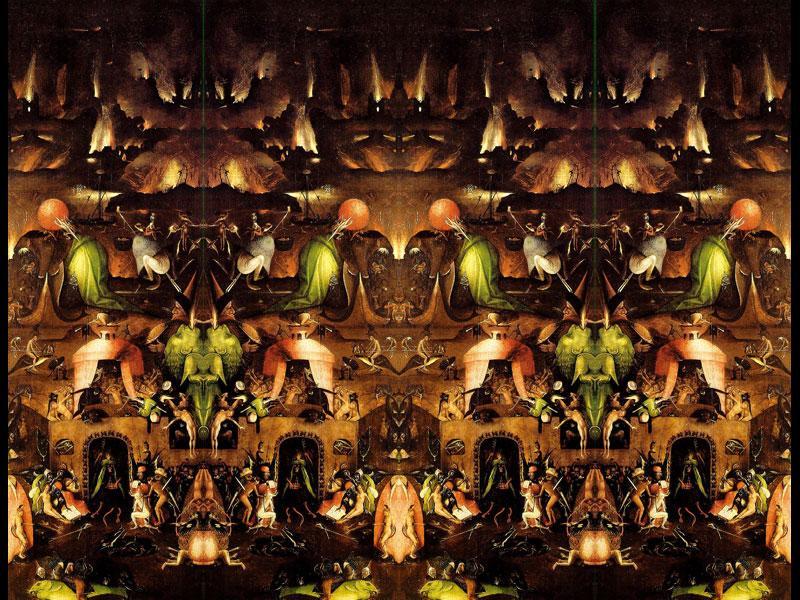
If there's a Hell, does it have ushers?
"Good evening, madam, may I help you? Ah, yes, let me see now. That would be in the fourth circle, centre section. Walk up these stairs here - it's the 214th row from the back, you'll be next to that gentlemen with the leeches stuck all over his naked body. You're welcome. Have an unpleasant eternity!"

Categories: Whimsy
"Good evening, madam, may I help you? Ah, yes, let me see now. That would be in the fourth circle, centre section. Walk up these stairs here - it's the 214th row from the back, you'll be next to that gentlemen with the leeches stuck all over his naked body. You're welcome. Have an unpleasant eternity!"
Categories: Whimsy
Pastoral
You know that feeling when you're sitting with someone you love on a quiet evening, by a fireplace, and you run your fingers fondly through her hair, feeling the smoothness of it, the familiar shape of the skull underneath, the remembered groove of the skin behind her ear? The way you let your fingers linger on nape of her neck and instant longer than necessary, so that that one moment of touch carries with it a lifetime of longing, of intimacy?
That's how Christoph Eschenbach conducted Beethoven's Sixth tonight - like the caress of an old friend. It was a fascinating performance - one that made up in serenity and languor what it lacked in momentum. Here was no surprise, no sudden lark of a note soaring high into the air, instead there was the sense of great calm that is nature's, the sound of it soothing, almost consoling. As though Eschenbach, knowing full well that everyone in his audience would have heard the Sixth before, decided to bring out the nostalgia in Beethoven's symphony, rounding out its edges, accentuating its curves, and giving it a sweet richness of tone. Tonight's performance of that slow movement ranks among the finest I've heard. And if the other movements seemed tame in comparison, but that's a small price to pay.
All in all, an interesting performance (it's always impressive when you go to listen to a piece that's almost hopelessly familiar, and come back with something, anything, you've not heard before). Plus there was the added bonus of a post-concert concert featuring one of the violinists from the Orchestra performing Beethoven's Second Violin Sonata, complete with its Andante piu tosto Allegretto, a heartbreaking gem of a movement - one of Beethoven's finest.
All in all, an evening well spent.
Categories: Personal
That's how Christoph Eschenbach conducted Beethoven's Sixth tonight - like the caress of an old friend. It was a fascinating performance - one that made up in serenity and languor what it lacked in momentum. Here was no surprise, no sudden lark of a note soaring high into the air, instead there was the sense of great calm that is nature's, the sound of it soothing, almost consoling. As though Eschenbach, knowing full well that everyone in his audience would have heard the Sixth before, decided to bring out the nostalgia in Beethoven's symphony, rounding out its edges, accentuating its curves, and giving it a sweet richness of tone. Tonight's performance of that slow movement ranks among the finest I've heard. And if the other movements seemed tame in comparison, but that's a small price to pay.
All in all, an interesting performance (it's always impressive when you go to listen to a piece that's almost hopelessly familiar, and come back with something, anything, you've not heard before). Plus there was the added bonus of a post-concert concert featuring one of the violinists from the Orchestra performing Beethoven's Second Violin Sonata, complete with its Andante piu tosto Allegretto, a heartbreaking gem of a movement - one of Beethoven's finest.
All in all, an evening well spent.
Categories: Personal
Thursday, February 23, 2006
Tagging along
 There's this bit in Nick Hornby's High Fidelity where someone (finally) asks the narrator what his Top 5 records of all time are. Faced with this question, the narrator, despite having spent pretty much all his adult life creating Top 5 lists of songs / albums and being generally a total music freak, can't for the life of him come up with a ready answer. The problem isn't that he doesn't have a Top 5 list - the problem is that he has too many, so that when the moment finally arrives, there's no way he can fit all the deserving music into one top 5 list. It's a hilarious scene.
That's pretty much how I felt when I saw Shoe-fiend's tag this morning. When you spend half your life thinking about books, it's almost impossible to fit any coherent information about them into one tiny little book tag. It's like those forms where they say 'Tell us about yourself' and give you all of two lines to fill out. That may be okay if you're Paris Hilton, but for any real human being it's almost impossible to know where to start.
Still, I've never been able to resist the temptation to talk about books, even if only through a random book tag, so here goes:
Total number of books I own
(Ah! That one I can actually tell you. Exactly. One of the benefits of being a hyper-anal control freak is that I've actually counted the precise number of books in my bookshelf back in India, so instead of giving you some general estimate I can actually do this right. Let's see - that would be 618 books in India, plus 102 books here - making it 720 books. There. If you want more granularity, I can even tell you that these include some 178 books of poetry (127 in India, 51 here).
Oh, but wait, my friend R has a dozen or so of my books that I left behind with him when I moved out of Bombay. And I think M still has a couple of my books. And what about books that people have borrowed from me and not returned? Do those count? I have no real hope of ever seeing them again, but that doesn't mean I've renounced my claim of ownership. But adding all of that would make it...Oh, dammit)
Say ~ 725 - 750 books. Not including text-books / management books of course (that's work)
Last book(s) I bought:
Michael Ondaatje: The Cinammon Peeler
(suddenly realised I didn't actually own that! Much trauma)
Eugenio Montale: Collected Poems 1920 - 1954
Last book I read:
Okay, first of all, you have to understand that I often read multiple books in parallel, so which the last book I read is depends on whether you measure by the last book completed, or the last book I started and have managed to complete. To eliminate such technicalities, the books I read over the last three days are:
Amitav Ghosh: Incendiary Circumstances
(See my review here)
Imre Kertesz: Fatelessness
(A glorious book - Kertesz is phenomenal in every sense of the term - except that every time I read him, I'm reminded of this line from a Ramanujan poem that talks about how his mother's taste for bitter gourds reappears in his daughter's craving for Dostoyevsky. That's even truer of Kertesz, I think)
Books I'm currently reading
Cesare Pavese: Disaffections (Complete Poems)
(clearly, it's Italian poet month)
Ismail Kadare: The General of the Dead Army
(I've never read Kadare - so figured it was time)
Joan Didion: After Henry
(Part of my long-term project to read through all of Joan Didion's work over the next year)
Five books that I've really enjoyed or have influenced me
Right. Here's where I just cannot bring myself to pick five books. So I'm going to compromise (i.e. cheat). I'm going to come up with five categories of books. Then I'm going to pick five books in each category. And if you think that's unfair, you should come and see the kind of trauma I went through making these choices. I've spent pretty much the whole day agonising about them. Any more and it would be like Sophie's Choice (ah, one more book sneaked in! No, no, that one doesn't count.) [1]
1. Fiction
Franz Kafka: Complete Stories
(I don't actually own this edition - more's the pity - but have read pretty much all its contents)
Jane Austen: Emma
Italo Calvino: Invisible Cities
Virginia Woolf: To the Lighthouse
(This edition, unlike mine, has an introduction by Eudora Welty. Oooh!)
J. R. R. Tolkien: The Silmarillion
(I'm tempted to put this in non-fiction, actually)
2. Non-fiction
Henry David Thoreau: Walden
Friedrich Nietzsche: Beyond Good and Evil
(Nietzsche writes, speaking of the Will to Truth: "We did indeed pause for a long time before the question of the origin of this will - until finally we came to a halt before an even more fundamental question. We asked after the value of this will. Granted we want truth: why not rather untruth?")
Robert Graves: The White Goddess
(have you ever had that experience where you read a book and it tells you what you've always known but never managed to verbalise? This is a book that sends shivers down my spine)
Albert Camus: The Myth of Sisyphus
(You knew this one was coming, didn't you?)
Colin Wilson: The Outsider
(Wilson's book figures here only because it dictated so much of my own reading when I was 20 / 21; as a book that influenced my life, it's hard to overlook)
3. Poetry
T.S. Eliot: Collected Poems 1909 - 1962
(one of the five first books of poetry I ever bought. And perhaps the only book where I can recite some 80% of the contents from memory)
Derek Walcott: Omeros
(Walcott is so relentlessly magnificient)
Sylvia Plath: Collected Poems
(I know, I know. Talk about being predictable. But this is Plath, after all)
Rainer Maria Rilke: Ahead of all parting - Selected Poetry
(I never entirely appreciated Stephen Mitchell's translation until I read some other version of Rilke and realised how terrible they were by comparison)
Arun Kolatkar: Jejuri
(Finally, finally, an international edition. Thank you Amit Chaudhuri. If you never read any other Indian poetry in English, you must, simply must, read this one)
4. Plays
William Shakespeare: The Complete Plays
(There is no way I'm going to pick between Shakespeare. I mean okay, so you can safely take out Merry Wives of Windsor and Love's Labour Lost and stuff, but you can't seriously ask me to choose between Lear, Hamlet, Midsummer Night's Dream and the Henry IV plays. I should say, though, that I'm fundamentally opposed to Shakespeare's Complete Works editions and don't actually own one. I believe in buying the plays individually. I don't understand how anyone can read one of these massive monster editions. )
Tennessee Williams: The Glass Menagerie
("I give you truth in the pleasant disguise of illusion". True beauty is always this fragile, this helpless.)
Samuel Beckett: The Dramatic Works
(Again, I can't bring myself to pick one. And besides, with Beckett, you could argue they're not different plays at all, just one play endlessly repeated so that it's different each time)
Sophocles: The Theban Plays
(By rights, this should be in poetry. But whatever)
Oscar Wilde: The Plays
(The genius of being perfectly trivial)
5. Others
Art Spiegelman: Maus
Goscinny and Uderzo: The Asterix Series
(I couldn't skip this one. What if the sky fell on my head?)
Barbara Minto: The Pyramid Principle
(There isn't a day goes by when I don't wish more people had read this book)
Richmal Crompton: The William Series
(How many books can give you the same amount of pleasure whether you read them at 8, 18 or 28?)
Agha Shahid Ali: In Memory of Begum Akhtar
(This one for purely sentimental reasons - I personally think it's one of Shahid's least accomplished books, but it's the one book of poetry we had lying around the house when I was a kid, and it set off a chain reaction that is still going)
Books I plan to buy next
(aka, the contents of my Amazon Wishlist)
Alexander Pushkin: Eugene Onegin (the Nabokov translation)
Constantin Cavafy: Collected Works
(I've read this, of course, but think it's important to own them. What if I suddenly get the urge to read Cavafy and the library is shut?)
Donald Justice: Collected Poems
James Merrill: Collected Poems
(I should emphasise, that I tend to buy only poetry now - novels I typically just issue out and read. Mom, Dad - you can go back to breathing now.)
Books that caught my attention but I've never read:
Soren Kierkegaard: Either / Or
Saul Bellow: The Adventures of Augie March
F. Scott Fitzgerald: The Last Tycoon
Rabelias: Gargantua and Pantagruel
(A book which I own as of January this year, but haven't read yet)
Turgenev: First Love and other stories
Books I own but have never got around to reading
Thomas Paine: The Rights of Man
James Joyce: Finnegan's Wake
(well, technically, I've read the first four pages some three times. That's about how long my nerve holds out)
Vaslav Nijinsky: The Diary of Vaslav Nijinsky
John Dryden: Collected Works
Theodore Dreiser: Sister Carrie
People I'm passing this on to:
No one. (Yes, the buck stops here). If you're reading this and enjoyed it and feel like you want to share your own list, consider yourself tagged. I'm not going to pick on anyone in particular. Though if you got this far, I'd love to read what you come up with, so don't feel shy about adding your own name to the comments section of this post.
Notes
[1] Books within each category are in no particular order
Categories: Personal
Wednesday, February 22, 2006
And the rain it raineth 32.65% every day
What's with all these 'chance of precipitation' percentages you get in weather forecasts nowadays? Remember the good old days when the day was going to be either 'sunny' or have a 'chance of rain' or 'light showers' ? So much more evocative than saying 20% or 30% or 40%. I mean, back then you could stand in your window with your jaw tightly clenched and watch the rain pouring down and take pride in the fact that you were living through an honest to god 'Thunderstorm' - no, really, look, it said so in the paper. Now you're just another in an endless series of statistics - just some poor, lonely 80% stuck inside your apartment.
I mean to begin with, what are these numbers supposed to mean anyway? Is 30% probability high? Is 40%? Look, I'm as good with numbers as the next guy, but do you really think I want to spend precious minutes of my day trying to weigh the actuarial pros and cons of carrying an umbrella?I mean okay, so if I were trying to forecast the yield of rice in Western Punjab or something, I could see how % chance of precipitation would be useful, but I just want to know if there's a chance I could get wet, for crying out loud. What do I need the stupid weather forecast for if I'm going to have make up my own mind anyway? It's the certainty one read weather forecasts for, the blithe arrogance of voice that proclaimed that the day would be sunny, and brooked no dissent. Never mind if it actually turned out to be the rainiest day of the year, and you got caught in a downpour and your favourite coat turned into the pelt of a mangy hyena - at least you had someone else to blame. "But the newspaper said it was going to be sunny", you could plainitively bleat, and the day's scapegoat would be duly slaughtered by those around you.
Now, of course, the decision's left up to you. Oh, you can still claim that the weather forecast gave you misleading information, but that's like saying you thought there were WMD's in Iraq - the responsibility's still yours. This means you have to agonise over it. All those old phrases about pessimists and optimists and glasses full and empty come back to haunt you. Is a 10% probability of rain reason to carry an umbrella? Am I just being paranoid? Maybe I'm obsessive compulsive. Maybe I'm going to end up like Jack Nicholson in that movie. Or worse, like Jack Nicholson in that other movie. Or like Jack Nicholson in that third one. Or like Jack Nicholson in real life! Help!. See - all that trauma just because some snivelling Princeton graduate of a copy editor decided to save 6 characters of type in the weather column. Was it worth it, I ask you?
The worst part about these percentages is the sense of hope they give you. I mean in the old days it would just say 'Rain' and that was it. You would stay home. You would make yourself some cocoa. You would bring out the little solitaire table and your deck of cards. When the sunshine came beaming through your window you would smile and shake your head. You weren't going to fall into that trap, no sirree, you'd read your weather forecast - they weren't going to get you that easy. When the whole day passed and it didn't rain at all, you'd tell yourself you were being prudent. Why take a risk with your health? Better to save it for a rainy day. Or whatever.
Now, though, it says 80%. Which means (you do the math at your usual lightening speed) that there's a 20% chance that it won't rain. You decide to think positively for a change. You look scornfully at people wandering about with umbrellas - why is everyone so pessimistic these days, you think to yourself. After you've finished changing out of your damp clothes you brood over the injustice of it all. It could have stayed clear and it didn't. This is no longer just about the weather - it's about your personal bad luck. Things never work out for you, do they? You must have done something to deserve it. You feel vaguely guilty for not making that 20% chance come true.
People who like these percentages will argue that it gives you more information. Fair enough. Let's say you really want to build a full-blown economic model to help you decide whether you should wear that raincoat / carry that umbrella. Would just telling you the probability that it will rain be enough? What about the probability that there'll be a gusting wind and the rain will be coming at you horizontally and you'll end up getting drenched anyway? What about the probability that your cheap import of an umbrella will choose the one moment when the rain is pouring down heaviest to get blown away or bent out of shape? What about the probability, that you'll step out of your door and stand there for the next five minutes cursing your umbrella because it won't open. What about the probability that the person you're having dinner with will not bother to bring her raincoat and so you'll have to do the chivalrous thing and give her yours (MR are you listening?)? What about the probability that just as you're getting to office all dry under your umbrella and congratulating yourself on having read and correctly interpreted the 60% chance of rain, some speed demon of a bus will go through a puddle and drench you through and through? If you really want me to figure out whether it's worth carrying an umbrella or not, how about giving me some of the facts I really need, instead of this one piffling number?
The one good thing about these % things (I have to admit) is that they give you hourly forecasts, so you can really plan your life. What you want to go for dinner NOW? Are you kidding me? Didn't you see that the chance of rain just quadrupled from 5% to 20% two minutes ago? I'm not going out in that!
Categories: Humour
I mean to begin with, what are these numbers supposed to mean anyway? Is 30% probability high? Is 40%? Look, I'm as good with numbers as the next guy, but do you really think I want to spend precious minutes of my day trying to weigh the actuarial pros and cons of carrying an umbrella?I mean okay, so if I were trying to forecast the yield of rice in Western Punjab or something, I could see how % chance of precipitation would be useful, but I just want to know if there's a chance I could get wet, for crying out loud. What do I need the stupid weather forecast for if I'm going to have make up my own mind anyway? It's the certainty one read weather forecasts for, the blithe arrogance of voice that proclaimed that the day would be sunny, and brooked no dissent. Never mind if it actually turned out to be the rainiest day of the year, and you got caught in a downpour and your favourite coat turned into the pelt of a mangy hyena - at least you had someone else to blame. "But the newspaper said it was going to be sunny", you could plainitively bleat, and the day's scapegoat would be duly slaughtered by those around you.
Now, of course, the decision's left up to you. Oh, you can still claim that the weather forecast gave you misleading information, but that's like saying you thought there were WMD's in Iraq - the responsibility's still yours. This means you have to agonise over it. All those old phrases about pessimists and optimists and glasses full and empty come back to haunt you. Is a 10% probability of rain reason to carry an umbrella? Am I just being paranoid? Maybe I'm obsessive compulsive. Maybe I'm going to end up like Jack Nicholson in that movie. Or worse, like Jack Nicholson in that other movie. Or like Jack Nicholson in that third one. Or like Jack Nicholson in real life! Help!. See - all that trauma just because some snivelling Princeton graduate of a copy editor decided to save 6 characters of type in the weather column. Was it worth it, I ask you?
The worst part about these percentages is the sense of hope they give you. I mean in the old days it would just say 'Rain' and that was it. You would stay home. You would make yourself some cocoa. You would bring out the little solitaire table and your deck of cards. When the sunshine came beaming through your window you would smile and shake your head. You weren't going to fall into that trap, no sirree, you'd read your weather forecast - they weren't going to get you that easy. When the whole day passed and it didn't rain at all, you'd tell yourself you were being prudent. Why take a risk with your health? Better to save it for a rainy day. Or whatever.
Now, though, it says 80%. Which means (you do the math at your usual lightening speed) that there's a 20% chance that it won't rain. You decide to think positively for a change. You look scornfully at people wandering about with umbrellas - why is everyone so pessimistic these days, you think to yourself. After you've finished changing out of your damp clothes you brood over the injustice of it all. It could have stayed clear and it didn't. This is no longer just about the weather - it's about your personal bad luck. Things never work out for you, do they? You must have done something to deserve it. You feel vaguely guilty for not making that 20% chance come true.
People who like these percentages will argue that it gives you more information. Fair enough. Let's say you really want to build a full-blown economic model to help you decide whether you should wear that raincoat / carry that umbrella. Would just telling you the probability that it will rain be enough? What about the probability that there'll be a gusting wind and the rain will be coming at you horizontally and you'll end up getting drenched anyway? What about the probability that your cheap import of an umbrella will choose the one moment when the rain is pouring down heaviest to get blown away or bent out of shape? What about the probability, that you'll step out of your door and stand there for the next five minutes cursing your umbrella because it won't open. What about the probability that the person you're having dinner with will not bother to bring her raincoat and so you'll have to do the chivalrous thing and give her yours (MR are you listening?)? What about the probability that just as you're getting to office all dry under your umbrella and congratulating yourself on having read and correctly interpreted the 60% chance of rain, some speed demon of a bus will go through a puddle and drench you through and through? If you really want me to figure out whether it's worth carrying an umbrella or not, how about giving me some of the facts I really need, instead of this one piffling number?
The one good thing about these % things (I have to admit) is that they give you hourly forecasts, so you can really plan your life. What you want to go for dinner NOW? Are you kidding me? Didn't you see that the chance of rain just quadrupled from 5% to 20% two minutes ago? I'm not going out in that!
Categories: Humour
Tuesday, February 21, 2006
Bhishma Redux
Right, now for a spot of mythological revisionism.
STATUTORY WARNING: If you're one of those people who get all devout and uptight about the Mahabharat and feel that all mythological icons should be respected and worshipped and stuff - DO NOT read this post. Or, rather, read it (it might clear your sinuses) but don't say I didn't warn you.
It has long been a theory of mine, that Bhishma (or Bhishm, I'd rather not put in these irritating a's at the end) was gay [1].
Here's the official version of the Bhishm story (or at least the version as gleaned from Irawati Karve's Yuganta, the TV version of Mahabharat and Amar Chitra Katha) [2]. He's a prince of Hastinapur who discovers that his father has the hots for some fisherwoman, except said fisherwoman won't sleep with him unless he can guarantee that her offspring, and not Bhishm, will become king. Bhishm, hearing of this, not only renounces the throne, but, to put the matter to rest forever, takes a vow of life-long celibacy. So committed is he to this vow that even when the welfare of the Kaurav empire requires that a heir be produced, and Bhishm emerges as the logical sperm donor for this enterprise, he refuses to father a child and safeguard the empire, thereby setting of a chain of events that leads inexorably to the split between the Kauravs and the Pandavs and the great war that was fought between them. In this war, Bhishm is originally the leader of the Kaurav forces, and proves an almost insurmountable opponent to the Pandavs, until they use the fact that Bhishm will not fight Shikhandi to defeat him. Bhishm will not fight Shikhandi, we are told, because Shikhandi used to be a woman and Bhishm does not fight women. How chivalrous! How noble!
If you think about it for a minute, this story doesn't really hold water. First, the bit about Bhishm being this chivalrous old world type is a little hard to buy. I mean, remember, the whole point about the Amba thing was that he went around abducting these women so they could marry what's his name and keep the dynasty going. And then he wouldn't do the square thing by Amba. Hardly what you would call a chivalrous act. If he was willing to drive Amba to suicide when she was a woman, why not be prepared to kill her when she'd been reborn as a man? More importantly, this is the same Bhishm who did nothing, if memory serves, when the whole Draupadi striptease thing was going down. Surely allowing a defenseless young woman to be stripped naked by a hundred horny men is a lot less chivalrous than killing one former woman who's attacking you in battle. At this point, Bhishm apologists will argue that the Shikhandi thing was just an excuse, that Bhishm just chose to die. Or that it was his way of atoning for the one wrong he ever committed. But that just feels too easy.
As for the Bhishm's great vow - even that, when you think about it, seems problematic. Are we really to believe that a young man (a prince no less) would not just give up his rightful throne, he would give up on sex for the rest of his life just so his father could sleep with some woman? And in doing so, give his consent to a request that went against every established precedent of primogeniture? Was such an extreme vow even necessary, you might ask? Could he have bargained for, and got away with less? And why go on with the vow when it clearly made no sense for the empire? When Satyavati actually pleaded with him to renounce it? The traditional version of the story will argue that this was a great and noble thing to do, but it's always struck me as being unbelievably obtuse. It's not just that it was bad policy for the state, it's also that, in refusing to break his vow, Bhishm actually overturned the code of patrilineal succession - neither the Pandavs nor the Kauravs were related by any ties of blood to the original line of the kings of Hastinapur (though they were, of course, related to Satyavati, so that succession, amazingly, had become matrilineal - so much for patriarchy!). Think about the codes that the Kshatriyas lived by and ask yourself if that isn't extreme. Think about the fact that is a man who wouldn't fight a woman after she'd 'turned into a man' but was okay with letting the succession of his kingdom pass out of his father's bloodline.
You could argue that it was a question of personal honour - even though a fairly idiotic type of honour. But notice that to overcome the problems this vow of his caused, Bhishm had to essentially set up a whole bunch of fairly dishonourable acts. There's the whole Amba story, for one. Plus you now have a set-up where someone who's virtually an outsider has to be brought in to impregnate the queens of Hastinapur. So that the kings of Hastinapur are now effectively children born out of wedlock and fathered by a man who was also born out of wedlock. So much for family honour!
Here's what I think is really going on.
Let's start with Bhishm's birth. The first thing we're told about him is that his mother tried to kill him when he was a baby. If that won't guarantee that you're going to grow up having issues with women I don't know what will. The next thing we know, he's back as the prince and heir to the throne of Hastinapur, and pretty much the first thing he does is go and vow to have no children. And remember this is in an age when there's no birth control, so no children pretty much means no sex. How unbelievably hard would that be for a young man to promise (and for what?) - unless he was homosexual, in which case it would be a really convenient way of getting permanently out of all this fathering princes for the kingdom nonsense. It's not even like his father seriously proposed this to him - he went out and found the fisherman in question and pretty much browbeat him into accepting this vow. What an unbelievable masterstroke for him. How he must have laughed his head off - not only does he get out of doing something he doesn't want to do, he becomes a hero for it!
The rest follows easily enough. Every time the situation demands that Bhishm breaks his vow, he falls back on this notion of honour, simply because it's easier to use the vow as an excuse than to make the point that he simply doesn't want to. As for Shikhandi - that's the most obvious bit, isn't it? All this woman turning into man stuff is so much gobbledy-gook. Shikhandi's simply a former lover of Bhishm's, one who, for whatever reasons, has gone over to the Pandav's side and who Bhishm will not attack because he still thinks of him as a 'woman' that is to say, as a beloved.
Obviously, there's no way I can prove this is true (anymore than anyone can prove it was false - if anything, we KNOW that Bhishm never slept with a woman). Nor am I a major Mahabharat scholar. I just think it fits the facts of the case so much better than the traditional explanation that it's at least worth thinking about. For all you know, that might even have been the original version of the story, and it's only centuries of intolerance and silly prudishness that have distorted it to produce the tale we now know.
Notes
[1] If you haven't already figured this out from reading my blog, I'm a strong supporter of gay rights and of 'non-traditional' sexual preferences in general. So when I say I think Bhishm was gay, I absolutely DO NOT mean that as being denigrating - if anything it would raise my respect for him considerably. Then he wouldn't be some clueless old fraud, he would be pretty much the smartest person in that whole story.
[2] Obviously there's a lot more to the Bhishm story, but this is the important stuff.
[3] N.B. If you want an even more fun hypothesis you can go the Terry Pratchett route and argue that Bhishm was really a woman. But that's a whole other post.
[4] Oh, and what about all that stuff about him lying on a bed of arrows? Talk about phallic symbolism.
Categories: Whimsy
STATUTORY WARNING: If you're one of those people who get all devout and uptight about the Mahabharat and feel that all mythological icons should be respected and worshipped and stuff - DO NOT read this post. Or, rather, read it (it might clear your sinuses) but don't say I didn't warn you.
It has long been a theory of mine, that Bhishma (or Bhishm, I'd rather not put in these irritating a's at the end) was gay [1].
Here's the official version of the Bhishm story (or at least the version as gleaned from Irawati Karve's Yuganta, the TV version of Mahabharat and Amar Chitra Katha) [2]. He's a prince of Hastinapur who discovers that his father has the hots for some fisherwoman, except said fisherwoman won't sleep with him unless he can guarantee that her offspring, and not Bhishm, will become king. Bhishm, hearing of this, not only renounces the throne, but, to put the matter to rest forever, takes a vow of life-long celibacy. So committed is he to this vow that even when the welfare of the Kaurav empire requires that a heir be produced, and Bhishm emerges as the logical sperm donor for this enterprise, he refuses to father a child and safeguard the empire, thereby setting of a chain of events that leads inexorably to the split between the Kauravs and the Pandavs and the great war that was fought between them. In this war, Bhishm is originally the leader of the Kaurav forces, and proves an almost insurmountable opponent to the Pandavs, until they use the fact that Bhishm will not fight Shikhandi to defeat him. Bhishm will not fight Shikhandi, we are told, because Shikhandi used to be a woman and Bhishm does not fight women. How chivalrous! How noble!
If you think about it for a minute, this story doesn't really hold water. First, the bit about Bhishm being this chivalrous old world type is a little hard to buy. I mean, remember, the whole point about the Amba thing was that he went around abducting these women so they could marry what's his name and keep the dynasty going. And then he wouldn't do the square thing by Amba. Hardly what you would call a chivalrous act. If he was willing to drive Amba to suicide when she was a woman, why not be prepared to kill her when she'd been reborn as a man? More importantly, this is the same Bhishm who did nothing, if memory serves, when the whole Draupadi striptease thing was going down. Surely allowing a defenseless young woman to be stripped naked by a hundred horny men is a lot less chivalrous than killing one former woman who's attacking you in battle. At this point, Bhishm apologists will argue that the Shikhandi thing was just an excuse, that Bhishm just chose to die. Or that it was his way of atoning for the one wrong he ever committed. But that just feels too easy.
As for the Bhishm's great vow - even that, when you think about it, seems problematic. Are we really to believe that a young man (a prince no less) would not just give up his rightful throne, he would give up on sex for the rest of his life just so his father could sleep with some woman? And in doing so, give his consent to a request that went against every established precedent of primogeniture? Was such an extreme vow even necessary, you might ask? Could he have bargained for, and got away with less? And why go on with the vow when it clearly made no sense for the empire? When Satyavati actually pleaded with him to renounce it? The traditional version of the story will argue that this was a great and noble thing to do, but it's always struck me as being unbelievably obtuse. It's not just that it was bad policy for the state, it's also that, in refusing to break his vow, Bhishm actually overturned the code of patrilineal succession - neither the Pandavs nor the Kauravs were related by any ties of blood to the original line of the kings of Hastinapur (though they were, of course, related to Satyavati, so that succession, amazingly, had become matrilineal - so much for patriarchy!). Think about the codes that the Kshatriyas lived by and ask yourself if that isn't extreme. Think about the fact that is a man who wouldn't fight a woman after she'd 'turned into a man' but was okay with letting the succession of his kingdom pass out of his father's bloodline.
You could argue that it was a question of personal honour - even though a fairly idiotic type of honour. But notice that to overcome the problems this vow of his caused, Bhishm had to essentially set up a whole bunch of fairly dishonourable acts. There's the whole Amba story, for one. Plus you now have a set-up where someone who's virtually an outsider has to be brought in to impregnate the queens of Hastinapur. So that the kings of Hastinapur are now effectively children born out of wedlock and fathered by a man who was also born out of wedlock. So much for family honour!
Here's what I think is really going on.
Let's start with Bhishm's birth. The first thing we're told about him is that his mother tried to kill him when he was a baby. If that won't guarantee that you're going to grow up having issues with women I don't know what will. The next thing we know, he's back as the prince and heir to the throne of Hastinapur, and pretty much the first thing he does is go and vow to have no children. And remember this is in an age when there's no birth control, so no children pretty much means no sex. How unbelievably hard would that be for a young man to promise (and for what?) - unless he was homosexual, in which case it would be a really convenient way of getting permanently out of all this fathering princes for the kingdom nonsense. It's not even like his father seriously proposed this to him - he went out and found the fisherman in question and pretty much browbeat him into accepting this vow. What an unbelievable masterstroke for him. How he must have laughed his head off - not only does he get out of doing something he doesn't want to do, he becomes a hero for it!
The rest follows easily enough. Every time the situation demands that Bhishm breaks his vow, he falls back on this notion of honour, simply because it's easier to use the vow as an excuse than to make the point that he simply doesn't want to. As for Shikhandi - that's the most obvious bit, isn't it? All this woman turning into man stuff is so much gobbledy-gook. Shikhandi's simply a former lover of Bhishm's, one who, for whatever reasons, has gone over to the Pandav's side and who Bhishm will not attack because he still thinks of him as a 'woman' that is to say, as a beloved.
Obviously, there's no way I can prove this is true (anymore than anyone can prove it was false - if anything, we KNOW that Bhishm never slept with a woman). Nor am I a major Mahabharat scholar. I just think it fits the facts of the case so much better than the traditional explanation that it's at least worth thinking about. For all you know, that might even have been the original version of the story, and it's only centuries of intolerance and silly prudishness that have distorted it to produce the tale we now know.
Notes
[1] If you haven't already figured this out from reading my blog, I'm a strong supporter of gay rights and of 'non-traditional' sexual preferences in general. So when I say I think Bhishm was gay, I absolutely DO NOT mean that as being denigrating - if anything it would raise my respect for him considerably. Then he wouldn't be some clueless old fraud, he would be pretty much the smartest person in that whole story.
[2] Obviously there's a lot more to the Bhishm story, but this is the important stuff.
[3] N.B. If you want an even more fun hypothesis you can go the Terry Pratchett route and argue that Bhishm was really a woman. But that's a whole other post.
[4] Oh, and what about all that stuff about him lying on a bed of arrows? Talk about phallic symbolism.
Categories: Whimsy
Monday, February 20, 2006
The discontent of our winter
Winter arrived yesterday. Like mislaid baggage. Or a schoolbus you were hoping you'd missed. I stepped out of my apartment building and the cold slapped me in the face like an indignant mistress*. Every breath I took was like gargling with razors. Compared to this my refrigerator is a warm, fuzzy dog. Half way down the block I realised that these things gnawing at the side of my face were really my ears - I didn't worry too much about them though - it was clear they'd be falling off soon.
The trouble with my body is that it has a fundamentally imperialist perspective on blood circulation. It recognises that it needs all these distant, foreign parts, all these far-flung colonies of toes and fingers, but it figures you've got to give the natives the minimum possible otherwise they're just going to get uppity. So on even the mildest of winter days my hands will habitually be the kind of temperature that's guaranteed to make marble shiver. Worse, my jaw will freeze up till I have the diction of a neanderthal with too tight braces. "Aw won ko-po-ke-kho" I'll say, pointing desperately at the board, and the helpful lady behind the Starbucks counter will stare at me like I'm speaking Gagauz for a minute or two before the light of realisation dawns in her eyes and she goes and fixes me a Mocha Frappuccino to make me feel better this sub-zero morning. (You should see the hurt in her eyes when I finally manage to explain to her that I want a cappuccino, not a frappuccino - like, how was she supposed to know that I would want HOT coffee when the temperature was just 0 F outside).
But that's not the worst part, of course. The worst part is when you finally get back to your house and pull off gloves-hat-scarf and sink into the warmth of your chair, and your nerves, having watched the action thus far from a numb distance, decide to bestir themselves and join the festivities. So for the next ten minutes you discover what an ice cube must feel like when you drop it into your drink. You thaw. You melt. Your ears feel like they're on loan from an elephant for the sheer radius of the pain. You decide feeling is overrated. What's wrong with having just four senses anyway? You try to tell yourself that the fact that you can feel the pain is a good thing - it means you haven't, as per your earlier hypothesis, got frostbite. This makes you think of amputations with a certain tender fondness. You wonder if you'll still be able to listen to your iPod if your ears really do fall off.
It's just when you've finally got yourself acclimatized to the room that you open the refrigerator to make yourself some hot chocolate and realise that you've forgotten to get the milk.
The thing I really hate about winters in the US is their deceptiveness. I mean, at least back in Delhi** when it gets really cold, the days look appropriately glum. The sky glowers at you, the streets put on their drabbest, most faded colours. Any sunlight that actually puts in an appearance has the decency to look suitably sheepish and abashed - like it's only there because your mother knows its mother. But here you take a look out of the window and it'll be a joyous and cheerful day. The sky will be the most glorious azure. The sunlight will have that blonde, beaming look of hostesses on television quiz shows. You'll stand at the window like some mouse staring at a piece of great, golden cheese. You know it's a trap, but you think to yourself, "just a little nibble of a walk" and you step out of your house and the cold grabs you. Is that fair, I ask you? Shouldn't consumer groups be doing something about this? Shouldn't the surgeon general's office be sending up planes to write warnings across the sky in big white letters. Shouldn't days like yesterday come with a little tag that says 'do not remove under penalty of law'?
What price the sunny side of the street if you've still got wind chill?
Also, forgive me for being anal, but is anyone up there looking at the calendar? I mean, it's February people - the days are supposed to be getting warmer, not plunging towards absolute zero with all the grace of a Russian submarine. I've heard of better late than never but this is just plain ridiculous.
Thanks a lot, weather gods. Next time, use Fed Ex. At least that way we'll get our Winter on time.
*Not that I've ever had an indignant mistress, of course. Apparently you need to be rich enough to buy diamond necklaces and the like to have mistresses. If you're just a poor PhD student and can't afford stuff like that, all you get is the indignation.
** Contrary to popular rumour, there is, of course, no such thing as a Bombay Winter.
Categories: Humour, Whimsy
The trouble with my body is that it has a fundamentally imperialist perspective on blood circulation. It recognises that it needs all these distant, foreign parts, all these far-flung colonies of toes and fingers, but it figures you've got to give the natives the minimum possible otherwise they're just going to get uppity. So on even the mildest of winter days my hands will habitually be the kind of temperature that's guaranteed to make marble shiver. Worse, my jaw will freeze up till I have the diction of a neanderthal with too tight braces. "Aw won ko-po-ke-kho" I'll say, pointing desperately at the board, and the helpful lady behind the Starbucks counter will stare at me like I'm speaking Gagauz for a minute or two before the light of realisation dawns in her eyes and she goes and fixes me a Mocha Frappuccino to make me feel better this sub-zero morning. (You should see the hurt in her eyes when I finally manage to explain to her that I want a cappuccino, not a frappuccino - like, how was she supposed to know that I would want HOT coffee when the temperature was just 0 F outside).
But that's not the worst part, of course. The worst part is when you finally get back to your house and pull off gloves-hat-scarf and sink into the warmth of your chair, and your nerves, having watched the action thus far from a numb distance, decide to bestir themselves and join the festivities. So for the next ten minutes you discover what an ice cube must feel like when you drop it into your drink. You thaw. You melt. Your ears feel like they're on loan from an elephant for the sheer radius of the pain. You decide feeling is overrated. What's wrong with having just four senses anyway? You try to tell yourself that the fact that you can feel the pain is a good thing - it means you haven't, as per your earlier hypothesis, got frostbite. This makes you think of amputations with a certain tender fondness. You wonder if you'll still be able to listen to your iPod if your ears really do fall off.
It's just when you've finally got yourself acclimatized to the room that you open the refrigerator to make yourself some hot chocolate and realise that you've forgotten to get the milk.
The thing I really hate about winters in the US is their deceptiveness. I mean, at least back in Delhi** when it gets really cold, the days look appropriately glum. The sky glowers at you, the streets put on their drabbest, most faded colours. Any sunlight that actually puts in an appearance has the decency to look suitably sheepish and abashed - like it's only there because your mother knows its mother. But here you take a look out of the window and it'll be a joyous and cheerful day. The sky will be the most glorious azure. The sunlight will have that blonde, beaming look of hostesses on television quiz shows. You'll stand at the window like some mouse staring at a piece of great, golden cheese. You know it's a trap, but you think to yourself, "just a little nibble of a walk" and you step out of your house and the cold grabs you. Is that fair, I ask you? Shouldn't consumer groups be doing something about this? Shouldn't the surgeon general's office be sending up planes to write warnings across the sky in big white letters. Shouldn't days like yesterday come with a little tag that says 'do not remove under penalty of law'?
What price the sunny side of the street if you've still got wind chill?
Also, forgive me for being anal, but is anyone up there looking at the calendar? I mean, it's February people - the days are supposed to be getting warmer, not plunging towards absolute zero with all the grace of a Russian submarine. I've heard of better late than never but this is just plain ridiculous.
Thanks a lot, weather gods. Next time, use Fed Ex. At least that way we'll get our Winter on time.
*Not that I've ever had an indignant mistress, of course. Apparently you need to be rich enough to buy diamond necklaces and the like to have mistresses. If you're just a poor PhD student and can't afford stuff like that, all you get is the indignation.
** Contrary to popular rumour, there is, of course, no such thing as a Bombay Winter.
Categories: Humour, Whimsy
Sometimes I almost wish I were wrong / who's your doggie now?
A couple of weeks ago, in comments to a post about the whole Danish cartoon thing (a comments track that I never managed to keep up with - sorry!) I expressed my horror at discovering that India actually had laws (laws, mind you!) that allowed people to be prosecuted for actions that give offence to religious sensibilities. My argument was that this was absurd, because (among other things) religion was fundamentally illogical (or rather infra-logical) anyway, so there was really no saying what might constitute an offense against it (my comments to that post have a longer discussion of this). You could effectively throw pretty much anyone in prison by arguing that he / she had insulted your religion in some way or the other.
Then today morning I see this post by Uma talking about how a journalist got thrown into prison for submitting a story about the name of a film-star's dog, because some zealot somewhere found the story offensive. Doesn't that sound like something out of a Kundera novel? The scariest part about the whole thing is the way the newspaper report Uma links to tippy-toes around telling us what the article actually said or what the name of the dog was that gave such offense - presumably for fear of having more of their reporters hauled off to prison. So much for freedom of the press.
Meanwhile, if someone does know what the alleged name of the dog was (even if it turned out not to be true - and I wonder if it became not true after the original article got published) would you mind telling me? I don't read the ToI in general, but I'd love to know. And if it offends some random fanatics out there, so much the better.
Categories: CurrentAffairs
Then today morning I see this post by Uma talking about how a journalist got thrown into prison for submitting a story about the name of a film-star's dog, because some zealot somewhere found the story offensive. Doesn't that sound like something out of a Kundera novel? The scariest part about the whole thing is the way the newspaper report Uma links to tippy-toes around telling us what the article actually said or what the name of the dog was that gave such offense - presumably for fear of having more of their reporters hauled off to prison. So much for freedom of the press.
Meanwhile, if someone does know what the alleged name of the dog was (even if it turned out not to be true - and I wonder if it became not true after the original article got published) would you mind telling me? I don't read the ToI in general, but I'd love to know. And if it offends some random fanatics out there, so much the better.
Categories: CurrentAffairs
Sunday, February 19, 2006
His Masters voiced
How many bards gild the lapses of time!
A few of them have ever been the food
Of my delighted fancy,- I could brood
Over their beauties, earthly, or sublime:
And often, when I sit me down to rhyme,
These will in throngs before my mind intrude:
But no confusion, no disturbance rude
Do they occasion; 'tis a pleasing chime.
So the unnumber'd sounds that evening store;
The songs of birds- the whisp'ring of the leaves-
The voice of waters- the great bell that heaves
With solemn sound,- and thousand others more,
That distance of recognizance bereaves,
Make pleasing music, and not wild uproar.
Part I: The Wondering Minstrels: A Rave
If I had to pick my favourite site on the Web, it would be, hands down, Minstrels. The Wondering Minstrels represents, for me, the single greatest act of genius on the World Wide Web. Other people can have their Googles, their Hotmails, I would have died happy if I'd just been the first person to come up with the idea for Minstrels.
Yet, as Keats would put it: "'tis is a gentle luxury to weep / that I have not the cloudy winds to keep / fresh for the opening of the morning's eye". The thing that makes Minstrels so brilliant, in my opinion, is not just the delightful idea of having a poem delivered to your inbox every morning (though there have been days where that poem, and that poem alone has been the thing that made life worth living). It's also the inclusiveness of the enterprise, and the sheer range of poetry that has resulted - so that it's hard to conceive of a richer or more varied collection of poetry anywhere on the Web. Over the years, Minstrels has been responsible for introducing me to a number of exceptional poets I'd never heard of before, and one of my favourite exercises is to spend hours going through their index trying to spot poets they don't have represented. It's a frustrating exercise at times, but also a delightful one.
The other thing that I love about Minstrels is its personality. Plenty of websites will give you a more extensive collection of poetry, but only on Minstrels will the poems come accompanied with commentary that is sometimes insightful, sometimes charming, and always, always, entertaining. There are literally times when the comments attached to the poem (and the discussion that follows on the website) can actually be as rewarding as the poem itself. There is a wide range of comments as well - from long critiques of a particular poem to descriptions of how the poem is personally significant to the person submitting it. It's the closest thing to having a community of literally hundreds of people who care deeply about poetry as I've ever experienced.
Which is why it's a shame, I think, that Minstrels seems to be drying up. The e-groups has been sporadic at best for over six months now, and the last poem currently on the site is dated Jan 19th - which is over a month ago. Surely this couldn't be because submissions are drying up, or because there aren't millions of good poems still left to be included? Any guesses on what's going wrong, anyone?
Part II: A shameless bit of self-promotion (aka the commercial)
In the meantime, in case you don't already know this, Black Mamba, along with Veena, has started a new blog called poitre which features, in addition to the poems themselves, recordings of said poems read aloud (sometimes by professionals, sometimes by people who should be professionals - see the Rivera submissions - and sometimes by rank amateurs who should, and do, know better but can't help themselves) - an endeavour they've been nice enough to include me in (thus undoing, in small part, the irreparable damage caused by my childhood experiences of being excluded from games at my neighbourhood playground). BM's original post describing the idea of the blog can be found here, and comments / suggestions / requests (no, Mister Rick, I will NOT play it again!) / members are always welcome.
Categories: Links, Poetry, Personal
A few of them have ever been the food
Of my delighted fancy,- I could brood
Over their beauties, earthly, or sublime:
And often, when I sit me down to rhyme,
These will in throngs before my mind intrude:
But no confusion, no disturbance rude
Do they occasion; 'tis a pleasing chime.
So the unnumber'd sounds that evening store;
The songs of birds- the whisp'ring of the leaves-
The voice of waters- the great bell that heaves
With solemn sound,- and thousand others more,
That distance of recognizance bereaves,
Make pleasing music, and not wild uproar.
- John Keats
Part I: The Wondering Minstrels: A Rave
If I had to pick my favourite site on the Web, it would be, hands down, Minstrels. The Wondering Minstrels represents, for me, the single greatest act of genius on the World Wide Web. Other people can have their Googles, their Hotmails, I would have died happy if I'd just been the first person to come up with the idea for Minstrels.
Yet, as Keats would put it: "'tis is a gentle luxury to weep / that I have not the cloudy winds to keep / fresh for the opening of the morning's eye". The thing that makes Minstrels so brilliant, in my opinion, is not just the delightful idea of having a poem delivered to your inbox every morning (though there have been days where that poem, and that poem alone has been the thing that made life worth living). It's also the inclusiveness of the enterprise, and the sheer range of poetry that has resulted - so that it's hard to conceive of a richer or more varied collection of poetry anywhere on the Web. Over the years, Minstrels has been responsible for introducing me to a number of exceptional poets I'd never heard of before, and one of my favourite exercises is to spend hours going through their index trying to spot poets they don't have represented. It's a frustrating exercise at times, but also a delightful one.
The other thing that I love about Minstrels is its personality. Plenty of websites will give you a more extensive collection of poetry, but only on Minstrels will the poems come accompanied with commentary that is sometimes insightful, sometimes charming, and always, always, entertaining. There are literally times when the comments attached to the poem (and the discussion that follows on the website) can actually be as rewarding as the poem itself. There is a wide range of comments as well - from long critiques of a particular poem to descriptions of how the poem is personally significant to the person submitting it. It's the closest thing to having a community of literally hundreds of people who care deeply about poetry as I've ever experienced.
Which is why it's a shame, I think, that Minstrels seems to be drying up. The e-groups has been sporadic at best for over six months now, and the last poem currently on the site is dated Jan 19th - which is over a month ago. Surely this couldn't be because submissions are drying up, or because there aren't millions of good poems still left to be included? Any guesses on what's going wrong, anyone?
Part II: A shameless bit of self-promotion (aka the commercial)
In the meantime, in case you don't already know this, Black Mamba, along with Veena, has started a new blog called poitre which features, in addition to the poems themselves, recordings of said poems read aloud (sometimes by professionals, sometimes by people who should be professionals - see the Rivera submissions - and sometimes by rank amateurs who should, and do, know better but can't help themselves) - an endeavour they've been nice enough to include me in (thus undoing, in small part, the irreparable damage caused by my childhood experiences of being excluded from games at my neighbourhood playground). BM's original post describing the idea of the blog can be found here, and comments / suggestions / requests (no, Mister Rick, I will NOT play it again!) / members are always welcome.
Categories: Links, Poetry, Personal
The Judgement
It was the night of the moon festival, and the villagers were all sleeping peacefully in their beds. This was unusual, because sleep, especially sound sleep, was a luxury few could afford in a desert land torn by strife and civil war. Tonight was a night of indulgence: the large flagons of wine earlier in the evening had been just a prelude, it was a good night's rest that was the true intoxicant. Even the village dogs were drunk on it.
The man stood in the shadow of his doorway listening for the slightest sound that might suggest another waking soul. There was none. He was the only one still awake in the village, the only one who had not partaken of the night's festivities. Oh, there were the sentries, of course, but they were too far away to matter, lost in the dark mystery of the night, in its essential otherness. There were four of them, four lookouts placed at the four corners of the village, watching for any movement across the great plain that might signal the coming of an enemy. Though come to think of it, even they might be dozing on a night like this. Not that it mattered.
Looking out from his doorway, he studied the familiar layout of the village. It wasn't much of a place - just a few dozen houses crowded together haphazardly in the middle of the desert, as though in drawing back from the world the huts had bumped into each other. Four streets crossed through in ragged perpendiculars, one of them traveling an extra quarter of a mile to the covered well that made the inhabitation of this village possible. By day the houses were dusty and sagging, but the night had lent them the magic of silhouettes, and the faint starlight trickled among them like spilled mercury.
Far away, on the other side of the village, the great ash heap that had been the night's bonfire died its slow lonely death. The faint glow of it sparked an explosion of outrage in the man's breast. So they wouldn't let him come to the festival, eh? Called him a brute and a pervert, spat at him on the street? All because he tried to show that pesky little girl from next door a good time - it was just a game, after all, what did she have to go crying to her mother for, the stupid slut? They all thought they were so smart, so superior. Well he'd show them. He was going away tonight - it was the only thing to do - but he wasn't going to give them the satisfaction of thinking that they had made him slink away like a beaten dog. No sir. Tonight was the night he paid them back for all the insults of the past year, the beatings they'd given him, the way they'd convinced his wife to leave him. Tonight he'd show them that you can't treat a man like that and get away with it.
Once he was absolutely certain that everyone else in the village was asleep, he stepped out into the street, gesturing for the bandits to follow. There were six of them - dark swarthy men cloaked in blackness and violence, their greed palpable in the clear night air. They had been hidden away in his house for a long time now (as long as three days for the some of them), and their movements were a little stiff from the confinement, but already he could see them taking on the deliberateness of purpose that comes from long practice.
His deal with these bandits was simple. He would give them shelter in his house and lay the village open to them so they could loot and plunder at will. In return, they were to spare his life and allow him to leave unmolested with his possessions. And no one, not a single soul other than himself, was to be left alive in the village. These were strange terms, and the chief of the bandits had stared at the man who had come to offer them with a suspicion that was tinged with disgust. But these were hard times and the chief was not a man to pass up on easy pickings. He had given, reluctantly, his word.
And so it had gone forward. The men had arrived singly, or in twos, some sneaking their way past the sentries in the dead of night (the sentries kept watch for large bands of armed intruders, a man alone could slip past easily), others arriving with the wagons of merchants and staying behind, unnoticed, when the wagons left. Two of them had actually come up to his front door in broad daylight. This had excited some comment in the village, and a delegation of neighbours had come to check who these men might be, but he had told him that they were kin from distant parts, come to visit, and the villagers had been too caught up in their preparations for the holy festival to pay much attention to such trivial matters.
Now the six men fanned out, daggers drawn, swords at the ready. The first order of business was to kill the sentries, but this was easily done, partly because the sentries would hardly be expecting an attack from within the village, and partly because he had told them the exact location of the sentry posts, so that the guards, though hidden, were easily found. With the guards put down, he watched in fascination as the men fanned out, each picking the door of a hut seemingly at random, then stepping swiftly through the door (doors were not locked in the village - crime was unknown here) only to emerge five minutes later with a bundle of valuables clenched in their fists. These bundles they deposited at his feet, leaving them there for safekeeping while they returned to rob another house, then another one. When they came close to him to drop off the loot, he could see the blood staining their hands, smell the death on their clothes. He threw his head back and saw the stars winking at him and he wanted to laugh.
As the men went about their murderous business, careful to let no cry of warning escape from their victims (though here are there there would be the sound of a scuffle, of something falling, of something broken), he sat and thought about what he was going to do when this was all over. There was a camp of the Imperial army some 12 miles off to the east, he knew. He had decided to head for that, figuring that where there was war there was always opportunity. But what would he tell them? How would he explain? His initial thought had been to tell them that his village had been attacked and destroyed by bandits (which was true, after all) and that he had been the only one lucky enough to escape. But would they believe him? Would they not rather suspect him of having conspired with the criminals? And what if they pursued the bandits and caught them, as the army was known to do, and the bandits talked and implicated him as well? No, that would never do.
But what if the men destroying the village were not bandits but angels? Farishtas of destruction sent down to punish the townspeople for their villainy? His heart warmed to this idea, the natural justice of it, the rightness of condemning his accusers, recommending it strongly to his mind. Yes, a judgement had fallen upon his village, and he and he alone had been spared because he was a righteous man and had kept God's covenants. He pictured the scene where the angels gave him this message, and it brought tears to his eyes. Of course, his audience might be a little skeptical of such a miracle, but he would tell them that the angels had also prophesied certain victory to the Imperial Army. That should win the commander to his side.
By now the men were almost done with their slaughter. There were only the last houses left, the ones where the young maidens of the village lived, which he had carefully pointed out to the men earlier in the day. There was little need for secrecy now - everyone else in the village was already dead or dying - and soon the screams of the girls split the silence of the night air. He stood listening to them, picturing in his mind the things that were being done to the girls, rubbing his hands together with glee at the thought of it. That'll show him, he thought. That'll teach them to make fun of me.
When the last screams had all died down and the men had gathered around the plunder, he helped them load the loot onto the horses from the village stable, then took them over to the oil merchant's hut, where they broke open a cask of oil and proceeded to douse the houses with it, carrying it in the big stone jugs they found lying in the merchant's shop. Not that a spark set off among these thatched houses would lack for fuel, of course, it had been a long summer and the roofs were dry and ripe for fire. Still it didn't hurt to make sure. While the men went about this business, he went inside his own house for one last time, and carried out the baggage he had kept packed and ready there. Then he headed out of the village, walking east at a brisk pace, not even turning back to look when the smell of smoke and the crackle of the flame told him that the village had been torched. The glow of the fire danced all around him, lighting him on his path. Shadows flickered on the edges of his consciousness. For a moment he considered what would happen if the bandits decided to turn on him, decided not to let him go as a witness to their actions. He listened for a sound on the path behind him. There was none. The leader of the bandits had kept his word. As the first hint of dawn began to creep into the sky his heart lightened, and he went on his way with a steadier air. Behind him, the houses of Sodom burned to the ground.
Note
Okay, so this is getting a little obsessive. Forgive me. It's just that after yesterday's story, I simply couldn't resist this one. The thing that's always intrigued me about the Sodom and Gomorrah story (Genesis: 18 - 19) is the fact that, since Lot was the only survivor, logically we only have his word for what went on in these towns. Call me a cynic, but you have to be at least a little suspicious, I think, when only one man survives a cataclysmic event and then it turns out he was the noblest, most righteous man of them all. It sounds a little too much like the plot of a M. Night Shyamalan film.
Categories: Fiction
The man stood in the shadow of his doorway listening for the slightest sound that might suggest another waking soul. There was none. He was the only one still awake in the village, the only one who had not partaken of the night's festivities. Oh, there were the sentries, of course, but they were too far away to matter, lost in the dark mystery of the night, in its essential otherness. There were four of them, four lookouts placed at the four corners of the village, watching for any movement across the great plain that might signal the coming of an enemy. Though come to think of it, even they might be dozing on a night like this. Not that it mattered.
Looking out from his doorway, he studied the familiar layout of the village. It wasn't much of a place - just a few dozen houses crowded together haphazardly in the middle of the desert, as though in drawing back from the world the huts had bumped into each other. Four streets crossed through in ragged perpendiculars, one of them traveling an extra quarter of a mile to the covered well that made the inhabitation of this village possible. By day the houses were dusty and sagging, but the night had lent them the magic of silhouettes, and the faint starlight trickled among them like spilled mercury.
Far away, on the other side of the village, the great ash heap that had been the night's bonfire died its slow lonely death. The faint glow of it sparked an explosion of outrage in the man's breast. So they wouldn't let him come to the festival, eh? Called him a brute and a pervert, spat at him on the street? All because he tried to show that pesky little girl from next door a good time - it was just a game, after all, what did she have to go crying to her mother for, the stupid slut? They all thought they were so smart, so superior. Well he'd show them. He was going away tonight - it was the only thing to do - but he wasn't going to give them the satisfaction of thinking that they had made him slink away like a beaten dog. No sir. Tonight was the night he paid them back for all the insults of the past year, the beatings they'd given him, the way they'd convinced his wife to leave him. Tonight he'd show them that you can't treat a man like that and get away with it.
Once he was absolutely certain that everyone else in the village was asleep, he stepped out into the street, gesturing for the bandits to follow. There were six of them - dark swarthy men cloaked in blackness and violence, their greed palpable in the clear night air. They had been hidden away in his house for a long time now (as long as three days for the some of them), and their movements were a little stiff from the confinement, but already he could see them taking on the deliberateness of purpose that comes from long practice.
His deal with these bandits was simple. He would give them shelter in his house and lay the village open to them so they could loot and plunder at will. In return, they were to spare his life and allow him to leave unmolested with his possessions. And no one, not a single soul other than himself, was to be left alive in the village. These were strange terms, and the chief of the bandits had stared at the man who had come to offer them with a suspicion that was tinged with disgust. But these were hard times and the chief was not a man to pass up on easy pickings. He had given, reluctantly, his word.
And so it had gone forward. The men had arrived singly, or in twos, some sneaking their way past the sentries in the dead of night (the sentries kept watch for large bands of armed intruders, a man alone could slip past easily), others arriving with the wagons of merchants and staying behind, unnoticed, when the wagons left. Two of them had actually come up to his front door in broad daylight. This had excited some comment in the village, and a delegation of neighbours had come to check who these men might be, but he had told him that they were kin from distant parts, come to visit, and the villagers had been too caught up in their preparations for the holy festival to pay much attention to such trivial matters.
Now the six men fanned out, daggers drawn, swords at the ready. The first order of business was to kill the sentries, but this was easily done, partly because the sentries would hardly be expecting an attack from within the village, and partly because he had told them the exact location of the sentry posts, so that the guards, though hidden, were easily found. With the guards put down, he watched in fascination as the men fanned out, each picking the door of a hut seemingly at random, then stepping swiftly through the door (doors were not locked in the village - crime was unknown here) only to emerge five minutes later with a bundle of valuables clenched in their fists. These bundles they deposited at his feet, leaving them there for safekeeping while they returned to rob another house, then another one. When they came close to him to drop off the loot, he could see the blood staining their hands, smell the death on their clothes. He threw his head back and saw the stars winking at him and he wanted to laugh.
As the men went about their murderous business, careful to let no cry of warning escape from their victims (though here are there there would be the sound of a scuffle, of something falling, of something broken), he sat and thought about what he was going to do when this was all over. There was a camp of the Imperial army some 12 miles off to the east, he knew. He had decided to head for that, figuring that where there was war there was always opportunity. But what would he tell them? How would he explain? His initial thought had been to tell them that his village had been attacked and destroyed by bandits (which was true, after all) and that he had been the only one lucky enough to escape. But would they believe him? Would they not rather suspect him of having conspired with the criminals? And what if they pursued the bandits and caught them, as the army was known to do, and the bandits talked and implicated him as well? No, that would never do.
But what if the men destroying the village were not bandits but angels? Farishtas of destruction sent down to punish the townspeople for their villainy? His heart warmed to this idea, the natural justice of it, the rightness of condemning his accusers, recommending it strongly to his mind. Yes, a judgement had fallen upon his village, and he and he alone had been spared because he was a righteous man and had kept God's covenants. He pictured the scene where the angels gave him this message, and it brought tears to his eyes. Of course, his audience might be a little skeptical of such a miracle, but he would tell them that the angels had also prophesied certain victory to the Imperial Army. That should win the commander to his side.
By now the men were almost done with their slaughter. There were only the last houses left, the ones where the young maidens of the village lived, which he had carefully pointed out to the men earlier in the day. There was little need for secrecy now - everyone else in the village was already dead or dying - and soon the screams of the girls split the silence of the night air. He stood listening to them, picturing in his mind the things that were being done to the girls, rubbing his hands together with glee at the thought of it. That'll show him, he thought. That'll teach them to make fun of me.
When the last screams had all died down and the men had gathered around the plunder, he helped them load the loot onto the horses from the village stable, then took them over to the oil merchant's hut, where they broke open a cask of oil and proceeded to douse the houses with it, carrying it in the big stone jugs they found lying in the merchant's shop. Not that a spark set off among these thatched houses would lack for fuel, of course, it had been a long summer and the roofs were dry and ripe for fire. Still it didn't hurt to make sure. While the men went about this business, he went inside his own house for one last time, and carried out the baggage he had kept packed and ready there. Then he headed out of the village, walking east at a brisk pace, not even turning back to look when the smell of smoke and the crackle of the flame told him that the village had been torched. The glow of the fire danced all around him, lighting him on his path. Shadows flickered on the edges of his consciousness. For a moment he considered what would happen if the bandits decided to turn on him, decided not to let him go as a witness to their actions. He listened for a sound on the path behind him. There was none. The leader of the bandits had kept his word. As the first hint of dawn began to creep into the sky his heart lightened, and he went on his way with a steadier air. Behind him, the houses of Sodom burned to the ground.
Note
Okay, so this is getting a little obsessive. Forgive me. It's just that after yesterday's story, I simply couldn't resist this one. The thing that's always intrigued me about the Sodom and Gomorrah story (Genesis: 18 - 19) is the fact that, since Lot was the only survivor, logically we only have his word for what went on in these towns. Call me a cynic, but you have to be at least a little suspicious, I think, when only one man survives a cataclysmic event and then it turns out he was the noblest, most righteous man of them all. It sounds a little too much like the plot of a M. Night Shyamalan film.
Categories: Fiction
Subscribe to:
Posts (Atom)

 Posts
Posts

