Article in last week's New Yorker:
Bullshitting can involve an element of artistry; it offers, as Frankfurt acknowledges, opportunities for “improvisation, color, and imaginative play.” When the bullshitting is done from an ulterior motive, like the selling of a product or the manipulation of an electorate, the outcome is likely to be a ghastly abuse of language. When it is done for its own sake, however, something delightful just might result. The paradigm here is Falstaff, whose refusal to be enslaved by the authority of truth is central to his comic genius. Falstaff's merry mixture of philosophy and bullshit is what makes him such a clubbable man, far better company than the dour Wittgenstein. We should by all means be severe in dealing with bullshitters of the political, the commercial, and the academic varieties. But let's not banish plump Jack.
At last - someone who understands.
Monday, August 22, 2005

Restless Farewell
Is it just me or do other people get last minute travelling blues as well? Take today. I'm off on a one week trip to some obscure parts of the West. I've been looking forward to this all week. Yet today, with two hours left to go before I set off, I'm sitting here thinking "Why did I do this to myself? I could have just spent the time vegetating at home, reading a book. Instead I'm going off traipsing through god alone knows what wilderness. All sorts of terrible things could happen. I could get in an accident and die, I could get arrested for some crime I didn't commit and get lynched by vigilantes (I don't even have a cousin Vinny!) - worse, my iPod could run out of battery. Why, oh why am I doing this to myself? Is it too late to cancel?"
Of course, there's a part of me that knows that I'm just imagining this - that I'm going to have a great time and everything's going to be fine. But I swear - if it wasn't for the fact that I'm going with friends and that Jet Blue won't refund my money, I would seriously have considered cancelling, even now.
You know how some people have wander lust? I have stay-at-home lust - the restless feeling you get when all you want to do is stay at home and relax and you can't.
Oh well. As Dylan would say:
Oh, ev'ry thought that's strung a knot in my mind,
I might go insane if it couldn't be sprung.
But it's not to stand naked under unknowin' eyes,
It's for myself and my friends my stories are sung.
But the time ain't tall,
Yet on time you depend and no word is possessed
By no special friend.
And though the line is cut,
It ain't quite the end,
I'll just bid farewell till we meet again.
Of course, there's a part of me that knows that I'm just imagining this - that I'm going to have a great time and everything's going to be fine. But I swear - if it wasn't for the fact that I'm going with friends and that Jet Blue won't refund my money, I would seriously have considered cancelling, even now.
You know how some people have wander lust? I have stay-at-home lust - the restless feeling you get when all you want to do is stay at home and relax and you can't.
Oh well. As Dylan would say:
Oh, ev'ry thought that's strung a knot in my mind,
I might go insane if it couldn't be sprung.
But it's not to stand naked under unknowin' eyes,
It's for myself and my friends my stories are sung.
But the time ain't tall,
Yet on time you depend and no word is possessed
By no special friend.
And though the line is cut,
It ain't quite the end,
I'll just bid farewell till we meet again.
Sunday, August 21, 2005
The Hold
It was the first time they had held hands.
On their way back to Philadelphia, the night train crawling from the cocoon of New York like a defeated caterpillar, they emerged from the darkness of the tunnel into the softer half-light of an autumn dusk. Far away, the lights of the traffic lay like decimals on the water, dividing the creek between them. She sat by the window, her body half turned to him, her back wedged into the corner between seat and wall. Her eyes had the bleary look of the ring a glass leaves on a table when it has been left out too long. She had been crying. She looked exhausted.
The conductor came by and checked their tickets. The carriage wasn't particularly full, but there were the usual strangers - some dozing lightly on their seats, others reading, still others staring out of their windows into the day-dreaming vacancy of space. He noticed none of this. The sadness he saw in her face drew him like a newly risen moon, to which the other passengers were as the pricking of stars. Setting the bag out of his way, he moved closer to her, began to stroke her hair. Again and again his fingers traced the outline of her skull, as if hoping to discover in it the shape of her grief.
His other hand slipped into hers.
Afterwards, neither of them would remember how it happened - when he found her, how he unclenched her, what passed between touch and touch. It was just there - the moment coming together somehow, past and future locking like two sets of lonely fingers, a triumph unconsciously achieved that neither of them, had they noticed, would have had the courage for.
Newark, Elizabeth.
He realised he had been babbling. The empathy in his voice was real, of course, but his words made little sense. Logic danced through them like a shadow, ready to retreat should she turn to them like a searchlight, seeking the truth in what they said.
She had no such light. Lulled by his words, she rested her head back, slipped slowly into sleep. Her mouth fell open a little, her shoulders gave way. Now and then she twitched a little, as if trying to struggling out of a dream. But otherwise she was still.
Staring at her, he felt a wave of affection wash over him. He felt deeply protective of her, almost possessive. As if this plain, almost clumsy body was his to hold and comfort, his to defend. There was no real attraction here, there was only sympathy, and the need to have something to care for. On the seat behind them a little boy jumped up, waving his toy bow. He scowled at the boy, willing him to try something so that he could leap to her defense. He must keep her safe, he decided. It had been a long weekend. It was the least he could do.
After a while, he became aware of being watched. People were staring at them. Slowly, trying to appear casual, he removed his hand from her head, stopped stroking her hair.
Rahway, Metropark.
Ten minutes later, his arm was beginning to ache. He realised how uncomfortably he was sitting. In the ardour of the moment he had paid no attention to this - so that the hand that held hers was at an awkward angle for him - the arm crossing his chest and turned a little outward. He tried to ease his hand away from her, but she was holding it too tightly. If he pulled it away now it was sure to wake her. He must keep still.
That was proving difficult though. Now that he had noticed it, the discomfort increased rapidly. His muscles were beginning to tighten, ache; he felt a cramp coming on. He must pull it away. She seemed to be deep in sleep by now, surely she wouldn't notice. He tried again, a little more forcefully this time. His hand started to slip free. Then, instinctively, she tightened her grip on his fingers, like one clutching on to a slipping blanket on a cold night. It was no good. He would just have to leave his hand there.
A stab of pain shot through his arm. He gritted his teeth. This was it, then, the test. He mustn't let her down. Let's see - they were already at Edison - that meant another half hour before they got to Trenton. He would have to wake her then. Surely he could hold on for that long? For her?
The thing to do, of course, was to take your mind off it. Think of something else. Do something else. His book! He eyed his bag, lying in the overhead, and realised there was no way he could reach it without taking his hand away. A cigarette perhaps? But you probably weren't allowed to smoke on the train, and anyway, how would he strike a match with only one hand to do it with? Gingerly, with his one free hand, he reached over and grabbed her magazine. The Economist. He leafed idly through it, a cacophony of figures leaping out at him from every page.
His arm was starting to go numb now. He was sure he could feel the circulation shutting down. How long could you not move an arm before it froze in place and gangrene set in and they had to amputate? What rot! Gangrene, I ask you! He was losing it.
But maybe he should wake her anyway. After all, she probably hadn't noticed that they were holding hands when she fell asleep. He certainly hadn't. What if she were embarassed afterwards? Shouldn't he spare her that? If he just yanked his hand away now, she would wake with no memory of them holding hands, and only a vague sense of what had woken her. Surely that would be best. Not that he cared about the ache in his arm. Of course not. He was only thinking of her.
He looked at her face. She looked so peaceful, so relaxed. He couldn't disturb that. He sighed and went back to his magazine.
Now the conductor had come over again. What did he want? He signed to the conductor to keep his voice down - pointing to her and miming sleep. What do you want, he mouthed? He wanted the tickets; apparently you were supposed to leave them clipped to the seat after they had been checked. Very well. Where had he put them? In his wallet. In his back pocket. On the wrong side. Damn. Very slowly, with the conductor watching in amazement, he half stood up, twisted his body in a grotesque corkscrew (the other passengers were watching now), reached back to his pocket with his one free hand, pulled out his wallet, opened it, yanked the tickets out with his teeth, dropped the wallet in his lap (he was sitting again), took the tickets from his mouth and handed them to the conductor who eyed them suspiciously and then took them gingerly from one edge. And all this without moving his other hand away.
As he eased back into his seat, he was aware of people staring at him. He could feel the sweat breaking out over his brow. New Brunswick. The movement to get his wallet out had jogged his arm out of its numbness. It screamed with pain now. It was excruciating. He brought his other hand over to massage it, but it did no good. Princeton Junction. Only ten minutes more. He gave up on the magazine and sat counting the seconds. One hundred and one, one hundred and two. Time crawling across the floor of his mind slow as an ant.
Just after Hamilton she awoke. Her hand slipped out of his easily, quickly - it took him a couple of seconds to realise that it was gone and he could draw his suffering arm back. He looked at her, waiting to see what she would say. Was there a hint of embarassment in the way she looked at him now, a sense of shared intimacy? She said nothing. Could it be that she hadn't noticed? Surely not. He scowled, slowly stroking his arm back to life (the pain was flowing out of it fast; he would recover after all).
As they drew into Trenton, he felt like screaming at her. "You ungrateful, unfeeling...thing!", he felt like saying, "do you realise what I did for you? All that time - one whole hour - holding your bloody hand while my arm MOANED in agony. Risking amputation, or at least severe muscle strain. Not being able to get to my book, not being able to smoke. And the people staring, and the conductor. Do you have any idea what it took out of me? Have you nothing to say about that? Nothing?!"
Behind her, the darkness had turned the window into a mirror. It showed him his face. He realised suddenly how ridiculous he seemed, sitting there so indignant. As they drew into the station, he smiled. "Better grab your luggage", he said, turning to face her, "this is where we get off".
On their way back to Philadelphia, the night train crawling from the cocoon of New York like a defeated caterpillar, they emerged from the darkness of the tunnel into the softer half-light of an autumn dusk. Far away, the lights of the traffic lay like decimals on the water, dividing the creek between them. She sat by the window, her body half turned to him, her back wedged into the corner between seat and wall. Her eyes had the bleary look of the ring a glass leaves on a table when it has been left out too long. She had been crying. She looked exhausted.
The conductor came by and checked their tickets. The carriage wasn't particularly full, but there were the usual strangers - some dozing lightly on their seats, others reading, still others staring out of their windows into the day-dreaming vacancy of space. He noticed none of this. The sadness he saw in her face drew him like a newly risen moon, to which the other passengers were as the pricking of stars. Setting the bag out of his way, he moved closer to her, began to stroke her hair. Again and again his fingers traced the outline of her skull, as if hoping to discover in it the shape of her grief.
His other hand slipped into hers.
Afterwards, neither of them would remember how it happened - when he found her, how he unclenched her, what passed between touch and touch. It was just there - the moment coming together somehow, past and future locking like two sets of lonely fingers, a triumph unconsciously achieved that neither of them, had they noticed, would have had the courage for.
Newark, Elizabeth.
He realised he had been babbling. The empathy in his voice was real, of course, but his words made little sense. Logic danced through them like a shadow, ready to retreat should she turn to them like a searchlight, seeking the truth in what they said.
She had no such light. Lulled by his words, she rested her head back, slipped slowly into sleep. Her mouth fell open a little, her shoulders gave way. Now and then she twitched a little, as if trying to struggling out of a dream. But otherwise she was still.
Staring at her, he felt a wave of affection wash over him. He felt deeply protective of her, almost possessive. As if this plain, almost clumsy body was his to hold and comfort, his to defend. There was no real attraction here, there was only sympathy, and the need to have something to care for. On the seat behind them a little boy jumped up, waving his toy bow. He scowled at the boy, willing him to try something so that he could leap to her defense. He must keep her safe, he decided. It had been a long weekend. It was the least he could do.
After a while, he became aware of being watched. People were staring at them. Slowly, trying to appear casual, he removed his hand from her head, stopped stroking her hair.
Rahway, Metropark.
Ten minutes later, his arm was beginning to ache. He realised how uncomfortably he was sitting. In the ardour of the moment he had paid no attention to this - so that the hand that held hers was at an awkward angle for him - the arm crossing his chest and turned a little outward. He tried to ease his hand away from her, but she was holding it too tightly. If he pulled it away now it was sure to wake her. He must keep still.
That was proving difficult though. Now that he had noticed it, the discomfort increased rapidly. His muscles were beginning to tighten, ache; he felt a cramp coming on. He must pull it away. She seemed to be deep in sleep by now, surely she wouldn't notice. He tried again, a little more forcefully this time. His hand started to slip free. Then, instinctively, she tightened her grip on his fingers, like one clutching on to a slipping blanket on a cold night. It was no good. He would just have to leave his hand there.
A stab of pain shot through his arm. He gritted his teeth. This was it, then, the test. He mustn't let her down. Let's see - they were already at Edison - that meant another half hour before they got to Trenton. He would have to wake her then. Surely he could hold on for that long? For her?
The thing to do, of course, was to take your mind off it. Think of something else. Do something else. His book! He eyed his bag, lying in the overhead, and realised there was no way he could reach it without taking his hand away. A cigarette perhaps? But you probably weren't allowed to smoke on the train, and anyway, how would he strike a match with only one hand to do it with? Gingerly, with his one free hand, he reached over and grabbed her magazine. The Economist. He leafed idly through it, a cacophony of figures leaping out at him from every page.
His arm was starting to go numb now. He was sure he could feel the circulation shutting down. How long could you not move an arm before it froze in place and gangrene set in and they had to amputate? What rot! Gangrene, I ask you! He was losing it.
But maybe he should wake her anyway. After all, she probably hadn't noticed that they were holding hands when she fell asleep. He certainly hadn't. What if she were embarassed afterwards? Shouldn't he spare her that? If he just yanked his hand away now, she would wake with no memory of them holding hands, and only a vague sense of what had woken her. Surely that would be best. Not that he cared about the ache in his arm. Of course not. He was only thinking of her.
He looked at her face. She looked so peaceful, so relaxed. He couldn't disturb that. He sighed and went back to his magazine.
Now the conductor had come over again. What did he want? He signed to the conductor to keep his voice down - pointing to her and miming sleep. What do you want, he mouthed? He wanted the tickets; apparently you were supposed to leave them clipped to the seat after they had been checked. Very well. Where had he put them? In his wallet. In his back pocket. On the wrong side. Damn. Very slowly, with the conductor watching in amazement, he half stood up, twisted his body in a grotesque corkscrew (the other passengers were watching now), reached back to his pocket with his one free hand, pulled out his wallet, opened it, yanked the tickets out with his teeth, dropped the wallet in his lap (he was sitting again), took the tickets from his mouth and handed them to the conductor who eyed them suspiciously and then took them gingerly from one edge. And all this without moving his other hand away.
As he eased back into his seat, he was aware of people staring at him. He could feel the sweat breaking out over his brow. New Brunswick. The movement to get his wallet out had jogged his arm out of its numbness. It screamed with pain now. It was excruciating. He brought his other hand over to massage it, but it did no good. Princeton Junction. Only ten minutes more. He gave up on the magazine and sat counting the seconds. One hundred and one, one hundred and two. Time crawling across the floor of his mind slow as an ant.
Just after Hamilton she awoke. Her hand slipped out of his easily, quickly - it took him a couple of seconds to realise that it was gone and he could draw his suffering arm back. He looked at her, waiting to see what she would say. Was there a hint of embarassment in the way she looked at him now, a sense of shared intimacy? She said nothing. Could it be that she hadn't noticed? Surely not. He scowled, slowly stroking his arm back to life (the pain was flowing out of it fast; he would recover after all).
As they drew into Trenton, he felt like screaming at her. "You ungrateful, unfeeling...thing!", he felt like saying, "do you realise what I did for you? All that time - one whole hour - holding your bloody hand while my arm MOANED in agony. Risking amputation, or at least severe muscle strain. Not being able to get to my book, not being able to smoke. And the people staring, and the conductor. Do you have any idea what it took out of me? Have you nothing to say about that? Nothing?!"
Behind her, the darkness had turned the window into a mirror. It showed him his face. He realised suddenly how ridiculous he seemed, sitting there so indignant. As they drew into the station, he smiled. "Better grab your luggage", he said, turning to face her, "this is where we get off".
Friday, August 19, 2005
The End of an Affair
It's always tough when relationships end, isn't it?
 For years now, this woman has been an integral part of my life - day after day I've woken up to find her smiling face peering out at me over my morning cup of coffee, night after night her laughing eyes have been the last thing I've looked into before going to bed. She's the one person who's always been there for me, always welcoming, always reliable (except for the occassional network outage) - no matter how foul my mood she's always stood by me, always accepted me for who I am (as long as I remembered my password, of course). As relationships go, my friendship with her has been one of the most pleasant and most long-lasting of my life.
So imagine my shock when I logged on to check mail this morning and found that her wonderful face had been replaced by a bunch of random pictures of people having fun on a beach. Why? Why did it have to end this way? No word, no mail, just this awful absence staring back at me from the homepage, the laughing pictures on the screen serving only to mock me. Did I do something wrong? Did she, perhaps, find out how much time I'd been spending with G? I'm devastated. I can't think straight. I type in the old log-in and password and my mail opens, but the words have lost their magic now and my inbox seems empty, so empty. How can I find her? Where shall I look for her? I have nothing - no name, no phone number, just the indelible memory of that charming smile beaming out at me. Is this how Love ends - not with a bang, but a whimper? What was it Janis Joplin sang: "I'd give all my tomorrows / for one single yesterday" - but it's impossible now, it's too late.
YahooMail woman - please come back. Please don't leave me this way. I know I should have appreciated you more when I had you. I know I should have spent more time paying attention to you, instead of always brushing past you so rudely, in a hurry to get to my mail. Forgive me, you must. Think of all those hours we've stayed up together, waiting for someone to e-mail us. You must come back. Or if you can't just tell me where you are and I'll follow you to the ends of the earth (or well, to the furthest Starbucks - which is the same thing really). My obssessive mail checking just isn't the same without you. [breaks down and sobs]
 For years now, this woman has been an integral part of my life - day after day I've woken up to find her smiling face peering out at me over my morning cup of coffee, night after night her laughing eyes have been the last thing I've looked into before going to bed. She's the one person who's always been there for me, always welcoming, always reliable (except for the occassional network outage) - no matter how foul my mood she's always stood by me, always accepted me for who I am (as long as I remembered my password, of course). As relationships go, my friendship with her has been one of the most pleasant and most long-lasting of my life.
So imagine my shock when I logged on to check mail this morning and found that her wonderful face had been replaced by a bunch of random pictures of people having fun on a beach. Why? Why did it have to end this way? No word, no mail, just this awful absence staring back at me from the homepage, the laughing pictures on the screen serving only to mock me. Did I do something wrong? Did she, perhaps, find out how much time I'd been spending with G? I'm devastated. I can't think straight. I type in the old log-in and password and my mail opens, but the words have lost their magic now and my inbox seems empty, so empty. How can I find her? Where shall I look for her? I have nothing - no name, no phone number, just the indelible memory of that charming smile beaming out at me. Is this how Love ends - not with a bang, but a whimper? What was it Janis Joplin sang: "I'd give all my tomorrows / for one single yesterday" - but it's impossible now, it's too late.
YahooMail woman - please come back. Please don't leave me this way. I know I should have appreciated you more when I had you. I know I should have spent more time paying attention to you, instead of always brushing past you so rudely, in a hurry to get to my mail. Forgive me, you must. Think of all those hours we've stayed up together, waiting for someone to e-mail us. You must come back. Or if you can't just tell me where you are and I'll follow you to the ends of the earth (or well, to the furthest Starbucks - which is the same thing really). My obssessive mail checking just isn't the same without you. [breaks down and sobs]
Contracked
Contracked, adj. (given to) excessive reliance on contracts, (person who) believes that verbal and written agreements are the only way to solve things
Was talking to a friend the other day about the importance of having the 'relationship conversation' - you know - the one where you agree that things are going to be 'exclusive' and 'committed'. Her point was that she wished she didn't have to make all of this explicit, but that she couldn't live with the insecurity of not having that verbal commitment.
Personally, I've never understood why people do this - what exactly do they hope to get out of such verbal contracts?
First, the contract can never be complete. I mean it's not like you can sit down and define exactly what each person will and will not do in every conceivable situation that presents itself. You're still going to have to trust the person, believe in their good intentions. And if you're doing that anyway, then what do you need some kind of verbal commitment for*?
On the contrary, I think part of the problem is that definitions mean different things to different people - the interpretation you put on the word 'boyfriend' for instance, may be very different from the meaning the other person ascribes to it - so that by scaffolding yourself to a definition you actually risk more confusion than you solve. It's like trying to walk across the country with a fictional map. If you didn't have the map you would take it slower, be more attentive to things around you and more willing to explore and discover the lie of the land. As it is, you're likely to go falling into ditches and then looking up in indignation to say "but that's not on the map!"
Second, it's not like the contract is enforceable. To begin with, just because someone says something doesn't mean they're actually going to stick to it. It always amazes me how people will not trust the actions of those they're in relationships with, but will trust their words - though you would think actions would be harder to fake than words. And it's not just that the other person might be lying to you - the point is that there's enough uncertainty in the system that the other person might not know either. What does it mean when someone says they will love you forever, or could never feel about someone else the way they feel about you? Only that they lack imagination.
Of course, the one thing the contract will give you is evidence of having been wronged, should things fall apart. And perhaps the satisfaction of knowing that it wasn't all about you deluding yourself - that at best you were not the only person deluded and at worst you were actively deluded by someone else. But this is a chimic pleasure, surely. First, being able to prove that the person claimed to love you / promised you commitment doesn't mean that you weren't wrong, only that your culpability is of a different kind - you're not self-delusional (thank God!), you're just a really bad judge of character! Second, if this is someone you truly cared for, then presumably the biggest problem here is the hurt of losing them - whose fault it was is hardly relevant (I wrote once: "Guilt is just another way of arranging the furniture"). If you've just been hit by a bus, is it really going to make you feel better to know that it was the driver's fault?
The key point, though, is that contracts cannot change how people feel. You cannot legislate desire, you cannot order the heart about. Loving someone is not like delivering the paper every morning - you can't say, "you promised to love me so now you have to". It's this ungovernable nature of human passion that is what makes all relationship contracts irrelevant.
Which brings me to the third argument I have against relationship contracts - even if they were enforceable in a superficial sense, even if you could somehow bind the person to you with a contract and make sure that they never left you, would you really want to? Do you really want the other person to be in a relationship just because he / she promised at some point and now HAS to comply, or would you rather that the other person was with you because he / she really wanted to be**? Even if you could legislate the fact of the relationship (and to some extent that's exactly what marriage - shudder! - does) you could not control its quality, so that you'd end up tied to a stifling and unhappy relationship where both people participated more out of a sense of duty (or pity) than out of any genuine desire for each other. People will argue that the fact that there are high exit barriers will pre-dispose you to make compromises and make the relationship work. Perhaps. But why would you want to compromise? I, for one, have no desire to coerce someone into loving me - I would be loved voluntarily, or not at all.
The problem with these contracts, I feel, is that they lull people into a false sense of security. This means both that they begin to take the other person for granted - feeling that they no longer need to put in the effort to make themselves interesting to the other person (and thereby lowering the chances of the relationship actually working) - and that they now have expectations about future security that leave them open to disappointment. You could argue, of course, that being in a relationship should not involve putting in effort in the first place, but this is just laziness, and it ignores the reciprocity of the argument - if you're not putting in effort for the other person, then chances are they're not putting in effort for you either - and that's something you're losing out on.
Another common argument that people make for relationship contracts is that the high exit barriers keep you from making rash / hasty decisions. This is true, but it's an argument for children. What you're essentially saying is that you're too irresponsible and immature to handle a relationship yourself, so you'd rather that society handled it for you***. But people who can't be responsible about their relationships shouldn't be in them in the first place. And again, one would hope that what would give you pause before doing something rash would be the value you place on the other person, not the value you place on some larger social norm / public opinion.
Understand that I'm not saying that one must avoid getting into contracts as a matter of principle. Only that one must recognise the contract as irrelevant and see beyond it. I can see why it's important to have a sense of security in a relationship that you're hugely emotionally invested in - the point is that for your own good you'd better make sure that that sense of security is based on more than some verbal agreement on the 'rules' of the relationship. Because the contract doesn't really mean anything.
Notes:
* There's the seperate point here about why people (still) value sexual exclusivity over, say emotional or intellectual exclusivity, but that's another post.
** The answer to this could be yes, of course - given social conditioning / pressure, people may want to be in a relationship for the sake of being in a relationship and most of what I'm saying doesn't apply in that scenario. I just think that people are too needlessly afraid of being alone - and it saddens me to see people ending up in dead-end relationships simply to escape being with themselves.
*** It's also, of course, a great way of making society a scapegoat for your own bad decisions. Why admit that you didn't have the guts to break off an unhealthy relationship when you can blame society for it?
Was talking to a friend the other day about the importance of having the 'relationship conversation' - you know - the one where you agree that things are going to be 'exclusive' and 'committed'. Her point was that she wished she didn't have to make all of this explicit, but that she couldn't live with the insecurity of not having that verbal commitment.
Personally, I've never understood why people do this - what exactly do they hope to get out of such verbal contracts?
First, the contract can never be complete. I mean it's not like you can sit down and define exactly what each person will and will not do in every conceivable situation that presents itself. You're still going to have to trust the person, believe in their good intentions. And if you're doing that anyway, then what do you need some kind of verbal commitment for*?
On the contrary, I think part of the problem is that definitions mean different things to different people - the interpretation you put on the word 'boyfriend' for instance, may be very different from the meaning the other person ascribes to it - so that by scaffolding yourself to a definition you actually risk more confusion than you solve. It's like trying to walk across the country with a fictional map. If you didn't have the map you would take it slower, be more attentive to things around you and more willing to explore and discover the lie of the land. As it is, you're likely to go falling into ditches and then looking up in indignation to say "but that's not on the map!"
Second, it's not like the contract is enforceable. To begin with, just because someone says something doesn't mean they're actually going to stick to it. It always amazes me how people will not trust the actions of those they're in relationships with, but will trust their words - though you would think actions would be harder to fake than words. And it's not just that the other person might be lying to you - the point is that there's enough uncertainty in the system that the other person might not know either. What does it mean when someone says they will love you forever, or could never feel about someone else the way they feel about you? Only that they lack imagination.
Of course, the one thing the contract will give you is evidence of having been wronged, should things fall apart. And perhaps the satisfaction of knowing that it wasn't all about you deluding yourself - that at best you were not the only person deluded and at worst you were actively deluded by someone else. But this is a chimic pleasure, surely. First, being able to prove that the person claimed to love you / promised you commitment doesn't mean that you weren't wrong, only that your culpability is of a different kind - you're not self-delusional (thank God!), you're just a really bad judge of character! Second, if this is someone you truly cared for, then presumably the biggest problem here is the hurt of losing them - whose fault it was is hardly relevant (I wrote once: "Guilt is just another way of arranging the furniture"). If you've just been hit by a bus, is it really going to make you feel better to know that it was the driver's fault?
The key point, though, is that contracts cannot change how people feel. You cannot legislate desire, you cannot order the heart about. Loving someone is not like delivering the paper every morning - you can't say, "you promised to love me so now you have to". It's this ungovernable nature of human passion that is what makes all relationship contracts irrelevant.
Which brings me to the third argument I have against relationship contracts - even if they were enforceable in a superficial sense, even if you could somehow bind the person to you with a contract and make sure that they never left you, would you really want to? Do you really want the other person to be in a relationship just because he / she promised at some point and now HAS to comply, or would you rather that the other person was with you because he / she really wanted to be**? Even if you could legislate the fact of the relationship (and to some extent that's exactly what marriage - shudder! - does) you could not control its quality, so that you'd end up tied to a stifling and unhappy relationship where both people participated more out of a sense of duty (or pity) than out of any genuine desire for each other. People will argue that the fact that there are high exit barriers will pre-dispose you to make compromises and make the relationship work. Perhaps. But why would you want to compromise? I, for one, have no desire to coerce someone into loving me - I would be loved voluntarily, or not at all.
The problem with these contracts, I feel, is that they lull people into a false sense of security. This means both that they begin to take the other person for granted - feeling that they no longer need to put in the effort to make themselves interesting to the other person (and thereby lowering the chances of the relationship actually working) - and that they now have expectations about future security that leave them open to disappointment. You could argue, of course, that being in a relationship should not involve putting in effort in the first place, but this is just laziness, and it ignores the reciprocity of the argument - if you're not putting in effort for the other person, then chances are they're not putting in effort for you either - and that's something you're losing out on.
Another common argument that people make for relationship contracts is that the high exit barriers keep you from making rash / hasty decisions. This is true, but it's an argument for children. What you're essentially saying is that you're too irresponsible and immature to handle a relationship yourself, so you'd rather that society handled it for you***. But people who can't be responsible about their relationships shouldn't be in them in the first place. And again, one would hope that what would give you pause before doing something rash would be the value you place on the other person, not the value you place on some larger social norm / public opinion.
Understand that I'm not saying that one must avoid getting into contracts as a matter of principle. Only that one must recognise the contract as irrelevant and see beyond it. I can see why it's important to have a sense of security in a relationship that you're hugely emotionally invested in - the point is that for your own good you'd better make sure that that sense of security is based on more than some verbal agreement on the 'rules' of the relationship. Because the contract doesn't really mean anything.
Notes:
* There's the seperate point here about why people (still) value sexual exclusivity over, say emotional or intellectual exclusivity, but that's another post.
** The answer to this could be yes, of course - given social conditioning / pressure, people may want to be in a relationship for the sake of being in a relationship and most of what I'm saying doesn't apply in that scenario. I just think that people are too needlessly afraid of being alone - and it saddens me to see people ending up in dead-end relationships simply to escape being with themselves.
*** It's also, of course, a great way of making society a scapegoat for your own bad decisions. Why admit that you didn't have the guts to break off an unhealthy relationship when you can blame society for it?
Thursday, August 18, 2005
The Dark Side

I love dark chocolate.
Actually, I really love chocolate per se (Nikki Giovanni writes: "The reason I like chocolate is / I can lick my fingers / And nobody tells me I'm not polite") I love the sensualness of it - the gooey taste of it in your mouth, the richness of it coating your tongue, the way the pleasure melts slowly into your bloodstream.
I wrote once:
Who dreamt
That joy could be this dark?
That love could be bitten in half
So easily?
That guilt was a girl with sticky hands?
Who knew regret could taste like sunlight?
Or that the defeat of an entire summer
Would dissolve in a single mouth?
When you give yourself equally
There is no surrender
There is only the certainty of being melted and glorious
At the instant of your destruction.
- 'Chocolate'; December 2003
But dark chocolate is a special favourite of mine - there's something about the intense bitterness of it that makes it, for me, the concentrated essence of everything chocolate-y. A really good dark chocolate is like fine wine - that first insistent rosebud of flavour that blossoms slowly into the full, rich flower of an aftertaste. The same heady feeling flowing straight from your palate to your brain, the connections in your head resolving themselves into a network of intense, almost infinite joy.
Some people, I know, don't like dark chocolate - they feel it's too bitter. For such philistines there are many alternatives - milk chocolates, peanut flavoured chocolates, granola bars, even (shudder!) fruit candies. But for the true chocolate connoisseur there is only one true taste of chocolate - and that is the subtle, delicate and amazingly concise flavour of genuine bitterness.
P.S. A friend of mine brought me two huge slabs of dreamy dark chocolate this weekend, hence the rapture. This post is most definitely dedicated to her.
Wednesday, August 17, 2005
Did he or didn't he?
Forgive me, I couldn't resist.
At the risk of offending people who take hip-hop seriously, I have to admit that I died laughing reading this article about the rapidly changing nomenclature of a certain popular 'artist'. I can totally see how people who listen to hip-hop could have problems dealing with the incredible complexity of names over two syllables. How were they to know that the P was silent.
For what it's worth, I think this is a bold and dynamic artistic move, that many other artist should emulate. Think of all the other people who could have names that were so much more evocative, if they just chose not to mind their Ps: Britney Sears, Ink Floyd, The Artist formerly known as Rinse, The Retenders, Jimmy Age, Charlie 'Arker, Aul McCartney; not to mention the Red Hot Chilli Eers or Dee Urle.
At the risk of offending people who take hip-hop seriously, I have to admit that I died laughing reading this article about the rapidly changing nomenclature of a certain popular 'artist'. I can totally see how people who listen to hip-hop could have problems dealing with the incredible complexity of names over two syllables. How were they to know that the P was silent.
For what it's worth, I think this is a bold and dynamic artistic move, that many other artist should emulate. Think of all the other people who could have names that were so much more evocative, if they just chose not to mind their Ps: Britney Sears, Ink Floyd, The Artist formerly known as Rinse, The Retenders, Jimmy Age, Charlie 'Arker, Aul McCartney; not to mention the Red Hot Chilli Eers or Dee Urle.
Photo Finish
What do passport photos have against me? I mean, okay, so I'm no Cary Grant to look at, but my homely little visage is serviceable enough - useful for being recognised at my favourite coffee shop and for being cooed over by myopic great aunts (the only people in the world who continue to believe, despite all evidence to the contrary, that I am a 'handsome young man'). But put this same mug on a passport size snap and you instantly have something that will have every self-respecting homeland security guard reaching for his gun, and editors from the National Enquirer clamouring for permission to use it as part of their lead story on 'Signs of Extra-Terrestrial Life'.
This has been true for as far back as I can remember. In college, my black and white passport snap became the subject of much concern at the UNHCR, and some little know African country was almost put under sanctions until someone pointed out that it was just my normal face - not the grim rictus of some fiendish warlord's half-famished victim. In b-school my photograph gained acclaim among ornithologists as depicting (in the shape of my hair) a wonderful example of the nest-building technique of the common Indian crow. My yearbook photograph is an intense exploration of the artistic possibilities of roadkill, as inspired by Paul Klee. The snap of me in my passport regularly gives pause to the most stalwart immigration officials, causing them to blanch in shock and giving the phrase 'undesirable alien' a whole new meaning. When I applied to grad school the photograph I sent in had the media trumpeting the return of the Michelin man, complete with three spare tires under his chin. As for the photograph on my current security ID - let's just say that every time I swipe it, it takes the automated doors an extra three seconds or so to decide to let me in. And even then they're pretty reluctant.
The one good passport-size photograph I ever had taken (my collar was straight, my hair looked combed, my eyes were open, I was ACTUALLY smiling) was one of those instant four piece things (so that I couldn't get copies) of which one snap went into an application for a gym that I never visited, a second was given to my travel agent who then proceeded to lose it and two others got destroyed accidentally when someone didn't bother to check whether there was anything in the envelope before tearing it. I sometimes think the gods are jealously guarding my face from the general public.
What is it about passport size photos that makes them so difficult? To begin with there's the smile. Look, I'm as happy a person as the next guy and am capable of laughing like a madman when the spirit takes me, but I just can't turn it on and off at random. And what self-respecting person is going to go around saying the names of dairy products in public at four o clock in the afternoon? So there I'll be, sitting in the photographer's studio and the person will say "smile" like it's an order, only I'm not feeling like smiling - I'm nervous and on edge and there's very definitely nothing funny about this. Still I try. I put on what I fondly imagine is my sardonic, half amused, half whimsical grin (an exotic expression that is supposed to be marked by the slightest up-tilt of the corner's of my mouth, but usually ends up looking like someone has pinned the sides of my face into a straight line with a couple of drawing pins). The photographers says "Smile" again. I'm miffed. I am smiling, you cretin. Give a man a camera with a phallic looking lens and suddenly he's an art critic. What does he know? Did Mona Lisa have to put up with this sort of thing? By now my lightly amused smile has become a scowl. I feel like snarling. The photographer starts to say something else, then sees the tips of my canines starting to peep from under my lips and decides to let it be. He takes the snap. I come out looking like I'm biting down on a 440 Volt wire, but at least it's over.
Digital cameras have made this even worse. At least in the old days there was hope. The guy took your snap and told you to come back in a couple of days to collect them. You spent the time in between checking out the faces of models in apparel ads, fondly imagining that's what you would look like. You had some vision of carrying the photographs in a special X-ray proof case so women wouldn't see them and go wild. Then you went back and were handed four intimate close-ups of your bathroom mop. This, it seemed, was you. You sighed. Life went on.
Now there's no such hope. Ten seconds after the crime has been done, there it is on the computer screen, staring back at you with an expression that says "it's your face that's done this to me! I'm going to sue!". Worse, there's actually the choice of trying again. Like that's going to help.
Take yesterday. I'm in the license centre getting a new photo ID. The woman at the counter tells me to sit back in the chair and takes a quick snap. Next thing it's up on her computer screen (with all the ten people behind me in line watching) and she's asking me to check it. What am I supposed to say? No, that's not me. There must have been some mistake with the paperwork somewhere. I'm actually Brad Pitt? If I say "yes, that's fine" she's going to look at me like - is THAT what you really want to look like on government records? So you're admitting that that's your actual FACE? Do you know what the penalty for being so gawky is in the state of Pennyslvania? If say "err..no, could we try that again?" I'm practically admitting to being both vain and deluded. I sigh and say, that's fine. She prints my photo ID out, hands it to me. I am now officially a ghoul. I imagine emergency medics checking to see if I'm an organ donor and then taking one look at my face and deciding that it's not worth it.
Once, just once, I'd like to have a passport photograph that didn't look like a cat taking out its frustrations on a badly stuffed sofa. Is that too much to ask?
P.S. On a seperate note, I've never really understood why people are so obsessed with the way their passport size snaps come out. I mean it would be nice to look good in the snap, but I wouldn't put actual effort into it (like combing my hair, for instance - a ritual I undertake on a strictly quarterly basis). I know people who will get a complete facial done just because they need to have a photograph taken. Or will buy a new shirt so that the collar looks freshly starched. This seems a little excessive, to say the least. I mean at the end of the day as long as people can recognise you it doesn't matter how you look, right? I mean they're not going to take a look at my ID in a bar and say "We're sorry, you're the right age, but you're too ugly to drink". They won't, will they?
This has been true for as far back as I can remember. In college, my black and white passport snap became the subject of much concern at the UNHCR, and some little know African country was almost put under sanctions until someone pointed out that it was just my normal face - not the grim rictus of some fiendish warlord's half-famished victim. In b-school my photograph gained acclaim among ornithologists as depicting (in the shape of my hair) a wonderful example of the nest-building technique of the common Indian crow. My yearbook photograph is an intense exploration of the artistic possibilities of roadkill, as inspired by Paul Klee. The snap of me in my passport regularly gives pause to the most stalwart immigration officials, causing them to blanch in shock and giving the phrase 'undesirable alien' a whole new meaning. When I applied to grad school the photograph I sent in had the media trumpeting the return of the Michelin man, complete with three spare tires under his chin. As for the photograph on my current security ID - let's just say that every time I swipe it, it takes the automated doors an extra three seconds or so to decide to let me in. And even then they're pretty reluctant.
The one good passport-size photograph I ever had taken (my collar was straight, my hair looked combed, my eyes were open, I was ACTUALLY smiling) was one of those instant four piece things (so that I couldn't get copies) of which one snap went into an application for a gym that I never visited, a second was given to my travel agent who then proceeded to lose it and two others got destroyed accidentally when someone didn't bother to check whether there was anything in the envelope before tearing it. I sometimes think the gods are jealously guarding my face from the general public.
What is it about passport size photos that makes them so difficult? To begin with there's the smile. Look, I'm as happy a person as the next guy and am capable of laughing like a madman when the spirit takes me, but I just can't turn it on and off at random. And what self-respecting person is going to go around saying the names of dairy products in public at four o clock in the afternoon? So there I'll be, sitting in the photographer's studio and the person will say "smile" like it's an order, only I'm not feeling like smiling - I'm nervous and on edge and there's very definitely nothing funny about this. Still I try. I put on what I fondly imagine is my sardonic, half amused, half whimsical grin (an exotic expression that is supposed to be marked by the slightest up-tilt of the corner's of my mouth, but usually ends up looking like someone has pinned the sides of my face into a straight line with a couple of drawing pins). The photographers says "Smile" again. I'm miffed. I am smiling, you cretin. Give a man a camera with a phallic looking lens and suddenly he's an art critic. What does he know? Did Mona Lisa have to put up with this sort of thing? By now my lightly amused smile has become a scowl. I feel like snarling. The photographer starts to say something else, then sees the tips of my canines starting to peep from under my lips and decides to let it be. He takes the snap. I come out looking like I'm biting down on a 440 Volt wire, but at least it's over.
Digital cameras have made this even worse. At least in the old days there was hope. The guy took your snap and told you to come back in a couple of days to collect them. You spent the time in between checking out the faces of models in apparel ads, fondly imagining that's what you would look like. You had some vision of carrying the photographs in a special X-ray proof case so women wouldn't see them and go wild. Then you went back and were handed four intimate close-ups of your bathroom mop. This, it seemed, was you. You sighed. Life went on.
Now there's no such hope. Ten seconds after the crime has been done, there it is on the computer screen, staring back at you with an expression that says "it's your face that's done this to me! I'm going to sue!". Worse, there's actually the choice of trying again. Like that's going to help.
Take yesterday. I'm in the license centre getting a new photo ID. The woman at the counter tells me to sit back in the chair and takes a quick snap. Next thing it's up on her computer screen (with all the ten people behind me in line watching) and she's asking me to check it. What am I supposed to say? No, that's not me. There must have been some mistake with the paperwork somewhere. I'm actually Brad Pitt? If I say "yes, that's fine" she's going to look at me like - is THAT what you really want to look like on government records? So you're admitting that that's your actual FACE? Do you know what the penalty for being so gawky is in the state of Pennyslvania? If say "err..no, could we try that again?" I'm practically admitting to being both vain and deluded. I sigh and say, that's fine. She prints my photo ID out, hands it to me. I am now officially a ghoul. I imagine emergency medics checking to see if I'm an organ donor and then taking one look at my face and deciding that it's not worth it.
Once, just once, I'd like to have a passport photograph that didn't look like a cat taking out its frustrations on a badly stuffed sofa. Is that too much to ask?
P.S. On a seperate note, I've never really understood why people are so obsessed with the way their passport size snaps come out. I mean it would be nice to look good in the snap, but I wouldn't put actual effort into it (like combing my hair, for instance - a ritual I undertake on a strictly quarterly basis). I know people who will get a complete facial done just because they need to have a photograph taken. Or will buy a new shirt so that the collar looks freshly starched. This seems a little excessive, to say the least. I mean at the end of the day as long as people can recognise you it doesn't matter how you look, right? I mean they're not going to take a look at my ID in a bar and say "We're sorry, you're the right age, but you're too ugly to drink". They won't, will they?

Tuesday, August 16, 2005
Sins of Omission
A combination of yesterday's post and a post on a friend's blog that quoted an Ogden Nash poem, made me think of one of my favourite distinctions - the concept of sins of omission vs. sins of commision. Ogden Nash puts this brilliantly:
Portrait Of The Artist As A Prematurely Old Man
It is common knowledge to every schoolboy and even every Bachelor of Arts,
That all sin is divided into two parts.
One kind of sin is called a sin of commission, and that is very important,
And it is what you are doing when you are doing something you ortant,
And the other kind of sin is just the opposite and is called a sin of omission and is equally bad in the eyes of all right-thinking people, from Billy Sunday to Buddha,
And it consists of not having done something you shuddha.
I might as well give you my opinion of these two kinds of sin as long as, in a way, against each other we are pitting them,
And that is, don't bother your head about the sins of commission because however sinful, they must at least be fun or else you wouldn't be committing them.
It is the sin of omission, the second kind of sin,
That lays eggs under your skin.
The way you really get painfully bitten
Is by the insurance you haven't taken out and the checks you haven't added up the stubs of and the appointments you haven't kept and the bills you haven't paid and the letters you haven't written.
Also, about sins of omission there is one particularly painful lack of beauty,
Namely, it isn't as though it had been a riotous red-letter day or night every time you neglected to do your duty;
You didn't get a wicked forbidden thrill
Every time you let a policy lapse or forget to pay a bill;
You didn't slap the lads in the tavern on the back and loudly cry Whee,
Let's all fail to write just one more letter before we go home, and this round of unwritten letters is on me.
No, you never get any fun
Out of things you haven't done,
But they are the things that I do not like to be amid,
Because the suitable things you didn't do give you a lot more trouble than the unsuitable things you did.
The moral is that it is probably better not to sin at all, but if some kind of sin you must be pursuing,
Well, remember to do it by doing rather than by not doing.
Portrait Of The Artist As A Prematurely Old Man
It is common knowledge to every schoolboy and even every Bachelor of Arts,
That all sin is divided into two parts.
One kind of sin is called a sin of commission, and that is very important,
And it is what you are doing when you are doing something you ortant,
And the other kind of sin is just the opposite and is called a sin of omission and is equally bad in the eyes of all right-thinking people, from Billy Sunday to Buddha,
And it consists of not having done something you shuddha.
I might as well give you my opinion of these two kinds of sin as long as, in a way, against each other we are pitting them,
And that is, don't bother your head about the sins of commission because however sinful, they must at least be fun or else you wouldn't be committing them.
It is the sin of omission, the second kind of sin,
That lays eggs under your skin.
The way you really get painfully bitten
Is by the insurance you haven't taken out and the checks you haven't added up the stubs of and the appointments you haven't kept and the bills you haven't paid and the letters you haven't written.
Also, about sins of omission there is one particularly painful lack of beauty,
Namely, it isn't as though it had been a riotous red-letter day or night every time you neglected to do your duty;
You didn't get a wicked forbidden thrill
Every time you let a policy lapse or forget to pay a bill;
You didn't slap the lads in the tavern on the back and loudly cry Whee,
Let's all fail to write just one more letter before we go home, and this round of unwritten letters is on me.
No, you never get any fun
Out of things you haven't done,
But they are the things that I do not like to be amid,
Because the suitable things you didn't do give you a lot more trouble than the unsuitable things you did.
The moral is that it is probably better not to sin at all, but if some kind of sin you must be pursuing,
Well, remember to do it by doing rather than by not doing.
- Ogden Nash
While this may seem like a flippant distinction (and certainly in Nash's ever capable hands a hilarious one), I think there's an extremely important point here. One of the central tenets by which I try to live my life is the idea that it's better to try something and not have it work out than to not try it at all (WARNING: anyone who even thinks of quoting Tennyson at this point is just ASKING for a juicy punch in the eye). The reason for this is that the things you don't get around to doing are easily idealised. If you try something and it doesn't work out you then know that it hasn't worked out and can put it behind you; but if you don't try it at all it grows quickly into something larger than life - a spectre that blots out the meek sun of your happiness, a regret that will not go away*. Thoreau writes in Walden:
"I went to the woods because I wished to live deliberately, to front only the essential facts of life, and see if I could not learn what it had to teach, and not, when I came to die, discover that I had not lived. "
That's it exactly - it's not the life you live that you regret, it's all the lives you don't. Empson writes:
Not to have fire is to be a skin that shrills.
The complete fire is death. From partial fires
The waste remains, the waste remains and kills.
It is the poems you have lost, the ills
From missing dates, at which the heart expires.
Slowly the poison the whole blood stream fills.
The waste remains, the waste remains and kills.
Notes:
* I don't really agree with the whole notion of regrets anyway - but that's a topic for another post
** Some of you will see the similarity between this and Type I and Type II error - false negatives and false positives. I guess my overall philosophy is that it's better to have false positives than to have false negatives - purely because the really important and wonderful things in life are much rarer and so missing out on those is much more costly then being taken in by a few mirages along the way.
Monday, August 15, 2005
Of gnomes, trolls and other tabled beings
One of the most lingering side-effects of working for the Firm is an undeniable fascination with putting things into 2x2 matrices. No sooner has a thought occured to you or a problem presented itself than you start casting around for ways to express it in two dichotomous dimensions. There's something strangely comforting about being able to fit everything into those four little squares - as if the world were at once controllable and interesting. This is not about trying to be clever - it's just how some of us naturally think. The average Firm employee will not spend time plucking petals from flower saying 'she loves me / she loves me not', he will make a 2x2 matrix with 'She loves me' one one axis and 'I love her' on the other and classify all the women he knows along those two dimensions!
So comments on an earlier post about the difference between trolls and gnomes made me instantly start thinking of ways to make the distinction more interesting by expressing it as a matrix. The result draws heavily upon an apocryphal classification scheme prevalent in the Firm - only the names for the individual cells are my own.
Essentially this elegantly simple classification scheme has two dimensions: Taking yourself too seriously and trying too hard. The interaction of the two gives us the following figure.
So comments on an earlier post about the difference between trolls and gnomes made me instantly start thinking of ways to make the distinction more interesting by expressing it as a matrix. The result draws heavily upon an apocryphal classification scheme prevalent in the Firm - only the names for the individual cells are my own.
Essentially this elegantly simple classification scheme has two dimensions: Taking yourself too seriously and trying too hard. The interaction of the two gives us the following figure.
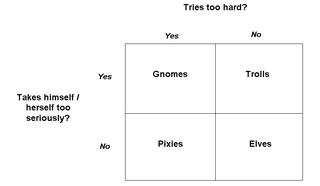
Trolls are dull, silent creatures, secure and self-righteous. Typically lacking in any sense of humour whatsoever, Trolls are usually content to live their own insular and smug lives, and rarely inflict their opinions on other people. However, they are extremely sensitive to things that they see as attacking their values / beliefs and are quick to take offense at things that are said against them. They have an almost morbid fear of being made to look ridiculous and are unappreciative of jokes at their expense. These fears / hurts express themselves as disengagement rather than confrontation, however - Trolls are the ultimate passive-aggressives. Because they are afraid of being shown up, Trolls will tend not to react openly to negative stimuli, preferring to let a simmering resentment grow within them. Interestingly, Trolls are often pious and 'sincere' though this is a fake sincerity that is based on complacency rather than humility. Because their puny brains are often incapable of dealing with contradiction, Trolls have trouble respecting / considering other people's opinions and prefer a 'simple' if suffocating world view where they are always right.
Gnomes are possibly the most annoying of all creatures in this matrix. Opinionated and belligerent, Gnomes will seek out views that run contrary to their own without provocation, and proceed to attack them with all the bitterness they can muster. While Gnomes may often be full of biting wit, they have no real sense of humour, simply because they will never make (and usually cannot take) jokes at their own expense - humour to them is more a weapon than a toy. Driven by insecurity, Gnomes will constantly seek opportunities to assert their own points of view, but will be unwilling to listen to others and will react to opposing positions based more on emotional frenzy than on rational thought. Gnomes will never admit to being wrong. Logic is wasted on gnomes because they are selective listeners and will use it only to support conclusions that favour them - never considering how the same argument could be used against them. Gnomes are incapable of seeing things from the other point of view. The average Gnome suffers from a strong persecution complex and is extremely self-involved - to the point of assuming that everything in the world is somehow about him / her.
Pixies are the featherbrains of the world. Generous and good of heart, Pixies are anxious to please and desperate for acceptance. Rather than being self-involved, Pixies are infact almost entirely externally involved - they often have no discernible opinions / talents / personalities of their own, but always seem to be in search of external validation. While they are the most likely to make jokes (including jokes about themselves) their jokes are usually more notable for their quantity rather than their quality. Pixies are wanna-bes - strivers have no real personality and usually an extremely limited depth of understanding about the things that they talk about - yet silence makes them uncomfortable and they are often uncomfortable being alone. Unlike Gnomes, who are convinced that everyone hates them, Pixies cannot stand the thought that anyone could hate them and are therefore almost self-effacing in their desire to please - they arrange away confrontations. While pixies may have little faith in their own worth, they may often be convinced that other people find them charming and intelligent and believe that effort is all it takes to be respected - not realising how silly and cloying they may seem. Pixies can be annoying, but you cannot bring yourself to hate them - you know that they mean well and you often like them, but you cannot begin to take them seriously.
Elves are, of course, the most aspirational of all the life-forms in this model. Like Trolls, Elves are little concerned with what other people think about them, but unlike Trolls they are secure enough to admit that other people could be right. Elves have a great sense of humour and will laugh at themselves as much as they will laugh at others - they are intensely aware of both the world's absurdity and of their own ridiculousness. Frequently clever and talented, Elves use these gifts in a whimsical manner, often more interested in the effects / process than in the final meaning of what they come in with. Relativists by nature, Elves are uncomfortable with moral absolutes, and tend to take a more contingent view of the world. While they may often be interested in arts and culture, Elves seek these out more for their own pleasure than in order to impress others / be accepted by them. Even though they recognise that they might be wrong, Elves are not afraid to state their opinions on various issues, though they may be willing to change this opinion if they find a convincing argument that suggests a better one. Open and friendly, Elves have strong personalities, but see no reason to inflict them on other people unless asked to.
Friday, August 12, 2005
Matisse

Interesting article about Matisse's life in the New York Review of Books.
Hilary Spurling writes about the terrible irony that the one place where Matisse is least revered is in his own home town.
It was a shock to find, on my first visit to his home town of Bohain-en-Vermandois, that nobody had ever heard of him. "Matys? Mathis?" asked the local lawyer, whose firm had once represented Matisse's father from an office that still stands a few hundred yards from the house where the painter grew up. "How are you spelling that? With an h, or with a y?" Gradually I began to meet an older generation, people in their seventies and eighties whose parents and grandparents had talked about the Matisse boy as a kind of village idiot—le sot Matisse—a dropout with a record of successive failures, who ran away to Paris in the end to be a painter. "Madame, have you seen his paintings?" one old lady asked me in 1991. "A child could paint better than that, Madame." At the art school in St. Quentin, where the young Matisse enrolled in secret for drawing lessons without telling his father, the elderly college principal was still so bitterly ashamed of his only celebrated ex-student that he could barely bring himself to pronounce the name.
(Note to future terrorists: If you are going to attack some place in France, could you take this town out first? Thanks awfully. )
Spurling argues that to disassociate the artist's life (especially the life of a painter as raw and emotional as Matisse) from his work is to rob that work of a critical emotional context. Spurling's new biography of Matisse attempts to move beyond this artificial barrier and look more closely at Matisse as a human being.
"The invisible man who emerged from my researches was passionate, generous, and driven. Far from being humorless or heartless, he could be extremely funny, a first-rate mimic and raconteur (Matisse potrayed himself in private all his life in a stream of absurd, scratchy, self-mocking cartoons), as well as a loyal friend, endlessly and unobtrusively kind to those in trouble, especially to fellow painters. Admittedly, he was also almost impossible to live with. The sheer relentless force and intensity of his energy at close quarters made him intolerable at times. "
I'm not sure I agree with this. That is to say, I think it makes sense if you're writing a biography of the man (certainly his emotional life is more than relevant then) but I'm not sure why you would do so in the first place. The point about Matisse is not whether he was humiliated by scandal or made miserable by war, the point about Matisse is his art. Matisse's paintings don't need to be provided with emotional context, they make their own. The raw energy bursting out of his canvasses is a context enough, if you open your heart to it.
I guess I've always been sceptical about the whole genre of artist's biographies. I think they're an interesting form of writing in themselves, but I'm chary of claims that say they enhance or inform your appreciation of the artist's work. I see them as a sort of sophisticated voyeurism. Art, I feel, should be evaluated on its own terms and not in terms of what was happening to the artist at the time. What was happening to the artist may be interesting in itself, but it has nothing to do with his art.
Novelty Seeking
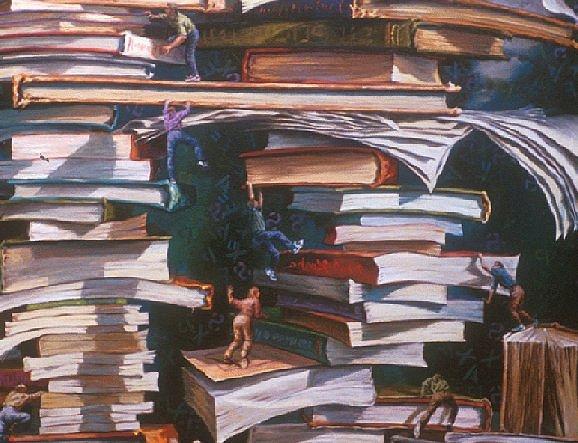
Reading the Booker Long List made me realise how incredible an year it's been for novels by writers I care for. At least half the authors still writing whose work I love have published in the last 12 months. 2004-05 has seen new books by (in descending order of importance to me): J.M. Coetzee, Derek Walcott, Haruki Murakami, Philip Roth, Salman Rushdie, Jeanette Winterson, Imre Kertesz, Ian McEwan, Zadie Smith, Colm Toibin and Julian Barnes. Not to mention the new Marilynne Robinson. And the new Irving and Ishiguro novels (both of whom I find readable but far from exciting).
My cup runneth over.
Thursday, August 11, 2005
Why me?
In other news, Sitemeter informs me that if you go to google and type in "asexual relationship" it gives you a link to this blog. Great. So much for my dating life.
And to think of some of the things people complain about.
And to think of some of the things people complain about.
That *Beep* Sound
Is it just me, or are voice mail systems rapidly evolving into a form of alien intelligence? Remember how leaving a message for someone was easy? There'd be the obligatory hapless greeting*, then a quick beep, and then the floor was all yours.
Now there are about twenty minutes of instructions before you actually get to the beep. Do you want to leave a call-back number? Do you want to send a fax? Do you want to initiate divorce proceedings? Would you like to launch a full-scale nuclear strike against whatever middle eastern country the Bush administration has decided to blame for terrorist attacks today? Just press 9 followed by the number pi to six decimal places followed by the pound sign.
And all the while you're standing there, all keyed-up, waiting for the beep. It's like listening to a Wagner aria - you keep thinking, now it's over; no; now; no; this has to be it; NO; oh, come on already! You're kicking yourself for not going to the bathroom before you started; you're wondering what the neighbours will say when they force open the door and find you lying there, starved to death, the phone in your hand still going "to leave a really angry message, then think better of it, then decide what the hell, please press 974 followed by the pound sign".
Oh, and of course, just about the time you begin to relax and tune out this irritating voice droning on in your ear, the beep takes you by surprise. And it's not even a proper beep anymore, more like a 'be'. So that you only realise that the instructions are over when the silence has gone on for about half a minute. Then you panic. You realise you're supposed to have been talking all this time. You end up spluttering like a bumbling halfwit. Next thing you know you've left a message that goes: "(Looooong Pause) o. um. err... hi there! it's me. I mean it's Falstaff. Listen, I just called to say that err.. that is I wan". That's where you get cut off. So much for sounding suave. I wonder if Bogart ever left voice mail.
Who designs this stuff, anyway? Presumably the same idiots who, back in school, would countdown to a race going "Ready, 1, 2, 2 and half, 2 and three quarters, 2.9, 2.95....". In the old days they would grow up to be the long-winded introductory speakers who would spend 45 minutes introducing the evening's main dignitary, after they'd told you that he / she needed no introduction. Now they have a new calling (forgive the pun!).
And why do all voice mail services have to have the same irritating female voice? I mean, look, it's not like I have anything particularly intelligent to talk to my friends about. I'd be quite happy to sit around listening to a hearty male voice from the answering service. Maybe we could swap a few jokes, go down to the bar and get a drink. Instead I always end up being given instructions by someone who sounds uncannily like my ninth grade geography teacher. I have nightmares about not being able to tell a mesa from a plateau or a cove from a bay.
And then, of course, there's the performance anxiety. I mean here I was, in all my naivete, thinking, "Oh, he's not in - no big deal, I'll just leave him a message". But apparently it IS a big deal. Someone has spent more time thinking through this seemingly simple task than NASA spent planning the Discovery launch (admittedly that's not a high bar, but still). It IS rocket science. I can't just say "Hey, it's Falstaff, call me back". Not after they've gone to all this effort. It would be an anti-climax. I need something grander, more significant. Like the Gettysburg address. What would Zarathustra have sprach? What do I mean when I say I called? Who is this me person anyway?
Or I'll start feeling guilty. I imagine standing in front of the board of AT&T as they shake their heads at me and say "You made us go to all that trouble just because you wanted to chat?". I feel like I have to make up some reason for calling. Something better than "just wanted to see how you were doing". How about "I'm standing on the window ledge of the 42nd floor and I just wanted to let you know that all existence is one big fish before I jump to my certain death". Nice. Urgency, pathos, a touch of oriental mystique. Or how about "Will you marry me?". That sounds about important enough.
Oh, and while we're on the subject, why does every single person I know promise that they'll call back "as soon as they can"? Do they really expect me to believe this? Isn't it more likely that they'll stop for coffee first? Maybe grab a shower or watch Desperate Housewives or something? And what am I supposed to do if they don't call me back as soon as possible. Call the voice mail police? "All right, buddy, it's all over. We saw you. You spent two extra minutes checking out that blonde over by the bar when you could have been calling Falstaff. It's a fair bust**. We've got it all on tape. You'd better come along quietly".
For that matter, do I really want to be called back as soon as possible? Wouldn't I rather you'd had time to relax? I imagine you crawling out of your wrecked car, blood running from the gash where your head hit the windshield, dragging your broken left leg behind you, pulling out your cell phone to call me because you can and you promised. Is what I wanted to talk about really that important?
Personally, I don't even claim that I'll call people back. Why make rash promises? And what's all this stuff about not being able to take the call. Maybe I can and just don't want to. So I just say: "Hi, this is Falstaff. I'm not taking your call right now, so leave me a message." No false hope there. I might call you back. I might not. Couldn't say for sure.
* Have you ever noticed how your message greeting never sounds as cool as those you hear on TV, no matter how hard you try? I mean all the people on TV - even those who can't act - manage to sound cool and relaxed on their voice mail greetings, while you invariably sound like you've just been chased for miles cross-country by a demented serial killer and in your panic ended up recording a new message greeting instead of calling 911
**Yes, yes, I meant that pun too.
Now there are about twenty minutes of instructions before you actually get to the beep. Do you want to leave a call-back number? Do you want to send a fax? Do you want to initiate divorce proceedings? Would you like to launch a full-scale nuclear strike against whatever middle eastern country the Bush administration has decided to blame for terrorist attacks today? Just press 9 followed by the number pi to six decimal places followed by the pound sign.
And all the while you're standing there, all keyed-up, waiting for the beep. It's like listening to a Wagner aria - you keep thinking, now it's over; no; now; no; this has to be it; NO; oh, come on already! You're kicking yourself for not going to the bathroom before you started; you're wondering what the neighbours will say when they force open the door and find you lying there, starved to death, the phone in your hand still going "to leave a really angry message, then think better of it, then decide what the hell, please press 974 followed by the pound sign".
Oh, and of course, just about the time you begin to relax and tune out this irritating voice droning on in your ear, the beep takes you by surprise. And it's not even a proper beep anymore, more like a 'be'. So that you only realise that the instructions are over when the silence has gone on for about half a minute. Then you panic. You realise you're supposed to have been talking all this time. You end up spluttering like a bumbling halfwit. Next thing you know you've left a message that goes: "(Looooong Pause) o. um. err... hi there! it's me. I mean it's Falstaff. Listen, I just called to say that err.. that is I wan". That's where you get cut off. So much for sounding suave. I wonder if Bogart ever left voice mail.
Who designs this stuff, anyway? Presumably the same idiots who, back in school, would countdown to a race going "Ready, 1, 2, 2 and half, 2 and three quarters, 2.9, 2.95....". In the old days they would grow up to be the long-winded introductory speakers who would spend 45 minutes introducing the evening's main dignitary, after they'd told you that he / she needed no introduction. Now they have a new calling (forgive the pun!).
And why do all voice mail services have to have the same irritating female voice? I mean, look, it's not like I have anything particularly intelligent to talk to my friends about. I'd be quite happy to sit around listening to a hearty male voice from the answering service. Maybe we could swap a few jokes, go down to the bar and get a drink. Instead I always end up being given instructions by someone who sounds uncannily like my ninth grade geography teacher. I have nightmares about not being able to tell a mesa from a plateau or a cove from a bay.
And then, of course, there's the performance anxiety. I mean here I was, in all my naivete, thinking, "Oh, he's not in - no big deal, I'll just leave him a message". But apparently it IS a big deal. Someone has spent more time thinking through this seemingly simple task than NASA spent planning the Discovery launch (admittedly that's not a high bar, but still). It IS rocket science. I can't just say "Hey, it's Falstaff, call me back". Not after they've gone to all this effort. It would be an anti-climax. I need something grander, more significant. Like the Gettysburg address. What would Zarathustra have sprach? What do I mean when I say I called? Who is this me person anyway?
Or I'll start feeling guilty. I imagine standing in front of the board of AT&T as they shake their heads at me and say "You made us go to all that trouble just because you wanted to chat?". I feel like I have to make up some reason for calling. Something better than "just wanted to see how you were doing". How about "I'm standing on the window ledge of the 42nd floor and I just wanted to let you know that all existence is one big fish before I jump to my certain death". Nice. Urgency, pathos, a touch of oriental mystique. Or how about "Will you marry me?". That sounds about important enough.
Oh, and while we're on the subject, why does every single person I know promise that they'll call back "as soon as they can"? Do they really expect me to believe this? Isn't it more likely that they'll stop for coffee first? Maybe grab a shower or watch Desperate Housewives or something? And what am I supposed to do if they don't call me back as soon as possible. Call the voice mail police? "All right, buddy, it's all over. We saw you. You spent two extra minutes checking out that blonde over by the bar when you could have been calling Falstaff. It's a fair bust**. We've got it all on tape. You'd better come along quietly".
For that matter, do I really want to be called back as soon as possible? Wouldn't I rather you'd had time to relax? I imagine you crawling out of your wrecked car, blood running from the gash where your head hit the windshield, dragging your broken left leg behind you, pulling out your cell phone to call me because you can and you promised. Is what I wanted to talk about really that important?
Personally, I don't even claim that I'll call people back. Why make rash promises? And what's all this stuff about not being able to take the call. Maybe I can and just don't want to. So I just say: "Hi, this is Falstaff. I'm not taking your call right now, so leave me a message." No false hope there. I might call you back. I might not. Couldn't say for sure.
* Have you ever noticed how your message greeting never sounds as cool as those you hear on TV, no matter how hard you try? I mean all the people on TV - even those who can't act - manage to sound cool and relaxed on their voice mail greetings, while you invariably sound like you've just been chased for miles cross-country by a demented serial killer and in your panic ended up recording a new message greeting instead of calling 911
**Yes, yes, I meant that pun too.
Wednesday, August 10, 2005
Huh?
Just saw a news article on Yahoo! saying that Sinead O'Connor's come out with a new Reggae album. Yup, you heard me, a REGGAE album. Trying very hard to imagine what that will sound like. I mean the woman doesn't even have enough hair to put beads in. And reggae beats with uilleann pipes? What's the hit single going to be - "No woman, no rye"?
Apparently Ms. O'Connor sees it as an expression of her gratitude for "the teachings of Rastafari". You mean like wearing very loud shirts, never washing your hair and singing off-key in a high plaintive voice? Or saying 'mon' all the time? Or never quite managing to button your clothes all the way up?
In other news, did you know that Ms. O'Connor's last album was titled "She Who Dwells in the Secret Place of the Most High Shall Abide Under the Shadow of the Almighty". Catchy title, honey. No wonder it sold all of six and a half copies (one of the CDs broke and the customer only returned half of it to claim her refund).
Apparently Ms. O'Connor sees it as an expression of her gratitude for "the teachings of Rastafari". You mean like wearing very loud shirts, never washing your hair and singing off-key in a high plaintive voice? Or saying 'mon' all the time? Or never quite managing to button your clothes all the way up?
In other news, did you know that Ms. O'Connor's last album was titled "She Who Dwells in the Secret Place of the Most High Shall Abide Under the Shadow of the Almighty". Catchy title, honey. No wonder it sold all of six and a half copies (one of the CDs broke and the customer only returned half of it to claim her refund).
A fate worse than death
Aphasia n. Loss of speech, partial or total, or loss of power to understand written or spoken language, as a result of disorder of the cerebral speech centres.
 Between 1900 and 1903, Norwegian playwright Henrik Ibsen suffered a series of three strokes that robbed him of his memory for words and left him with no further ability to write. Peter Watts, in an essay on Ibsen's life, describes how in those last days (Ibsen died in 1906) Ibsen's son, Sigurd, came upon his father sitting at his table, struggling to write out the letters of the alphabet. I can't think of a more heartbreaking sight.
Was this perhaps vengeance from the God that Ibsen had spent a lifetime denying? What sort of petty tyrant inflicts a punishment so treacherous on so worthy an adversary? How insecure do you have to be to enforce so cruel a censorship?
All his life, Ibsen showed us the haunting visage of human misery, stripped of all adornment. His plays are a celebration of Irony (that greatest and most potent of all demons), of the importance of the individual, of the need to live greedily and without guilt and to enjoy and suffer the terrible beauty of our lives with all the raw force that we can muster. It is both glorious and ironic that his own last years should be so exact a vindication of all his writing.
Someone asked me once if I was afraid to die, and I replied of course, who isn't? But there are things I am more afraid of than death - and the loss of words is one of them.
P.S. The painting: Francisco Goya El sueño de la razón produce monstruos which Babelfish translates as 'The dream of reason produces monsters'
P.P.S. Sorry about the F minor note - that's what happens when you stay up till 3 am reading Ibsen. Tomorrow will be a happier day. I promise.
 Between 1900 and 1903, Norwegian playwright Henrik Ibsen suffered a series of three strokes that robbed him of his memory for words and left him with no further ability to write. Peter Watts, in an essay on Ibsen's life, describes how in those last days (Ibsen died in 1906) Ibsen's son, Sigurd, came upon his father sitting at his table, struggling to write out the letters of the alphabet. I can't think of a more heartbreaking sight.
Was this perhaps vengeance from the God that Ibsen had spent a lifetime denying? What sort of petty tyrant inflicts a punishment so treacherous on so worthy an adversary? How insecure do you have to be to enforce so cruel a censorship?
All his life, Ibsen showed us the haunting visage of human misery, stripped of all adornment. His plays are a celebration of Irony (that greatest and most potent of all demons), of the importance of the individual, of the need to live greedily and without guilt and to enjoy and suffer the terrible beauty of our lives with all the raw force that we can muster. It is both glorious and ironic that his own last years should be so exact a vindication of all his writing.
Someone asked me once if I was afraid to die, and I replied of course, who isn't? But there are things I am more afraid of than death - and the loss of words is one of them.
P.S. The painting: Francisco Goya El sueño de la razón produce monstruos which Babelfish translates as 'The dream of reason produces monsters'
P.P.S. Sorry about the F minor note - that's what happens when you stay up till 3 am reading Ibsen. Tomorrow will be a happier day. I promise.
Tuesday, August 09, 2005
The Escape
When they handed him the gun, that first time, he couldn't believe it. One long year of the most horrifying tortures and then this? It was impossible, it didn't make sense. Yet there it undeniably was, the weight of it resting heavy in his palm. He sat staring at it for a while, trying to wrap his mind around it the way he had wrapped his fingers. Then it occured to him that he was being watched. Any moment now one of them could reach forward and take it away from him. The thought sent a shudder through his spent frame. Without a second's further hesitation, he lifted the gun up, put the barrel in his mouth (the taste of the metal cold and a little greasy), shut his eyes, took a deep breath, and pulled the trigger.
It was a moment before the sound of their laughter got through to him; a moment before the ghost of the explosion cleared and he realised that the bitter taste in his mouth was not death but deceit. As the enormity of the trick they had played on him sank in, he felt a panic rising within him. Desperately, like a man searching his wallet for a note he knows he doesn't have, he broke open the gun, checked for bullets. There were none. He started to cry helplessly. A guard came over, still chuckling to himself, and took the gun out of his hand. "Did you really think we were going to let you get away so easily?", the warden asked. "What do you want from me?", he screamed, the tears running down his face, "I've already told you everything I know". "Ah!", said the Warden, "then it's the things you don't know that we'll have to find out, won't we?"
The second year he was better prepared. He had a plan. He didn't even bother to check if the gun was loaded. The minute they handed it to him, he took it by the barrel and swung it into his face with all the power he could muster. There was a sharp crunch, like an apple being bitten into, and his face exploded in pain. He could taste the rich, sweet flavour of his blood, could feel it pouring freely from his almost certainly broken nose. But he was still alive. He looked up at the guards anxiously, to see if they would try and stop him. They hadn't moved - they just stood around with an amused expression on their faces, like a group of fond uncles watching a child at play.
The second swing was harder, and aimed for the head. This time the impact was more of a crack, like a plank of wood snapping into two. The pain blotted out everything for a moment, the world spun; then, slowly, like water rippling to stillness, his awareness of the room returned. A part of him was frightened now, was straining against the leash of his will like a frantic animal. He tried to think clearly. He must use more force, he must get his arms to obey him. He gathered up all his strength and swung a third time.
When he woke up he was still lying in the cell, but the gun had been taken away from him, and the blood had caked over his mouth so that his lips wouldn't open. Not that there was anything to say. The warden stood over him, smiling down. "Very good", he said, "keep this up and we won't have to beat you anymore. You can do it yourself". And the men laughed.
The third year he knew better than to try using his own strength. Instead he used gravity. He tossed the gun up as high as it could go in the cloistered cell and then let it come falling down on his shaved head.
When he came to this time, they told him that he had managed to fracture his skull, but it was a hairline crack and the doctor said it would mend. Meanwhile his neck and head had been bolted in place so he couldn't do himself any more damage.
The fourth year they put a helmet on him. He still went on hitting it with the gun (he couldn't think of what else to do) but all he achieved this time was a minor headache.
The fifth year he came up with the idea of attacking a guard. After all, he had a helmet on, he had a heavy gun to use as a club, he could do real damage. Not that he had any hope of escaping. But maybe if he got to a guard they would have to shoot him. He hadn't reckoned with their tasers though. He'd barely reached the nearest guard when the electricity jolted through his body, turned his bones to water. As he lay on the floor, feeling his muscles slowly twitch back to life, he could hear them laughing.
The sixth year he tried dismantling the gun and choking himself on the pieces. But he couldn't seem to get one stuck in his windpipe. The first one he tried he gagged on, and couldn't get it to go down. The second one was too small, and he ended up swallowing it. Screaming with frustration (the guards were laughing themselves silly by now) he tried a third one and thought he'd finally managed it this time, but the warden came over and gave him a heavy pat on the back and the piece flew out. Then they prised his teeth open and took it away from him.
The seventh year he started to pick the gun up but realised he had no idea what to do with it. He put it back on the table, shoved it away. Then he broke down and started to cry. This time there was real satisfaction on the warden's face.
The eighth year he didn't even try reaching for the gun. He just sat there, staring at it as it lay on the table, clear-eyed and resigned. There was the atmosphere of a temple in the room now, with him standing calmly in the centre, a humble priest, rapt in his admiration of the gun-metal god, and the guards like acolytes in their grey, hooded uniforms, watching him closely, trying to learn.
The ninth, tenth and eleventh year the same thing happened. He would sit there, perfectly placid, staring intensely at the gun as if trying to will it out of existence, as if without it, without the false hope it offered, he could finally come to terms with his fate. These cermonies of his slowly acquired the dignity of a mass - off-duty guards would come to watch him, would leave his cell with a nagging sense of peace.
The twelfth year he reached out, very slowly, to touch the gun. The watching guards drew in their breath, wondering what would come of such sacrilege. But at the first contact with the gun he shuddered back, as if appalled by his own presumption. The gun was still there. He lowered his head in defeat.
When he entered the cell in the thirteenth year, there was a light in his eyes they had never seen before, and for the first time the warden felt genuinely frightened. But the ceremony had to go on. At first the prisoner paid no attention to the gun. He sat staring at the light that was filtering in through the cell window, as though gathering the stray dust of his thoughts into a sunbeam of resolve. Then, when he sensed that his time was almost up, he turned at last to the gun, lifted it from the table with all the ceremonial grace of a knight receiving his sword, placed the barrel in his mouth again, just the way he had done that first time. The guards were puzzled. What could he mean by this? Surely he knew by now that the gun was never loaded. For a moment he sat there with the gun stuck in his mouth like some monstrous animal he was trying to swallow. He was smiling now, and his whole body seemed relaxed. Then, gathering himself together in one great breath, he shut his eyes and fired.
They all heard the click of the empty trigger. They all heard the clatter of the gun falling from his hand to the floor. They all saw his body slump suddenly in the chair, like a bag of old, defeated clothes. They all felt the breath going out of the room, that sense of a sudden vacancy.
For a while nobody moved. Then, very slowly, the warden reached over and felt at the prisoner's throat. After a moment he looked up, a bewildered panic spreading across his face. There was no pulse. The prisoner had escaped.
It was a moment before the sound of their laughter got through to him; a moment before the ghost of the explosion cleared and he realised that the bitter taste in his mouth was not death but deceit. As the enormity of the trick they had played on him sank in, he felt a panic rising within him. Desperately, like a man searching his wallet for a note he knows he doesn't have, he broke open the gun, checked for bullets. There were none. He started to cry helplessly. A guard came over, still chuckling to himself, and took the gun out of his hand. "Did you really think we were going to let you get away so easily?", the warden asked. "What do you want from me?", he screamed, the tears running down his face, "I've already told you everything I know". "Ah!", said the Warden, "then it's the things you don't know that we'll have to find out, won't we?"
The second year he was better prepared. He had a plan. He didn't even bother to check if the gun was loaded. The minute they handed it to him, he took it by the barrel and swung it into his face with all the power he could muster. There was a sharp crunch, like an apple being bitten into, and his face exploded in pain. He could taste the rich, sweet flavour of his blood, could feel it pouring freely from his almost certainly broken nose. But he was still alive. He looked up at the guards anxiously, to see if they would try and stop him. They hadn't moved - they just stood around with an amused expression on their faces, like a group of fond uncles watching a child at play.
The second swing was harder, and aimed for the head. This time the impact was more of a crack, like a plank of wood snapping into two. The pain blotted out everything for a moment, the world spun; then, slowly, like water rippling to stillness, his awareness of the room returned. A part of him was frightened now, was straining against the leash of his will like a frantic animal. He tried to think clearly. He must use more force, he must get his arms to obey him. He gathered up all his strength and swung a third time.
When he woke up he was still lying in the cell, but the gun had been taken away from him, and the blood had caked over his mouth so that his lips wouldn't open. Not that there was anything to say. The warden stood over him, smiling down. "Very good", he said, "keep this up and we won't have to beat you anymore. You can do it yourself". And the men laughed.
The third year he knew better than to try using his own strength. Instead he used gravity. He tossed the gun up as high as it could go in the cloistered cell and then let it come falling down on his shaved head.
When he came to this time, they told him that he had managed to fracture his skull, but it was a hairline crack and the doctor said it would mend. Meanwhile his neck and head had been bolted in place so he couldn't do himself any more damage.
The fourth year they put a helmet on him. He still went on hitting it with the gun (he couldn't think of what else to do) but all he achieved this time was a minor headache.
The fifth year he came up with the idea of attacking a guard. After all, he had a helmet on, he had a heavy gun to use as a club, he could do real damage. Not that he had any hope of escaping. But maybe if he got to a guard they would have to shoot him. He hadn't reckoned with their tasers though. He'd barely reached the nearest guard when the electricity jolted through his body, turned his bones to water. As he lay on the floor, feeling his muscles slowly twitch back to life, he could hear them laughing.
The sixth year he tried dismantling the gun and choking himself on the pieces. But he couldn't seem to get one stuck in his windpipe. The first one he tried he gagged on, and couldn't get it to go down. The second one was too small, and he ended up swallowing it. Screaming with frustration (the guards were laughing themselves silly by now) he tried a third one and thought he'd finally managed it this time, but the warden came over and gave him a heavy pat on the back and the piece flew out. Then they prised his teeth open and took it away from him.
The seventh year he started to pick the gun up but realised he had no idea what to do with it. He put it back on the table, shoved it away. Then he broke down and started to cry. This time there was real satisfaction on the warden's face.
The eighth year he didn't even try reaching for the gun. He just sat there, staring at it as it lay on the table, clear-eyed and resigned. There was the atmosphere of a temple in the room now, with him standing calmly in the centre, a humble priest, rapt in his admiration of the gun-metal god, and the guards like acolytes in their grey, hooded uniforms, watching him closely, trying to learn.
The ninth, tenth and eleventh year the same thing happened. He would sit there, perfectly placid, staring intensely at the gun as if trying to will it out of existence, as if without it, without the false hope it offered, he could finally come to terms with his fate. These cermonies of his slowly acquired the dignity of a mass - off-duty guards would come to watch him, would leave his cell with a nagging sense of peace.
The twelfth year he reached out, very slowly, to touch the gun. The watching guards drew in their breath, wondering what would come of such sacrilege. But at the first contact with the gun he shuddered back, as if appalled by his own presumption. The gun was still there. He lowered his head in defeat.
When he entered the cell in the thirteenth year, there was a light in his eyes they had never seen before, and for the first time the warden felt genuinely frightened. But the ceremony had to go on. At first the prisoner paid no attention to the gun. He sat staring at the light that was filtering in through the cell window, as though gathering the stray dust of his thoughts into a sunbeam of resolve. Then, when he sensed that his time was almost up, he turned at last to the gun, lifted it from the table with all the ceremonial grace of a knight receiving his sword, placed the barrel in his mouth again, just the way he had done that first time. The guards were puzzled. What could he mean by this? Surely he knew by now that the gun was never loaded. For a moment he sat there with the gun stuck in his mouth like some monstrous animal he was trying to swallow. He was smiling now, and his whole body seemed relaxed. Then, gathering himself together in one great breath, he shut his eyes and fired.
They all heard the click of the empty trigger. They all heard the clatter of the gun falling from his hand to the floor. They all saw his body slump suddenly in the chair, like a bag of old, defeated clothes. They all felt the breath going out of the room, that sense of a sudden vacancy.
For a while nobody moved. Then, very slowly, the warden reached over and felt at the prisoner's throat. After a moment he looked up, a bewildered panic spreading across his face. There was no pulse. The prisoner had escaped.
Monday, August 08, 2005
Put in a good word for me
Yesterday's blog made me think about how much I love palimpsest as a word. It's somehow palpable and incestuous and conveys so beautifully that sense of layers of hidden meaning. That made me think about all the other words I really love (in the interests of not revealing the abysmal depths of my Commando comics German - don't you think Dumbkopf is such a wonderfully evocative word - I'm sticking to English) :
Palimpsest (see above)
Myrmidon (a word at once poetic and lethal, redolent of shaken spears and rosy-fingered dawns)
Impeccable (the sound says it all: the 'im' turning up its nose and then the precise decimal of the 'k' sound putting you in your place)
Manifesto (such a powerful, driving word. Like a great engine revving up - Spender writes "After the first powerful plain manifesto / The black statement of pistons" - but also with something deeply human about it - so much better than 'dynamo' for instance - and something vaguely magical, as though it could be the name of some Shakespearian magician)
Deciduous (a helpless word - filled with the sorrow of things shed; R.S. Thomas writes "In the forests of metal / the one human sound / was the lament of the poets / for deciduous language")
Travesty (a word that goes too far and is suddenly brought back, the sense of lines crossed, rules broken, of living outside the norms)
Execrable (you can just feel yourself scraping the bottom of the barrel here, the contempt, the physical disgust contained in that word. Lovely)
Metempsychosis (a combination of two beloved words - metamorphosis and pysche; this is a magical word, at once exact and visionary, a word that speaks of the complexity, alchemical processes)
Igneous (something black and hard and coal-like and burning; a word that erupts into your mind and then slowly cools)
Cornucopia (you can just see the horn overflowing with more things than you can cope with can't you? A word literally brimming with promise and possibilities)
Finis. (Don't you just love how the absence of the h that you just naturally add on heightens the sense of abruptness, of something not quite complete?).
No, seriously, Finis.
Palimpsest (see above)
Myrmidon (a word at once poetic and lethal, redolent of shaken spears and rosy-fingered dawns)
Impeccable (the sound says it all: the 'im' turning up its nose and then the precise decimal of the 'k' sound putting you in your place)
Manifesto (such a powerful, driving word. Like a great engine revving up - Spender writes "After the first powerful plain manifesto / The black statement of pistons" - but also with something deeply human about it - so much better than 'dynamo' for instance - and something vaguely magical, as though it could be the name of some Shakespearian magician)
Deciduous (a helpless word - filled with the sorrow of things shed; R.S. Thomas writes "In the forests of metal / the one human sound / was the lament of the poets / for deciduous language")
Travesty (a word that goes too far and is suddenly brought back, the sense of lines crossed, rules broken, of living outside the norms)
Execrable (you can just feel yourself scraping the bottom of the barrel here, the contempt, the physical disgust contained in that word. Lovely)
Metempsychosis (a combination of two beloved words - metamorphosis and pysche; this is a magical word, at once exact and visionary, a word that speaks of the complexity, alchemical processes)
Igneous (something black and hard and coal-like and burning; a word that erupts into your mind and then slowly cools)
Cornucopia (you can just see the horn overflowing with more things than you can cope with can't you? A word literally brimming with promise and possibilities)
Finis. (Don't you just love how the absence of the h that you just naturally add on heightens the sense of abruptness, of something not quite complete?).
No, seriously, Finis.
Sunday, August 07, 2005
Blogging / I'm losing my marbles..errr...glass beads
Yesterday's comments about my blogging led to some interesting soul searching over what it is about blogs that I find so addictive (Typical! all the deep philosophical questions I faff my way through, but some general comment sends me into a tail spin of self-contemplation).
Much has been written and said about the power of blogs as a means of information sharing and communication. As an illustration of the power of human networks and the kind of free-wheeling information transfer technology makes possible, the blogosphere is virtually unparalleled. And while I remain unconvinced about blogs' ultimate power to take on more conventional news media (much of the stuff you read in the NY Times, for instance, smacks entirely of paranoia) I can see how they are fast evolving into a legitimate alternate channel for information dissemination.
There's also, of course, the entertainment value of blogs. In some ways, I suspect, the urge to read blogs (and subsequently write them) is the same urge that drives people to watch reality shows on TV - the need to connect to 'real' people. In a world where social ties are rapidly haemorrhaging under the influence of an entertainment industry that encourages isolation, blogs are an important means of re-integrating ourselves into society. And not just any society but a society of (potentially) like-minded people. Blogs allow us to read about people whose thoughts / experiences are often surprisingly similar to our own; they permit us to engage such people in debate; they enable the kind of sharing of ideas that once used to happen through conversations in other 'real world' social settings.
All of this is, I suspect, well understood. What gets overlooked, I feel, (at least explicitly, though I suspect most regular bloggers sense this) is the potential that blogs offer as a new artistic medium. Writing a blog is a fundamentally different artistic experience from any other form of writing. Think about it. It's not journalism (or doesn't have to be) because there's too much personality involved, because it can afford to be less topical and because (compared to say, op-eds) there's a much lower need to engage specific issues*. It's not fiction because it's too self-referential and the format is too short to allow any real plot development. It's not poetry. It's not even like keeping a diary because there is the constant awareness of another's presence reading it and judging you, and because, unlike a diary, things you write here will answer back through other people.
Understand: I'm not saying that a blog can't be any one of these things. The point is that it doesn't need to be. What's exciting about blogs (as I guess is true of any new medium) is the way it allows you to explore new forms of expression in a field where forms are yet to solidify. Throughout history, changes in technology have enabled changes in art (think how the printing press changed writing, think how the development of the pianoforte changed music)
What does this new medium afford us? First, it allows us to be casual (even flippant) in a way that more conventional publishing never did. There's an immediacy to blog writing, a spontaneity, that is hard to maintain in more conventional publications, which usually require a more polished, edited tone. As an exploration of personality, the voice of the blog world is a voice much closer to Bukowski than to Eliot, much closer to Kerouac than to Woolf.
Second, blogs fragment writing space, so that the challenge becomes not so much to write consistently but rather to put together a collage of fragments that are interesting in themselves but together form a consistent picture of a human intelligence. Imagine having to paint a picture where you were allowed just one brush stroke a day and people judged you both on the precision and beauty of that single stroke and on the overall picture that emerged, day by day, from your canvas. Imagine that you had to find ways by which each new stroke could surprise, enhance and reimagine this picture. That's what blogs are like. (What was it Eliot said? "The knowledge imposes a pattern, and falsifies / For the pattern is new in every moment / And every moment is a new and shocking / Valuation of all we have been")
Third, blogs allow you to conjure with a wide variety of external material - allowing you to cross-reference and connect to other blogs / articles / images. This means that one is able to create a virtual network of ideas, a reverse palimpsest of thought where the reader can either skim the surface or plunge deeper and deeper into one particular post, exploring the trails of thought that led to the one statement, the one idea that finally appeared in the post.
Fourth, of course, blogs allow instant feedback - thus enabling the writer to get reactions from his / her readers almost instantly, and making writing, for once, a more participatory form, almost, in some ways a performance art.**
Fifth (and this is implicit in the second point above, but bears spelling out) blogs focus the writing on the person, rather than on the ideas / issues / events / plots or fictional characters. This is remarkably interesting and fresh perspective to be writing from (though one that comes most naturally, I suspect, to poets)
As a corollary, blog allow us to reinvent ourselves - not so much because they allow us to assume fictional personalities that may bear little or no resemblance to our real selves (though that too is possible) - but rather because they allow us to sharpen and display the aspects of our personality that we want to, and suppress everything else. There's an element of control you have dealing with people through your blog that you don't have in other, more messy social interactions.
What makes this exciting is that each one of these elements it at once a challenge and an opportunity. Just as in a more metaphysical space the idea that everything is permitted is at once liberating and frightening, so too the ease with which blogs allow us to publish is a dizzying prospect, because it means that we need to be our own editors, and need to find a way to create that is intensely our own. By themselves, each one of these elements are easily ignored. The challenge, in my view, is precisely not to ignore them but to use them to the fullest extent possible. People will argue, for instance, that one of the liberating things about blogs is that you don't have to write beautifully to keep one. This is just laziness - like saying you don't need to have something interesting to say if you're talking to a friend who will listen anyway. The thing that makes blogging fascinating is the task of saying something beautiful and precise and interesting even though you don't need to.
This then, is what really moves me about blogging. As someone who's always been interested in writing in all its forms, blogging is an exciting creative enterprise, an exercise in expression unlike any other (notice that I say expression and not self-expression - I'm not interested in projecting my self here, I am interested in the artistic possibilities). The parallel that comes to mind most strongly is that of the Glass Bead Game in Herman Hesse's Magister Ludi. The Game is a quasi-religious, quasi-academic intellectual and creative exercise where the players use symbols, motifs and ideas from a wide variety of sources deployed according to complex rules in order to create an abstract thought pattern. Players of the game go through years of rigorous training picking up its subtler points, and the Master of the Game is a revered and respected figure. Blogging, for me, is like that. That's why, for instance, I am reluctant to post my poems on this blog (or to talk much about actual events in my life) - not because I have any difficulty sharing them with a wider audience, but simply because poems are an art form in themselves (as are diaries for that matter) and blogs have the potential to be so much more than the medium for another art form - they have the capacity to be art forms in themselves.
So, dear Meditative Rose, this is not about how much I like to give fundae and expound on everything under the sun (or rather, it is about that, but that itself is more about the quest for expression rather than about a genuine concern for ideas - I like discussions because they stimulate me and help me live more fully - I have few, if any, beliefs that I'm wedded to, and therefore I'm rarely concerned what people do with my fundae) - I'm almost entirely unconcerned with finding an audience or actually communicating with other people. This blog is, in a sense, a purely artistic enterprise: an opportunity to give free rein to my imagination, my intelligence and my writing skills (such as these are) and to explore the barriers of what I can bring myself to write.
Eliot writes:
"Trying to use words, and every attempt
Is a wholly new start, and a different kind of failure
Because one has only learnt to get the better of words
For the thing one no longer has to say, or the way in which
One is no longer disposed to say it. And so each venture
Is a new beginning, a raid on the inarticulate
With shabby equipment always deteriorating
In the general mess of imprecision of feeling,
Undisciplined squads of emotion. And what there is to conquer
By strength and submission, has already been discovered
Once or twice, or several times, by men whom one cannot hope
To emulate—but there is no competition—
There is only the fight to recover what has been lost
And found and lost again and again: and now, under conditions
That seem unpropitious. But perhaps neither gain nor loss.
For us, there is only the trying. The rest is not our business."
- The Four Quartets, East Coker. V.
Notes:
* There's also the minor point that no one will actually publish the stuff we wrote even if we were to write proper Op-ed pieces. But that's just an aside!
**This is an entirely mixed blessing, of course. One of the things that most pains me about the modern world (and which will surely merit a longer post at some point) is how we've come to equate popularity with talent, when the two very rarely go together. I've never understood, for instance, why the fact that a book is a bestseller should motivate me to read it - given how poor the tastes of the general public are anything that appeals to the lowest common denominator is hardly likely to be any good.
Much has been written and said about the power of blogs as a means of information sharing and communication. As an illustration of the power of human networks and the kind of free-wheeling information transfer technology makes possible, the blogosphere is virtually unparalleled. And while I remain unconvinced about blogs' ultimate power to take on more conventional news media (much of the stuff you read in the NY Times, for instance, smacks entirely of paranoia) I can see how they are fast evolving into a legitimate alternate channel for information dissemination.
There's also, of course, the entertainment value of blogs. In some ways, I suspect, the urge to read blogs (and subsequently write them) is the same urge that drives people to watch reality shows on TV - the need to connect to 'real' people. In a world where social ties are rapidly haemorrhaging under the influence of an entertainment industry that encourages isolation, blogs are an important means of re-integrating ourselves into society. And not just any society but a society of (potentially) like-minded people. Blogs allow us to read about people whose thoughts / experiences are often surprisingly similar to our own; they permit us to engage such people in debate; they enable the kind of sharing of ideas that once used to happen through conversations in other 'real world' social settings.
All of this is, I suspect, well understood. What gets overlooked, I feel, (at least explicitly, though I suspect most regular bloggers sense this) is the potential that blogs offer as a new artistic medium. Writing a blog is a fundamentally different artistic experience from any other form of writing. Think about it. It's not journalism (or doesn't have to be) because there's too much personality involved, because it can afford to be less topical and because (compared to say, op-eds) there's a much lower need to engage specific issues*. It's not fiction because it's too self-referential and the format is too short to allow any real plot development. It's not poetry. It's not even like keeping a diary because there is the constant awareness of another's presence reading it and judging you, and because, unlike a diary, things you write here will answer back through other people.
Understand: I'm not saying that a blog can't be any one of these things. The point is that it doesn't need to be. What's exciting about blogs (as I guess is true of any new medium) is the way it allows you to explore new forms of expression in a field where forms are yet to solidify. Throughout history, changes in technology have enabled changes in art (think how the printing press changed writing, think how the development of the pianoforte changed music)
What does this new medium afford us? First, it allows us to be casual (even flippant) in a way that more conventional publishing never did. There's an immediacy to blog writing, a spontaneity, that is hard to maintain in more conventional publications, which usually require a more polished, edited tone. As an exploration of personality, the voice of the blog world is a voice much closer to Bukowski than to Eliot, much closer to Kerouac than to Woolf.
Second, blogs fragment writing space, so that the challenge becomes not so much to write consistently but rather to put together a collage of fragments that are interesting in themselves but together form a consistent picture of a human intelligence. Imagine having to paint a picture where you were allowed just one brush stroke a day and people judged you both on the precision and beauty of that single stroke and on the overall picture that emerged, day by day, from your canvas. Imagine that you had to find ways by which each new stroke could surprise, enhance and reimagine this picture. That's what blogs are like. (What was it Eliot said? "The knowledge imposes a pattern, and falsifies / For the pattern is new in every moment / And every moment is a new and shocking / Valuation of all we have been")
Third, blogs allow you to conjure with a wide variety of external material - allowing you to cross-reference and connect to other blogs / articles / images. This means that one is able to create a virtual network of ideas, a reverse palimpsest of thought where the reader can either skim the surface or plunge deeper and deeper into one particular post, exploring the trails of thought that led to the one statement, the one idea that finally appeared in the post.
Fourth, of course, blogs allow instant feedback - thus enabling the writer to get reactions from his / her readers almost instantly, and making writing, for once, a more participatory form, almost, in some ways a performance art.**
Fifth (and this is implicit in the second point above, but bears spelling out) blogs focus the writing on the person, rather than on the ideas / issues / events / plots or fictional characters. This is remarkably interesting and fresh perspective to be writing from (though one that comes most naturally, I suspect, to poets)
As a corollary, blog allow us to reinvent ourselves - not so much because they allow us to assume fictional personalities that may bear little or no resemblance to our real selves (though that too is possible) - but rather because they allow us to sharpen and display the aspects of our personality that we want to, and suppress everything else. There's an element of control you have dealing with people through your blog that you don't have in other, more messy social interactions.
What makes this exciting is that each one of these elements it at once a challenge and an opportunity. Just as in a more metaphysical space the idea that everything is permitted is at once liberating and frightening, so too the ease with which blogs allow us to publish is a dizzying prospect, because it means that we need to be our own editors, and need to find a way to create that is intensely our own. By themselves, each one of these elements are easily ignored. The challenge, in my view, is precisely not to ignore them but to use them to the fullest extent possible. People will argue, for instance, that one of the liberating things about blogs is that you don't have to write beautifully to keep one. This is just laziness - like saying you don't need to have something interesting to say if you're talking to a friend who will listen anyway. The thing that makes blogging fascinating is the task of saying something beautiful and precise and interesting even though you don't need to.
This then, is what really moves me about blogging. As someone who's always been interested in writing in all its forms, blogging is an exciting creative enterprise, an exercise in expression unlike any other (notice that I say expression and not self-expression - I'm not interested in projecting my self here, I am interested in the artistic possibilities). The parallel that comes to mind most strongly is that of the Glass Bead Game in Herman Hesse's Magister Ludi. The Game is a quasi-religious, quasi-academic intellectual and creative exercise where the players use symbols, motifs and ideas from a wide variety of sources deployed according to complex rules in order to create an abstract thought pattern. Players of the game go through years of rigorous training picking up its subtler points, and the Master of the Game is a revered and respected figure. Blogging, for me, is like that. That's why, for instance, I am reluctant to post my poems on this blog (or to talk much about actual events in my life) - not because I have any difficulty sharing them with a wider audience, but simply because poems are an art form in themselves (as are diaries for that matter) and blogs have the potential to be so much more than the medium for another art form - they have the capacity to be art forms in themselves.
So, dear Meditative Rose, this is not about how much I like to give fundae and expound on everything under the sun (or rather, it is about that, but that itself is more about the quest for expression rather than about a genuine concern for ideas - I like discussions because they stimulate me and help me live more fully - I have few, if any, beliefs that I'm wedded to, and therefore I'm rarely concerned what people do with my fundae) - I'm almost entirely unconcerned with finding an audience or actually communicating with other people. This blog is, in a sense, a purely artistic enterprise: an opportunity to give free rein to my imagination, my intelligence and my writing skills (such as these are) and to explore the barriers of what I can bring myself to write.
Eliot writes:
"Trying to use words, and every attempt
Is a wholly new start, and a different kind of failure
Because one has only learnt to get the better of words
For the thing one no longer has to say, or the way in which
One is no longer disposed to say it. And so each venture
Is a new beginning, a raid on the inarticulate
With shabby equipment always deteriorating
In the general mess of imprecision of feeling,
Undisciplined squads of emotion. And what there is to conquer
By strength and submission, has already been discovered
Once or twice, or several times, by men whom one cannot hope
To emulate—but there is no competition—
There is only the fight to recover what has been lost
And found and lost again and again: and now, under conditions
That seem unpropitious. But perhaps neither gain nor loss.
For us, there is only the trying. The rest is not our business."
- The Four Quartets, East Coker. V.
Notes:
* There's also the minor point that no one will actually publish the stuff we wrote even if we were to write proper Op-ed pieces. But that's just an aside!
**This is an entirely mixed blessing, of course. One of the things that most pains me about the modern world (and which will surely merit a longer post at some point) is how we've come to equate popularity with talent, when the two very rarely go together. I've never understood, for instance, why the fact that a book is a bestseller should motivate me to read it - given how poor the tastes of the general public are anything that appeals to the lowest common denominator is hardly likely to be any good.
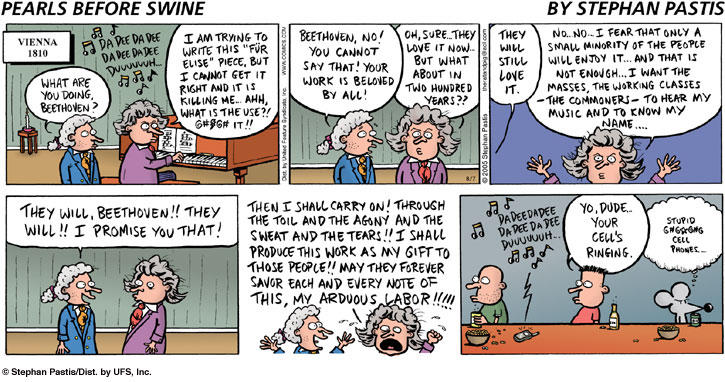
Saturday, August 06, 2005
Johann Sebastian Bach
What is Bach like?
You ask.
Like emptiness dancing,
Like ghosts on a trapeze.
Like the collapse of beauty
In a geometry forever.
Like a feather on the whirlwind.
Like a mirror unbroken
In a room of sunbeams.
Like the breathless rose
That blossoms between lovers –
The first petals of touch
In a new winter.
- November 2003
What an amazing day I had yesterday! Watched Ingmar Bergman's glorious, glorious Saraband (my review here). Then came home and sat for hours listening to Bach's Cello Suites and re-reading Ted Hughes' Crow (extract here)
Bliss.
You ask.
Like emptiness dancing,
Like ghosts on a trapeze.
Like the collapse of beauty
In a geometry forever.
Like a feather on the whirlwind.
Like a mirror unbroken
In a room of sunbeams.
Like the breathless rose
That blossoms between lovers –
The first petals of touch
In a new winter.
- November 2003
What an amazing day I had yesterday! Watched Ingmar Bergman's glorious, glorious Saraband (my review here). Then came home and sat for hours listening to Bach's Cello Suites and re-reading Ted Hughes' Crow (extract here)
Bliss.
Friday, August 05, 2005
Commited / There's no place like home
The story so far...
[Playing Star Wars theme]
In a blog far, far away, Falstaff, the last surviving Jaded-eye knight, is fighting a desperate battle to protect the magical forces of Pscyho Anal Isis from falling into the hands of Princess Meditative Rose and her evil henchmen. After a few inconclusive skirmishes on the planet fingeek (ruled by the indomitable warlord known as He Who Shall Not Be Flamed), the rebel forces find their home base under attack and are forced to withdraw to the mystical, inhospitable world known to the faithful only by the numbers 2x3x7. Here, in the dark jungles of Comments, the battle continues unabated...
P.S. Now if only I could find myself a woman in a gold bikini
[Playing Star Wars theme]
In a blog far, far away, Falstaff, the last surviving Jaded-eye knight, is fighting a desperate battle to protect the magical forces of Pscyho Anal Isis from falling into the hands of Princess Meditative Rose and her evil henchmen. After a few inconclusive skirmishes on the planet fingeek (ruled by the indomitable warlord known as He Who Shall Not Be Flamed), the rebel forces find their home base under attack and are forced to withdraw to the mystical, inhospitable world known to the faithful only by the numbers 2x3x7. Here, in the dark jungles of Comments, the battle continues unabated...
P.S. Now if only I could find myself a woman in a gold bikini
Is that three zeros or four?
Hmmm...just received notice from the university billing department reminding me that I still haven't paid my bill for July. Apparently if I don't pay up by today they'll start charging me interest at some exorbitant rate.
Just one problem - the total amount of the bill is, exactly, $0.00. (Yup, that's zero, nil, zilch) So I'm not entirely sure how I'm supposed to pay it. Will they take a cheque, I wonder? Maybe I could charge it to my credit card and then when it comes due there I could make a transfer for the full amount from my bank account. Or maybe I could transfer it to another credit card. Could I split it among multiple cards, do you think? Maybe I could take out a mortgage or something (I don't actually own any property, but how much collateral could you need for a loan of nothing anyway?). Or get a loan. I need real financial advice here people. I can already see an infinity of meaningless transaction stretching out before me.
On the other hand, I could just let them keep charging me interest on this. Let's see at a 20% monthly charge compounded for four years, a principal of $0.00 will come to, roughly, $0.00. Hmm... that doesn't sound so bad. I wonder if it'll hurt my credit rating?
Why are people so stupid?
Just one problem - the total amount of the bill is, exactly, $0.00. (Yup, that's zero, nil, zilch) So I'm not entirely sure how I'm supposed to pay it. Will they take a cheque, I wonder? Maybe I could charge it to my credit card and then when it comes due there I could make a transfer for the full amount from my bank account. Or maybe I could transfer it to another credit card. Could I split it among multiple cards, do you think? Maybe I could take out a mortgage or something (I don't actually own any property, but how much collateral could you need for a loan of nothing anyway?). Or get a loan. I need real financial advice here people. I can already see an infinity of meaningless transaction stretching out before me.
On the other hand, I could just let them keep charging me interest on this. Let's see at a 20% monthly charge compounded for four years, a principal of $0.00 will come to, roughly, $0.00. Hmm... that doesn't sound so bad. I wonder if it'll hurt my credit rating?
Why are people so stupid?
Thursday, August 04, 2005
Dedication
Isn't it sad how we always overlook the simple heroes that surround us in our daily lives?
Take the receptionist in my office for instance. Every day this woman comes into work an hour early, just so she can get an early start on all the meaningless prattle she has to get through during the day. At a time when the rest of us are crawling slowly towards our cubicles, coffee cup in hand, feeling like things that have crawled out of the primordial slime and may ultimately evolve into human beings, this stalwart woman is already filling the silence of our office with pointless chatter. By the time her day officially starts (at 9 am) she will already have made at least half a dozen completely trivial decisions and told everyone in office about them (that is to say, she will have gone to each person individually and told them about it - the fact that thanks to her loud nasal voice and the extreme thinness of our cubicle walls we all heard it the first time doesn't count of course). And it's not like she discriminates or anything. This is a woman who refuses to pick favourites, no matter how tempting it may seem. She will tell anyone and everyone the story of what her grandchild did at his second birthday party or what the doctor said about the pain in her knee - even total strangers. She's the Mother Teresa of piffle.
Where would we be without her, I wonder? What would we do if she were not here to lull us into that sense of dull annoyance, which is the hall-mark of a true working day? How would we ever get to work in an atmosphere of complete silence, denied the obvious wisdom of her trite homilies?
Why does she do it though? It's not like she doesn't have a wonderful home, a loving family. Why come in an hour early just to bore people with her twaddle? Perhaps because she knows, this brave woman, that once the day begins there will be a thousand other distractions to take care of - phones will ring, mail will arrive, she may even have to deal with (horror!) visitors. So better to get in one solid hour of uninterrupted chat right at the beginning of the day; that way she can go home in the evening with a clear conscience, aglow with the knowledge of another meaningless day successfully chatted away.
A drug on the market
This is so bizarre! Narcotics officers in Georgia arrest Indian store clerks for selling them cough medicine, matches and camping fuel! Have conclusive evidence that the clerk is a drug pusher because he / she nodded along to some obscure drug slang! Never mind that the clerk barely speaks English and almost certainly hasn't got around to reading The Naked Lunch.
I've never been much in favour of drug policing anyway, and this is just ridiculous. You can't go around arresting people for selling perfectly legal goods over the counter, just because they could be used to make drugs. I mean there are all sorts of things you can do with over the counter stuff - I remember reading somewhere that you could make high explosives with a mix of kerosene and fertiliser. Does this mean that a store clerk who sells those two things to a customer is a terrorist? I mean hello, we're talking about a country where it's legal to own guns, for crying out loud. And it's not like the store clerk is picking this stuff out for you and handing it to you along with a booklet on cooking meth for dummies - they're just charging up whatever you ask for. You don't really expect store clerks to listen to what you're saying (even if they do speak English) let alone conduct a detailed semantic analysis of every possible interpretation you words could have. Don't these cops have anything better to do with their lives than bait hassled store clerks?
And what about the customers themselves? If I have a cold and want to fix it before I go camping (not that I would ever go camping, of course - are you kidding me, it's the OUTDOORS!) do I run the risk of being arrested and put into prison for years on drug charges? And if I really were a meth junkie, this is hardly going to stop me. So no store in the country will sell me everything I need to make meth in one shot - am I suddenly going to give up my drug habit because I'd rather live through the withdrawal symptoms than go to two different stores and get some of the ingredients I need from one and some from the other?
Maybe these guys should stop smoking the stuff they confiscate.
P.S. In other news, you can make meth from stuff you buy at your local grocery store! Where would we be without the NY Times?
I've never been much in favour of drug policing anyway, and this is just ridiculous. You can't go around arresting people for selling perfectly legal goods over the counter, just because they could be used to make drugs. I mean there are all sorts of things you can do with over the counter stuff - I remember reading somewhere that you could make high explosives with a mix of kerosene and fertiliser. Does this mean that a store clerk who sells those two things to a customer is a terrorist? I mean hello, we're talking about a country where it's legal to own guns, for crying out loud. And it's not like the store clerk is picking this stuff out for you and handing it to you along with a booklet on cooking meth for dummies - they're just charging up whatever you ask for. You don't really expect store clerks to listen to what you're saying (even if they do speak English) let alone conduct a detailed semantic analysis of every possible interpretation you words could have. Don't these cops have anything better to do with their lives than bait hassled store clerks?
And what about the customers themselves? If I have a cold and want to fix it before I go camping (not that I would ever go camping, of course - are you kidding me, it's the OUTDOORS!) do I run the risk of being arrested and put into prison for years on drug charges? And if I really were a meth junkie, this is hardly going to stop me. So no store in the country will sell me everything I need to make meth in one shot - am I suddenly going to give up my drug habit because I'd rather live through the withdrawal symptoms than go to two different stores and get some of the ingredients I need from one and some from the other?
Maybe these guys should stop smoking the stuff they confiscate.
P.S. In other news, you can make meth from stuff you buy at your local grocery store! Where would we be without the NY Times?
Wednesday, August 03, 2005
World's Worst: You're Fired
Ten Worst Things to say when you're firing someone
1. "I'm really sorry about this, but the board specifically asked that it be a virgin and you're the only one we have." ("Laid, laid off - what's the difference?")
2. "See this revolver? Well we'll just slip a single cartridge into it, shall we, and then we'll spin it around like so..." ("I'd really like you take the lead on this")
3. "It's not you. It's us." ("Can't we just stay friends?")
4. "I'm sorry, Bob. The truth is you came under a cloud so fast, we didn't get time to attach the silver lining." ("Here's a piece of lint from the inside of my pocket, if that helps.")
5. "Even as we speak, a special task force is trashing your cube, deleting your hard drive, disabling your security access, putting all your stuff in rain-soaked boxes and throwing it onto the pavement from the 34th floor. By the time you leave this room you will have ceased to officially exist. So no hard feelings, okay." ("Oh, and there's a guy waiting outside with a stomach pump. Apparently the cafetaria is worried that you may smuggle some of their food out with you.")
6. "I can't help it Aaron. We looked through the employee list for people to fire and yours was the first name that popped up." ("Why couldn't you be more like Zygfeld over there? His job is secure forever")
7. "We discussed your latest performance review with your family and they completely agree." ("In fact, they're thinking of laying you off as well.")
8. "You know how you're always complaining about how your job isn't stimulating enough? How about you figure out the best way to survive on dumpster trash and we don't pay you for it? Does that sound like an assignment or what?" ("Don't think of it as getting fired. Think of it as being professionally challenged")
9. "I can't help it. I know you helped double our profitability last year, but now our Feng-Shui expert says that having an actual person in your cubicle is blocking the positive chi flows into the office." ("My all-seeing crystal here is sensing a very negative aura around you")
10. "Look at it this way, once our equity crashes making all your stock options worthless you'll realise that you weren't getting paid enough here anyway" ("And they'll be arresting you for all those things we've pinned onto you any day now, so it's not like you're not going to need another job")
1. "I'm really sorry about this, but the board specifically asked that it be a virgin and you're the only one we have." ("Laid, laid off - what's the difference?")
2. "See this revolver? Well we'll just slip a single cartridge into it, shall we, and then we'll spin it around like so..." ("I'd really like you take the lead on this")
3. "It's not you. It's us." ("Can't we just stay friends?")
4. "I'm sorry, Bob. The truth is you came under a cloud so fast, we didn't get time to attach the silver lining." ("Here's a piece of lint from the inside of my pocket, if that helps.")
5. "Even as we speak, a special task force is trashing your cube, deleting your hard drive, disabling your security access, putting all your stuff in rain-soaked boxes and throwing it onto the pavement from the 34th floor. By the time you leave this room you will have ceased to officially exist. So no hard feelings, okay." ("Oh, and there's a guy waiting outside with a stomach pump. Apparently the cafetaria is worried that you may smuggle some of their food out with you.")
6. "I can't help it Aaron. We looked through the employee list for people to fire and yours was the first name that popped up." ("Why couldn't you be more like Zygfeld over there? His job is secure forever")
7. "We discussed your latest performance review with your family and they completely agree." ("In fact, they're thinking of laying you off as well.")
8. "You know how you're always complaining about how your job isn't stimulating enough? How about you figure out the best way to survive on dumpster trash and we don't pay you for it? Does that sound like an assignment or what?" ("Don't think of it as getting fired. Think of it as being professionally challenged")
9. "I can't help it. I know you helped double our profitability last year, but now our Feng-Shui expert says that having an actual person in your cubicle is blocking the positive chi flows into the office." ("My all-seeing crystal here is sensing a very negative aura around you")
10. "Look at it this way, once our equity crashes making all your stock options worthless you'll realise that you weren't getting paid enough here anyway" ("And they'll be arresting you for all those things we've pinned onto you any day now, so it's not like you're not going to need another job")
Tuesday, August 02, 2005
Not quite so Platonic after all
One of the (many, many) things that irritate me about the world is the way that people who've never actually taken the trouble to read the great philosophers have no compunction in quoting their 'ideas' anyway. This means that these thinkers often get taken completely out of context and some of the most interesting ideas in human history are reduced, by popular usage, to mere platitudes. [1]
The classic example of this is the use of the word Platonic to mean an asexual relationship (the OED defines Platonic as 2. Applied to love or affection for one of the opposite sex, of a purely spiritual character, and free from sensual desire. Also of affection for one of the same sex.). All you have to do is actually read the Symposium to see how far from Plato's original discussion this usage is.
What Plato says
Just to set the record straight, here (in a grossly simplified version) is what Plato is actually saying (he puts the words in Socrates' mouth [2]; actually, he puts them in Socrates' mouth as being the words he heard from the oracle Diotima, but the argument is clearly his own):
If Love exists, Plato starts by arguing, it must be for something - that is to say it must have an object or end in mind. This end, Plato argues (more from empirics than anything else) is good and beauty - the purpose of which is to grant man happiness. Love, then, is the pursuit of everlasting good. But how is a mortal creature to achieve this end? If we are all doomed to die, surely this pursuit is bound to end in failure? It follows that he who loves must crave immortality, and must seek for ways to make himself immortal. The purpose of love, then, is generation - the extension of the self beyond the confines of one's own life.
How is this generation to be achieved, and what form must it take? That is, logically, a function of how the self is defined. Those who define the self as a physical entity, as bloodline or family, are "pregnant in the body" and must therefore achieve immortality through physical procreation - by having children in other words, and allowing these children to carry on their names, their memories, their bloodlines (Plato would have said genes, I'm sure, if he'd known about them).
But sexual reproduction is not the only way to ensure the immortality of the self. There is a nobler, higher way, one that is accessible to those who define their self in terms of ideas and interests, in terms of the soul; those who are, in Plato's terms "pregnant in the spirit". Such people will 'reproduce' through friendships / relationships with others - passing on their thoughts, their experience, their knowledge, ensuring that they live on in the minds of men rather than in their blood. The physical act of sex is irrelevant here - the true heirs of the spiritual lover are his works, and these are superior to mortal children precisely because they possess, in themselves, the power to last forever. Plato speaks of the 'children' of Homer and argues that these will be revered and respected long after all the mortal bloodlines of Homer's contemporaries have been lost. (Yeats writes: "Pardon, old fathers, if you still remain....Pardon that for a barren passion's sake / Although I have come close on forty-nine / I have no child, I have nothing but a book / Nothing but that to prove your blood and mine.")
These then, are the lesser mysteries of Love. But Plato does not stop here, he goes on to propose a heirarchy of love, a spiritual staircase of ever increasing vision. I quote: "the true order of going,or being led by another, to the things of love, is to begin from the beauties of earth and mount upwards for the sake of that other beauty, using these as steps only, and from one going on to two, and from two to all fair forms, and from fair forms to fair practices, and from fair practices to fair notions, until from fair notions he arrives at the notion of absolute beauty, and at last knows what the essenceof beauty is". There is thus, in Plato's conception of the world, an absolute beauty, a vision so dazzling that compared to it all lesser human loves fall away.
Why Platonic Love may not be so Platonic after all
A few things are important to notice here. First, Plato is not for a minute arguing against sexual pleasure / sensual gratification. His point is simply that these are not essential to the higher forms of love - they are not the reason for it. True Platonic lovers may sleep together, but the sexual tie is not what binds them to each other and therefore sexual fidelity is unimportant. Equally, reproduction is not the main purpose of this love (as it is with other forms of male-female relationships) so that gender becomes irrelevant as well - sexual relations with one of your own gender may actually make more sense, since it may be easier to pass on ideas / interests to someone of your own sex, which is the whole point of the relationship in the first place. The true Platonic lover finds beauty in everything, even sex, but sex is not more or less important than anything else and therefore is not what defines the relationship as it does with lower, more human loves.
In fact, the entire argument in the Symposium centres around (and glorifies) homosexual relationships between older men (lovers) and their younger proteges (beloveds). These are the relationships that the culture of the ancient Greeks praises and respects - Plato is explicitly critical of women and has nothing but contempt for relationships with them (political correctness is not a strong suit of the Greek philosophers - reading the Symposium can be a feminist's worst nightmare - but I think it's important to look beyond the bias of the times and see the truth in what Plato is saying without getting hung up on this - just because he's wrong about women doesn't mean he's wrong about anything else). It's ironic therefore, that the word Platonic should be used primarily in the sense of love or affection for the opposite sex, when that is certainly not the sense in which Plato meant it. One suspects that centuries of victorian morality that considered homosexuality absolutely taboo may have had something to do with this.
It should be obvious by now why the traditional use of the word Platonic is so wrong. What we normally consider critical for a 'Platonic' relationship - the absence of sex - isn't really important in Plato's view; on the other hand, what truly Platonic love requires - a deep, uplifting spiritual connection - may not exist in many relationships that we call 'Platonic' [3].[4]
Notes:
[1] I'm not even going to get into how much it irritates me that we live with a simplified (and misguided) image of these men. So Descartes is that "I think therefore I am" guy. Plato is the guy who said you can have love without sex (I mean, look, it's not even as though the Symposium is his major work, for crying out loud). And don't even get me started on what people keep doing to Nietszche.
[2] It's ironic that Plato uses Socrates as his mouthpiece to deliver a lengthy and fairly prescriptive discourse on Love. It's unclear that the real Socrates - who's entire credo was to question rather than to judge - would have been anything but suspicious of something stated this baldly as being 'the truth'
[3] The crummiest joke I ever heard about this was about this woman who gets caught sleeping with a man half her age and someone says to her "You said it was all Platonic!" to which she replies "It was. Play for him, tonic for me." (hey, I warned you it was a crummy joke)
[4] Knowing this can make conversations fairly complicated:
Friend: "So, this thing with you and her, is it Platonic or what?"
Yours Truly: "Errr...no, not really."
F: "So you're sleeping with her then."
YT: "No, no, nothing like that."
F: "So it's Platonic then"
YT: "No, it isn't. I mean we're not sleeping together but there's no major spiritual connection either. We're just friends. That is to say, not JUST friends, because you know friends are important too. More important than relationships, you know, they last longer and cause less stress. So friends. Not just friends. Just friends. I mean friends."
F: "So you want to sleep with her then."
YT: "No, no, I told you - it's not like that - it's totally platonic. I mean it's not really. I mean it's asexual. Not that we're actively avoiding sex or anything - it's just not part of the equation. So call it ultra-sexual. Or is it infra-sexual? Oh, damn it! Just forget about her okay. Let's just go watch the bloody movie"
The classic example of this is the use of the word Platonic to mean an asexual relationship (the OED defines Platonic as 2. Applied to love or affection for one of the opposite sex, of a purely spiritual character, and free from sensual desire. Also of affection for one of the same sex.). All you have to do is actually read the Symposium to see how far from Plato's original discussion this usage is.
What Plato says
Just to set the record straight, here (in a grossly simplified version) is what Plato is actually saying (he puts the words in Socrates' mouth [2]; actually, he puts them in Socrates' mouth as being the words he heard from the oracle Diotima, but the argument is clearly his own):
If Love exists, Plato starts by arguing, it must be for something - that is to say it must have an object or end in mind. This end, Plato argues (more from empirics than anything else) is good and beauty - the purpose of which is to grant man happiness. Love, then, is the pursuit of everlasting good. But how is a mortal creature to achieve this end? If we are all doomed to die, surely this pursuit is bound to end in failure? It follows that he who loves must crave immortality, and must seek for ways to make himself immortal. The purpose of love, then, is generation - the extension of the self beyond the confines of one's own life.
How is this generation to be achieved, and what form must it take? That is, logically, a function of how the self is defined. Those who define the self as a physical entity, as bloodline or family, are "pregnant in the body" and must therefore achieve immortality through physical procreation - by having children in other words, and allowing these children to carry on their names, their memories, their bloodlines (Plato would have said genes, I'm sure, if he'd known about them).
But sexual reproduction is not the only way to ensure the immortality of the self. There is a nobler, higher way, one that is accessible to those who define their self in terms of ideas and interests, in terms of the soul; those who are, in Plato's terms "pregnant in the spirit". Such people will 'reproduce' through friendships / relationships with others - passing on their thoughts, their experience, their knowledge, ensuring that they live on in the minds of men rather than in their blood. The physical act of sex is irrelevant here - the true heirs of the spiritual lover are his works, and these are superior to mortal children precisely because they possess, in themselves, the power to last forever. Plato speaks of the 'children' of Homer and argues that these will be revered and respected long after all the mortal bloodlines of Homer's contemporaries have been lost. (Yeats writes: "Pardon, old fathers, if you still remain....Pardon that for a barren passion's sake / Although I have come close on forty-nine / I have no child, I have nothing but a book / Nothing but that to prove your blood and mine.")
These then, are the lesser mysteries of Love. But Plato does not stop here, he goes on to propose a heirarchy of love, a spiritual staircase of ever increasing vision. I quote: "the true order of going,or being led by another, to the things of love, is to begin from the beauties of earth and mount upwards for the sake of that other beauty, using these as steps only, and from one going on to two, and from two to all fair forms, and from fair forms to fair practices, and from fair practices to fair notions, until from fair notions he arrives at the notion of absolute beauty, and at last knows what the essenceof beauty is". There is thus, in Plato's conception of the world, an absolute beauty, a vision so dazzling that compared to it all lesser human loves fall away.
Why Platonic Love may not be so Platonic after all
A few things are important to notice here. First, Plato is not for a minute arguing against sexual pleasure / sensual gratification. His point is simply that these are not essential to the higher forms of love - they are not the reason for it. True Platonic lovers may sleep together, but the sexual tie is not what binds them to each other and therefore sexual fidelity is unimportant. Equally, reproduction is not the main purpose of this love (as it is with other forms of male-female relationships) so that gender becomes irrelevant as well - sexual relations with one of your own gender may actually make more sense, since it may be easier to pass on ideas / interests to someone of your own sex, which is the whole point of the relationship in the first place. The true Platonic lover finds beauty in everything, even sex, but sex is not more or less important than anything else and therefore is not what defines the relationship as it does with lower, more human loves.
In fact, the entire argument in the Symposium centres around (and glorifies) homosexual relationships between older men (lovers) and their younger proteges (beloveds). These are the relationships that the culture of the ancient Greeks praises and respects - Plato is explicitly critical of women and has nothing but contempt for relationships with them (political correctness is not a strong suit of the Greek philosophers - reading the Symposium can be a feminist's worst nightmare - but I think it's important to look beyond the bias of the times and see the truth in what Plato is saying without getting hung up on this - just because he's wrong about women doesn't mean he's wrong about anything else). It's ironic therefore, that the word Platonic should be used primarily in the sense of love or affection for the opposite sex, when that is certainly not the sense in which Plato meant it. One suspects that centuries of victorian morality that considered homosexuality absolutely taboo may have had something to do with this.
It should be obvious by now why the traditional use of the word Platonic is so wrong. What we normally consider critical for a 'Platonic' relationship - the absence of sex - isn't really important in Plato's view; on the other hand, what truly Platonic love requires - a deep, uplifting spiritual connection - may not exist in many relationships that we call 'Platonic' [3].[4]
Notes:
[1] I'm not even going to get into how much it irritates me that we live with a simplified (and misguided) image of these men. So Descartes is that "I think therefore I am" guy. Plato is the guy who said you can have love without sex (I mean, look, it's not even as though the Symposium is his major work, for crying out loud). And don't even get me started on what people keep doing to Nietszche.
[2] It's ironic that Plato uses Socrates as his mouthpiece to deliver a lengthy and fairly prescriptive discourse on Love. It's unclear that the real Socrates - who's entire credo was to question rather than to judge - would have been anything but suspicious of something stated this baldly as being 'the truth'
[3] The crummiest joke I ever heard about this was about this woman who gets caught sleeping with a man half her age and someone says to her "You said it was all Platonic!" to which she replies "It was. Play for him, tonic for me." (hey, I warned you it was a crummy joke)
[4] Knowing this can make conversations fairly complicated:
Friend: "So, this thing with you and her, is it Platonic or what?"
Yours Truly: "Errr...no, not really."
F: "So you're sleeping with her then."
YT: "No, no, nothing like that."
F: "So it's Platonic then"
YT: "No, it isn't. I mean we're not sleeping together but there's no major spiritual connection either. We're just friends. That is to say, not JUST friends, because you know friends are important too. More important than relationships, you know, they last longer and cause less stress. So friends. Not just friends. Just friends. I mean friends."
F: "So you want to sleep with her then."
YT: "No, no, I told you - it's not like that - it's totally platonic. I mean it's not really. I mean it's asexual. Not that we're actively avoiding sex or anything - it's just not part of the equation. So call it ultra-sexual. Or is it infra-sexual? Oh, damn it! Just forget about her okay. Let's just go watch the bloody movie"
Monday, August 01, 2005
Joyce in the morning
A friend wrote in to say she thinks this blog is insanely schizophrenic (she meant it as a compliment, of course). And if there was any doubt about that:
You're Ulysses!
by James Joyce
Most people are convinced that you don't make any sense, but compared to what else you could say, what you're saying now makes tons of sense. What people do understand about you is your vulgarity, which has convinced people that you are at once brilliant and repugnant. Meanwhile you are content to wander around aimlessly, taking in the sights and sounds of the city. What you see is vast, almost limitless, and brings you additional fame. When no one is looking, you dream of being a Greek folk hero.
Finally, a random quiz that gives me results that make sense (read: that I like) - not like the Which Friends Character are you? quiz I took a couple of years back and was told that I was Joey! Joey!! can you believe that? Aaaargghhh!!
Try it for yourself here
You're Ulysses!
by James Joyce
Most people are convinced that you don't make any sense, but compared to what else you could say, what you're saying now makes tons of sense. What people do understand about you is your vulgarity, which has convinced people that you are at once brilliant and repugnant. Meanwhile you are content to wander around aimlessly, taking in the sights and sounds of the city. What you see is vast, almost limitless, and brings you additional fame. When no one is looking, you dream of being a Greek folk hero.
Finally, a random quiz that gives me results that make sense (read: that I like) - not like the Which Friends Character are you? quiz I took a couple of years back and was told that I was Joey! Joey!! can you believe that? Aaaargghhh!!
Try it for yourself here
Subscribe to:
Posts (Atom)

 Posts
Posts

