Another day, another set of movies. Today's crop included a short documentary by James Longley called Sari's Mother, as well as a one-hour feature by Danish film-maker Eva Mulvad about Afghanistan politician Malalai Joya, called Enemies of Happiness.
The Mulvad documentary is a fascinating watch - less for what it tells us about Joya, than for its depiction of a society coming to reluctant grips with democracy. Set almost entirely in the ten days leading up to the first parliamentary elections in Afghanistan in 2005, Enemies of Happiness chronicles the day to day life of Malalai Joya, a 28-year old woman fighting the election on a platform of women's rights and opposition to warlords, a stance that had her banished from the national assembly in 2003 (for violating 'common courtesy' - link leads to video clip of the incident) and that has made her the target of assassination attempts ever since. As the film unfolds, we see Joya struggling to cope with the pressures of the forthcoming election, balancing her role as a sort of impromptu village elder giving advice and support to those who come to her with their troubles, while struggling to get her message out there in a pre-election environment where she cannot move out of her office unless wearing a burqa and with a heavily armed escort in tow.
There is no doubt that Joya is an inspiring figure (you can read more about her here) but I can't help feeling that the film is a little too obviously on her side, it's viewpoint so heavily subjective that it's impossible to arrive at your own opinion of Joya, making one's approval of her an article of faith. Things are made even more problematic by the fact that the film provides little or no background information about the issues Joya is fighting for or the context she's fighting in, treating all that as something the viewer would know about (which I suppose one should, but frankly, I don't). Instead the film spends a lot of its time on the details of one particular problem - somewhat tangential, I would think, to Joya's main platform - the insistence of an 80 year old opium dealer on marrying a girl younger than his grandchild against her wishes. By itself, it's not an uninteresting story, but in the larger context of the film it feels like a distraction, and I found myself wishing the film had spent more time telling us about the 'warlords' that Joya is fighting against - who they are, what they're guilty of, etc.
Where the film works, I think, is in documenting Afghanistan's first tentative steps towards democracy. Some of its most fascinating scenes are only peripherally about Joya - the UN briefing of the candidates standing for election ten days before polling, or the scenes at the polling stations as people figure out how this whole thing works. These scenes are both rueful and heartening, and their magic lies, fittingly enough, in the knowledge that, ultimately, democracy is about the people. To watch a 100 year old woman enact how she used to place mines to kill the Russians, and then hobble her way into a polling booth to cast her vote for Joya is to see, in miniature, what democracy should really be about, and to have hope that, no matter how much the democratic process is subverted by self-seeking warlords, some change will happen, even in a place as unpromising as Afghanistan.
By contrast, James Longley's Sari's Mother is an unsatisfying work. The story of a woman whose son (Sari) has been infected by HIV via blood transfusion and is now fighting to receive aid and compensation from the Iraqi government, Sari's Mother seems directionless and insipid, a mini-documentary hastily assembled from a section left out of Longley's Iraq in Fragments (which I blogged about here). Sari's plight is heart-breaking, of course, but while one feels sympathy for him and his family, it's hard to achieve any level of indignation. Sari's mother tells us how she's been fighting for four years to get support for her son, but in the film the footage of her encounter with the authorities (billed in the film description as "a Sisyphean journey to Baghdad, into the offices of government officials, devastated hospitals and through the country’s labyrinthine healthcare system") lasts all of two minutes, and, by the standards of your average government office back in India seems fairly responsive (though I can't help wondering how much of that is because she's accompanied by an American with a camera). Longley spends the rest of his time filming Sari and his family at home, and while the footage is beautiful in parts and certainly redolent with atmosphere, it really doesn't tell us very much about Sari's family or the world they live in. The one mention of the situation in Iraq beyond the family's immediate concerns seems artificially tacked on, so that the only real sense of being in Iraq you get from the film is by hearing the helicopters pass over the family's house.
One scene, however, stands out in my mind - a scene of Sari's siblings playing in the yard, pretending that they're fighters placing a bomb in the path of the foreigners, the childish glee in their voices as their little clay 'humvee' runs over the pebble 'mine' and blows up. So much for winning hearts and minds.
Wednesday, February 20, 2008

Infamous Five
Sigh. First Space Bar, then Anindita. I suppose I'm going to get no peace till I do this silly tag. So here:
The Family
Friends
Me
My Love
Something I like (and posts that follow)
So there.
The Family
Friends
Me
My Love
Something I like (and posts that follow)
So there.
Tuesday, February 19, 2008
Coming shortly to a theater near you
Just got back from watching all ten of the Academy Award nominated short features for the year - five animation and five live action. It's a decidedly mixed bag: some of the films (Even Pigeons Go To Heaven, Tanghi Argentini) are clearly 'shorts' - clever little pieces that make for amusing viewing, but would fall apart if they were stretched for another five minutes [1]; others are bizarre (Madame Tutli-Putli) or just plain silly (The Substitute); some (Mozart of the Pickpockets, My Love) are so delightful that I was disappointed they didn't go on for longer; while others (well, one, at least) may as well be full-length features for the emotional and visual impact they pack.
Among the animated shorts, I really loved Alexander Petrov's My Love. The story is a little cheesy (ok, so it's VERY cheesy) but the sheer visual exhilaration of the film more than makes up for it (see the opening scenes here - though Youtube doesn't do justice to the richness of the colors). Petrov's palette is drawn straight from the impressionists (Renoir, in particular, seems strongly suggested), except he marries it to the imagination of a surrealist, so that the result is a hazy, dream-like tone punctuated by glorious swirls of living color that will take your breath away. Frame after frame of this film seems like it should be hanging in some museum, and the nostalgic, fairy-tale quality this gives the film works well with the story itself - about the awkward combination of innocence, sexual desire, intensity and unfaithfulness that is adolescent love.
In dramatic contrast to the visual splendor of My Love is Josh Raskin's I Met the Walrus, which provides hilarious visual accompaniment to an audio recording of an interview with John Lennon (you can see the trailer here). I'm admittedly prejudiced (I mean, this is Lennon we're talking about) but I sat through the whole length of this feature with a big grin plastered over my face, and when it was over ,wanted desperately to go back and watch it again. Raskin's art work isn't much, but his inventiveness is breathtaking, and as he segues effortlessly from image to image, joke to joke, his witty, zany drawings blending perfectly with Lennon's words, you just sit there with your eyes glued to the screen, afraid that you're missing something. Great stuff.
Among the live action films, I'll confess to being utterly charmed by Phillippe Pollet-Villard's Mozart of the Pickpockets. The film tells the story of two petty thieves - Philippe and Richard - who end up taking in a deaf and dumb boy they meet in the streets one day, only to discover that he's twice the pickpocket that they could ever be. Again, the story isn't much, but the two main characters are so delightful to watch that it really doesn't matter: Philippe and Richard are the Bouvard and Pecuchet of crime - a couple of hapless, hopelessly incompetent crooks who like to imagine that they're genuine tough guys when really they're pushovers. Watching the deftness with which Pollet-Villard's film plays out, I was reminded of Bertrand Blier's Going Places - Mozart of the Pickpockets is a far sweeter, far more modest film, but it has the same comic lightness, the same sureness of touch, so that you can easily imagine spending a pleasant hour and a half watching the shenanigans of this unlikely trio, and can't help feeling let down when the film draws to its (fairly tame) end.
But my pick of all the films I saw was Christian E. Christiansen's At Night, a moving, superbly acted, brilliantly filmed piece that delivers an unflinching yet beautiful portrait of three inmates of a cancer ward. The 'Night' here is both literal and metaphoric - the three women gather after lights out, but the real gloom that surrounds them is the shadow of death. It is the knowledge of their own mortality - a knowledge whose anguish and isolation the film perfectly captures - that drives these three to seek a small measure of comfort in each other's company. There's is a bond created out of terror and loneliness - what they have in common is a way of dying - yet in their togetherness they are like convicts in a penitentiary ("Death Row" as one of the characters remarks - and what is death but the most existential of prisons), sympathetic to each other's suffering but jealous of each other's consolations.
As though to do justice to his character's despair, Christiansen's film is a study in starkness, awash in neon, its visual landscape leached of all color, even hope. In shot after loving shot, what you see staring back at you from those ravaged faces, from those pain-filled and terrified eyes, is a need for love and comfort that is achingly human, a vulnerability that cannot be named because it is mortal, but that demands to be seen. Nothing can quite match the sheer poetry of sickness that Bergman and Nykvist created in Cries and Whispers, but there are moments when At Night approaches that level of perfection. The result is an exquisite and captivating film, that, in a mere 39 minutes manages to take you deep into the emotional wastelands of its characters' minds, and delivers the kind of quality experience that many a full-length feature can only aspire to. If At Night is anything to go by, Christiansen is a director to watch out for.
[1] To see what this looks like, you have only to watch Daniel Barber's The Tonto Woman - based on a powerful enough short story by Elmore Leonard, the film takes about twice as long as it needs to, tries to substitute atmosphere for movement, and ends up so self-conscious that it comes perilously close to being a parody of itself.
Among the animated shorts, I really loved Alexander Petrov's My Love. The story is a little cheesy (ok, so it's VERY cheesy) but the sheer visual exhilaration of the film more than makes up for it (see the opening scenes here - though Youtube doesn't do justice to the richness of the colors). Petrov's palette is drawn straight from the impressionists (Renoir, in particular, seems strongly suggested), except he marries it to the imagination of a surrealist, so that the result is a hazy, dream-like tone punctuated by glorious swirls of living color that will take your breath away. Frame after frame of this film seems like it should be hanging in some museum, and the nostalgic, fairy-tale quality this gives the film works well with the story itself - about the awkward combination of innocence, sexual desire, intensity and unfaithfulness that is adolescent love.
In dramatic contrast to the visual splendor of My Love is Josh Raskin's I Met the Walrus, which provides hilarious visual accompaniment to an audio recording of an interview with John Lennon (you can see the trailer here). I'm admittedly prejudiced (I mean, this is Lennon we're talking about) but I sat through the whole length of this feature with a big grin plastered over my face, and when it was over ,wanted desperately to go back and watch it again. Raskin's art work isn't much, but his inventiveness is breathtaking, and as he segues effortlessly from image to image, joke to joke, his witty, zany drawings blending perfectly with Lennon's words, you just sit there with your eyes glued to the screen, afraid that you're missing something. Great stuff.
Among the live action films, I'll confess to being utterly charmed by Phillippe Pollet-Villard's Mozart of the Pickpockets. The film tells the story of two petty thieves - Philippe and Richard - who end up taking in a deaf and dumb boy they meet in the streets one day, only to discover that he's twice the pickpocket that they could ever be. Again, the story isn't much, but the two main characters are so delightful to watch that it really doesn't matter: Philippe and Richard are the Bouvard and Pecuchet of crime - a couple of hapless, hopelessly incompetent crooks who like to imagine that they're genuine tough guys when really they're pushovers. Watching the deftness with which Pollet-Villard's film plays out, I was reminded of Bertrand Blier's Going Places - Mozart of the Pickpockets is a far sweeter, far more modest film, but it has the same comic lightness, the same sureness of touch, so that you can easily imagine spending a pleasant hour and a half watching the shenanigans of this unlikely trio, and can't help feeling let down when the film draws to its (fairly tame) end.
But my pick of all the films I saw was Christian E. Christiansen's At Night, a moving, superbly acted, brilliantly filmed piece that delivers an unflinching yet beautiful portrait of three inmates of a cancer ward. The 'Night' here is both literal and metaphoric - the three women gather after lights out, but the real gloom that surrounds them is the shadow of death. It is the knowledge of their own mortality - a knowledge whose anguish and isolation the film perfectly captures - that drives these three to seek a small measure of comfort in each other's company. There's is a bond created out of terror and loneliness - what they have in common is a way of dying - yet in their togetherness they are like convicts in a penitentiary ("Death Row" as one of the characters remarks - and what is death but the most existential of prisons), sympathetic to each other's suffering but jealous of each other's consolations.
As though to do justice to his character's despair, Christiansen's film is a study in starkness, awash in neon, its visual landscape leached of all color, even hope. In shot after loving shot, what you see staring back at you from those ravaged faces, from those pain-filled and terrified eyes, is a need for love and comfort that is achingly human, a vulnerability that cannot be named because it is mortal, but that demands to be seen. Nothing can quite match the sheer poetry of sickness that Bergman and Nykvist created in Cries and Whispers, but there are moments when At Night approaches that level of perfection. The result is an exquisite and captivating film, that, in a mere 39 minutes manages to take you deep into the emotional wastelands of its characters' minds, and delivers the kind of quality experience that many a full-length feature can only aspire to. If At Night is anything to go by, Christiansen is a director to watch out for.
[1] To see what this looks like, you have only to watch Daniel Barber's The Tonto Woman - based on a powerful enough short story by Elmore Leonard, the film takes about twice as long as it needs to, tries to substitute atmosphere for movement, and ends up so self-conscious that it comes perilously close to being a parody of itself.
Sunday, February 17, 2008
Miniature version of Solar System discovered; developed by Apple
Cupertino, California
A spokesperson for the Apple Corporation acknowledged today that the miniature version of the Solar System discovered last week is, in fact, developed by Apple. Speaking at a press conference, the spokesperson said that the development of the miniature Solar System - tentatively called iWorld - is a logical extension of Apple's long-standing corporate strategy of pandering to Steve Job's God complex and hoping that consumers will go along.
Rumors about the connection between Apple and the newly discovered planetary system have been rife since Thursday, when astronomer Dan Newton first noticed a similarity between the orbital pattern of the system and the dial on his son's iPod. Newton said the discovery felt "like an apple falling on his head".
Confirming the rumors today, the Apple spokesperson said that the new iWorld was not only capable of sustaining Life (as many have speculated) but could also make phone calls, play movies, and have a more exciting sex life than its owner. The iWorld is currently in limited release, but will be freely available to all galaxies by 2010.
The Apple announcement comes even as insider sources in Microsoft report that Bill Gates attempts to develop his own personal Universe continue to be dogged by failure, with repeated crashes proving the new version of the Universe highly unstable. As one source said, "who wants a Universe where you have to go back to Big Bang every two days or so?"
In other news, Apple also announced the launch of the iDogWhistle - a new mp3 player that solves the problem of iPod listeners being unable to hear sounds around them by playing music at frequencies inaudible to the human ear.
A spokesperson for the Apple Corporation acknowledged today that the miniature version of the Solar System discovered last week is, in fact, developed by Apple. Speaking at a press conference, the spokesperson said that the development of the miniature Solar System - tentatively called iWorld - is a logical extension of Apple's long-standing corporate strategy of pandering to Steve Job's God complex and hoping that consumers will go along.
Rumors about the connection between Apple and the newly discovered planetary system have been rife since Thursday, when astronomer Dan Newton first noticed a similarity between the orbital pattern of the system and the dial on his son's iPod. Newton said the discovery felt "like an apple falling on his head".
Confirming the rumors today, the Apple spokesperson said that the new iWorld was not only capable of sustaining Life (as many have speculated) but could also make phone calls, play movies, and have a more exciting sex life than its owner. The iWorld is currently in limited release, but will be freely available to all galaxies by 2010.
The Apple announcement comes even as insider sources in Microsoft report that Bill Gates attempts to develop his own personal Universe continue to be dogged by failure, with repeated crashes proving the new version of the Universe highly unstable. As one source said, "who wants a Universe where you have to go back to Big Bang every two days or so?"
In other news, Apple also announced the launch of the iDogWhistle - a new mp3 player that solves the problem of iPod listeners being unable to hear sounds around them by playing music at frequencies inaudible to the human ear.
Friday, February 15, 2008
Dies Irae
I don't normally post youtube videos on this blog, but saw this one while searching for stuff for the comments thread on ??!'s blog, and thought it was the perfect bit of palate cleansing for the day after Valentine's. I've always been fond of Jenkin's setting of Dies Irae - I never cease to find the juxtaposition of the latin text and the discotheque-like beat amusing. Plus I think the Alfred Kubin images are a considerable value add, don't you?
Thursday, February 14, 2008
Go and shoot a falling satellite
So apparently the US is going on a turkey shoot in space. Not only do they plan to shoot down a falling satellite (which just happens to contain half a ton of a lethal fuel), they plan to do it using a technique they've never employed before, using instruments that have only been used in carefully controlled conditions and technology that is undergoing "modifications that are still under way". But not to worry, if they do miss the first time, they will have time for a second shot, maybe even a third. What could possibly go wrong?
Sources close to the Pentagon also report that the armed forces are reaching out to John Carpenter to direct the whole operation.
Of course, the authorities say they've looked at the risks and found that "broadly speaking, they are negligible." Now remember, this is the same administration that was convinced that there were WMDs in Iraq, so you can draw your own conclusions about how broad "broadly speaking" can be. One can only hope that Dick Cheney isn't overseeing the operation. Otherwise we might end up shooting the moon in the back of its head.
Ah well. Mustn't be pessimistic. I'm sure the whole thing will go off without a glitch. And if all else fails, they could always use the force.
Sources close to the Pentagon also report that the armed forces are reaching out to John Carpenter to direct the whole operation.
Of course, the authorities say they've looked at the risks and found that "broadly speaking, they are negligible." Now remember, this is the same administration that was convinced that there were WMDs in Iraq, so you can draw your own conclusions about how broad "broadly speaking" can be. One can only hope that Dick Cheney isn't overseeing the operation. Otherwise we might end up shooting the moon in the back of its head.
Ah well. Mustn't be pessimistic. I'm sure the whole thing will go off without a glitch. And if all else fails, they could always use the force.
Wednesday, February 13, 2008
The Flowers
No, he can't take them on the subway. Not at this time of day. He'll just have to walk - twenty five blocks in the mid-February cold - but it's worth it, if only to keep the flowers from getting crushed.
As he leaves the florist's he is aware of being noticed. It's the flowers, of course. Roses. Two dozen. Each one as delicate as a wineglass, as plush as a mouth. For a moment he is embarrassed by the vulgarity of the gesture, but he reminds himself that it's Valentine's Day, this kind of thing is expected, he's not doing anything wrong.
Walking down the street, he tries to read the faces that turn to him. Envy, longing, amusement, scorn - emotions that pass like windows - opaque expressions in which he sees only his own reflection, and not the people watching from the other side.
What do they see, these strangers? A man in his mid-thirties clutching an enormous bouquet. A tall, well-dressed man, plain looking but confident, competent, successful, but also sensitive and self-aware. The kind of man who is neither ignorant of his own feelings nor afraid to show them. A little short on imagination, perhaps, even a little old-fashioned, but a staunch romantic for all that. It pleases him, this picture he imagines other people seeing; in some obscure way it makes him proud. As though he had always wanted to become this man walking down Fifth Avenue with a bouquet of roses in his hand, headed for an evening with the woman he loves.
Back at the apartment he leaves the flowers on the side table, changes into something more casual, sees about dinner. Nothing too fancy, of course - he is no cook - but perhaps some wine? As the microwave hums into action, he puts some music on the stereo - Chopin, the Nocturnes - then dims the lights. Perfect.
By the time dinner is ready, the smell from the flowers fills the room. It is a pleasant smell, rich and lazy, though in a little while it will start to sicken. He will have to get rid of the flowers early tomorrow morning, go down before the super wakes up and leave them in the trash, so no one can tell where they came from. Chewing his way through his microwave meal, he thinks back over the walk, remembering the eyes of the others on him, reliving the exhilaration he felt. Imagining how it would feel to really be in love.
As he leaves the florist's he is aware of being noticed. It's the flowers, of course. Roses. Two dozen. Each one as delicate as a wineglass, as plush as a mouth. For a moment he is embarrassed by the vulgarity of the gesture, but he reminds himself that it's Valentine's Day, this kind of thing is expected, he's not doing anything wrong.
Walking down the street, he tries to read the faces that turn to him. Envy, longing, amusement, scorn - emotions that pass like windows - opaque expressions in which he sees only his own reflection, and not the people watching from the other side.
What do they see, these strangers? A man in his mid-thirties clutching an enormous bouquet. A tall, well-dressed man, plain looking but confident, competent, successful, but also sensitive and self-aware. The kind of man who is neither ignorant of his own feelings nor afraid to show them. A little short on imagination, perhaps, even a little old-fashioned, but a staunch romantic for all that. It pleases him, this picture he imagines other people seeing; in some obscure way it makes him proud. As though he had always wanted to become this man walking down Fifth Avenue with a bouquet of roses in his hand, headed for an evening with the woman he loves.
Back at the apartment he leaves the flowers on the side table, changes into something more casual, sees about dinner. Nothing too fancy, of course - he is no cook - but perhaps some wine? As the microwave hums into action, he puts some music on the stereo - Chopin, the Nocturnes - then dims the lights. Perfect.
By the time dinner is ready, the smell from the flowers fills the room. It is a pleasant smell, rich and lazy, though in a little while it will start to sicken. He will have to get rid of the flowers early tomorrow morning, go down before the super wakes up and leave them in the trash, so no one can tell where they came from. Chewing his way through his microwave meal, he thinks back over the walk, remembering the eyes of the others on him, reliving the exhilaration he felt. Imagining how it would feel to really be in love.
Monday, February 11, 2008
Caferati Contests 2008 / Apparently, Mediocrity really is my middle name
So it seems that two pieces of random doggerel I wrote for the Caferati sms poetry contest won 1st and 2nd prize. You can go read them here.
And while you're in the area, you might as well go read the short piece of mine that made it to the finals of the Flash Fiction thing. It's not a particularly great piece, but well, if you can't get a post out of this stuff then what's the point of writing it?
And while you're in the area, you might as well go read the short piece of mine that made it to the finals of the Flash Fiction thing. It's not a particularly great piece, but well, if you can't get a post out of this stuff then what's the point of writing it?
Sunday, February 10, 2008
He plays drums
like a blind man groping for direction. Eyes tightly closed. Only the insistent tap-tap-tap of his stick to guide him into the untraveled heart of the music. Corridors of rhythm. Silence like a ruined house.
We can only imagine what it sounds like inside his head. We listen, awed, as he stumbles, stops, hurries forward again; his occasional awkwardness melting into fluent triumph, getting to the point where we think he can go no further, where he must give up, only he goes on and on and we feel our heartbeats going out to him, our heads nodding their furious assent to his impossible urgency, secure in the knowledge that no matter how confused or crowded the song gets, he will find a way through.
He plays drums like a blind man. You must shut your eyes to hear.
We can only imagine what it sounds like inside his head. We listen, awed, as he stumbles, stops, hurries forward again; his occasional awkwardness melting into fluent triumph, getting to the point where we think he can go no further, where he must give up, only he goes on and on and we feel our heartbeats going out to him, our heads nodding their furious assent to his impossible urgency, secure in the knowledge that no matter how confused or crowded the song gets, he will find a way through.
He plays drums like a blind man. You must shut your eyes to hear.
Abort! Abort!
Another weekend, another protracted and pointless discussion on Ultra Violet. My own fault for trying to scratch beneath the surface of these posts instead of just nodding along, I suppose. I don't know why I bother [1].
This one involves a post by one Sharanya Manivannan which is intriguing only for how little it says and how long it takes to say it. Ms. Manivannan starts by telling us that even though we are entitled to have our own opinions on whether abortion is right or not, we must recognize that illegal abortions put women at risk and therefore it's important that women be permitted to choose - an argument she dwells on for a bit before concluding that it isn't particularly relevant in a country (India) where women have the legal right to have abortions.
This little digression over, she finally gets to what she really wants to say, which is to claim that women choosing abortions still face social disapproval. She describes this disapproval by saying that she can't remember the last time she heard a conversation about abortion that didn't involve "a hushed whisper, a disapproving tone or cluck of the tongue" by which what she really means is that women who choose to have abortions are seen as 'loose women' and that "The easiest way to damage a single woman’s reputation in India is to spread a rumour about her multiple abortions", though she doesn't, of course, say this (or says it only after a protracted comment exchange), simply expects us to somehow infer it.
What we're not supposed to infer, meanwhile, is that she would like to see a world where abortion was a casual act, free of any trauma or regret for the people involved. It's not that she doesn't believe this - she does. Or might. In any case, we're not supposed to infer it.
The summary of her post (as far as I can tell) is that it would be nice if women didn't have to face social censure over their choice to have an abortion - a pretty, if somewhat trite sentiment, which comes without any discussion of how this is to be achieved, particularly if it's acceptable for people to hold the view that abortion is wrong (as she seems to accept at the start of her post).
The problem, I think, is that Ms. Manivannan is confusing acceptance with approval. It is unrealistic to expect that the large numbers of people who see abortion as wrong or unethical are going to change their mind about it anytime soon. Indeed, it is not clear to me why they should (they're entitled to their opinion, after all) and I certainly don't think it's going to happen if we simply dismiss their issues as irrelevant. We can certainly expect and demand that their disapproval not be allowed to interfere in a woman's exercise of her right to have an abortion, or that it not be allowed to take that right away from her. And we can hope, in the name of a civil society, that they not harass women who have had an abortion (not 'honor' their choices, perhaps, but keep silent about them), and that they distinguish between disapproving of the act and disapproving of the actor. Though even that may be hoping for too much.
The real issue, of course (which is mentioned in Ms. Manivannan's post, but which she never really discusses) is that in a patriarchal world where women are often not economically empowered, and are therefore dependent on social approval, they may not have the ability to make independent choices that fly in the face of social censure. This is a valid concern - to the extent that it is true (I personally have no idea how serious the social taboo against abortion really is, I'm taking other people's word for the fact that it is serious), but the solution to it is is not to expect social attitudes to magically change to approve of women's choices. That's putting the cart before the horse. The solution to the problem of lack of real choice (with abortions, and more generally) is to work towards empowering women so that they can exercise their rights without having to rely on the approval of others. That empowerment, is also, of course, the way to change social attitudes themselves, but their key role is not to reduce social disapproval but to make it irrelevant. If empowerment doesn't happen, social attitudes won't change either. If it does, then social attitudes will probably change as well, but by then they won't matter that much anyway.
Of course, creating empowerment is a long and difficult process, but it's not like there's an alternative, is there? Certainly legitimizing the dependence of women on social approval while dreamily imagining that social mores will change doesn't help. As I've said before, I believe that those who oppose abortion should have every opportunity to state their case, and to do whatever they can to influence a woman's decision to have an abortion. If we disagree with them, and want to counteract their influence, we need to do so by creating a counter-community of people who support and celebrate a woman's right to have an abortion - which, of course, is what the pro-life vs. pro-choice dynamic, that Ms. Mannivannan so airily dismisses, is all about.
Finally, on abortions as a 'casual' choice. It seems unlikely to me that we'll ever get to the point where choosing to have an abortion will be an easy choice for the majority of women to make. I think it's safe to say that for most women choosing to have an abortion is a difficult, traumatic decision, and I think it would be even without the threat of social censure or the taboo (such as it is) around abortions. We can debate whether this emotional involvement comes from some kind of physiological maternal instinct, or from socially conditioned beliefs in the sanctity of life and parenthood. It certainly goes much beyond the threat of reprisals over the fact of having had an abortion, and beyond any narrow definition of gender role. Whether we want to see abortions become less of an emotional issue is a function of how important we see some of these factors being, but it's worth noting that the social values involved are deeply embedded in our social fabric, and imagining a world where abortion would not, by and large, be an emotionally charged choice, means imagining a world with a social and ethical superstructure dramatically different from the one we have today. Can such a superstructure be imagined? Yes, I think so. But I'm unsure that it would lead to a better, more egalitarian world than the one we've got now. At any rate, the whole question strikes me as being somewhat irrelevant to the immediate issue at hand. In any reasonably foreseeable future, abortion will remain a traumatic and emotionally troubling choice for everyone concerned, and therefore one that is difficult to talk about, even for those of us who don't disapprove of it.
Recognizing that, rather than trying to deny it for the sake of some ideology, is actually critical to taking the first steps towards opposing the kind of social censure that Ms. Manivannan claims is common. Much of the trouble, I suspect, is that the only people who freely declaim their views on abortion are those who don't recognize that it is a difficult choice for the women making it - and these are almost always the people who not only disapprove of abortions but have managed to convince themselves that the women who choose to have abortions treat them casually (hence their indignation). It's not clear to me that public opinion is really so staunchly anti-abortion. I think it's possible that it simply seems that way because those of us who are sensitive to the trauma involved find it awkward to talk about, so that all the air time goes to the anti-abortion zealots, leaving women who have abortions feeling victimized. The question to ask then, as I've said before, is not what we can do to change the minds of those who are against abortion, but how we can find ways to express our support and solidarity with women who do have abortions so they don't feel so alone. I'm not sure what the answer to that question is - maybe abortion support groups, maybe new pro-abortion depictions in the arts / media, maybe clearer, more concise blog posts - but it certainly seems to me that that is the right question to be asking.
[1] Actually, I do know why I bother - because I think the underlying issues are important, and deserve more careful consideration than they typically get - but I think I need to be less obsessive about it, don't you? From now on I'm making what I'm going to call the Falstaff Resolution. I will write one comment critiquing what I see as wrong with a post, and unless I get an intelligent, constructive response which suggests that the person is actually interested in engaging in a real discussion, I will LET IT GO! There. And I'm asking you, the reader, to help me stick to this resolution. If you see me going on and on about something [2], either on this blog or elsewhere, please call me on it - just leave a comment saying: 'Vade Retro Falstaff' or something along those lines. Seriously.
[2] After this post, obviously.
This one involves a post by one Sharanya Manivannan which is intriguing only for how little it says and how long it takes to say it. Ms. Manivannan starts by telling us that even though we are entitled to have our own opinions on whether abortion is right or not, we must recognize that illegal abortions put women at risk and therefore it's important that women be permitted to choose - an argument she dwells on for a bit before concluding that it isn't particularly relevant in a country (India) where women have the legal right to have abortions.
This little digression over, she finally gets to what she really wants to say, which is to claim that women choosing abortions still face social disapproval. She describes this disapproval by saying that she can't remember the last time she heard a conversation about abortion that didn't involve "a hushed whisper, a disapproving tone or cluck of the tongue" by which what she really means is that women who choose to have abortions are seen as 'loose women' and that "The easiest way to damage a single woman’s reputation in India is to spread a rumour about her multiple abortions", though she doesn't, of course, say this (or says it only after a protracted comment exchange), simply expects us to somehow infer it.
What we're not supposed to infer, meanwhile, is that she would like to see a world where abortion was a casual act, free of any trauma or regret for the people involved. It's not that she doesn't believe this - she does. Or might. In any case, we're not supposed to infer it.
The summary of her post (as far as I can tell) is that it would be nice if women didn't have to face social censure over their choice to have an abortion - a pretty, if somewhat trite sentiment, which comes without any discussion of how this is to be achieved, particularly if it's acceptable for people to hold the view that abortion is wrong (as she seems to accept at the start of her post).
The problem, I think, is that Ms. Manivannan is confusing acceptance with approval. It is unrealistic to expect that the large numbers of people who see abortion as wrong or unethical are going to change their mind about it anytime soon. Indeed, it is not clear to me why they should (they're entitled to their opinion, after all) and I certainly don't think it's going to happen if we simply dismiss their issues as irrelevant. We can certainly expect and demand that their disapproval not be allowed to interfere in a woman's exercise of her right to have an abortion, or that it not be allowed to take that right away from her. And we can hope, in the name of a civil society, that they not harass women who have had an abortion (not 'honor' their choices, perhaps, but keep silent about them), and that they distinguish between disapproving of the act and disapproving of the actor. Though even that may be hoping for too much.
The real issue, of course (which is mentioned in Ms. Manivannan's post, but which she never really discusses) is that in a patriarchal world where women are often not economically empowered, and are therefore dependent on social approval, they may not have the ability to make independent choices that fly in the face of social censure. This is a valid concern - to the extent that it is true (I personally have no idea how serious the social taboo against abortion really is, I'm taking other people's word for the fact that it is serious), but the solution to it is is not to expect social attitudes to magically change to approve of women's choices. That's putting the cart before the horse. The solution to the problem of lack of real choice (with abortions, and more generally) is to work towards empowering women so that they can exercise their rights without having to rely on the approval of others. That empowerment, is also, of course, the way to change social attitudes themselves, but their key role is not to reduce social disapproval but to make it irrelevant. If empowerment doesn't happen, social attitudes won't change either. If it does, then social attitudes will probably change as well, but by then they won't matter that much anyway.
Of course, creating empowerment is a long and difficult process, but it's not like there's an alternative, is there? Certainly legitimizing the dependence of women on social approval while dreamily imagining that social mores will change doesn't help. As I've said before, I believe that those who oppose abortion should have every opportunity to state their case, and to do whatever they can to influence a woman's decision to have an abortion. If we disagree with them, and want to counteract their influence, we need to do so by creating a counter-community of people who support and celebrate a woman's right to have an abortion - which, of course, is what the pro-life vs. pro-choice dynamic, that Ms. Mannivannan so airily dismisses, is all about.
Finally, on abortions as a 'casual' choice. It seems unlikely to me that we'll ever get to the point where choosing to have an abortion will be an easy choice for the majority of women to make. I think it's safe to say that for most women choosing to have an abortion is a difficult, traumatic decision, and I think it would be even without the threat of social censure or the taboo (such as it is) around abortions. We can debate whether this emotional involvement comes from some kind of physiological maternal instinct, or from socially conditioned beliefs in the sanctity of life and parenthood. It certainly goes much beyond the threat of reprisals over the fact of having had an abortion, and beyond any narrow definition of gender role. Whether we want to see abortions become less of an emotional issue is a function of how important we see some of these factors being, but it's worth noting that the social values involved are deeply embedded in our social fabric, and imagining a world where abortion would not, by and large, be an emotionally charged choice, means imagining a world with a social and ethical superstructure dramatically different from the one we have today. Can such a superstructure be imagined? Yes, I think so. But I'm unsure that it would lead to a better, more egalitarian world than the one we've got now. At any rate, the whole question strikes me as being somewhat irrelevant to the immediate issue at hand. In any reasonably foreseeable future, abortion will remain a traumatic and emotionally troubling choice for everyone concerned, and therefore one that is difficult to talk about, even for those of us who don't disapprove of it.
Recognizing that, rather than trying to deny it for the sake of some ideology, is actually critical to taking the first steps towards opposing the kind of social censure that Ms. Manivannan claims is common. Much of the trouble, I suspect, is that the only people who freely declaim their views on abortion are those who don't recognize that it is a difficult choice for the women making it - and these are almost always the people who not only disapprove of abortions but have managed to convince themselves that the women who choose to have abortions treat them casually (hence their indignation). It's not clear to me that public opinion is really so staunchly anti-abortion. I think it's possible that it simply seems that way because those of us who are sensitive to the trauma involved find it awkward to talk about, so that all the air time goes to the anti-abortion zealots, leaving women who have abortions feeling victimized. The question to ask then, as I've said before, is not what we can do to change the minds of those who are against abortion, but how we can find ways to express our support and solidarity with women who do have abortions so they don't feel so alone. I'm not sure what the answer to that question is - maybe abortion support groups, maybe new pro-abortion depictions in the arts / media, maybe clearer, more concise blog posts - but it certainly seems to me that that is the right question to be asking.
[1] Actually, I do know why I bother - because I think the underlying issues are important, and deserve more careful consideration than they typically get - but I think I need to be less obsessive about it, don't you? From now on I'm making what I'm going to call the Falstaff Resolution. I will write one comment critiquing what I see as wrong with a post, and unless I get an intelligent, constructive response which suggests that the person is actually interested in engaging in a real discussion, I will LET IT GO! There. And I'm asking you, the reader, to help me stick to this resolution. If you see me going on and on about something [2], either on this blog or elsewhere, please call me on it - just leave a comment saying: 'Vade Retro Falstaff' or something along those lines. Seriously.
[2] After this post, obviously.
Saturday, February 09, 2008
She plays jazz
She plays jazz 'cos she cannot play the blues.
She plays jazz like a long distance runner with a pair of new shoes.
Like a child woman, wild woman, woman breaking loose.
She plays jazz 'cos she cannot play the blues.
She plays bass like a lover, fingering his heart; holds it in her arms and plucks its neck like a goose.
She plays bass like it was the humming of the earth, thunder in a cave, a growling deep inside her like a river of bad news.
She plays bass 'cos she cannot play the blues.
She plays music like it was blood with fingers, like it was soul with a thump; like it was all that she had in her, all she knew how to do.
She plays jazz because she's too precious, too young, too heartless, too new; too I-don't-know, something - you choose.
She plays jazz 'cos she cannot play the blues.
She plays jazz like a long distance runner with a pair of new shoes.
Like a child woman, wild woman, woman breaking loose.
She plays jazz 'cos she cannot play the blues.
She plays bass like a lover, fingering his heart; holds it in her arms and plucks its neck like a goose.
She plays bass like it was the humming of the earth, thunder in a cave, a growling deep inside her like a river of bad news.
She plays bass 'cos she cannot play the blues.
She plays music like it was blood with fingers, like it was soul with a thump; like it was all that she had in her, all she knew how to do.
She plays jazz because she's too precious, too young, too heartless, too new; too I-don't-know, something - you choose.
She plays jazz 'cos she cannot play the blues.
Friday, February 08, 2008
Little Known Hazards of Python Videos
Part VI C: The Songs
Re-watched The Meaning of Life the other day, and haven't been able to stop humming 'Every Sperm is Sacred' since. This would have been bad enough if I'd been doing it at home (though I do so hate getting a song, especially a not particularly good song, stuck in my head) but I actually caught myself sort of half-singing it on the bus yesterday. The nice old lady sitting next to me looked most offended.
Re-watched The Meaning of Life the other day, and haven't been able to stop humming 'Every Sperm is Sacred' since. This would have been bad enough if I'd been doing it at home (though I do so hate getting a song, especially a not particularly good song, stuck in my head) but I actually caught myself sort of half-singing it on the bus yesterday. The nice old lady sitting next to me looked most offended.
Thursday, February 07, 2008
The People You Meet in Heaven
Just reflecting on km's comment to this post, it occurs to me that maybe the reason there are so many engineers involved in terrorist attacks (assuming it's all the Will of God) is that Heaven is running short of virgins.
Imagine if all these people who go around martyring themselves were greeted in Paradise not by a flock of ravish-able houris, but by a gaggle of sex-starved engineers. Now that would be Divine Justice.
Imagine if all these people who go around martyring themselves were greeted in Paradise not by a flock of ravish-able houris, but by a gaggle of sex-starved engineers. Now that would be Divine Justice.
Wednesday, February 06, 2008
Women Patriarchs
It's been a while since I pontificated, hasn't it? Well then.
Reading this post over at Ultra Violet made me think (somewhat tangentially) about a kind of reverse-sexism we're often guilty of - the assumption that a woman, any woman, will naturally be sympathetic to / concerned about women's rights issues.
The logic behind this bias is not hard to see. All women are, to a lesser or greater extent, victims of patriarchy, so it seems reasonable to assume that a woman will have greater empathy for the plight of her fellow-victims and will be prepared to make common cause with them.
Except, of course, it doesn't work that way. If the history of oppression teaches us anything, it teaches us that victimization at the hands of a common oppressor does not automatically lead to unity. Instead, class consciousness takes time and effort to achieve, and collective action requires a level of coordination that is truly astonishing when you consider how much the participants have to gain. This is true even when the oppression is explicit and clearly perceived, let alone when it comes disguised in a superstructure of tradition and community 'values' so that those oppressed may not even recognize themselves as such. In fact, because the oppressed have access to little power / resources as a class, they end up seeing each other as competition, and fight amongst each other for what little privilege is allowed them, instead of trying to work collectively for more. And those who do manage to secure status / privilege for themselves now have a vested interest in maintaining the social order and often end up working to support the oppressor rather than to help the oppressed.
It's not hard to see this at work where gender is concerned. Pick any patriarchal institution and you'll find scores of women serving as its agents. Attempts to deny women the right to abortion, for instance, have widespread female support, even though such legislation means taking away women's right over their own body and granting it to the state. Women are perpetrators in dowry deaths and genital mutilation and, as we have seen, are often active advocates of the idea that women can avoid being attacked / harassed if they dress properly, stay at home and generally 'behave responsibly'.
None of this is to suggest, of course, that women are not, as a group, more likely to be concerned about women's rights than men (or, in other words, the probability that a given individual will be sympathetic towards gender issues is higher if that individual is a woman). That, sadly, is still true. But one must guard against the fallacy of division that ascribes this property to every woman. That's why the notion of the 'first woman president' is a largely meaningless one [1]. We have little or no reason to expect that a woman who is president will be, simply by the fact of being a woman, more responsive to gender issues than a man would be in her place [2].
In her post, Indhu says that "we should subject all political offices and the state to a feminist scrutiny". I agree. And I think a key starting point there is moving beyond the tokenism that sees electing women to political office as being somehow a victory for women's rights. Electing feminists to political office may certainly help, electing women per se is unlikely to. The flip side to subjecting male politicians to the same scrutiny or expectations (as Indhu suggests) is recognizing that our expectations from female politicians should be no higher than those from their male counterparts. In both cases, we should demand much, but (realistically) expect little.
[1] This is not to say, to take a different context, that if Hillary were to become President she's unlikely to pay attention to gender issues. Given Hillary's background, as well as her probable need to keep women voters happy if she wants to be reelected, I'd expect her to be responsive to women's concerns. But I'm not convinced, for example, that she'll be more responsive to them than, say, Obama.
[2] The assumption that women will be naturally more sympathetic to other women also leads, of course, to a backlash against those who do not conform to this expectation, with people feeling disappointed and betrayed when women behave in patriarchal ways. My point is that the expectation that leads to this sense of betrayal is erroneous, and we'd be all better off if we recognized that once and for all, instead of being repeatedly surprised when it didn't come true.
Update: Reading through this again, I realize that I missed a 'not' in the last but one paragraph. This is why one should not write posts late in the night after an evening at the local pub. It's still a terribly constructed sentence but hopefully you know what I mean.
Reading this post over at Ultra Violet made me think (somewhat tangentially) about a kind of reverse-sexism we're often guilty of - the assumption that a woman, any woman, will naturally be sympathetic to / concerned about women's rights issues.
The logic behind this bias is not hard to see. All women are, to a lesser or greater extent, victims of patriarchy, so it seems reasonable to assume that a woman will have greater empathy for the plight of her fellow-victims and will be prepared to make common cause with them.
Except, of course, it doesn't work that way. If the history of oppression teaches us anything, it teaches us that victimization at the hands of a common oppressor does not automatically lead to unity. Instead, class consciousness takes time and effort to achieve, and collective action requires a level of coordination that is truly astonishing when you consider how much the participants have to gain. This is true even when the oppression is explicit and clearly perceived, let alone when it comes disguised in a superstructure of tradition and community 'values' so that those oppressed may not even recognize themselves as such. In fact, because the oppressed have access to little power / resources as a class, they end up seeing each other as competition, and fight amongst each other for what little privilege is allowed them, instead of trying to work collectively for more. And those who do manage to secure status / privilege for themselves now have a vested interest in maintaining the social order and often end up working to support the oppressor rather than to help the oppressed.
It's not hard to see this at work where gender is concerned. Pick any patriarchal institution and you'll find scores of women serving as its agents. Attempts to deny women the right to abortion, for instance, have widespread female support, even though such legislation means taking away women's right over their own body and granting it to the state. Women are perpetrators in dowry deaths and genital mutilation and, as we have seen, are often active advocates of the idea that women can avoid being attacked / harassed if they dress properly, stay at home and generally 'behave responsibly'.
None of this is to suggest, of course, that women are not, as a group, more likely to be concerned about women's rights than men (or, in other words, the probability that a given individual will be sympathetic towards gender issues is higher if that individual is a woman). That, sadly, is still true. But one must guard against the fallacy of division that ascribes this property to every woman. That's why the notion of the 'first woman president' is a largely meaningless one [1]. We have little or no reason to expect that a woman who is president will be, simply by the fact of being a woman, more responsive to gender issues than a man would be in her place [2].
In her post, Indhu says that "we should subject all political offices and the state to a feminist scrutiny". I agree. And I think a key starting point there is moving beyond the tokenism that sees electing women to political office as being somehow a victory for women's rights. Electing feminists to political office may certainly help, electing women per se is unlikely to. The flip side to subjecting male politicians to the same scrutiny or expectations (as Indhu suggests) is recognizing that our expectations from female politicians should be no higher than those from their male counterparts. In both cases, we should demand much, but (realistically) expect little.
[1] This is not to say, to take a different context, that if Hillary were to become President she's unlikely to pay attention to gender issues. Given Hillary's background, as well as her probable need to keep women voters happy if she wants to be reelected, I'd expect her to be responsive to women's concerns. But I'm not convinced, for example, that she'll be more responsive to them than, say, Obama.
[2] The assumption that women will be naturally more sympathetic to other women also leads, of course, to a backlash against those who do not conform to this expectation, with people feeling disappointed and betrayed when women behave in patriarchal ways. My point is that the expectation that leads to this sense of betrayal is erroneous, and we'd be all better off if we recognized that once and for all, instead of being repeatedly surprised when it didn't come true.
Update: Reading through this again, I realize that I missed a 'not' in the last but one paragraph. This is why one should not write posts late in the night after an evening at the local pub. It's still a terribly constructed sentence but hopefully you know what I mean.
This just in: FIITJEE to offer coaching classes for Al Qaeda Entrance Exams
A piece in the Primary Sources section of this month's Atlantic points to a study that finds (I quote from the abstract) that engineers "are strongly overrepresented among graduates in violent groups" within the Islamist movement. As the Atlantic summary puts it:
And you thought the most sinister thing about engineers was their lack of social skills.
Personally, I think it's all about sexual frustration. That's what all this fundamentalist violence is really about, isn't it? Bombings as orgasm substitute. And it's a well established fact that engineers are the most sexually frustrated people on the planet. Well then.
Still, any study that finds that engineers are all zombified servants of the dark side can't be all wrong can it?
The authors couldn’t find evidence to support the idea that radical groups seek out engineers for their skills. Instead, they speculate that something in the engineer’s mind-set—the emphasis on structure and rules, and on finding singular solutions to complicated problems—may fit neatly with Islamist notions of the ideal society....They also note that engineers tend to be high-achievers who rise by merit, which may make them more likely to be frustrated by their interactions with corrupt bureaucracies in the Middle East and North Africa and thus receptive to radical messages.
And you thought the most sinister thing about engineers was their lack of social skills.
Personally, I think it's all about sexual frustration. That's what all this fundamentalist violence is really about, isn't it? Bombings as orgasm substitute. And it's a well established fact that engineers are the most sexually frustrated people on the planet. Well then.
Still, any study that finds that engineers are all zombified servants of the dark side can't be all wrong can it?
Monday, February 04, 2008
Suicide Attack Kills One
Too tired to really blog today, but found myself thinking about this headline over at the NY Times. The first time I read it, I thought to myself - now there's a particularly ineffective suicide attack. It turns out what they mean is that the attack killed one person in addition to the suicide bomber.
Am I the only person who finds this confusing? Does the death of the suicide bomber himself not count because he's a terrorist? Or a Palestinian? Or is it because the victim is the only person 'killed', the bomber choosing to die (so that, for instance, it would be two die in suicide bombing but only one killed), and if so, shouldn't it be suicide attacker kills one (so that the act kills two but the actor kills one - or is it valid to conflate the actor and the act?)? Or is the logic that calling it a 'suicide attack' implies that one person died anyway, so that counting the bomber among the people killed would be redundant (sort of like saying 'the firefighter rescued one person from the fire' - meaning one other person, his rescue of himself being implied), which, of course, makes me wonder whether there is such a thing as an unsuccessful suicide attack and whether an attack that kills no one but the suicide bomber would be called successful or unsuccessful?
Am I the only person who finds this confusing? Does the death of the suicide bomber himself not count because he's a terrorist? Or a Palestinian? Or is it because the victim is the only person 'killed', the bomber choosing to die (so that, for instance, it would be two die in suicide bombing but only one killed), and if so, shouldn't it be suicide attacker kills one (so that the act kills two but the actor kills one - or is it valid to conflate the actor and the act?)? Or is the logic that calling it a 'suicide attack' implies that one person died anyway, so that counting the bomber among the people killed would be redundant (sort of like saying 'the firefighter rescued one person from the fire' - meaning one other person, his rescue of himself being implied), which, of course, makes me wonder whether there is such a thing as an unsuccessful suicide attack and whether an attack that kills no one but the suicide bomber would be called successful or unsuccessful?
Sunday, February 03, 2008
Underground Parking
He returns to the parking lot like a ghost breaking into a mausoleum, the cars laid out like graves.
It is 6 am outside, the beginning of dawn, but in here it is, as always, twilight - the light of a bleached and sterile world, where the cars wear their shells of neon and naked tubes hang from the ceiling, white as the bones of some long extinct monster.
It seems to him now that the garage is a museum of emptiness, an eternity of waiting in which his footsteps sound as hollow as time. This is not a haunted place, rather it a space sucked dry of all possibility of spirit, a blankness so preternatural that he can feel it erasing him even as he walks to his car, can feel himself shrinking, his presence an irrelevance in the maw of the garage.
He reaches his car, gets in. The slam of the door revives him, restores to him a sense of self. He turns the key in the ignition and the stereo comes on. R.E.M. Carefully, as though afraid that the void may still claim him, he backs out of his slot, then winds his way up the two levels to the road, a soul escaping purgatory, gathering momentum as he reaches the surface and sees the faint but unmistakable light of day framed in his windshield.
It is 6 am outside, the beginning of dawn, but in here it is, as always, twilight - the light of a bleached and sterile world, where the cars wear their shells of neon and naked tubes hang from the ceiling, white as the bones of some long extinct monster.
It seems to him now that the garage is a museum of emptiness, an eternity of waiting in which his footsteps sound as hollow as time. This is not a haunted place, rather it a space sucked dry of all possibility of spirit, a blankness so preternatural that he can feel it erasing him even as he walks to his car, can feel himself shrinking, his presence an irrelevance in the maw of the garage.
He reaches his car, gets in. The slam of the door revives him, restores to him a sense of self. He turns the key in the ignition and the stereo comes on. R.E.M. Carefully, as though afraid that the void may still claim him, he backs out of his slot, then winds his way up the two levels to the road, a soul escaping purgatory, gathering momentum as he reaches the surface and sees the faint but unmistakable light of day framed in his windshield.
Friday, February 01, 2008
In which Falstaff goes for a Concert after a month, and Stravinsky mops the floor with Bernstein
Poor Bernstein. It's bad enough that one of last century's finest conductors is now at risk of going down in history as the composer of the insufferable kitsch that is the score to the West Side Story. But when the Philadelphia Orchestra (in yet another of its inspired programming choices) decides to follow the schmaltzy strains of 'Mariaaaaa' (even as rendered by Joshua Bell, who I can't help feeling is a tad overrated [1]) with the genius of Stravinsky's Petrushka, the whole thing just seems too monstrously unfair.
Petrushka, as usual, was pure joy. The vitality, the subversion, the heart-pounding ruthlessness of it all, the orchestra turned into a precision machine, one capable of stopping on a dime, and the sense of being endlessly second guessed (even though you've heard the piece half a dozen times before) that keeps you on the edge of your seat throughout the performance. Remember how Blake said "Energy is eternal delight". Stravinsky is the best proof of that assertion I can think of.
[1] It's possible I'm being unfair. I thought his performance yesterday was considerably inferior to the other violin soloists I've seen play with the Philadelphia Orchestra this season - Midori, Sarah Chang - but Midori was playing Britten and Chang my beloved Mendelssohn, while Bell was playing Barber and extracts from the West Side Story. You can see why I liked the others better.
Petrushka, as usual, was pure joy. The vitality, the subversion, the heart-pounding ruthlessness of it all, the orchestra turned into a precision machine, one capable of stopping on a dime, and the sense of being endlessly second guessed (even though you've heard the piece half a dozen times before) that keeps you on the edge of your seat throughout the performance. Remember how Blake said "Energy is eternal delight". Stravinsky is the best proof of that assertion I can think of.
[1] It's possible I'm being unfair. I thought his performance yesterday was considerably inferior to the other violin soloists I've seen play with the Philadelphia Orchestra this season - Midori, Sarah Chang - but Midori was playing Britten and Chang my beloved Mendelssohn, while Bell was playing Barber and extracts from the West Side Story. You can see why I liked the others better.
Wednesday, January 30, 2008
Living to fight another Tag
Okay, so I know Space Bar tagged me to do the 5 post thing, but frankly the whole thing strikes me as being too dull, so I'm not going to bother.
What I will do instead is respond to a challenge SB posted over a month ago that, sadly, no one took her up on (at least as far as I know). Here goes:
A spine-chilling thriller that will have you biting your nails right from the first page! From the moment Lydia Montgomery discovers the toilet seat left up in her country-estate bathroom, the action never flags. Join Detective Inspector Littlelles on a mansion-wide manhunt through corridors of dimly-lit intrigue. Experience the horror as one gruesome discovery follows another - napkins are found badly folded, coffee-rings appear on the side table, a mysterious tap is left dripping all night. Who is behind these ghastly deeds? Could it be Hosmer, the recalcitrant butler who refuses to dust behind the bookshelves? Or Angus, the gardener Lydia fired two years ago for trailing compost over her front door mat? Why does John, Lydia's husband, keep squeezing their tube of toothpaste from the middle? And who is the mysterious Chambermaid M? Prepare to be shocked as the truth about these and other thrilling questions is revealed in The Vanityville Horror, the latest novel from the author of such masterpieces as The Mystery of the Mangled Antimacassar and Who Trimmed the Rose Bushes? Will Littleless get to the bottom of the mystery in time, or will the criminal manage to disarrange Lydia's linen closet before he or she is caught? To find out, buy a copy of The Vanityville Horror today!
What I will do instead is respond to a challenge SB posted over a month ago that, sadly, no one took her up on (at least as far as I know). Here goes:
A spine-chilling thriller that will have you biting your nails right from the first page! From the moment Lydia Montgomery discovers the toilet seat left up in her country-estate bathroom, the action never flags. Join Detective Inspector Littlelles on a mansion-wide manhunt through corridors of dimly-lit intrigue. Experience the horror as one gruesome discovery follows another - napkins are found badly folded, coffee-rings appear on the side table, a mysterious tap is left dripping all night. Who is behind these ghastly deeds? Could it be Hosmer, the recalcitrant butler who refuses to dust behind the bookshelves? Or Angus, the gardener Lydia fired two years ago for trailing compost over her front door mat? Why does John, Lydia's husband, keep squeezing their tube of toothpaste from the middle? And who is the mysterious Chambermaid M? Prepare to be shocked as the truth about these and other thrilling questions is revealed in The Vanityville Horror, the latest novel from the author of such masterpieces as The Mystery of the Mangled Antimacassar and Who Trimmed the Rose Bushes? Will Littleless get to the bottom of the mystery in time, or will the criminal manage to disarrange Lydia's linen closet before he or she is caught? To find out, buy a copy of The Vanityville Horror today!
Tuesday, January 29, 2008
Matchless
Another day, another 'relationship' piece in the NY Times - this one talking about researchers who are using sophisticated algorithms to help people find their soulmates [1], and making millions of dollars without having to deal with peer review. The thing that disturbed me, reading the article, was that I wasn't thinking "maybe that's what I should do to find a partner" as you'd expect from someone with a love-life as non-existent as mine; I was thinking "maybe that's what I should have done my dissertation on". Clearly the claims of Love are no match for the trials of the Proposal Defense [2].
I can't help thinking, by the way, that these personality match things are pretty scary. Never mind how much they increase the probability of your finding a mate. Just think of the self-revelation involved. There you are thinking you're this amazingly suave, charming person, and then suddenly you're on this boring date and you realize that this dull, opinionated, thoroughly unattractive person sitting across the table from you is the closest match to your own personality type, selected from among millions of potential candidates by a scientific, time-tested process. It's like the dating service of Dorian Gray.
I'd try it myself, except that if these algorithms are even slightly accurate I'd end up going out with some short-sighted frumpette who'd speak exclusively in haikus, refuse my suggestion to catch a movie because there were no Swedish films playing, guzzle six cups of espresso, get hysterical because the coffee shop was playing music composed in (horrors!) the twentieth century and because (gasp!) there were other people around, throw pepper in the face of the three year old at the next table and commit suicide in the ladies room halfway through the date, leaving behind a note that said that she was secretly lesbian. All of which would be pretty romantic, actually, except that I'm not into necrophilia (certain short stories notwithstanding).
Oh, and did you hear about the PhD student who came up with the absolutely infallible algorithm to identify potential couples? Apparently he could have made it really big, but he picked the wrong adviser.
[1] Actually, I toyed with the idea of developing an instrument that would help identify compatible couples myself at some point (it was first year, I'd been taking classes on designing and validating questionnaires, constructing scales, etc.) then decided I'd rather start a blog. Somehow I knew that the temptation to prevent Dan Brown fans from getting together and mating would be too much for me. With great power, etc.
[2] On the importance of capitalizing key terms to achieve the proper poetic effect, see Lewis Carroll, as quoted by A.E. Stallings here (scroll down to the bottom of the post)
[3] And for those of you who think I use too many endnotes, check out this short story over at the Guardian. So there.
I can't help thinking, by the way, that these personality match things are pretty scary. Never mind how much they increase the probability of your finding a mate. Just think of the self-revelation involved. There you are thinking you're this amazingly suave, charming person, and then suddenly you're on this boring date and you realize that this dull, opinionated, thoroughly unattractive person sitting across the table from you is the closest match to your own personality type, selected from among millions of potential candidates by a scientific, time-tested process. It's like the dating service of Dorian Gray.
I'd try it myself, except that if these algorithms are even slightly accurate I'd end up going out with some short-sighted frumpette who'd speak exclusively in haikus, refuse my suggestion to catch a movie because there were no Swedish films playing, guzzle six cups of espresso, get hysterical because the coffee shop was playing music composed in (horrors!) the twentieth century and because (gasp!) there were other people around, throw pepper in the face of the three year old at the next table and commit suicide in the ladies room halfway through the date, leaving behind a note that said that she was secretly lesbian. All of which would be pretty romantic, actually, except that I'm not into necrophilia (certain short stories notwithstanding).
Oh, and did you hear about the PhD student who came up with the absolutely infallible algorithm to identify potential couples? Apparently he could have made it really big, but he picked the wrong adviser.
[1] Actually, I toyed with the idea of developing an instrument that would help identify compatible couples myself at some point (it was first year, I'd been taking classes on designing and validating questionnaires, constructing scales, etc.) then decided I'd rather start a blog. Somehow I knew that the temptation to prevent Dan Brown fans from getting together and mating would be too much for me. With great power, etc.
[2] On the importance of capitalizing key terms to achieve the proper poetic effect, see Lewis Carroll, as quoted by A.E. Stallings here (scroll down to the bottom of the post)
[3] And for those of you who think I use too many endnotes, check out this short story over at the Guardian. So there.
Sunday, January 27, 2008
Hey Judith

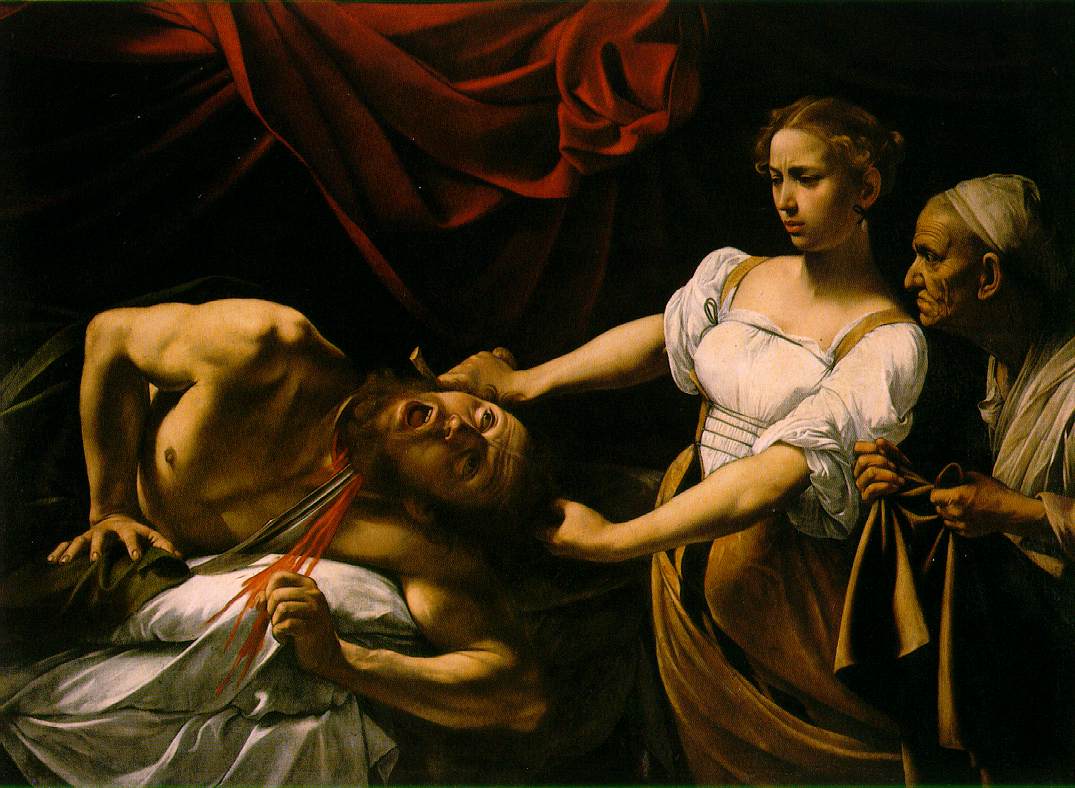
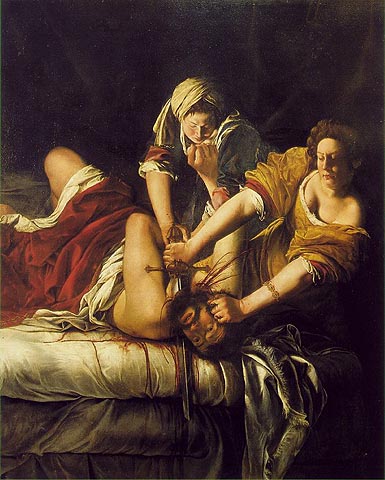
Sunday. Time for a little poetry. Today's poem comes to your courtesy of Poetry Daily, and is as fine an example of Ekphrasis as you're likely to come across. It doesn't hurt that it describes one of my favorite subjects in painting - the slaying of Holofernes by Judith. And since I'm informed by Sarah Boxer over at the NYRB that "Blog writing is id writing—grandiose, dreamy, private, free-associative, infantile, sexy, petty, dirty" and that bloggers are like "impresarios, curators, or editors, picking and choosing things they find on line, occasionally slapping on a funny headline or adding a snarky (read: snotty and catty) comment" [1] I figure I should get with it and provide value by reproducing the poem with links to the paintings Rosser is describing, so you can really see what she's talking about:
Judith Bearing the Head of HolofernesIn her place I wouldn't be quite so casual:
I'd probably put it down pretty quickly,
somewhere level so it wouldn't roll,
as they always say heads are going to do
when there's trouble. You wouldn't want
actual rolling, which might add that touch
of the comic we're so terrified
we might perceive in the dreadful.
Almost every Judith holds him by the hair,
risking the least contact with blood-slime.
Though in Ghirlandaio's case
the maidservant carries the sword
while Judith balances Holofernes' head
in a basket on her own, like a demented
Carmen Miranda, the two of them strolling
casually along, chatty in flowing robes.
Botticelli, whose gods look like women
and whose women look like angels,
but who knew something about real life,
has the maidservant bearing the basket.
Giorgione's Judith places her foot on his hair
presumably in triumph, but clearly also
to keep the head from rolling;
in fact she gazes down too fondly at him,
as if she were footstroking her cat.A few artists show the shadowy servant
stuffing him into a sack like a head of iceberg.
Apparently in those portraits where she's still
holding the sword, she never let go of his hair
in the first place, after hacking.
But wouldn't a sufficiently heavy weapon
require two hands? In other contexts,
the brawniest executioners are always pictured
holding the sword aloft with both hands.
It's not easy cutting through bones,
as any woman knows who's quartered a chicken
(or cooked it whole to avoid having to).
She only had to smite him twice.
But Judith had the adrenaline of the righteous,
having prayed for strength. Still, you have to wonder.
To look at Caravaggio's pale-cheeked Judith
you'd think she was watching her lab partner
slicing a frog. She doesn't seem at all sure
she should be doing this, judging by her expression
of utter disgust and the way she holds herself
away from the act as if to pretend
those ruddy arms and hands aren't hers,
or to avoid splattering her lovely white blouse,
though the blouse was added later to cover her nudity.
Important to remember Judith came to the tent
of General Holofernes expressly to seduce him,
a fact some centuries felt they should suppress.
The Assyrian king had sent him to sack Israel,
and the ultimate expression of any territory's invasion,
as we never tire of demonstrating,
is the physical invasion of its women.
So Judith knew he'd relax about the whole thing
once she offered to take him in. In every version
she also got him drunk—though she appears
pretty enough not to have needed the wine
as encouragement; a woman that insecure
would surely need two hands to follow through.
Even Artemisia Gentileschi had so little faith
in her Judith that she supplied four hands—
the maidservant is holding Holofernes down
with her full weight while Judith gingerly
saws at his neck with a cello-bow-angled wrist.
Oh I suppose you could defend it as a show
of heroism in sisterhood. But what about
the divine individual and her sole sister self?
That's the Judith that makes the story sell.In fact, the only Judith I've ever seen who could
single-handedly have hacked through a man's neck
is that of Jacopo Palma the Elder—
now there's a woman with some heft!—
whereas Cranach the Elder's willowy gentlewoman
(I'd kill for a jacket like that) in her gloves
and velvet hat might be returning a mask
too lifelike for her costume ball.
Allori's dreamy-lidded Judith seems to tell us
over her shoulder that math was never
her best subject—true, she's the image
of Allori's most recent ex-mistress
and it's his own head she's toting—
and Saraceni's Judith, holding the head
as if it were a teapot with a hair handle,
wants to know how many lumps.
Unlikeliest of all, however lovely her lines,
Veronese's Judith lifts his head by the temples
with aristocratically delicate hands,
the way you'd treat a head you liked,
one that was still attached to a nice person.No, the only one I can believe is Jacopo Palma's:
- J. Allyn Rosser
his Judith firmly, efficiently grips both the hilt
of the sword and a hank of hair in one hand,
a fistful of beard in the other. These are chunky,
Gauguin-size hands. Her shoulders are massive.
Not much of a neck on her, which helps
to make her appear invulnerable.
She looks like she'd do it again
if the head somehow reattached itself.
She looks like she's only a tiny bit surprised
that she managed it. She looks like she knows
her story will be told by painters who will mostly be men
who are going to have trouble seeing this scene
as anything but apocryphal, and she's fine with that.
That is, after all, what we need them to think.
Lovely. I particularly love the description of the Caravaggio, as well as the Cranach the Elder. And I have Rosser to thank for introducing me to the Artemisia Gentileschi painting, which is one of the finest on the subject I've seen. Interestingly, though perhaps awkwardly for Rosser's poem, Google also throws up this beauty when you search for Gentileschi's Judith. A glorious painting - not only for the visual splendor of that candle or the way the interplay of dark and light perfectly echoes the scene's juxtaposition of evil and virtue, but because of the way Gentileschi enhances the story, picturing not the actual killing, nor some silly triumph afterwards, but the more realistic problem of getting away with it afterwards, the possibility of being discovered, the need for stealth and caution. It's a tense yet trembling painting, its Judith believable precisely because she looks so businesslike, so aware, so much more tough-minded sergeant than alluring maid, that you cannot bring yourself to doubt her competence (my only quibble being the lack of bloodstains)
Interestingly, Rosser ignores the two paintings that first come to my mind when Judith is mentioned. The first is Klimt's Judith (see above), the second (see below) is Jan Sanders van Hemessen's Judith, which can be seen at the Art Institute of Chicago, and which, aside from being a stunning painting, meets, at least to my satisfaction, Rosser's criterion of believability.

A few other paintings I found, seaching for these ones, that I thought were interesting: Mantegna's version, where Judith looks like she's plucking fruit of a tree, and Caravaggio's David with the Head of Goliath, which isn't about Judith obviously, but it might as well be, and it's certainly interesting (and plausible) to think that 'Judith' was a boy.
[1] Is it just me, or do other people find these media stories about 'bloggers' faintly ridiculous? They remind me a little of this long ago Doonesbury comic where Mark's dad tries to 'talk the new generation's language' by watching the Mod Squad. As though all bloggers were similar enough to allow for such quasi-anthropological study. As though anecdotal evidence from a few prominent blogs was sufficient to make generalizations about a population of 100 million, a large proportion of which doesn't even blog in English. Will someone please explain to these people that blogger is just a tool, not a religion. I thought Boxer's article was a bit of a fluff-piece, at least by NYRB standards, though I'd forgive her anything for tossing in that Plato comparison, even if it doesn't make too much sense.
Friday, January 25, 2008
DICE
[Piece from a while back that I never got around to posting.]
Of all the great inventions of the 21st Century, the Defarge Inter-universal Calibrating Engine (DICE) was arguably the most important. Just as the 20th Century was the century of the Bomb and the dawn of the Nuclear Age, so the 21st was the century of DICE.
Developed by the Pentagon, DICE was named after French theorist Louis Defarge, whose seminal hypothesis about the possibility of Inter-universe transfer was the principle underlying DICE. Defarge started from a perspective that saw the Universe as being an accumulation of an infinite series of random events that added up to one coherent whole – a cyclone of Reality created by the flutter of a whole flock of quantum butterflies –bounded in space time by probabilistic forces. In theory, changing any one of those events, or suppressing them from happening, would fundamentally alter the development of the Universe, giving rise to an alternate reality. Probabilistically speaking, the world we lived in was, in fact, surrounded by an infinite number of such parallel worlds, divided from ours by walls of nothing more than chance.
Thus far many others had gone before him. Defarge’s contribution was to argue (and mathematically prove) that it was possible to tamper retrospectively with the sequence of events that led to this present reality – in other words, to switch to a different Universe, rather like a train jumping tracks. The key, according to Defarge, lay in the fact that most events that made up this reality were so insignificant that they may as well not have happened, that they had, in fact, ceased to exist in the subjective sense since no one had any apprehension of them. Reality, though virtually indestructible, was thus also porous, and manipulations in the present could, in theory, allow us to influence a minute event in the past. Not any particular event, mind, and not at any particular time – the possibility existed only because the change to be accomplished remained undefined.
This was not, as Defarge was quick to point out, time travel – that was still impossible. Indeed, his point was that it was precisely because we humans had always conceived of the problem of time travel as the problem of moving an object from the present to a specified time and place in the past, that we had failed to recognize this opportunity – of exerting an influence on the past in order to change the present. “You cannot break the skin of reality with a hammer”, Defarge wrote, “but you can pierce it with a needle”.
When these theories of Defarge were first published, in his book Chance and Stasis: The Possibility of Inter-Universal Transfer, no one took them seriously. Defarge was described as being a “dreamer” and a “writer of science fiction” and his ideas were dismissed as having “no basis in fact, however rich they may be in imagination”. Yet a small team of researchers at the Los Alamos National Laboratory paid close attention to Defarge’s calculations, and the result, five years later, was the unveiling of DICE, a device that was designed to do precisely what Defarge had claimed was possible – to reach back in time to alter some undefined event, thus retrospectively recalibrating the Universe and switching the whole world to an alternate reality. Housed in an unknown location somewhere in the Nevada desert, and controlled directly from the White House, DICE was, essentially, a giant Restart button, one that allowed humankind to wipe out the immediate past and permanently switch to a different world.
There was a catch, though. Actually, two catches. First, because of the improbabilities involved, DICE could only be used once. Second, and more important, because it was impossible to control exactly what event in the past got changed (or, more strictly speaking, it was impossible to change any event in the past that was known and identifiable – the act of focusing on an event in the past making it ineligible for change), there was no way to predict what the new reality would look like. The practical implication of this was spelled out in his introductory lecture by Dr. Tnetrop Dakkar, the leader of the team that designed DICE:
At any rate, argument and debate was rife everywhere. In some cities, riots broke out over the question of DICE, with demonstrators for one group coming to blows with demonstrators for the other. Soon the world was divided into the believers, who saw DICE as mankind’s only hope of being saved, and the skeptics, who saw DICE as a false invention and relied on no such redemption.
Years passed. Whatever else DICE was or was not capable of, the boost it gave to the power and prestige of the United States was undeniable. Already the world’s greatest superpower, the US became even more preeminent, and, as a result, even more arrogant, than it had been before. Partly it was sheer awe at the power that the US now commanded - its ability to restart history - that caused nations to want to stay on its good side. But mostly it was just the knowledge that there’s no point in trying to wipe out an enemy who would simply reset the world if pushed to the brink.
Every decade or so, some catastrophe would lead some people to demand that DICE be used. Every earthquake, tsunami, cyclone, terrorist strike, war or genocide brought its own cries for the use of DICE, with the friends and relatives of the victims pledging their willingness to live with the consequences of whatever reality they may end up in.
To all these requests, however, the Keepers of DICE offered little more than a polite refusal. These Keepers themselves had changed considerably since the time when DICE was first developed. Originally in the hands of senior functionaries in the Pentagon, the supervision of DICE had been spun off into a separate service when it was realized that the monitoring of DICE required a perspective far broader, far more removed, than that involved in military strategy. From here on, the Keepers soon evolved into something very like a sect, with a handful of new recruits being chosen every year from the world’s leading universities to join the service. The Keepers were withdrawn, solitary men who lived in a haze of alternate realities joined to a constant awareness of the ephemeral nature of the present world. They seldom married, seldom had friends outside of work. Instead, like acolytes praying to an aloof God, they spent long hours trying to model and imagine the various possibilities of what the world would look like if DICE were used. This was, by definition, an impossible task - the possibilities were infinite to begin with, and working through the full implications of a single change on the structure of the Universe would require a computer as big as the Universe itself – all the Keepers’ simulations amounted to was an elaborate ritual of video games. Still, because of their proximity to this ineluctable power, and because of the influence they themselves might bear on the future of mankind, these Keepers were held in high esteem.
And the Keepers did have power – or rather the Head Keeper did. While in theory, the decision to activate DICE lay with the President of the United States and with him / her alone, it was understood that the real authority rested with the Head Keeper. After all, he / she was the one who understood (or at least understood as well as anyone else) the ramifications of activating DICE. It would take a real madman to use DICE against the advice of the Head Keeper. Not even Presidents of the United States were that crazy.
When nuclear war finally came, no one was quite sure what triggered it. Some claimed it was human folly – a hotheaded young pilot flying a plane armed with nuclear missiles who overreacted and started the whole thing – others that it was the logical consequence of centuries of neo-imperialist economic oppression by the Western World, still others that it was the work of religious fanatics (Jews or Muslims, depending on where you lived) who had formed a conspiracy to destroy the world.
At any rate, it wasn’t long before the chain of nuclear response and counter-response had played itself out, leaving the world at the brink of extinction. 98% of the human race was estimated to be dead already, and those who remained were unlikely to survive the radiation damage they had suffered. Even if they did survive, moreover, the complete decimation of all life systems, the blocking off of sunlight and the ruin of both land and sea, meant that life on earth was now impossible in any meaningful sense. It was time, therefore, to turn to DICE.
The Keepers, after weeks of collecting data and running simulations to see whether the world might in fact, survive on its own, approved. The President, horrified by the destruction he had seen, saw no other way. On what would have been a bright spring morning in April if the clouds from the nuclear fall-out hadn’t wiped out the sky, the leaders of the free world gathered in a small, secret location to reset the world forever. The security codes were punched in, the starting sequence initiated. Finally, at a nod from the President, the Head Keeper pressed the red button.
The Universe changed.
The new world was different from the old one, even though this wouldn’t have been immediately obvious to an outside observer (not that outside observers were possible). Not much had changed. Earth was still a nuclear wasteland, mankind was still dying out. Beyond this tiny planet, the order of the galaxies was the same as it had always been, though perhaps a star or two had shifted position slightly. The difference was that in this new Universe there was no DICE, no possibility of turning the world back and starting again – it had never been invented, never been conceived. Here, in this universe, destruction was inevitable, and there was no hope.
Of all the great inventions of the 21st Century, the Defarge Inter-universal Calibrating Engine (DICE) was arguably the most important. Just as the 20th Century was the century of the Bomb and the dawn of the Nuclear Age, so the 21st was the century of DICE.
Developed by the Pentagon, DICE was named after French theorist Louis Defarge, whose seminal hypothesis about the possibility of Inter-universe transfer was the principle underlying DICE. Defarge started from a perspective that saw the Universe as being an accumulation of an infinite series of random events that added up to one coherent whole – a cyclone of Reality created by the flutter of a whole flock of quantum butterflies –bounded in space time by probabilistic forces. In theory, changing any one of those events, or suppressing them from happening, would fundamentally alter the development of the Universe, giving rise to an alternate reality. Probabilistically speaking, the world we lived in was, in fact, surrounded by an infinite number of such parallel worlds, divided from ours by walls of nothing more than chance.
Thus far many others had gone before him. Defarge’s contribution was to argue (and mathematically prove) that it was possible to tamper retrospectively with the sequence of events that led to this present reality – in other words, to switch to a different Universe, rather like a train jumping tracks. The key, according to Defarge, lay in the fact that most events that made up this reality were so insignificant that they may as well not have happened, that they had, in fact, ceased to exist in the subjective sense since no one had any apprehension of them. Reality, though virtually indestructible, was thus also porous, and manipulations in the present could, in theory, allow us to influence a minute event in the past. Not any particular event, mind, and not at any particular time – the possibility existed only because the change to be accomplished remained undefined.
This was not, as Defarge was quick to point out, time travel – that was still impossible. Indeed, his point was that it was precisely because we humans had always conceived of the problem of time travel as the problem of moving an object from the present to a specified time and place in the past, that we had failed to recognize this opportunity – of exerting an influence on the past in order to change the present. “You cannot break the skin of reality with a hammer”, Defarge wrote, “but you can pierce it with a needle”.
When these theories of Defarge were first published, in his book Chance and Stasis: The Possibility of Inter-Universal Transfer, no one took them seriously. Defarge was described as being a “dreamer” and a “writer of science fiction” and his ideas were dismissed as having “no basis in fact, however rich they may be in imagination”. Yet a small team of researchers at the Los Alamos National Laboratory paid close attention to Defarge’s calculations, and the result, five years later, was the unveiling of DICE, a device that was designed to do precisely what Defarge had claimed was possible – to reach back in time to alter some undefined event, thus retrospectively recalibrating the Universe and switching the whole world to an alternate reality. Housed in an unknown location somewhere in the Nevada desert, and controlled directly from the White House, DICE was, essentially, a giant Restart button, one that allowed humankind to wipe out the immediate past and permanently switch to a different world.
There was a catch, though. Actually, two catches. First, because of the improbabilities involved, DICE could only be used once. Second, and more important, because it was impossible to control exactly what event in the past got changed (or, more strictly speaking, it was impossible to change any event in the past that was known and identifiable – the act of focusing on an event in the past making it ineligible for change), there was no way to predict what the new reality would look like. The practical implication of this was spelled out in his introductory lecture by Dr. Tnetrop Dakkar, the leader of the team that designed DICE:
These peculiar features of DICE made it a subject of immediate controversy. Those who believed in Defarge’s hypothesis (or at least trusted the Pentagon) saw DICE as a boon granted to mankind, a final way out from the threat of annihilation. Others, more cynical, argued that since DICE was, by design, conveniently indemonstrable, it amounted to little more than a hoax. How do we know that this machine actually does what it claims to, they asked, perhaps the US is just bluffing? And even if they believe that it can reset the world how do we know it will work? It wouldn’t be the first time that a piece of experimental technology has failed. How do we know it won’t simply blow all of us up? Yet a third group saw DICE as a moral aberration, arguing that if the day of destruction came it would be because we had deserved it. Mankind, they said, had no right to interfere with the workings of a Higher Power. The Universe should not play DICE with God. A fourth group argued against this view – pointing out that since DICE could not control what Universe we ended up in, it would, in fact, be God who made that choice. Besides, they said, pointing to Pascal, God was not inconsistent with rational calculation: given a choice between certain destruction and infinitely unlikely survival, choosing the latter was the only moral choice.
“DICE is, and must be considered, an instrument of absolute last resort. It must be used only in the most extreme eventuality – when the destruction of the human race seems imminent, and it becomes impossible to imagine a world worse than the one we inhabit. DICE is, in every sense, the last, most desperate gamble of a species that has nothing left to lose. I hope and pray that we never need to use it.”
At any rate, argument and debate was rife everywhere. In some cities, riots broke out over the question of DICE, with demonstrators for one group coming to blows with demonstrators for the other. Soon the world was divided into the believers, who saw DICE as mankind’s only hope of being saved, and the skeptics, who saw DICE as a false invention and relied on no such redemption.
Years passed. Whatever else DICE was or was not capable of, the boost it gave to the power and prestige of the United States was undeniable. Already the world’s greatest superpower, the US became even more preeminent, and, as a result, even more arrogant, than it had been before. Partly it was sheer awe at the power that the US now commanded - its ability to restart history - that caused nations to want to stay on its good side. But mostly it was just the knowledge that there’s no point in trying to wipe out an enemy who would simply reset the world if pushed to the brink.
Every decade or so, some catastrophe would lead some people to demand that DICE be used. Every earthquake, tsunami, cyclone, terrorist strike, war or genocide brought its own cries for the use of DICE, with the friends and relatives of the victims pledging their willingness to live with the consequences of whatever reality they may end up in.
To all these requests, however, the Keepers of DICE offered little more than a polite refusal. These Keepers themselves had changed considerably since the time when DICE was first developed. Originally in the hands of senior functionaries in the Pentagon, the supervision of DICE had been spun off into a separate service when it was realized that the monitoring of DICE required a perspective far broader, far more removed, than that involved in military strategy. From here on, the Keepers soon evolved into something very like a sect, with a handful of new recruits being chosen every year from the world’s leading universities to join the service. The Keepers were withdrawn, solitary men who lived in a haze of alternate realities joined to a constant awareness of the ephemeral nature of the present world. They seldom married, seldom had friends outside of work. Instead, like acolytes praying to an aloof God, they spent long hours trying to model and imagine the various possibilities of what the world would look like if DICE were used. This was, by definition, an impossible task - the possibilities were infinite to begin with, and working through the full implications of a single change on the structure of the Universe would require a computer as big as the Universe itself – all the Keepers’ simulations amounted to was an elaborate ritual of video games. Still, because of their proximity to this ineluctable power, and because of the influence they themselves might bear on the future of mankind, these Keepers were held in high esteem.
And the Keepers did have power – or rather the Head Keeper did. While in theory, the decision to activate DICE lay with the President of the United States and with him / her alone, it was understood that the real authority rested with the Head Keeper. After all, he / she was the one who understood (or at least understood as well as anyone else) the ramifications of activating DICE. It would take a real madman to use DICE against the advice of the Head Keeper. Not even Presidents of the United States were that crazy.
When nuclear war finally came, no one was quite sure what triggered it. Some claimed it was human folly – a hotheaded young pilot flying a plane armed with nuclear missiles who overreacted and started the whole thing – others that it was the logical consequence of centuries of neo-imperialist economic oppression by the Western World, still others that it was the work of religious fanatics (Jews or Muslims, depending on where you lived) who had formed a conspiracy to destroy the world.
At any rate, it wasn’t long before the chain of nuclear response and counter-response had played itself out, leaving the world at the brink of extinction. 98% of the human race was estimated to be dead already, and those who remained were unlikely to survive the radiation damage they had suffered. Even if they did survive, moreover, the complete decimation of all life systems, the blocking off of sunlight and the ruin of both land and sea, meant that life on earth was now impossible in any meaningful sense. It was time, therefore, to turn to DICE.
The Keepers, after weeks of collecting data and running simulations to see whether the world might in fact, survive on its own, approved. The President, horrified by the destruction he had seen, saw no other way. On what would have been a bright spring morning in April if the clouds from the nuclear fall-out hadn’t wiped out the sky, the leaders of the free world gathered in a small, secret location to reset the world forever. The security codes were punched in, the starting sequence initiated. Finally, at a nod from the President, the Head Keeper pressed the red button.
The Universe changed.
The new world was different from the old one, even though this wouldn’t have been immediately obvious to an outside observer (not that outside observers were possible). Not much had changed. Earth was still a nuclear wasteland, mankind was still dying out. Beyond this tiny planet, the order of the galaxies was the same as it had always been, though perhaps a star or two had shifted position slightly. The difference was that in this new Universe there was no DICE, no possibility of turning the world back and starting again – it had never been invented, never been conceived. Here, in this universe, destruction was inevitable, and there was no hope.
Thursday, January 24, 2008
Quantum of Solace
So apparently, the title of the new Bond film is out, and it's (hold your breath) Quantum of Solace. Xan Brooks has dismissive things to say about it over at the Guardian Blog (he says it sounds like blancmange[1]) and I have to agree. I mean I don't really give a hang what the damn thing is called as long as it has significant portions of time devoted to the sight of Daniel Craig in tight-fitting swimwear (now there's a man whose quantum I'd be happy to solace any time), but still it's hard to think of any pairing or random words from the dictionary in the _________ of __________ format less evocative of thrilling, action-packed adventure. Even Schopenhauer could come up with racier titles than this. Frankly, it sounds like something out of a Psmith story - Lord Quantum of Solace, meet Lady Pale-Parabola of Joy.
[Actually, if you think about it, the whole James Bond franchise would be rather fun if it were written by Wodehouse. "What ho! old chap. The name is Bond. Pjames Bond." No really. Jeeves could be Q. and Aunt Agatha would make a totally outstanding M. And Gussie Fink-Nottle could be the evil mastermind who secretly (and perhaps inadvertently - this is Gussie we're talking about) plans the destruction of the world while drinking orange juice and tending his newts. And Bertie could be the dashing secret agent who goes off on missions of deadly espionage armed only with a purple cummerbund and comes back engaged to yet another loopy femme fatale. And wouldn't it be fun if you could stop Jaws in his tracks by saying the words 'Eulalie Soeurs'?]
Brooks, in his piece, laments the lack of easy rhymes for the title song. One rhyme for solace he misses [warning: extremely forced transition coming up] is Persepolis [see, I TOLD you], which I watched yesterday and which is a delightful film, surprisingly true to the graphic novel it's based on (I was worried that they may have jazzed it up too much - but no, they've kept the hand-drawn feel of the original) and like that book a heady mix of politics, humor and heartbreak. Satrapi's quasi-autobiographical Marjane may not be the most winning character you'll see on screen this year (that spot, I think, belongs to the title character in Juno) but she comes close.
[1] Not that blancmange's are anywhere near as harmless as they seem.
[Actually, if you think about it, the whole James Bond franchise would be rather fun if it were written by Wodehouse. "What ho! old chap. The name is Bond. Pjames Bond." No really. Jeeves could be Q. and Aunt Agatha would make a totally outstanding M. And Gussie Fink-Nottle could be the evil mastermind who secretly (and perhaps inadvertently - this is Gussie we're talking about) plans the destruction of the world while drinking orange juice and tending his newts. And Bertie could be the dashing secret agent who goes off on missions of deadly espionage armed only with a purple cummerbund and comes back engaged to yet another loopy femme fatale. And wouldn't it be fun if you could stop Jaws in his tracks by saying the words 'Eulalie Soeurs'?]
Brooks, in his piece, laments the lack of easy rhymes for the title song. One rhyme for solace he misses [warning: extremely forced transition coming up] is Persepolis [see, I TOLD you], which I watched yesterday and which is a delightful film, surprisingly true to the graphic novel it's based on (I was worried that they may have jazzed it up too much - but no, they've kept the hand-drawn feel of the original) and like that book a heady mix of politics, humor and heartbreak. Satrapi's quasi-autobiographical Marjane may not be the most winning character you'll see on screen this year (that spot, I think, belongs to the title character in Juno) but she comes close.
[1] Not that blancmange's are anywhere near as harmless as they seem.
Getting there
Poetry. The words like a gun in my mouth. The cold from the window a kiss, a blow-off, and the sun a hammer beating the river flat.
The sign on the bridge says 'Trenton Makes The World Takes' in squat, ugly letters. I shut my eyes and the blood in my head is staging its own personal sunset. Open them and the woman two rows down is teaching her daughter to play chinese checkers on one of those pocket-size magnetic game boards, telling her how she needs to think beyond the next move if she wants to win. Good advice, sister. Amazing the way one things leads to another, the way life leaps over you, knocks you off the board.
Like this connection I'm never going to make.
I could always kill time but I don't have the nerve for it. I imagine what it would feel like, the ticking growing faint under my hands, the throttled body of the clock they would find later, when I was far away. Maybe I should get a bite to eat instead. At the thought of food the hunger runs around inside me like a madman in a train station, shouting out destinations. I would kill for a drink.
The newspaper says the last speaker of the indigenous Alaskan language Eyak has died. Or maybe the newspaper doesn't say that and I just made it up. In any case I think - he must have spent a lot of time talking to himself, there at the end. Did I just say that aloud? God, I hope not.
Why is that man in the corner looking at me like that? Is he really speaking with someone, or just talking into his cellphone to pretend that he's not alone? Maybe he's on to me, knows I'm in the business too - you know, the spying on the self business. Maybe what he's really talking into is the secret receiver in his cuffs. The cellphone is just for camouflage. Idea for a joke about a secret agent who has a microphone stitched into the brim of his bowler, so that he's always talking through his hat. Hmm.
Okay, this guy is definitely talking about me. Calling for back-up, no doubt. They'll probably grab me when I get off the train. Or maybe they'll keep me on it, wait dour-faced while everyone else gets off, then ride with me to the depot, the four of them with their suits and their badly concealed shoulder-holsters sitting there in silence, penning me in. Waiting for me to make my move. Not that I've got any moves to make. Not any more. Trenton Makes The World Takes. Well, I've been made all right. I wonder where they'll take me.
The sign on the bridge says 'Trenton Makes The World Takes' in squat, ugly letters. I shut my eyes and the blood in my head is staging its own personal sunset. Open them and the woman two rows down is teaching her daughter to play chinese checkers on one of those pocket-size magnetic game boards, telling her how she needs to think beyond the next move if she wants to win. Good advice, sister. Amazing the way one things leads to another, the way life leaps over you, knocks you off the board.
Like this connection I'm never going to make.
I could always kill time but I don't have the nerve for it. I imagine what it would feel like, the ticking growing faint under my hands, the throttled body of the clock they would find later, when I was far away. Maybe I should get a bite to eat instead. At the thought of food the hunger runs around inside me like a madman in a train station, shouting out destinations. I would kill for a drink.
The newspaper says the last speaker of the indigenous Alaskan language Eyak has died. Or maybe the newspaper doesn't say that and I just made it up. In any case I think - he must have spent a lot of time talking to himself, there at the end. Did I just say that aloud? God, I hope not.
Why is that man in the corner looking at me like that? Is he really speaking with someone, or just talking into his cellphone to pretend that he's not alone? Maybe he's on to me, knows I'm in the business too - you know, the spying on the self business. Maybe what he's really talking into is the secret receiver in his cuffs. The cellphone is just for camouflage. Idea for a joke about a secret agent who has a microphone stitched into the brim of his bowler, so that he's always talking through his hat. Hmm.
Okay, this guy is definitely talking about me. Calling for back-up, no doubt. They'll probably grab me when I get off the train. Or maybe they'll keep me on it, wait dour-faced while everyone else gets off, then ride with me to the depot, the four of them with their suits and their badly concealed shoulder-holsters sitting there in silence, penning me in. Waiting for me to make my move. Not that I've got any moves to make. Not any more. Trenton Makes The World Takes. Well, I've been made all right. I wonder where they'll take me.
Tuesday, January 22, 2008
The Last Massage
They say the masseuse found him. Pushed her way into his bedroom and discovered him naked on the floor. Dead.
And I imagine Death too, as a kind of masseuse. Her hands not cold, as he had feared, but warm, instinctive, almost sensual.
Practiced fingers untangle the pathways of his body; release him, at last from pain's invisible net. Unknotted, undone, he surrenders gratefully to her touch, feels his muscles loosen, slips, unknowingly, into a deep, deep sleep.
And I imagine Death too, as a kind of masseuse. Her hands not cold, as he had feared, but warm, instinctive, almost sensual.
Practiced fingers untangle the pathways of his body; release him, at last from pain's invisible net. Unknotted, undone, he surrenders gratefully to her touch, feels his muscles loosen, slips, unknowingly, into a deep, deep sleep.
Monday, January 21, 2008
New York Weekend Part 1: Les Amants
I'm back.
Caught a screening of Louis Malle's Les Amants at the IFC Saturday morning, and came away fascinated. It's hard to put my finger on what, precisely, I liked about the film, in part because it's such a protean work, constantly shifting, constantly reinventing itself.
It starts off as social drama - the conflict between the dull virtues of provincial life and the sparkling but superficial charms of Paris society incarnated in the person of Jeanne Tournier (Jeanne Moreau) - a woman whose frustrations with passionless domesticity drive her to infidelity as a fashion statement. But just when you think the movie is headed for an emotional showdown, with Jeanne's husband inviting her lover to spend the weekend at their country house in Dijon (something roughly like the confrontation in Stanley Donen's The Grass Is Greener, only less funny and more French) in drives a deus ex machina and before you know it you're in the middle of a lyrical if slightly overdone pastiche of romantic desire, complete with moonlight and boats and a couple dressed in white wandering hand and hand through the open fields while Brahms' ravishing Streichsextett No. 1 plays in the background. And then, just when you're starting to tire of Malle's visual poetry, the movie turns again, and you find yourself caught in a finale of nail-biting suspense, that is tinged in its free-wheeling, convention defying exhilaration, with just a hint of La Nouvelle Vague. Watching Les Amants is like watching a heady combination of Bunuel, Rohmer and Hitchcock, all held together by the vividness of Malle's vision, and the magnetic screen presence of Jeanne Moreau.
And yes, I did say Hitchcock. Because in its own way Les Amants is every bit as tense and nerve-wracking as a well-made thriller - not Psycho perhaps, but Shadow of a Doubt. The brilliance of the film's denouement lies in the way Malle effortlessly plays with our expectations, leaving us permanently off-balance, the question will she / won't she penduluming about in our heads. Les Amants is a subversive film, in ways that Ibsen would have been proud of, but unlike Ibsen Malle does not set out to defy convention outright; instead, he flirts with it, pushes his film to the brink of the morality tale and leaves us with a sense not of triumph but of uneasiness. Love, like the glimpse of a spotless white horse grazing quietly by the road in the final shot, remains a vision, and convention is a killer still on the loose, so that Jeanne's escape from its clutches may yet prove temporary.
But the last half hour of Les Amants is also notable for the way in which Malle captures not the mechanics of sex, but the hysteresis of intimacy, the body's need to touch and hold. This is the film about which Justice Potter Stewart (in Jacobellis v. Ohio) famously said - rebutting the claim that it was pornographic - that "I know it [pornography] when I see it, and the motion picture involved in this case is not that." It's a fairly inane legal statement, but watching the film you can see exactly what he means. By the standards of its time Les Amants is undeniably explicit (though compared to say, Lust, Caution it seems almost genteel) but what Malle is documenting is not lust but the fascination of the flesh with its counterpart, the reluctance of lovers to be parted, even for a moment, the surrender to an appetite so voluptuous it can seem like sloth.
In the end, you fall in love with this movie the way Jeanne does - unexpectedly, impulsively and a little guiltily; knowing that other people will never understand it, that you barely understand it yourself; certain only, as Jeanne says in the film, that such happiness is not to be resisted.
Caught a screening of Louis Malle's Les Amants at the IFC Saturday morning, and came away fascinated. It's hard to put my finger on what, precisely, I liked about the film, in part because it's such a protean work, constantly shifting, constantly reinventing itself.
It starts off as social drama - the conflict between the dull virtues of provincial life and the sparkling but superficial charms of Paris society incarnated in the person of Jeanne Tournier (Jeanne Moreau) - a woman whose frustrations with passionless domesticity drive her to infidelity as a fashion statement. But just when you think the movie is headed for an emotional showdown, with Jeanne's husband inviting her lover to spend the weekend at their country house in Dijon (something roughly like the confrontation in Stanley Donen's The Grass Is Greener, only less funny and more French) in drives a deus ex machina and before you know it you're in the middle of a lyrical if slightly overdone pastiche of romantic desire, complete with moonlight and boats and a couple dressed in white wandering hand and hand through the open fields while Brahms' ravishing Streichsextett No. 1 plays in the background. And then, just when you're starting to tire of Malle's visual poetry, the movie turns again, and you find yourself caught in a finale of nail-biting suspense, that is tinged in its free-wheeling, convention defying exhilaration, with just a hint of La Nouvelle Vague. Watching Les Amants is like watching a heady combination of Bunuel, Rohmer and Hitchcock, all held together by the vividness of Malle's vision, and the magnetic screen presence of Jeanne Moreau.
And yes, I did say Hitchcock. Because in its own way Les Amants is every bit as tense and nerve-wracking as a well-made thriller - not Psycho perhaps, but Shadow of a Doubt. The brilliance of the film's denouement lies in the way Malle effortlessly plays with our expectations, leaving us permanently off-balance, the question will she / won't she penduluming about in our heads. Les Amants is a subversive film, in ways that Ibsen would have been proud of, but unlike Ibsen Malle does not set out to defy convention outright; instead, he flirts with it, pushes his film to the brink of the morality tale and leaves us with a sense not of triumph but of uneasiness. Love, like the glimpse of a spotless white horse grazing quietly by the road in the final shot, remains a vision, and convention is a killer still on the loose, so that Jeanne's escape from its clutches may yet prove temporary.
But the last half hour of Les Amants is also notable for the way in which Malle captures not the mechanics of sex, but the hysteresis of intimacy, the body's need to touch and hold. This is the film about which Justice Potter Stewart (in Jacobellis v. Ohio) famously said - rebutting the claim that it was pornographic - that "I know it [pornography] when I see it, and the motion picture involved in this case is not that." It's a fairly inane legal statement, but watching the film you can see exactly what he means. By the standards of its time Les Amants is undeniably explicit (though compared to say, Lust, Caution it seems almost genteel) but what Malle is documenting is not lust but the fascination of the flesh with its counterpart, the reluctance of lovers to be parted, even for a moment, the surrender to an appetite so voluptuous it can seem like sloth.
In the end, you fall in love with this movie the way Jeanne does - unexpectedly, impulsively and a little guiltily; knowing that other people will never understand it, that you barely understand it yourself; certain only, as Jeanne says in the film, that such happiness is not to be resisted.
Friday, January 18, 2008
Mengelberg and Manhattan
There's nothing quite like the sound of a trumpet player in full flow, is there? Just got back from a performance of the Misha Mengelberg Quartet, featuring an electrifying performance by trumpet player Dave Douglas. Also notable were Mengelberg's lovely melodies and the inimitable hi-jinx of Han Bennink, who is to percussion what Chico Marx is to the piano. But for me the highlight of the show was easily Douglas' performance. Glorious, glorious stuff.
Meanwhile, am off to NYC for the weekend - hoping to renew my long-standing love affair with the immortal Jeanne Moreau and catch the Klimt exhibition at the Neue Galerie (complete with pretentious French spelling). See you after the weekend.
Meanwhile, am off to NYC for the weekend - hoping to renew my long-standing love affair with the immortal Jeanne Moreau and catch the Klimt exhibition at the Neue Galerie (complete with pretentious French spelling). See you after the weekend.
I wasn't expecting all the hoop-la
Thursday, January 17, 2008
Falstaff and the Banquet
I never did get around to blogging about my California trip, did I?
While we are on the topic of food, one of the more fun parts of the trip (and unusual - given that I'm NOT a foodie) was the unrelenting focus on food, with the Bay Area being converted into my own personal smorgasbord. So there were Fontainebleau scrambled eggs in Haight-Ashbury, vegan sushi on Berkeley campus, chocolate hazelnut tarts at Tartine, dimsum in Milpitas, sardines and seafood stew on Cannery Row, arepas at the Coupa Cafe in Palo Alto, hummus and pita sandwiches in Mountain View, and, for New Year's Eve, a rum and chocolate cake baked by yours truly that didn't turn out half bad. Quite the culinary voyage.
***
Worst Experience:
Saravana Bhavan, Sunnyvale CA.
7.00 pm.
Falstaff and Z arrive. Listlessly eye invading hordes at the door.
7.05 pm.
Z: Well, I've put our name down for a table.
F: Did he say how long it would take?
Z: Fifteen minutes.
F: Dude, no way. Look at that waiting area. There must be a thousand people ahead of us.
Z: Don't exaggerate, there are only 994.
F: Ya, but two of them are pregnant.
Z: Look, he said 15 minutes. Let's just wait and see and if we don't get a table then we can always go elsewhere.
F: Sigh. Okay.
7.25 pm
F: It's half past seven.
Z: Ya, I know. I guess he was wrong about the 15 minutes.
F: I told you so. Can we go now?
Z: What, after we've waited twenty minutes? Of course not.
F: But, but...you said.
Z: Look, I'm sure we'll get a table any moment now.
F: How? That line in the waiting area hasn't moved.
Z: Well, don't look at me, you're the one who wanted to come here.
F: Me?
Z: Sure. You asked for this place.
F: I did not. You asked me if I was okay with South Indian and I said "Sure, why not"
Z: See - exactly.
7.40 pm
Z: Hmmm...this is getting ridiculous. It isn't normally this crowded you know.
F: *wounded silence*
Z: Maybe we should get it to go.
F: We can get it to go? Really? Why didn't we do that straight away?
Z: Because we were going to get a table.
F: Wha...Why?
Z: Well, I thought you might want to see what the place is like. You know, check out the ambiance.
F: What ambiance? The place is more crowded than Dadar station at rush hour.
Z: Well, you're the one who's always saying you miss Bombay.
F: Oh, never mind, let's just go order.
7.45 pm
[Bloody but unbowed, F & Z arrive at the counter, having hacked their way through a tropical rainforest of arms and legs]
Z: ...and we'll have one plate of X as well*
Uncle-ji at counter: X? You sure you want X? Why not have Y instead? Very tasty. Absolutely fresh.
Z: Okay, one plate of Y then. How long will it take?
Uncle-ji: Oh, ten minutes.
7.50 pm
[F & Z reduced to mere flotsam in sea of humanity, trying desperately to get the last molecules of remaining oxygen in the place into their lungs. F makes a break for it and goes stands in the parking lot. It's good to be back in the First World.]
8.15 pm
Z: How long is that order going to take?
Uncle-ji: It's almost done.
Z: You said ten minutes. It's been half an hour.
Uncle-ji: Yes, I know. It's that Y you ordered. We'd run out so we're having to make a new batch.
Z: But you told me to take Y. You said it was absolutely fresh.
Uncle-ji: And it will be. When it's ready.
Z: *grits teeth. tries not to swear* What about the rest of our order?
Uncle-ji: Oh, that's right here. It's been ready for twenty minutes.
Z: Right, forget the Y then. We're going.
8:20 pm
F: So, did the guy ever call our table?
Z: No. I asked him about that on the way out.
F: What did he say?
Z: He said it would be just fifteen minutes.
***
Best Experience
Foreign Cinema
Delicious skate fillet followed by braised peaches with icecream and chocolate mousse, with De Sica's The Garden of the Finzi-Continis playing on a giant screen in the background. Ah, the good life.
*Sorry, I don't actually remember what we ordered. The food was that unmemorable.
While we are on the topic of food, one of the more fun parts of the trip (and unusual - given that I'm NOT a foodie) was the unrelenting focus on food, with the Bay Area being converted into my own personal smorgasbord. So there were Fontainebleau scrambled eggs in Haight-Ashbury, vegan sushi on Berkeley campus, chocolate hazelnut tarts at Tartine, dimsum in Milpitas, sardines and seafood stew on Cannery Row, arepas at the Coupa Cafe in Palo Alto, hummus and pita sandwiches in Mountain View, and, for New Year's Eve, a rum and chocolate cake baked by yours truly that didn't turn out half bad. Quite the culinary voyage.
***
Worst Experience:
Saravana Bhavan, Sunnyvale CA.
7.00 pm.
Falstaff and Z arrive. Listlessly eye invading hordes at the door.
7.05 pm.
Z: Well, I've put our name down for a table.
F: Did he say how long it would take?
Z: Fifteen minutes.
F: Dude, no way. Look at that waiting area. There must be a thousand people ahead of us.
Z: Don't exaggerate, there are only 994.
F: Ya, but two of them are pregnant.
Z: Look, he said 15 minutes. Let's just wait and see and if we don't get a table then we can always go elsewhere.
F: Sigh. Okay.
7.25 pm
F: It's half past seven.
Z: Ya, I know. I guess he was wrong about the 15 minutes.
F: I told you so. Can we go now?
Z: What, after we've waited twenty minutes? Of course not.
F: But, but...you said.
Z: Look, I'm sure we'll get a table any moment now.
F: How? That line in the waiting area hasn't moved.
Z: Well, don't look at me, you're the one who wanted to come here.
F: Me?
Z: Sure. You asked for this place.
F: I did not. You asked me if I was okay with South Indian and I said "Sure, why not"
Z: See - exactly.
7.40 pm
Z: Hmmm...this is getting ridiculous. It isn't normally this crowded you know.
F: *wounded silence*
Z: Maybe we should get it to go.
F: We can get it to go? Really? Why didn't we do that straight away?
Z: Because we were going to get a table.
F: Wha...Why?
Z: Well, I thought you might want to see what the place is like. You know, check out the ambiance.
F: What ambiance? The place is more crowded than Dadar station at rush hour.
Z: Well, you're the one who's always saying you miss Bombay.
F: Oh, never mind, let's just go order.
7.45 pm
[Bloody but unbowed, F & Z arrive at the counter, having hacked their way through a tropical rainforest of arms and legs]
Z: ...and we'll have one plate of X as well*
Uncle-ji at counter: X? You sure you want X? Why not have Y instead? Very tasty. Absolutely fresh.
Z: Okay, one plate of Y then. How long will it take?
Uncle-ji: Oh, ten minutes.
7.50 pm
[F & Z reduced to mere flotsam in sea of humanity, trying desperately to get the last molecules of remaining oxygen in the place into their lungs. F makes a break for it and goes stands in the parking lot. It's good to be back in the First World.]
8.15 pm
Z: How long is that order going to take?
Uncle-ji: It's almost done.
Z: You said ten minutes. It's been half an hour.
Uncle-ji: Yes, I know. It's that Y you ordered. We'd run out so we're having to make a new batch.
Z: But you told me to take Y. You said it was absolutely fresh.
Uncle-ji: And it will be. When it's ready.
Z: *grits teeth. tries not to swear* What about the rest of our order?
Uncle-ji: Oh, that's right here. It's been ready for twenty minutes.
Z: Right, forget the Y then. We're going.
8:20 pm
F: So, did the guy ever call our table?
Z: No. I asked him about that on the way out.
F: What did he say?
Z: He said it would be just fifteen minutes.
***
Best Experience
Foreign Cinema
Delicious skate fillet followed by braised peaches with icecream and chocolate mousse, with De Sica's The Garden of the Finzi-Continis playing on a giant screen in the background. Ah, the good life.
*Sorry, I don't actually remember what we ordered. The food was that unmemorable.
Tuesday, January 15, 2008
There Was
Okay, so I did it. I went and watched There Will Be Blood. And I have to say I'm underwhelmed.
Oh, it's not a bad movie. Daniel Day-Lewis is every bit as good as I expected him to be (which is very, very good indeed) the rest of the cast does a sterling job, the cinematography is lovely, the direction unexceptionable. It's a little long - some two hours and forty minutes - and feels a bit like a mini-series rather than a film, but for all that it's a fairly gripping watch.
The trouble, I think, was that all the time I was watching it I had this strong sense of deja vu. As though I'd seen this film, or something very like it, a dozen times before. You know the story. Man starts from nothing, makes it big through a combination of hard work and conniving slyness. Ends up alienated and bitter, suspicious of everybody, with no meaningful connection to anyone (Hell, just in case you didn't get it they actually have a dialog in there where he talks about how he sees the worst in everyone). Under the slick, greasy surface of Paul Thomas Anderson's movie is a mish-mash of Citizen Kane, the Godfather and The Treasure of the Sierra Madre. That There Will Be Blood bears comparison to these masterpieces (and it does) does it great credit, of course, but it also leaves you feeling 'ah, that again'. It may be that the genre of the 'one man's rise to power' epic needs resurrecting, in which case Anderson has done as good a job of it as anyone could, but personally I can't say I felt it was something we were missing out on, and as a consequence the film left me largely unmoved.
None of this is to say that it's a film I regret watching. Day-Lewis's performance alone would make it worth the price of entry, and the movie certainly has its moments. The church scenes with Paul Dano are sparkling and hilarious, the interplay between Plainview (the character Day-Lewis plays) and his son is superbly done, and the ending is glorious. I just can't help feeling that all that energy and talent could have gone into making something a little more, well, new.
Oh, it's not a bad movie. Daniel Day-Lewis is every bit as good as I expected him to be (which is very, very good indeed) the rest of the cast does a sterling job, the cinematography is lovely, the direction unexceptionable. It's a little long - some two hours and forty minutes - and feels a bit like a mini-series rather than a film, but for all that it's a fairly gripping watch.
The trouble, I think, was that all the time I was watching it I had this strong sense of deja vu. As though I'd seen this film, or something very like it, a dozen times before. You know the story. Man starts from nothing, makes it big through a combination of hard work and conniving slyness. Ends up alienated and bitter, suspicious of everybody, with no meaningful connection to anyone (Hell, just in case you didn't get it they actually have a dialog in there where he talks about how he sees the worst in everyone). Under the slick, greasy surface of Paul Thomas Anderson's movie is a mish-mash of Citizen Kane, the Godfather and The Treasure of the Sierra Madre. That There Will Be Blood bears comparison to these masterpieces (and it does) does it great credit, of course, but it also leaves you feeling 'ah, that again'. It may be that the genre of the 'one man's rise to power' epic needs resurrecting, in which case Anderson has done as good a job of it as anyone could, but personally I can't say I felt it was something we were missing out on, and as a consequence the film left me largely unmoved.
None of this is to say that it's a film I regret watching. Day-Lewis's performance alone would make it worth the price of entry, and the movie certainly has its moments. The church scenes with Paul Dano are sparkling and hilarious, the interplay between Plainview (the character Day-Lewis plays) and his son is superbly done, and the ending is glorious. I just can't help feeling that all that energy and talent could have gone into making something a little more, well, new.
Monday, January 14, 2008
Barber-ism
You may have missed it if you happened to blink while reading / watching the news this morning, but the Golden Globes were announced last night.
Reading through the list of winners and nominees, I was struck by how I'd seen virtually every film in the Musical / Comedy category (with the exception of Hairspray) but almost nothing in the Drama category (except for No Country for Old Men). Talk about flashes of self-insight.
As a consequence, I have no opinion on the results in the Drama category. I am, however, amused and somewhat bewildered that Sweeney Todd won. Personally, I thought it was an extremely ordinary film, standard issue Hollywood entertainer complete with phony special effects and fake atmosphere, made bearable only by the sheer joy of Sondheim's lyrics. As for Johnny Depp's performance - look, no one loves Depp more than I do, but this is far from his best work. For half the film he seems to be channeling Christopher Walken, and the best thing you can say about his singing is that it's, well, courageous. All three of the other nominees that I've seen (Juno, Charlie Wilson's War and Across the Universe) deserve the award more.
I also think it's a shame that Diablo Cody didn't win for her screenplay of Juno. I suppose that's what happens when you mix original screenplays and adaptations of novels in the same category. I dare say No Country for Old Men is a better script, but it's a better script because it's 90% Cormac McCarthy.
I'm happy about Ratatouille winning best animation feature, and Diving Bell and Butterfly winning foreign language film (though I haven't seen 4 months, 3 weeks and 2 days yet); and Bardem for best supporting actor and Blanchett for best supporting actress just seemed inevitable.
Sigh. I suppose I should get around to reviewing all the films I watched over the holidays. And watching There Will Be Blood. So much to do, so little time.
Reading through the list of winners and nominees, I was struck by how I'd seen virtually every film in the Musical / Comedy category (with the exception of Hairspray) but almost nothing in the Drama category (except for No Country for Old Men). Talk about flashes of self-insight.
As a consequence, I have no opinion on the results in the Drama category. I am, however, amused and somewhat bewildered that Sweeney Todd won. Personally, I thought it was an extremely ordinary film, standard issue Hollywood entertainer complete with phony special effects and fake atmosphere, made bearable only by the sheer joy of Sondheim's lyrics. As for Johnny Depp's performance - look, no one loves Depp more than I do, but this is far from his best work. For half the film he seems to be channeling Christopher Walken, and the best thing you can say about his singing is that it's, well, courageous. All three of the other nominees that I've seen (Juno, Charlie Wilson's War and Across the Universe) deserve the award more.
I also think it's a shame that Diablo Cody didn't win for her screenplay of Juno. I suppose that's what happens when you mix original screenplays and adaptations of novels in the same category. I dare say No Country for Old Men is a better script, but it's a better script because it's 90% Cormac McCarthy.
I'm happy about Ratatouille winning best animation feature, and Diving Bell and Butterfly winning foreign language film (though I haven't seen 4 months, 3 weeks and 2 days yet); and Bardem for best supporting actor and Blanchett for best supporting actress just seemed inevitable.
Sigh. I suppose I should get around to reviewing all the films I watched over the holidays. And watching There Will Be Blood. So much to do, so little time.
Sunday, January 13, 2008
The Canteen
Handful by slow handful, the ghosts of the water are carried into the desert, to dance among the dunes.
He drowns the canteen. Holds its head under water till he is sure it is dead. Then slings its bloated corpse to his saddle and rides out into the sand.
For three days he drinks from its death. Afterwards death drinks from him.
He drowns the canteen. Holds its head under water till he is sure it is dead. Then slings its bloated corpse to his saddle and rides out into the sand.
For three days he drinks from its death. Afterwards death drinks from him.
Saturday, January 12, 2008
Notre Musique
What if there is a heaven, but it's reserved for suicides?
What if the real test is not a life of renunciation, but a renunciation of life?
What if Eternity is not fragments of existence free-falling outside the gravity of time, but an infinite nothingness, an embrace of the impossible?
Wouldn't that be better than either the tedium of pain without hope - which we call damnation - or the meaninglessness of pleasure without even the possibility of pain - which we call being saved?
What if the fires we have imagined are not the meteorites of falling angels but the inspired trajectories of minds escaping the self's atmosphere?
What if the real test is not a life of renunciation, but a renunciation of life?
What if Eternity is not fragments of existence free-falling outside the gravity of time, but an infinite nothingness, an embrace of the impossible?
Wouldn't that be better than either the tedium of pain without hope - which we call damnation - or the meaninglessness of pleasure without even the possibility of pain - which we call being saved?
What if the fires we have imagined are not the meteorites of falling angels but the inspired trajectories of minds escaping the self's atmosphere?
What keeps us alive
It's the weekend, so time for more poetry:
First, via Poetry Daily, this lovely poem by Li-Young Lee.
Next, from the latest issue of Poetry, John Brehm imagines New Yorkers in Heaven, though forgets to mention the complaints about how slow the angels are.
Then, from X.J. Kennedy, whose humorous talents I discover I've blogged about before, and then forgotten ( n!: you may just have a point about the senility thing) this hilarious ode to one of my favorite painters of all time:
And finally, always saving the best for last, a selection of poems from the inimitable David Kirby, who is officially poet of the month for me. Enjoy.
First, via Poetry Daily, this lovely poem by Li-Young Lee.
Next, from the latest issue of Poetry, John Brehm imagines New Yorkers in Heaven, though forgets to mention the complaints about how slow the angels are.
Then, from X.J. Kennedy, whose humorous talents I discover I've blogged about before, and then forgotten ( n!: you may just have a point about the senility thing) this hilarious ode to one of my favorite painters of all time:
Hello, Dali,(see also, Kennedy's take on Sigmund Freud as Santa Claus. For other such delights, BOA editions has a new collection of Kennedy's Comic Verse - Peeping Tom's Cabin)
Well hello, Dali,
It's so nice to see your Mona Lisa smile
Through her moustache, Dali,
At the cash, Dali,
You keep stashin'
From Christ's passion
Painted Dali style.
So drape them tree crotches
With them limp watches!
Other fellas may wax jealous -
They're just flops, pops!
Holy gee, Dali
Obvious to me, Dali,
At rakin' in the bacon you're the tops.
And finally, always saving the best for last, a selection of poems from the inimitable David Kirby, who is officially poet of the month for me. Enjoy.
Thursday, January 10, 2008
Take 29
You know how sometimes you're watching a movie and the people on the screen seem so alive, so real - more real than anyone you know, more real than you yourself have ever managed to be? As though the entire gist of their lives were contained in a handful of scenes, and yet behind it, stretching away in every direction, were a whole life time of other scenes, of moments you'll never see but can imagine anyway, imagine as clearly as if you'd known them all their lives. And you envy them their certainty, envy them knowing, so precisely, who they are.
Because you've known yourself all your life and you don't know who you are. And you sit there wishing that just once, just for a moment, just for an hour or the space of a feature, you could be that exact, that vivid.
Perhaps Sartre is right. Perhaps all existence is the search for an authenticity that doesn't exist.
I don't mind pretending. I just don't know who I'm supposed to be.
Because you've known yourself all your life and you don't know who you are. And you sit there wishing that just once, just for a moment, just for an hour or the space of a feature, you could be that exact, that vivid.
Perhaps Sartre is right. Perhaps all existence is the search for an authenticity that doesn't exist.
I don't mind pretending. I just don't know who I'm supposed to be.
Mare's Nest
I've never been a huge admirer of Walter de la Mare's poetry, but I quite enjoyed Peter Bennet's Workshop over at the Guardian, with poems in the spirit of De la Mare. I like the poems by Byro and Meeuws (I'd agree with Bennet that the latter is the most authentically De la Mare-ish of the lot) and am pleased to see an entry by an old friend, though suspect they've left out a paragraph break in printing it, so that it should really read:
Thrown over her shoulder the light from the lamp
glows in her lap - a fabric of gold.
Her fingers dance in its silken folds
sewing a dress
for a girl she knows, a bride to be;
head lowered to her work until
something distracts her; she stills,
stops to listen:
Go read the whole thing.
Thrown over her shoulder the light from the lamp
glows in her lap - a fabric of gold.
Her fingers dance in its silken folds
sewing a dress
for a girl she knows, a bride to be;
head lowered to her work until
something distracts her; she stills,
stops to listen:
Go read the whole thing.
Subscribe to:
Posts (Atom)
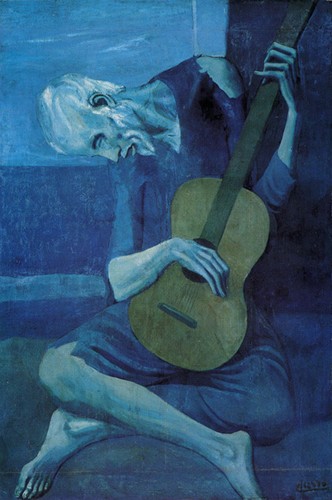

 Posts
Posts